No state backing. No paywalls. Just truth. Support Kashmir's independent voice. Join 2,400+ patrons who fund independent voices.
Zero Paywalls
Reader Funded
Award Winning
Secure Payment
Encrypted
Muzaffarabad | November 6, 2025: Every year on November 6, the people of Azad Jammu and Kashmir (AJK) observe Jammu Martyrs’ Day, a solemn remembrance of the tragic massacre that took place in November 1947. While Pakistan-administered Kashmir marks the day as a public holiday, it remains largely absent from mainstream global discourse. Yet, for many Kashmiris, this day stands as one of the most defining and painful moments in their collective memory — an event that shaped the very foundation of the Kashmir conflict.
As the subcontinent reeled from the aftershocks of Partition, the region of Jammu became the site of one of history’s lesser-known humanitarian catastrophes. Today, seventy-eight years later, the events of that November continue to resonate not only as a story of loss and displacement but also as a reminder of the dangers of communal polarization and political indecision.
When the British left India in August 1947, the princely state of Jammu and Kashmir, ruled by Maharaja Hari Singh, found itself in a precarious position. Unlike other princely states, which swiftly acceded either to India or Pakistan, the Maharaja hesitated. His state was majority Muslim (around 77% of the population at the time) but ruled by a Hindu monarch with strong ties to the Dogra elite.
No state backing. No paywalls. Just truth. Support Kashmir's independent voice. Join 2,400+ patrons who fund independent voices.
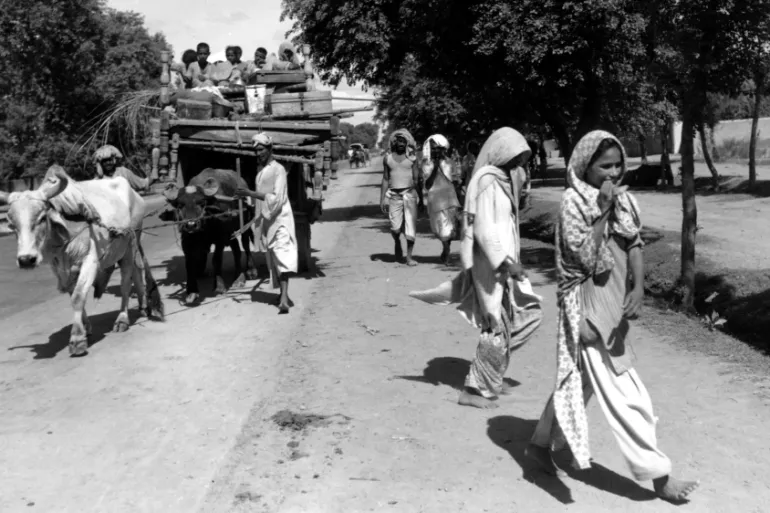
This indecision proved catastrophic. As communal violence swept across Punjab and other parts of northern India, Jammu — bordering the new Pakistani territory of Sialkot — became increasingly unstable. Refugees fleeing riots from across the border poured into the region, heightening tensions. Within weeks, sporadic violence erupted, quickly spiraling into mass killings and forced migrations.
Between October and November 1947, according to independent reports and historical research, tens of thousands of Muslims were killed in Jammu. Many others were forced to migrate to what had become Pakistan.
Eyewitnesses described convoys of Muslim families — men, women, and children — being escorted out of Jammu under the promise of safe passage, only to be ambushed and massacred along the way.
Some estimates, cited by historians and journalists including Victoria Schofield, Christopher Snedden, and reports referenced by Al Jazeera and The Guardian, suggest that anywhere between 20,000 and 250,000 Muslims were killed during those chaotic months. Pakistani accounts place the number even higher, while Indian estimates tend to be more conservative, often framing it within the broader context of Partition violence.
Archival evidence and survivor testimonies point toward the involvement of Dogra state forces, Hindu nationalist militias, and in some instances, armed Sikh groups. At the same time, thousands of Hindu and Sikh refugees from West Punjab had sought safety in Jammu, bringing with them harrowing stories of Muslim violence across the border — fueling a cycle of revenge and retribution.
Independent researchers, including scholars from SOAS University of London, Tata Institute of Social Sciences (TISS), and Pakistani academic circles, generally agree on three key points:
While Pakistani historians classify it as a “genocide” or “ethnic cleansing,” Indian scholars often describe it as part of the mutual communal violence of Partition, comparable to what happened in Rawalpindi or Amritsar. The truth, as independent sources suggest, lies somewhere between — a tragedy rooted in fear, revenge, and political chaos, where ordinary people of all faiths became victims of history’s cruel tide.
In Pakistan-administered Kashmir, Jammu Martyrs’ Day is observed as a day of mourning and remembrance. The official narrative portrays it as a targeted campaign to change Jammu’s demographic identity and punish Muslims for their political inclinations toward Pakistan. Public gatherings, seminars, and prayers are held across Muzaffarabad, Mirpur, and Rawalakot, reaffirming solidarity with those who perished.
For many in AJK, the massacre is viewed as a turning point that not only deepened the divide between Jammu and the Valley but also served as a catalyst for the Kashmir liberation movement that followed.
In India, particularly in Jammu, the events of 1947 are often contextualized within the broader chaos of Partition. Indian historians emphasize that violence was reciprocal, affecting both Muslims in Jammu and Hindus and Sikhs in Mirpur and Muzaffarabad, who faced massacres and forced displacement as tribal militias advanced into the region from Pakistan.
This interpretation argues that Jammu’s tragedy cannot be separated from the larger pattern of subcontinental upheaval — a tragedy on both sides, marked by mistrust and revenge.
Among independent Kashmiri scholars and journalists, a growing effort exists to adopt a humanitarian lens neither nationalist nor sectarian. They call for recognizing all victims, regardless of religion or political identity, and for establishing an independent truth commission to document the human cost of 1947 across the entire state of Jammu and Kashmir.
The human consequences of the 1947 Jammu violence were immense. According to data cited in Pakistani and international sources, over 200,000 Muslims fled from Jammu to Sialkot and other parts of Punjab. Many died of hunger, disease, or violence en route.
Simultaneously, thousands of Hindu and Sikh families from Mirpur, Kotli, and Muzaffarabad migrated to Jammu, escaping tribal attacks as conflict engulfed western Kashmir.
The tragedy thus became a mirror image of suffering — a cycle of displacement that reshaped the demographic and emotional geography of the region forever.
In the aftermath, Jammu’s population saw a historic shift. Before 1947, Muslims formed roughly 61% of the region’s population. By the 1951 Indian census, their proportion had fallen dramatically to around 38%.
Entire Muslim neighborhoods were emptied, properties were lost or redistributed, and a centuries-old mosaic of coexistence gave way to ethnic and religious segregation.
To this day, many families in Sialkot, Gujranwala, and Lahore trace their roots back to the villages of Jammu, keeping alive fading memories of ancestral homes across the border.
Despite its significance, the Jammu massacre remains underrepresented in global narratives of Partition. Unlike the tragedies of Punjab or Bengal, Jammu’s story rarely makes it into school textbooks or international media discussions.
For the people of Kashmir, however, it remains a core part of their historical identity — a wound that shaped their political consciousness.
In Muzaffarabad, Rawalakot, and Kotli, remembrance gatherings are held annually. Quranic recitations, candlelight vigils, and documentaries attempt to preserve the stories of those lost. On the Indian side, Jammu’s residents observe the day quietly, though official recognition remains minimal.
The observance of Jammu Martyrs’ Day today carries broader implications for the region’s ongoing search for peace. It invites reflection not only on the past but on the cost of silence and selective memory.
In a region where narratives are deeply polarized, the tragedy of 1947 reminds all sides — Indian, Pakistani, and Kashmiri — that every community suffered, and that reconciliation requires acknowledging every layer of pain.
Peace researchers from Jawaharlal Nehru University, Lahore University of Management Sciences, and King’s College London have emphasized that sustainable peace in Kashmir must begin with shared remembrance and empathy, not exclusive victimhood.
Human rights advocates have long urged for an independent, internationally facilitated commission to investigate the 1947 violence in Jammu and western Kashmir.
Such a commission, modeled after post-conflict truth and reconciliation efforts in South Africa or Rwanda, could document oral histories from survivors on all sides — providing long-overdue closure and recognition.
So far, neither India nor Pakistan has initiated an impartial inquiry. The absence of official accountability leaves the memory trapped between competing political narratives.
In the end, Jammu Martyrs’ Day transcends boundaries. It is not merely a day of mourning for Muslims of Jammu, but a reminder to humanity that unchecked hatred, political indecision, and communal division can lead to irreversible loss.
For the younger generation of Kashmiris, it offers a moment to learn, to reflect, and to reimagine a future based not on inherited animosity but on truth and coexistence.
Seventy-eight years later, the shadow of November 1947 still lingers over Jammu and Kashmir. The victims of that tragedy — whether Muslim, Hindu, or Sikh — deserve remembrance free from political manipulation.
Their stories call on the subcontinent’s people to confront history honestly and build bridges of understanding across lines that once divided them.
Trending Topics


The Azadi Times is an independent digital news platform based in Muzaffarabad, Kashmir, dedicated to credible journalism, in-depth reporting, and global analysis. We cover Kashmir, South Asia, and international affairs with a commitment to truth, editorial integrity, and public accountability.
Get important news delivered directly to your inbox and stay connected!
© 2026 The Azadi Times. All Rights Reserved.