

Muzaffarabad: In a potentially destabilizing move, the Indian government is reportedly considering the initiation of new water infrastructure projects on the rivers allocated to Pakistan under the historic Indus Waters Treaty (IWT). The development has raised deep concerns in Pakistan, where a majority of the country’s agricultural economy relies heavily on uninterrupted access to these transboundary rivers.
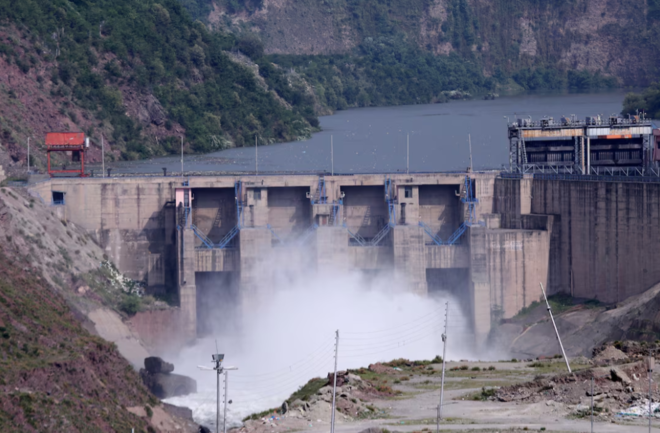
According to a report by Reuters, Indian Prime Minister Narendra Modi has directed relevant authorities to explore new construction on the Chenab, Jhelum, and Indus rivers—rivers that are designated for Pakistan’s use under the 1960 Indus Waters Treaty, brokered by the World Bank.
Among the proposed projects is a significant extension—approximately 120 kilometers—of the Ranbir Canal in Indian-administered Jammu & Kashmir, which draws water from the Chenab River. If materialized, such actions could alter water flow into Pakistan, potentially impacting millions of livelihoods in the already climate-stressed region.

The Azadi Times
No state grants. No corporate lobby. Just ground‑truth reporting from Kashmir & beyond
You make this possible.
Pakistan’s foreign minister, Ishaq Dar, has formally raised objections, labeling any disruption or unilateral interference with the treaty a breach of international law. He cautioned that any attempt to divert or reduce Pakistan’s share of water could be interpreted as an “act of war.”
This geopolitical shift comes amid heightened tensions following the recent tragic incident in Pahalgam, where over two dozen individuals lost their lives. Critics argue that the Indian government may be leveraging internal unrest to advance aggressive infrastructural and territorial strategies in the disputed region of Jammu & Kashmir.
Water remains a critical and sensitive issue in South Asia, particularly between nuclear-armed neighbors India and Pakistan. For Kashmir, a region caught at the crossroads of both nations’ strategic ambitions, the implications of any alteration to natural water flows could be profound—economically, ecologically, and politically.