
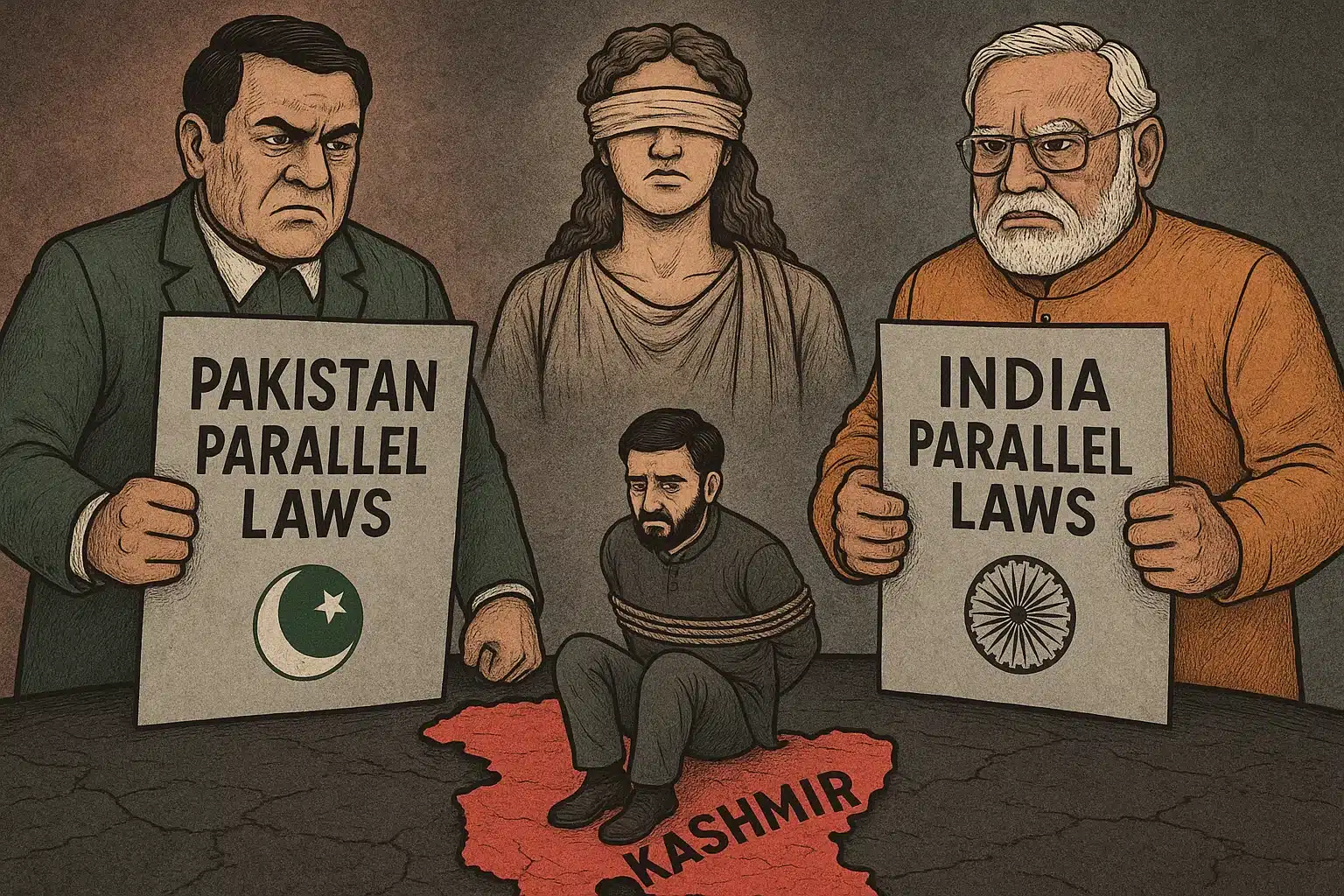

On opposite sides of the Line of Control, Kashmiris live under the shadow of two strikingly similar laws that shape their daily existence. In Gilgit-Baltistan, administered by Pakistan, political activists, student leaders, and dissenting voices are routinely placed under Schedule IV of the Anti-Terrorism Act, restricting their movement, freezing their accounts, and subjecting them to constant surveillance. Across the divide, in Indian-administered Jammu and Kashmir, the Public Safety Act (PSA) continues to be enforced as a blunt instrument, allowing authorities to detain individuals for extended periods without trial, often on vague or politically motivated charges.
For the ordinary Kashmiri, these laws are not abstract legal instruments; they are lived realities that define fear, uncertainty, and the constant negotiation of personal freedom. Families are separated, journalists face repeated arrests, and students are silenced for voicing their opinions. Despite the international recognition of both regions as disputed territories, neither state has allowed the promises of self-determination or political participation to take shape. Instead, both India and Pakistan maintain a parallel regime of surveillance, detention, and intimidation. The result is a shared narrative of repression, where the hopes and aspirations of everyday Kashmiris are caught between two governments and an international community that largely remains silent.
Schedule IV in Gilgit-Baltistan
Introduced as part of Pakistan’s Anti-Terrorism Act of 1997, Schedule IV allows the state to designate individuals as “proscribed persons.” Once listed, they face travel bans, restrictions on movement, frozen bank accounts, and relentless police monitoring. In Gilgit-Baltistan, a region with no representation in Pakistan’s national parliament and no constitutional protections, Schedule IV has become a tool not just against extremists but also against political activists, student leaders, and human rights defenders.
The Azadi Times
No state grants. No corporate lobby. Just ground‑truth reporting from Kashmir & beyond
You make this possible.
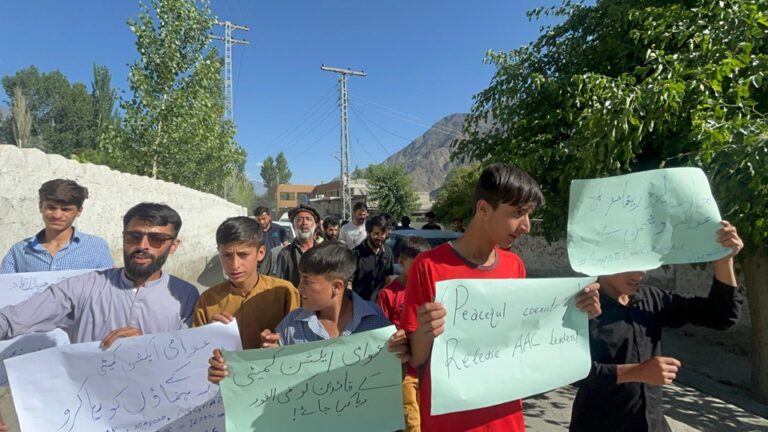
Rights organizations and local activists estimate that around 30 to 40 people are currently listed under Schedule IV in Gilgit-Baltistan, though the number fluctuates depending on political unrest and protests. Since the law’s introduction, hundreds of people have been temporarily detained or monitored, often without transparent judicial proceedings. Families often discover their relatives’ names on the list only when police summon them for questioning or when they are stopped at checkpoints. Critics argue that the vague criteria allow authorities to target voices of dissent, especially those calling for constitutional rights and economic justice in the region.
Public Safety Act (PSA) in Jammu and Kashmir
Passed in 1978, the PSA empowers authorities to detain any individual without trial for up to two years on vague grounds of threatening “public order” or “state security.” Amnesty International has long called the PSA a “lawless law.” Its implementation accelerated after the abrogation of Article 370 in 2019, with thousands detained—politicians, journalists, students, and ordinary civilians.
According to human rights groups and media reports, over 20,000 people have been booked under the PSA since the 1990s, making it one of the most widely used preventive detention laws in South Asia. Following 2019, at least 5,000 detentions were reported in the first year alone, many of them political leaders and teenagers accused of stone pelting. Detainees are frequently shifted to prisons outside Jammu and Kashmir, often hundreds of kilometers away, making family visits nearly impossible. Legal experts point out that the PSA bypasses normal criminal procedures, enabling authorities to re-arrest individuals immediately after courts order their release.
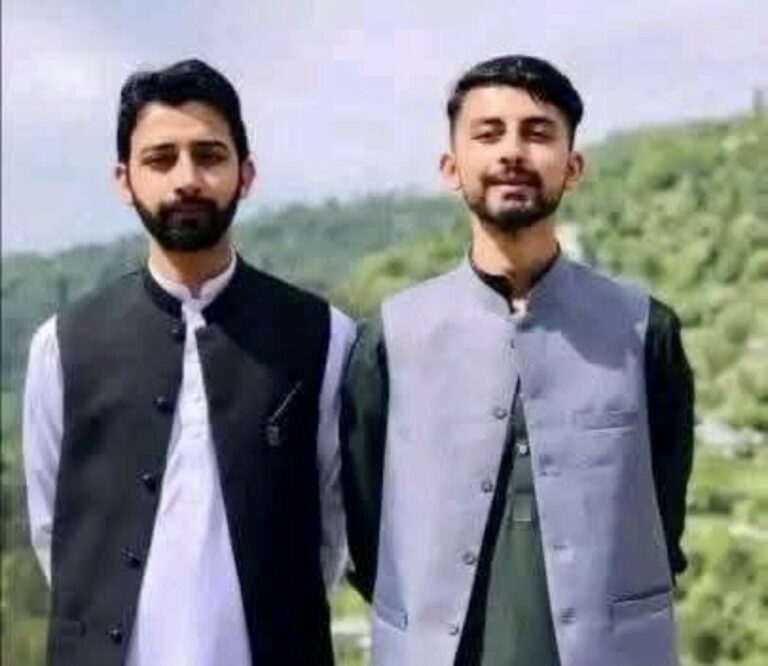
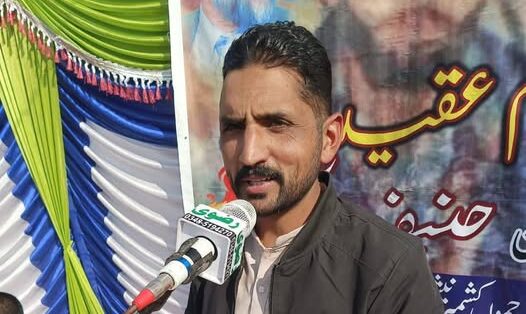
Detentions Under Schedule IV and PSA
In Kashmir, preventive detention laws are used to control dissent, targeting political activists, journalists, and community leaders. Below is a list of some prominent individuals detained under Schedule IV in Gilgit-Baltistan and PSA in Jammu & Kashmir. These names are verified from credible news and human rights sources.
| Region | Name | Position / Role | Detention Law | Details |
|---|---|---|---|---|
| Jammu & Kashmir | Mehraj Malik | AAP MLA, Doda | PSA | Detained for allegedly disturbing public order. |
| Jammu & Kashmir | Jaffer Hussain Butt | Resident, Kishtwar | PSA | Booked as Over Ground Worker (OGW). |
| Jammu & Kashmir | Liyaqat Ali | Resident, Kathua | PSA | Detained under multiple FIRs. |
| Jammu & Kashmir | Tahir Ahmad Kumar | Pakerpora, Budgam | PSA | Listed as “terror associate”. |
| Jammu & Kashmir | Shabir Ahmad Ganai | Karpora, Budgam | PSA | Detained under PSA for terror association. |
| Jammu & Kashmir | Asif Sultan | Journalist | PSA | Detained multiple times; court later quashed detention. |
| Gilgit-Baltistan | Ehsan Ali | Chairman, Awami Action Committee | Schedule IV | Listed as proscribed person. |
| Gilgit-Baltistan | Masoodur Rehman | Vice Chairman, ACC | Schedule IV | Targeted for political activism. |
| Gilgit-Baltistan | Javed Naji | Senior Member, ACC | Schedule IV | Included for activism. |
| Gilgit-Baltistan | Kausar Hussain | Spokesperson, ACC | Schedule IV | Named in proscribed list. |
| Gilgit-Baltistan | Issa Khan Danish | Journalist | Schedule IV | Listed for dissent reporting. |
| Gilgit-Baltistan | Mir Nisar Hasnain Rammal | Activist, Hunza | Schedule IV | Proscribed due to activism. |
This table highlights the scale and human impact of preventive detention in disputed Kashmir, showing how both Pakistani and Indian-administered regions use such laws to suppress dissent and control political expression.
The Human Cost
In Gilgit’s narrow valleys and highland towns, names quietly enter the Schedule IV list. Many activists discover their status only when denied access to their bank accounts or stopped at checkpoints. In Jammu and Kashmir, families awaken to midnight raids, their loved ones disappeared into jails hundreds of miles away in Uttar Pradesh or Haryana.
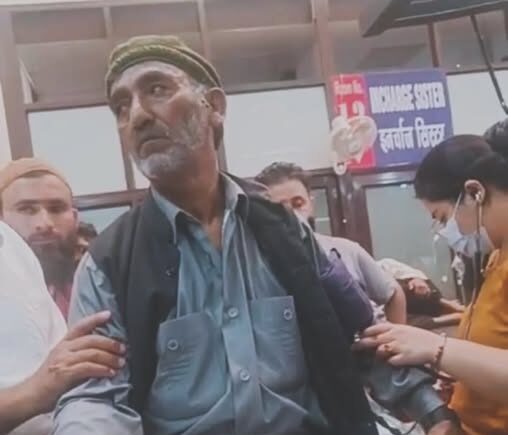
“I was never charged with a crime,” said Shabbir, a young activist from Gilgit who was listed under Schedule IV after organizing a student protest. “They told me I was a security risk. My only crime was raising my voice about unemployment.”
“We live with constant fear,” explained Aamina, a school teacher from Srinagar whose brother has been detained thrice under PSA. “Each time he comes out, he is more broken. They don’t need evidence, just suspicion. And suspicion never ends.”
The testimonies echo across borders, stitched together by a common thread: a systematic erosion of dignity.
A Disputed Land Without Protection
Kashmir’s unresolved political status continues to leave its people vulnerable. United Nations resolutions of 1948 and 1949 clearly recognized the right of Kashmiris to decide their political future through a plebiscite. Decades later, that commitment remains unfulfilled, as both India and Pakistan have instead tightened their administrative control over the region. Laws such as Schedule IV in Pakistan-administered Kashmir and the Public Safety Act (PSA) in Indian-administered Kashmir are used as instruments to monitor, restrict, and criminalize dissent.
What makes the situation more precarious is the absence of a strong international legal framework. Unlike Palestine, where the Geneva Conventions are often invoked in debates on occupation, Kashmir exists in a legal vacuum. This lack of global accountability allows unilateral state laws to dominate, leaving local populations without effective protection against political repression.
Parallel Narratives, Shared Repression
For decades, India and Pakistan have weaponized the narrative of terrorism to delegitimize Kashmiri resistance. In New Delhi’s lexicon, stone-pelting teenagers are “terror sympathizers.” In Islamabad’s discourse, demands for autonomy in Gilgit-Baltistan are “anti-state conspiracies.” The laws—PSA and Schedule IV—translate these narratives into lived realities.
“When my son demanded better electricity for our village, he was branded anti-national,” said Karimullah, a farmer from Skardu. “We are loyal to our land, not to slogans of Islamabad or Delhi. But the state only sees traitors.”
“Under PSA, even poets are a threat,” noted a Kashmiri journalist in exile. “If you write about freedom, they say you are disturbing public order. If you remain silent, they will still knock on your door.”
Resistance Amid Chains
Yet, repression has not silenced the people. Across Gilgit, Skardu, Srinagar, and Sopore, acts of resistance—small and large—continue. Students gather in whispered circles, documenting stories of those detained. Mothers march with photographs of missing sons. Writers embed dissent into poetry and prose.
Civil society networks attempt to challenge the legality of these laws. Lawyers in Gilgit-Baltistan argue that applying Schedule IV in a region outside Pakistan’s constitutional domain violates basic principles of justice. In Jammu and Kashmir, petitions against PSA reach the Indian Supreme Court, though outcomes remain bleak.
The struggle is not just political—it is existential. To resist is to assert humanity against a machinery that seeks erasure.
International Silence
Despite decades of human rights reports, the international community has largely remained silent. Geopolitical interests—whether China’s stakes in Gilgit-Baltistan through the China-Pakistan Economic Corridor, or India’s growing global alliances—have overshadowed Kashmir’s cries.
The United Nations issues statements of “concern” but has failed to establish monitoring mechanisms comparable to those in other conflict zones. Western capitals that champion democracy are reluctant to confront either India or Pakistan on their human rights record in Kashmir.
“We are not pawns in your great game,” said Yasmeen, a Kashmiri student now studying abroad. “We are people, families, communities. Why is our pain negotiable?”
Schedule IV and the PSA are not just laws—they are symbols of a deeper tragedy. They reveal how disputed territories, left unresolved by the international system, become laboratories of repression. They highlight how states, in the absence of accountability, craft their own rules of control. And they show how ordinary Kashmiris live in a permanent state of exception.
For now, the valleys remain under watch, the mountains echo with silenced voices, and the rivers carry stories of resilience. The chains are parallel, but so is the resistance.
Until the world listens, until justice is restored, the people of Kashmir will continue to remind us: freedom is not a crime.
This report is part of The Azadi Times’ ongoing series on law, resistance, and human rights in disputed Kashmir.