
Tuesday, April 14, 2026
21.5 C
Srinagar

India’s Move to Reconsider Indus Water Projects Raises Alarms in Pakistan

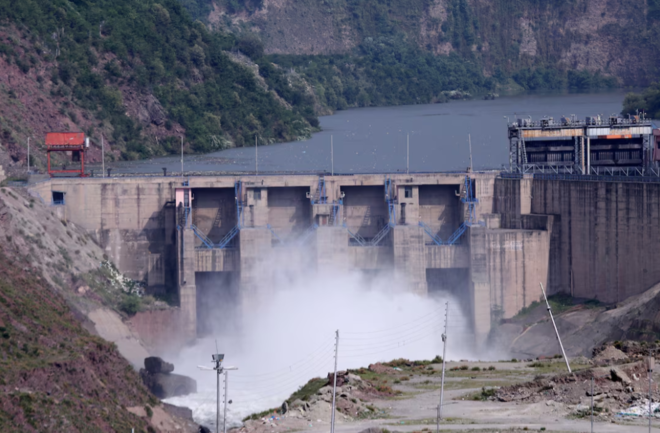
Muzaffarabad: In a potentially destabilizing move, the Indian government is reportedly considering the initiation of new water infrastructure projects on the rivers allocated to Pakistan under the historic Indus Waters Treaty (IWT). The development has raised deep concerns in Pakistan, where a majority of the country’s agricultural economy relies heavily on uninterrupted access to these transboundary rivers.

According to a report by Reuters, Indian Prime Minister Narendra Modi has directed relevant authorities to explore new construction on the Chenab, Jhelum, and Indus rivers—rivers that are designated for Pakistan’s use under the 1960 Indus Waters Treaty, brokered by the World Bank.

Among the proposed projects is a significant extension—approximately 120 kilometers—of the Ranbir Canal in Indian-administered Jammu & Kashmir, which draws water from the Chenab River. If materialized, such actions could alter water flow into Pakistan, potentially impacting millions of livelihoods in the already climate-stressed region.

Independent & Reader‑Funded

The Azadi Times

No state grants. No corporate lobby. Just ground‑truth reporting from Kashmir & beyond
You make this possible.

📰 No Paywall 🎯 Unfiltered 🌍 Global
Support Our Work Buy us a coffee • From $3

Pakistan’s foreign minister, Ishaq Dar, has formally raised objections, labeling any disruption or unilateral interference with the treaty a breach of international law. He cautioned that any attempt to divert or reduce Pakistan’s share of water could be interpreted as an “act of war.”

This geopolitical shift comes amid heightened tensions following the recent tragic incident in Pahalgam, where over two dozen individuals lost their lives. Critics argue that the Indian government may be leveraging internal unrest to advance aggressive infrastructural and territorial strategies in the disputed region of Jammu & Kashmir.

Water remains a critical and sensitive issue in South Asia, particularly between nuclear-armed neighbors India and Pakistan. For Kashmir, a region caught at the crossroads of both nations’ strategic ambitions, the implications of any alteration to natural water flows could be profound—economically, ecologically, and politically.


Hot this week

Saudi Arabia Opens Aquarabia: The Middle East’s Largest Water Theme Park

Qiddiya City, Saudi Arabia — The turnstiles began turning...

Ceiling Design in 2026: How the Fifth Wall Became the Focal Point of Modern Architecture

Walk into any newly constructed home or renovated commercial...

The Complete 2026 Artificial Intelligence Course Guide: From Free Fundamentals to $100K+ Career Transitions

The artificial intelligence education market has reached an inflection...

The Invisible Brain: What Is Machine Learning and Why It Already Runs Your Life

Machine learning is a subset of artificial intelligence in which...

Juicer Machine vs. Blender: The Complete 2025 Buying Guide for Every Budget

The global juicing appliance market has transformed dramatically over...

Top Stories

Saudi Arabia Opens Aquarabia: The Middle East’s Largest Water Theme Park

Qiddiya City, Saudi Arabia — The turnstiles began turning...

Ceiling Design in 2026: How the Fifth Wall Became the Focal Point of Modern Architecture

Walk into any newly constructed home or renovated commercial...

The Invisible Brain: What Is Machine Learning and Why It Already Runs Your Life

Machine learning is a subset of artificial intelligence in which...

Juicer Machine vs. Blender: The Complete 2025 Buying Guide for Every Budget

The global juicing appliance market has transformed dramatically over...

The Streaming A-List: 2025’s Most Acclaimed Movies Now on Netflix

With its library of over 3,500 films, Netflix has...

The Kashmir Files: Anatomy of a Blockbuster That Divided a Nation

Four years after its theatrical release, The Kashmir Files remains one...
spot_img

Related Stories