No state backing. No paywalls. Just truth. Support Kashmir's independent voice. Join 2,400+ patrons who fund independent voices.
Zero Paywalls
Reader Funded
Award Winning
Secure Payment
Encrypted
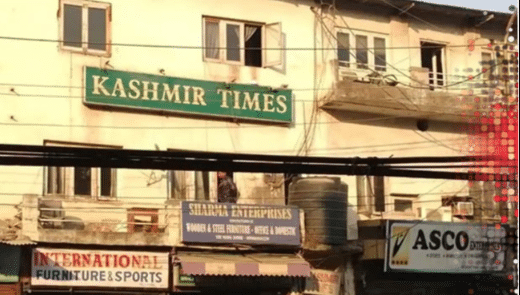
In Jammu and Kashmir, where information has increasingly become a controlled commodity, the line between journalism and criminality is being deliberately blurred. The recent raid on the offices of Kashmir Times—one of the region’s oldest and most respected independent newspapers—marks yet another troubling escalation in the systematic pressure exerted on critical media voices in Indian-administered Kashmir.
On 20 November 2025, agents of the Jammu and Kashmir State Investigation Agency (SIA), accompanied by police personnel, conducted a raid on the Kashmir Times editorial premises in Jammu, the winter capital of the territory. Documents, computers, and professional equipment were seized. What makes the operation particularly striking is that the office had been closed and non-operational since 2021.
The raid has drawn condemnation from international press freedom organisations, including Reporters Without Borders (RSF) and the Committee to Protect Journalists (CPJ), both of which have described the action as an unacceptable attack on independent journalism.
No state backing. No paywalls. Just truth. Support Kashmir's independent voice. Join 2,400+ patrons who fund independent voices.
Founded in 1954, Kashmir Times has long been recognised as a leading English-language newspaper providing coverage of Jammu and Kashmir’s political, social, and human rights landscape. For decades, it served as a critical yet professional platform at a time when dissenting perspectives were increasingly marginalised.
However, since the revocation of Jammu and Kashmir’s semi-autonomous status in August 2019, the newspaper has faced sustained institutional pressure.
Between 2019 and 2020, government advertisements—an essential source of revenue for regional newspapers—were withdrawn after Kashmir Times editor-in-chief Anuradha Bhasin challenged the prolonged internet shutdown in the Indian Supreme Court. In October 2020, the newspaper’s Srinagar office was sealed by authorities, and staff were evicted without formal legal proceedings.
By 2022, mounting financial and administrative constraints forced Kashmir Times to suspend its print edition, later relaunching as a digital-only outlet operated largely by freelance journalists.
Following the November 2025 raid, the SIA claimed that Kashmir Times was involved in a “criminal conspiracy” and accused the outlet of disseminating what it described as “secessionist” and “anti-national” narratives. An FIR reportedly names Anuradha Bhasin, despite her being abroad and unaware of any formal legal action against her.
Bhasin has categorically rejected the allegations, describing them as “bizarre” and “baseless.” She stated that the raided premises contained only old computers and archival material and had been inactive for four years.
Crucially, authorities have not publicly clarified which specific articles or reports allegedly triggered the investigation—raising serious concerns about transparency and due process.
RSF has described Jammu and Kashmir as a growing “black hole for information,” warning that the targeting of Kashmir Times fits into a broader pattern of repression designed to silence critical reporting. CPJ has called on authorities to return seized equipment and ensure that journalists are not criminalised for carrying out their professional duties.
These concerns are not isolated. On 5 August 2025, the Jammu and Kashmir Home Department ordered a ban on 25 books related to Kashmir’s history and political conflict, including Bhasin’s own work, A Dismantled State: The Untold Story of Kashmir After Article 370.
Taken together, these measures point to a shrinking space for independent thought, historical inquiry, and journalistic scrutiny.
Across the Line of Control, on both sides of divided Jammu and Kashmir, media increasingly operates under intense state oversight. Reports or analyses that diverge from officially sanctioned narratives are frequently labelled as “anti-state,” “inflammatory,” or “threatening to sovereignty.”
In such an environment, bans, raids, content removals, and legal intimidation have become tools of narrative management rather than instruments of justice.
The raid on a defunct office is therefore less about investigation and more about intimidation—sending a signal to journalists still working under difficult conditions that no space, physical or digital, is beyond reach.
Condemning the raid, Atif Maqbool, Founder and Editor-in-Chief of The Azadi Times, described the action as “an assault on the very idea of independent journalism.”
“When a newspaper that has been shut for years is raided and accused without transparent evidence, it is not law enforcement—it is narrative enforcement,” Maqbool said. “Kashmir Times represented decades of principled journalism. Silencing it is not just about one outlet; it is about controlling memory, history, and truth.”
Maqbool further stated that The Azadi Times remains committed to publishing independent, verifiable reporting from both sides of Jammu and Kashmir, at a time when few platforms are willing—or able—to do so.
The continued targeting of journalists in Jammu and Kashmir raises urgent questions for international media watchdogs, human rights organisations, and democratic institutions worldwide.
Independent journalism is not a threat to sovereignty; it is a safeguard against abuse of power. Criminalising reporting does not strengthen states—it erodes credibility, trust, and democratic legitimacy.
As press freedoms contract in one of the world’s most militarised regions, the international community must move beyond statements of concern toward sustained scrutiny and accountability.
The raid on Kashmir Times is not an isolated incident. It is part of a broader trajectory in which journalism that challenges official narratives is increasingly framed as criminal activity.
History shows that suppressing the press does not erase truth—it merely delays it. The question facing Jammu and Kashmir today is not whether independent journalism will survive, but how much damage will be done before it does.
Trending Topics


The Azadi Times is an independent digital news platform based in Muzaffarabad, Kashmir, dedicated to credible journalism, in-depth reporting, and global analysis. We cover Kashmir, South Asia, and international affairs with a commitment to truth, editorial integrity, and public accountability.
Get important news delivered directly to your inbox and stay connected!
© 2026 The Azadi Times. All Rights Reserved.