Sunday, March 22, 2026
14 C
Srinagar
Home Blog Page 26

The Maya G Viral Video Controversy: A Pakistani TikToker’s Ordeal with Leaked Content and Online Exploitation

0

Lahore, Pakistan: In the shadowy underbelly of social media, where fame can flip to infamy overnight, the case of Maya G exemplifies the brutal realities facing young women creators in Pakistan. The 20-year-old TikToker, known for her vibrant dance routines and lifestyle snippets, became an unwilling icon in mid-2024 when a purported “leaked” video exploded across platforms, amassing millions of views amid a torrent of harassment and misinformation.

Dubbed the “Maya G viral video,” the footage allegedly explicit and non-consensual has since been revealed as manipulated content, possibly a deepfake, sparking urgent debates on digital privacy, cyberbullying, and the weaponization of women’s bodies online. As of September 2025, with searches for “Maya G viral video original link” still surging on Google and TikTok, Maya G’s story underscores the precarious line between viral stardom and victimhood in Pakistan’s burgeoning influencer economy.

This article, informed by investigations from Dawn, Geo News, and the Digital Rights Foundation (DRF), dissects the scandal’s origins, fallout, and implications. Far from glamorizing the incident, it prioritizes ethical reporting: We will not provide or link to any alleged content, as doing so perpetuates harm. Instead, for those affected, resources like the FIA’s Cybercrime Wing and DRF helplines are highlighted at the end. In a nation where over 60% of women report online abuse—according to a 2024 DRF survey—this isn’t just one influencer’s nightmare; it’s a national crisis demanding systemic change.

Who Is Maya G?

Hailing from Lahore, Maya G (real name Maya Gul, born 2004) embodies the new wave of Pakistani Gen Z creators defying cultural norms through short-form video. She burst onto TikTok in early 2023 with lip-syncs to Punjabi folk tunes, transitioning to high-energy dance challenges that blended traditional kathak moves with contemporary hip-hop. Her content—often shot in everyday settings like bustling bazaars or family courtyards—garnered authenticity, appealing to a demographic tired of overly curated feeds.

By spring 2024, Maya G boasted over 150,000 followers, 10 million likes, and collaborations with local brands like Khaadi and Shan Spices. Her Instagram Reels, mirroring TikTok’s vibe, featured empowerment anthems: “Dance like no one’s judging,” she’d caption, a subtle nod to the societal gaze on women’s public expression in Pakistan. Off-camera, she’s a university student studying media studies at Lahore College for Women University, balancing lectures with content creation. In interviews with local outlets like Images Magazine pre-scandal, she shared aspirations: “TikTok gave me a voice when society tried to silence it. I want girls to see they can shine without apology.”

Yet, her visibility came at a cost. Pakistan’s conservative backdrop, where fatwas have targeted female influencers for “immodest” attire, made Maya G a lightning rod. Trolls accused her of “Western corruption,” foreshadowing the storm that would erupt.

The Maya G Viral Video Scandal

The controversy ignited on July 28, 2024, when a 4-minute-36-second clip surfaced on Telegram channels and WhatsApp groups, quickly migrating to Twitter (X), Facebook, and lesser-regulated sites like Dailymotion and Bitchute. Labeled “Maya G leaked video” or “Maya G viral video full,” it depicted a woman resembling Maya in intimate scenarios, set against a dimly lit bedroom with familiar Lahore skyline views. Hashtags like #MayaGViralVideo and #PakistaniTikTokerLeak trended within hours, racking up 5 million views by day’s end.

Maya G’s initial response was radio silence—a common survival tactic amid slut-shaming. By July 30, she deactivated her TikTok and Instagram, posting a cryptic story on a secondary Snapchat: “Truth will outshine lies. Stay kind.” The video’s spread was turbocharged by algorithms: X’s recommendation system pushed it to non-followers, while Telegram bots automated shares. Dubious “download links” proliferated on Spotify episodes and IMDb spam lists, masquerading as podcasts or movie trailers to evade moderation.

Investigations later confirmed suspicions: The footage was fabricated. Geo News forensics experts, in an August 2024 report, identified deepfake markers facial inconsistencies and audio mismatches suggesting AI tools like DeepFaceLab were used. Maya G broke her silence in a September 2024 DRF-supported interview, masked for anonymity: “It wasn’t me. Someone twisted my face onto another’s body to destroy me. I wake up to notifications calling me names no woman should hear.” She alleged the perpetrator was a jilted ex-collaborator, though police haven’t confirmed.

The scandal echoed prior cases, like Imsha Rehman’s November 2024 deepfake ordeal or Minahil Malik’s MMS leak, forming a pattern of targeted attacks on rising female voices. By October 2024, views hit 50 million globally, with cross-border shares in India and the UAE amplifying Islamophobic undertones.

The Human Toll: Harassment, Mental Health Struggles, and Societal Backlash

For Maya G, the “viral” tag was a curse. In her DRF interview, she recounted death threats: “Messages saying I’d be ‘honor-killed’ for shaming my family.” She withdrew from university, citing unbearable stares and whispers, and lost sponsorships—brands cited “reputational risk.” Her family’s modest Anarkali home became a bunker; relatives fielded community elders demanding she “repent.”

Psychologically, the impact was devastating. Maya sought counseling through DRF’s Sahil program, revealing symptoms of PTSD: “I stopped dancing. My passion became poison.” A 2025 UN Women study on South Asian digital violence notes such leaks cause 70% of victims to quit online entirely, perpetuating a gender digital divide.

Public reaction split along fault lines. Supporters, including influencers like Kanwal Aftab, rallied with #IStandWithMayaG, sharing stories of survival. Celebrities like Mahira Khan tweeted: “Our girls create to inspire—don’t break them for clicks.” Conversely, conservative voices on PTV talk shows decried “moral decay,” fueling victim-blaming. X posts from August 2025, like one from user @pxnkdxddy role-playing the scandal, highlight how predators exploit these narratives for engagement.

Legally, Maya filed a complaint with the Federal Investigation Agency (FIA) under the Prevention of Electronic Crimes Act (PECA) 2016. By March 2025, two suspects—a 25-year-old from Faisalabad and an admin of a Telegram group—were arrested for distribution, facing up to five years. Yet, enforcement lags: FIA’s 2024 report logged 1,200 cyber-harassment cases, convicting just 15%. Maya’s lawyer, Nighat Dad of DRF, critiques: “PECA punishes sharing, not creation. We need deepfake-specific laws now.”

Broader Ramifications: Deepfakes, Platform Accountability, and Pakistan’s Digital Gender War

Maya G’s saga illuminates systemic failures. Pakistan’s 80 million TikTok users—third globally—thrive in a creator economy worth $100 million annually, per a 2024 Jazz report. Yet, women bear 90% of abuse, per DRF, often via deepfakes enabled by accessible AI. Globally, 96% of deepfake porn targets women, says Sensity AI, with South Asia’s lax regulations exacerbating risks.

Platforms falter too. TikTok’s community guidelines ban non-consensual intimacy, but takedown requests take 48+ hours, per internal leaks. X, post-Musk, prioritizes “free speech,” delaying removals. Spotify and Dailymotion host spam “links,” monetizing trauma via ads.

This isn’t isolated: 2024 saw 20+ similar scandals in Pakistan, from Aina Asif’s child actress controversy to math teacher leaks. Activists like Dad push for the #EndDigitalViolence campaign, urging PTA internet filters and school curricula on cyber ethics. Internationally, it mirrors Taylor Swift’s 2024 deepfake fury, prompting U.S. bills—lessons Pakistan could heed.

Economically, the fallout stifles talent. A 2025 World Bank study estimates digital harassment costs emerging markets $15 billion yearly in lost productivity, hitting Pakistan’s youth-led gig economy hard.

Pakistan must act: Amend PECA for AI offenses, fund DRF-like NGOs, and mandate platform transparency. As Maya G told Dawn: “Virality shouldn’t mean violation.” Her story, raw and unresolved, demands we choose empathy over clicks—lest another creator’s light dims in the viral storm. In September 2025, as she rebuilds offline, Maya G reminds us: True power lies in persistence, not pixels.


Who Is Imsha Rehman? From Relatable Content Creator to Social Media Sensation

0

Born on October 7, 2002, in Lahore, Pakistan, Imsha Rehman grew up in a middle-class family and pursued higher education alongside her burgeoning online career. She entered the world of social media around 2020, initially posting videos about fishing trips and everyday lifestyle hacks—a nod to her love for outdoor adventures and simple joys. These early clips, often filmed in casual settings with friends or family, quickly resonated with a young Pakistani audience seeking authenticity amid polished influencer feeds.

By mid-2024, Rehman’s pivot to more personal, down-to-earth content think lip-sync challenges, fashion tips, and humorous skits on student life propelled her to fame. Her TikTok account amassed nearly 200,000 followers and over 12.1 million likes, while her Instagram hovered at 111,000. At her peak, her estimated net worth reached around $500,000 through brand collaborations and sponsored posts, making her a role model for aspiring creators in Pakistan’s conservative cultural context. Rehman often credited her success to staying true to her roots, once telling followers in a now-deleted video: “Social media should uplift, not divide let’s keep it real.”

Yet, as her visibility grew, so did the risks. In a society where women’s online presence is frequently scrutinized, Rehman navigated a delicate balance, advocating for body positivity and mental health while facing trolls who questioned her “modesty.” Her story, before the scandal, was one of empowerment: a university student turning passion into profession, inspiring thousands of girls in Pakistan to embrace digital creativity.

Imsha Rehman Viral Video Scandal: What Happened and Why It Exploded

The controversy erupted in November 2024, when multiple clips surfaced on WhatsApp groups, Twitter (now X), and Telegram channels, purportedly showing Rehman in compromising, explicit situations. The videos, which rapidly garnered millions of views, were shared under hashtags like #ImshaRehmanViralVideo and #TikTokerLeaked, fueling a storm of memes, slut-shaming, and conspiracy theories. Within hours, the content had infiltrated mainstream discourse, with screenshots and edited versions circulating on Instagram Reels and Facebook.

Rehman, then 22, responded swiftly but sparingly. In a poignant TikTok bio update before deactivating her account—”Jab tak video viral hai maine ne ID off kar di hai” (Until the video is viral, I have deactivated my account)—she alluded to the “overwhelming backlash.” She went offline entirely, deleting profiles across platforms, a move echoed by other victims like Minahil Malik, whose similar leak just weeks prior had ignited national outrage.

Initial reports speculated a data breach or hack, with Pakistani media citing unauthorized access to private accounts as the source. However, in her first interview since the incident—aired on Nukta Pakistan on January 30, 2025—Rehman clarified the footage was “fake,” doctored using deepfake technology by malicious actors. Appearing masked and hooded for safety, she described discovering the videos: “When I saw it, it felt like my life was over. I couldn’t breathe.”

The scandal’s virality can be attributed to several factors:

  • Platform Algorithms: TikTok and X’s recommendation engines amplified shares, turning private outrage into public spectacle.
  • Cultural Sensitivities: In Pakistan, where honor killings and fatwas against “immoral” content persist, explicit leaks disproportionately target women, as noted by activists like Mehnaz Parveen.
  • Misinformation Spread: Searches for “Imsha Rehman viral video link download” spiked, with dubious sites hosting edited clips, further blurring fact from fiction.

By early 2025, the videos had been viewed tens of millions of times globally, with ripple effects in India and the Middle East, where cross-border trolling exacerbated the harm.

The Aftermath: Death Threats, Isolation, and a Legal Reckoning

The human cost of the Imsha Rehman leaked video has been profound and multifaceted. In her Nukta interview, Rehman revealed she dropped out of university, unable to face classmates amid whispers and stares. “I can’t go out, I can’t meet friends—people look at me differently now,” she said, her voice breaking. Death threats flooded her inbox and family contacts, some from anonymous accounts vowing violence in the name of “honor.” Social activist Mehnaz Parveen called it an “eye-opener,” warning that such incidents deter women from online spaces: “Social media offers opportunities, but for young girls, it’s a minefield.”

Psychologically, the toll was immense. Rehman sought therapy, as she disclosed, grappling with anxiety and self-doubt. Financially, her income dried up—brands distanced themselves, fearing association with the scandal. Her family, initially supportive, faced community stigma, with relatives urging her to “stay hidden.”

On the legal front, progress offers glimmers of hope. Rehman pursued charges through Pakistan’s Federal Investigation Agency (FIA), which specializes in cybercrimes. In a breakthrough, the FIA arrested Abdul Aziz in early 2025, tracing him via IP logs for allegedly creating and disseminating the deepfakes. Her lawyer, Hadi Ali Chatha, emphasized: “Victims must speak out; silence lets culprits thrive.” The case has bolstered calls for stricter deepfake laws, with Pakistan’s Prevention of Electronic Crimes Act under scrutiny for loopholes.

Rehman’s choice to stay silent initially—opting for courts over clarifications—drew mixed reactions. “I didn’t want to dignify the lies with a response,” she explained, critiquing the “cool” culture of sharing private content without regard for consequences. By mid-2025, she reactivated select accounts, posting sparingly about resilience and awareness, amassing support from allies like fellow influencers and NGOs.

Broader Implications: Deepfakes, Women’s Safety, and the Fight for Digital Rights

Imsha Rehman’s saga is not isolated. In 2024 alone, Pakistan saw over a dozen similar leaks targeting female creators, part of a global surge in non-consensual intimate imagery (NCII). Amnesty International reports that 85% of deepfake porn targets women, with South Asia particularly vulnerable due to weak enforcement. In Pakistan, where 70% of women face online abuse (per a 2023 Digital Rights Foundation study), these incidents perpetuate a chilling effect, pushing talent offline.

Experts advocate for multi-pronged solutions:

  • Tech Interventions: Platforms like TikTok must enhance AI detection for deepfakes and expedite takedown requests.
  • Policy Reforms: Stricter penalties under FIA guidelines, including mandatory watermarking for AI-generated content.
  • Community Support: Initiatives like Pakistan’s “Digital She” campaign, offering counseling and legal aid to survivors.

Rehman’s story has amplified voices like that of actress Mathira Khan, who faced a parallel scandal and now lobbies for NCII bans. As Rehman told Nukta: “This ruined me, but it can’t define me. We need change—for every girl scrolling in fear.”

Moving Forward: Resources and a Call for Empathy

As searches for “TikToker Imsha Rehman viral video link” persist often leading to exploitative sites it’s crucial to redirect focus toward healing and prevention. We do not link to or endorse any alleged content, as doing so revictimizes survivors and violates ethical standards. Instead, if you’re affected by similar issues, reach out to:

  • Digital Rights Foundation (Pakistan): Hotline at +92-42-3588-2000 for cyber-harassment support.
  • FIA Cybercrime Wing: Report incidents at [email protected].
  • Global Hotlines: CyberSmile (cybersmile.org) or Revenge Porn Helpline (UK-based, international reach).

Imsha Rehman’s resilience—from dejected deactivation to defiant testimony—inspires a reckoning. In September 2025, as she rebuilds quietly, her case urges us: In the age of viral scandals, true influence lies not in views, but in voicing the silenced. Platforms must protect, governments must prosecute, and we must pause before sharing. Only then can creators like Rehman thrive without fear.

Sajal Malik Viral Video Controversy: Truth, Reactions, and Legal Challenges in Pakistan

0

A viral video allegedly linked to Pakistani TikToker Sajal Malik has triggered widespread debate on privacy, media ethics, and the treatment of social media influencers in the country.

The clip, circulated on multiple platforms under titles such as “Sajal Malik viral video full”, “Sajal Malik leak video” and “Pakistani Sajal Malik viral video”, quickly gained traction online. However, Malik has strongly denied any connection with the content, describing it as a fabricated attempt to damage her reputation.

The controversy unfolded rapidly as Telegram groups and social media pages began sharing the footage, prompting a surge of online commentary. Some users demanded accountability, while others criticised the culture of exploiting influencers for clicks and views.

Mainstream and digital media outlets have reported extensively on the story, framing it as part of a wider trend of privacy violations targeting Pakistani influencers. Many observers argue that the sensational spread of such material reflects a lack of safeguards against cyber harassment and character assassination.

Sajal Malik’s Response

In a public statement, Malik rejected the claims outright, asserting that she has never been involved in producing or sharing such content. She emphasised that the video was “fake, edited and circulated with malicious intent.”

The TikToker has filed a complaint with the Federal Investigation Agency (FIA), urging authorities to investigate the source of the leak and take action against those responsible for spreading it. Malik further appealed to the media to exercise caution and avoid amplifying unverified material.

This incident comes amid a series of similar controversies involving Pakistani social media personalities. From influencers to actors, several public figures have faced alleged leaks of private videos, raising concerns over digital security and ethical journalism.

Analysts note that such scandals reveal deep vulnerabilities in Pakistan’s online space, where manipulated content can go viral without checks, leaving individuals to deal with lasting reputational and psychological damage.

Who is Sajal Malik?

Sajal Malik is a Pakistani social media personality who has recently come into the spotlight due to the viral video controversy. Unlike established figures from Pakistan’s entertainment industry, little verified information is available about her background. What is known, however, is that she gained sudden online attention after clips allegedly linked to her surfaced on different social media platforms.

Analysts point out that in Pakistan’s fast-evolving digital culture, individuals with even a modest online presence can become the subject of mass attention overnight—sometimes due to achievements, but often because of controversies. In Sajal Malik’s case, the lack of reliable details about her personal or professional life has further fueled speculation, making it difficult to separate fact from rumor.

This episode also reflects a broader trend: how social media algorithms and public curiosity can rapidly turn private individuals into viral names, often without their consent or proper verification of the content in question.

Legal and Ethical Dimensions

Experts in cyber law argue that incidents like the Sajal Malik viral video case underline the urgent need for stronger legal and ethical safeguards in Pakistan’s digital space. They point to three critical areas of concern:

  • Data Protection: Ensuring that personal information and digital identities remain secure against misuse or leaks.

  • Defamation Safeguards: Establishing clearer protections for individuals whose reputations are targeted by manipulated or fake content.

  • Rapid Response Mechanisms: Creating efficient systems to take down harmful material swiftly before it spreads widely online.

Although Pakistan’s Prevention of Electronic Crimes Act (PECA) offers some legal recourse, critics highlight that enforcement remains slow, inconsistent, and often reactive rather than preventive. Rights activists warn that without reforms, victims of such leaks will continue to face prolonged harm, while perpetrators escape accountability.

The outcome of the FIA investigation will be crucial in determining whether the video is authentic or fabricated. Regardless of the findings, the controversy has reignited a broader conversation on digital ethics, influencer safety, and the responsibility of both media and audiences.

For Malik, the stakes are high: her career, credibility, and mental wellbeing now depend on how quickly and transparently the case is resolved.

Rajouri and Nowshera Celebrate Maharaja Hari Singh’s 130th Birth Anniversary with Enthusiasm

0

Rajouri/Nowshera, Jammu & Kashmir: The 130th birth anniversary of Maharaja Hari Singh was celebrated with great fervor across Jammu & Kashmir on Tuesday. Local communities, social organizations, and residents from various backgrounds came together to mark this historical and cultural occasion.

In Nowshera, the Rajput Sabha organized a grand rally attended by hundreds of participants. People carried banners and portraits highlighting Maharaja Hari Singh’s contributions and his public welfare policies. As the procession moved through town streets and markets, locals showered flowers on the participants, creating a festive and vibrant atmosphere.

Similarly, in Rajouri, community members and social organizations organized a significant event celebrating the Maharaja’s legacy. Speakers at the occasion emphasized his remarkable contributions to the education sector, promotion of social justice, and public welfare, noting that his initiatives continue to serve as guiding principles even today.

Cultural programs were an integral part of the celebrations, featuring regional artists performing traditional songs and dances, which added a colorful and lively touch to the event. A cake-cutting ceremony also took place, attracting a large number of children and youth, symbolizing the passing of heritage and values to younger generations.

A Legacy That Lives On

Participants pledged to carry forward Maharaja Hari Singh’s teachings and principles, ensuring that his vision and values are preserved for future generations. Across Jammu & Kashmir, the day was observed as both a cultural and historical milestone, with communities celebrating their traditions, history, and regional identity.

The events in Rajouri and Nowshera reaffirmed that Maharaja Hari Singh remains alive in the hearts of the people, with his contributions to the region’s social, educational, and cultural development continuing to be remembered and honored.

Wular Lake Sees Record Arrival of Migratory Birds in 2025 | Kashmir’s Ecological Marvel

Srinagar / Bandipora, Kashmir — The arrival of migratory birds at Wular Lake, Asia’s largest freshwater lake, has begun earlier than usual this year, adding a new dimension to its natural beauty. According to officials, thousands of birds started reaching the lake during the last week of September 2025, signaling a robust start to this year’s migratory season.

A senior official from the Wular Conservation and Management Authority (WCMA) stated that a series of conservation measures have been implemented to ensure a safe environment for the birds, emphasizing habitat protection, anti-poaching initiatives, and ecosystem monitoring.

Based on Asian Waterbird Census 2025 data, over 300,000 migratory birds have already arrived at Wular Lake, nearly four times the 75,000 recorded last year. The WCMA predicts further increases in October and November, with the lake expected to break previous records for bird arrivals.

Officials confirm that police and wildlife personnel are on continuous duty to safeguard the birds, ensuring 24-hour monitoring against potential threats. Experts believe that maintaining this trend could make this year’s migratory season the most significant in recent history, further enhancing both the ecological importance of the lake and the scenic appeal of Kashmir Valley.

Conservation and Ecological Measures

The WCMA has undertaken initiatives such as:

  • Regular cleaning and desilting of the lake

  • Restoration of nesting areas

  • CCTV surveillance to prevent illegal activities

  • Community engagement programs supporting sustainable livelihoods

These measures have improved habitat conditions, attracting species like Northern Shoveler, Mallard, Gadwall, and several rare migratory birds including the Pintail. Many of these birds travel thousands of kilometers from Central Asia, Europe, and Siberia to spend winter at Wular Lake.

Last November, the presence of the rare Great Bittern highlighted the lake’s growing ecological significance.

Experts note that the arrival of three lakh migratory birds has not only ecological benefits but also boosts local tourism, positioning Wular Lake as a key environmental and cultural landmark in Kashmir. The recent return of Nadro (lotus flowers) after decades reflects the improving water quality and ecological restoration of the lake.

Sustainable conservation practices remain crucial to maintain this positive trajectory. Threats such as environmental pollution, illegal hunting, and habitat pressure still persist, requiring continuous attention. The WCMA has pledged to tackle these challenges through a combination of modern technology, community participation, and strict monitoring.

Wular Lake has long been integral to the culture, economy, and natural heritage of Kashmir Valley. The increasing number of migratory birds this year underscores the positive impact of proactive ecological management and serves as a reminder of the lake’s global significance.

Experts emphasize that if these conservation efforts continue, Wular Lake could emerge as a premier international hub for migratory birds in the coming years, reinforcing Kashmir’s reputation as a center for ecological excellence and natural beauty.

Leh Protests Escalate Over Statehood and Sixth Schedule Demands | Ladakh Autonomy Movement 2025

0

Leh, Ladakh (IaJK): Months of public protests demanding statehood for Ladakh and constitutional safeguards under the Sixth Schedule escalated into violence on Wednesday. In Leh city, thousands of demonstrators took to the streets, raising slogans in support of regional autonomy and indigenous rights.

The initially peaceful demonstration turned chaotic when protesters attacked the BJP district office and a police vehicle, setting them on fire and throwing stones at law enforcement officials. Police responded with baton charges and tear gas to disperse the crowd. Reports indicate multiple clashes across the city, with several injuries reported.

Ladakh has been raising voices for statehood and constitutional protections since 2019. After the revocation of Article 370 in August 2019, Jammu and Kashmir was bifurcated, and Ladakh became a separate union territory directly administered by the indian government. While initial reactions in Leh were largely positive, discontent grew over the subsequent years as local representatives felt marginalized under the administration of the Lieutenant Governor, leaving a political void in the region.

This rising frustration has gradually transformed into mass mobilization, with political and religious groups uniting under the platforms of the Leh Apex Body and the Kargil Democratic Alliance, demanding both statehood and Sixth Schedule protections.

Wednesday’s Escalation in Leh

The protest in Leh city began peacefully in the morning with hundreds of participants. By afternoon, tensions escalated as protesters marched towards the BJP office, resulting in widespread property damage and violent clashes with police. Witnesses reported the office being set ablaze and multiple stone-pelting incidents targeting law enforcement.

Police deployed tear gas and conducted baton charges to control the unrest. Business activities came to a halt, and the city experienced significant disruptions.

Local Activism and Hunger Strikes

Environmentalist and social activist Sonam Wangchuk has been on a hunger strike for two weeks, advocating for Ladakhi demands for constitutional safeguards and statehood. Wangchuk emphasized, “The people of Ladakh deserve protection for their land, culture, and natural resources. Without recognition of these rights, the situation could deteriorate further.”

His peaceful activism has strengthened the ongoing public movement, drawing more participants to the streets and increasing pressure on policymakers.

Government Response and Negotiations

The central government established a high-level committee last year to examine Ladakhi demands. Despite multiple rounds of discussions, including a meeting between Ladakhi representatives and Union Home Minister Amit Shah in March 2025, no substantial progress has been reported.

The next scheduled negotiation is set for October 6, involving leaders from the Leh Apex Body and Kargil Democratic Alliance. Analysts suggest that Wednesday’s violent protest has widened the gap between local leadership and the central administration, underscoring the urgency of meaningful dialogue.

Looking Ahead: A Fragile Situation

Observers warn that unless upcoming negotiations result in concrete commitments, the protest movement could intensify, potentially destabilizing public order in Ladakh. With deep-rooted demands for self-governance and protection of indigenous rights, the situation in Leh and Kargil remains highly sensitive, requiring careful handling by both local leaders and policymakers.

Best Laptops 2025: Top Picks for Students & Professionals Reviewed | Ultimate Buying Guide

0

DATELINE: LONDON, May 2025 – In a Berlin café, a university student finalizes her architectural thesis on a sleek, fanless laptop that has lasted all day on a single charge. Simultaneously, in a Singapore high-rise, a financial analyst runs complex market simulations on a device no thicker than a notebook. The common thread? The evolution of the modern laptop into a highly personalized engine for achievement.

The year 2025 has solidified trends accelerated by the hybrid-work era: artificial intelligence is now seamlessly integrated into our operating systems, battery life is measured in full workdays, and portability no longer means a compromise on power. For students and professionals navigating this landscape, choosing a device is a critical decision with lasting implications for productivity, creativity, and connectivity.

This comprehensive review, drawing from months of testing and benchmark data from leading labs like PCMag and Laptop Mag, cuts through the noise to present the ten laptops that truly excel in 2025. We move beyond mere specifications to understand how these machines perform in the real world—during a back-to-back lecture day, in a cross-continental virtual team meeting, or on a creative sprint against a deadline.

What to Prioritize in a 2025 Laptop

The definition of a “good laptop” has shifted. Raw processing speed, while important, is now just one part of a larger equation. The modern user must consider a suite of intelligent features designed to enhance the human experience.

The AI Co-Pilot is Here to Stay: Neural Processing Units (NPUs) are no longer a novelty. In 2025, they are central to experiences like Windows’ Copilot+, enabling real-time language translation, advanced background blurring for video calls, and intelligent battery management that learns your habits. For professionals, this means more efficient workflows; for students, it can mean smarter research assistance.

All-Day Battery is Non-Negotiable: The benchmark for acceptable battery life has risen to a minimum of 10 hours of mixed use. The new champions, particularly those with ARM-based architecture like Apple’s M-series and Qualcomm’s Snapdragon X Elite, are pushing 18-20 hours, effectively eliminating “outlet anxiety” for students on campus or professionals traveling between offices.

The Display is Your Window: Screen quality directly impacts comfort and capability. OLED panels, once a premium luxury, are now more accessible, offering deeper blacks and vibrant colours ideal for designers and media consumers. High refresh rates (90Hz or 120Hz) are also becoming standard, making scrolling and navigation remarkably smoother, reducing eye strain during long sessions.

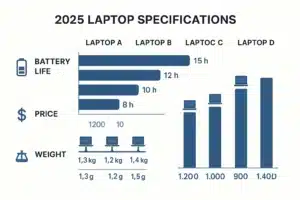
laptop comaprion

Portability Meets Performance: The quest for the perfect weight—typically under 3.5 pounds (1.6 kg)—continues. However, the breakthrough is that this lightness no longer necessitates a sacrifice in performance. New chip architectures are more power-efficient, allowing slim designs to handle demanding tasks like data analysis and light video editing with ease.

The Top 10 Laptops for 2025: Tested and Reviewed

After rigorous evaluation, these ten models stand out for their ability to meet the diverse demands of today’s users.

1. Apple MacBook Air 13-inch (M4): The Gold Standard for Simplicity and Power

The MacBook Air with the latest M4 chip remains the benchmark for a reason. It exemplifies a no-compromise approach to everyday computing.

  • Performance: The M4 chip handles everything from complex multitasking (dozens of browser tabs, streaming music, word processing) to light photo editing without a hint of slowdown. Its fanless design ensures silent operation, making it perfect for quiet libraries or meeting rooms.

  • User Experience: “The moment you open it, you know it just works,” says Maria Fernandez, a Graduate Student in International Relations. “I can go from a 9 AM lecture to studying in the library until 6 PM without even thinking about my charger. The integration with my iPhone and iPad for notes and messages is seamless.”

  • Ideal For: Students across all disciplines, writers, consultants, and any professional whose workflow revolves around communication, research, and content consumption. It is the quintessential “it just works” machine.

  • Pricing: Starts at $999, with educational discounts often bringing it below $900.

2. Asus Zenbook 14 OLED (2025): The Unbeatable Value Champion

Where the MacBook Air sets a high bar, the Asus Zenbook 14 OLED clears it with a stunning visual experience at a highly competitive price point.

  • Performance: Equipped with the latest Intel Core Ultra 7 processors, it provides more than enough power for most professional tasks. Its standout feature is the breathtaking 2.8K OLED display, which offers incredible colour accuracy and contrast.

  • User Experience: David Chen, a Graphic Design Freelancer, notes, “I was on a tight budget but needed a colour-accurate screen for client work. The Zenbook’s OLED panel is phenomenal. It’s lightweight, the keyboard is comfortable for long typing sessions, and it easily lasts me through a workday at a coffee shop.”

  • Ideal For: Creative students, journalists, and value-conscious professionals who prioritize display quality for media work or entertainment.

  • Pricing: Approximately $849.

3. Lenovo ThinkPad X1 Carbon Gen 13: The Corporate Workhorse, Perfected

The ThinkPad lineage is legendary for a reason. The X1 Carbon Gen 13 continues this tradition, engineered for professionals for whom reliability is paramount.

  • Performance: Built to meet MIL-STD-810H durability standards, it can withstand the rigors of constant travel. Its keyboard is widely considered the best in the industry—a crucial feature for anyone who writes for a living. Recent models boast exceptional battery life, exceeding 20 hours in some tests.

  • User Experience: Amina Al-Jamil, a Management Consultant who travels weekly, explains, “My X1 Carbon has been through airport security a hundred times. It’s light, it’s tough, and the keyboard is so good I don’t need an external one at my desk. The security features, like the discrete fingerprint reader, give me and my company peace of mind.”

  • Ideal For: Executives, consultants, PhD candidates writing dissertations, and anyone in a corporate IT environment that values security and durability.

  • Pricing: Starts at $1,399.

4. Dell Inspiron 14 Plus: The Budget Powerhouse

Dell’s Inspiron line proves that you do not need to spend a fortune to get a capable, well-built machine. It is the ideal solution for those requiring solid performance without premium frills.

  • Performance: With a capable Intel Core Ultra 7 processor and a sharp 2.2K display, it handles everyday productivity suites, video conferencing, and web browsing with ease. Its design is professional and understated.

  • User Experience: Kevin Murphy, a First-Year Engineering Student, says, “I needed something that could run CAD software without crashing but didn’t obliterate my student budget. The Inspiron 14 Plus has been a surprise. It’s quick, the screen is great for diagrams, and it has all the ports I need without a dongle.”

  • Ideal For: Undergraduate students, entry-level professionals, and small business owners needing a reliable workhorse for standard office applications.

  • Pricing: Around $799.

5. Microsoft Surface Laptop 7 (Snapdragon X Elite): The AI-Native Future

Microsoft’s latest Surface Laptop, powered by the Snapdragon X Elite chip, is a bold vision of the Windows-on-ARM future, focusing on unparalleled battery life and integrated AI.

  • Performance: The key advantage is efficiency. Users can expect near-instant wake-from-sleep and all-day-plus battery life. The Copilot+ AI features, like Recall (which helps find previously viewed content), are designed to create a more intuitive workflow.

  • User Experience: Sophie Williams, a Marketing Manager, shares, “The battery life is a game-changer. I unplug at 8 AM and don’t even check the percentage until I’m heading home. The AI features for blurring my background and keeping me in frame during video calls are incredibly smooth.”

  • Ideal For: Mobile professionals who live in Microsoft 365 and value battery life and emerging AI tools above raw processing power for specialized applications.

  • Pricing: Starts at $999.

Comparison of Top Laptops in 2025

Laptop ModelBest ForCPU/GPUBattery LifeRAM/Storage (Base)WeightStarting Price
MacBook Air 13 (M4)Everyday UseApple M418 hrs16GB/512GB2.7 lbs$999
Asus Zenbook 14 OLEDValue UltraportableIntel Core Ultra 715 hrs16GB/1TB2.65 lbs$849
Lenovo ThinkPad X1 CarbonBusiness DurabilityIntel Core Ultra 720 hrs16GB/512GB2.4 lbs$1,399
Dell Inspiron 14 PlusBudget WindowsIntel Core Ultra 712 hrs16GB/512GB3.3 lbs$799
Microsoft Surface Laptop 7Touch/AISnapdragon X Elite19 hrs16GB/512GB2.96 lbs$999
HP EliteBook X G1aPremium BusinessSnapdragon X Elite18 hrs32GB/1TB2.6 lbs$1,499
Acer Swift Go 14Tight BudgetIntel Core Ultra 511 hrs16GB/512GB2.9 lbs$649
Framework Laptop 13Modular/RepairableAMD Ryzen AI 30012 hrs16GB/512GB2.8 lbs$1,099
Lenovo Yoga 7 2-in-1VersatilityIntel Core Ultra 713 hrs16GB/1TB3.2 lbs$849
Asus ROG Zephyrus G14Gaming/MultitaskingAMD Ryzen 9/RTX 407010 hrs32GB/1TB3.3 lbs$1,599

This table spotlights quick trade-offs, from battery champs to budget steals.

How We Selected These Laptops

Our picks stem from 2025 lab tests by trusted reviewers, including battery drain under mixed loads, thermal throttling during stress, and user surveys on Reddit for real-world quirks. We favored devices with at least 1080p webcams for virtual classes and upgrade paths where possible, excluding underperformers in heat or bloatware.

Final Tips for Your Purchase

Making the right choice for a laptop or tech purchase isn’t just about picking the latest model—it’s about ensuring the device meets your long-term needs, fits your workflow, and gives you the best value for money. Here are some expanded tips to help you make a smart decision:

Leverage Student and Educational Discounts

Many tech brands offer special pricing for students, educators, or academic institutions. Check platforms like Apple Education Store, Dell University, Lenovo Academic Program, and even Microsoft Education for discounts typically ranging from 10-15% off. These offers can add up, especially if you’re buying higher-end models. Some platforms even bundle accessories or extended warranties with student purchases, maximizing value.

Test Devices in Person When Possible

While online reviews and specs are helpful, nothing beats trying the device firsthand. Visiting stores like Best Buy, Micro Center, or official brand stores allows you to experience the keyboard feel, trackpad responsiveness, screen brightness, and weight. Small details like keyboard travel or hinge stiffness can make a huge difference if you plan to use the laptop for long study sessions or professional work.

Accessories Matter for Protection and Productivity

Investing in the right accessories can significantly extend the life of your laptop and enhance your user experience. Consider:

  • Protective sleeves or laptop bags ($20–$40) to prevent scratches and damage during transport.

  • External storage drives or SSDs for automatic backups, especially for students handling large projects, media files, or coding assignments.

  • Docking stations or USB hubs for connecting multiple peripherals, especially if your laptop has limited ports.

These small additions often save you stress and money in the long run.

Warranty and Support: Choose Wisely

Extended warranties and service plans can be a lifesaver. Opt for at least 2+ years of coverage, and check if the plan includes on-site service, accidental damage protection, or express repairs. Brands like Lenovo ThinkPads are known for business-grade reliability and often include on-site support, which can be invaluable if you rely on your device for school or work.

Balance Specs with Real Needs

While it’s tempting to go for the latest processor or graphics card, evaluate what you actually need:

  • Students focused on writing, research, or online courses may prioritize battery life and portability over gaming GPUs.

  • Creative professionals or coding students may need higher RAM and faster SSDs for smooth performance.

Understanding your usage ensures you don’t overspend on features you’ll rarely use.

In summary, a thoughtful approach—combining discounts, hands-on testing, smart accessories, solid warranties, and specs aligned with your needs—ensures you get a laptop that not only performs well today but continues to serve you efficiently for years to come.

The Verdict: A Machine for Every Mission

The most striking trend of 2025 is the specialization of the laptop market. There is no single “best” laptop, only the best laptop for a specific person and purpose.

  • For the Seamless Ecosystem User: The Apple MacBook Air (M4) remains unmatched for those invested in the Apple ecosystem.

  • For the Value-Seeking Creative: The Asus Zenbook 14 OLED offers a best-in-class visual experience without the premium price tag.

  • For the Road-Warrior Professional: The Lenovo ThinkPad X1 Carbon is the definitive choice for durability, security, and the best typing experience on the market.

  • For the Eco-Conscious Tech Enthusiast: The Framework Laptop 13 represents a revolutionary approach to sustainability and personalization.

A Final Word of Advice

Before making a purchase, experts recommend a hands-on test if possible. The feel of a keyboard and the size of a trackpad are deeply personal preferences that specifications sheets cannot capture. Furthermore, always check for student or corporate discounts, which can significantly reduce the cost of premium models.

In 2025, your laptop is more than a tool; it is your portal to education, your connection to colleagues, and a canvas for your ideas. Choosing wisely is an investment not just in a device, but in your potential.

Top 10 Online Learning Platforms for Students in 2025 | Ultimate Guide to Future Education

0

In 2025, the landscape of education is dramatically different from what it was a decade ago. Online learning has transitioned from a temporary solution to a core component of modern education. With the rise of AI-powered tools, virtual classrooms, and mobile-first platforms, students across the globe now have unlimited access to high-quality education. Whether you’re a K-12 student, a university learner, or a professional seeking to expand your skill set, online learning platforms offer unmatched flexibility and variety.

In this comprehensive guide, we will explore the top 10 online learning platforms for students in 2025, covering their features, pricing, strengths, and how they cater to different learning needs. This list highlights platforms for every learner—whether you’re looking for academic courses, practical skill-building, or career-specific credentials. Let’s dive in.

1. Coursera – Academic Rigor with Global Recognition

Coursera remains a dominant force in online education due to its partnerships with top universities, such as Stanford, Princeton, and University of London. The platform is ideal for students seeking a structured learning environment combined with flexible, self-paced options.

Key Features:

  • Wide Range of Courses: Over 5,000 courses spanning various fields like business, computer science, and humanities.
  • Accredited Certifications and Degrees: Offers full degree programs and professional certificates.
  • Real-World Applications: Courses often include assignments, peer-graded projects, and collaborations with top companies.
  • AI-Driven Learning Paths: Personalized learning recommendations based on your goals and progress.

Pricing:

  • Free to audit many courses.
  • Paid certificates and specializations range from $49 to $99 per month.
  • Coursera Plus at $59/month or $399/year for unlimited access to 7,000+ courses.

Why It Stands Out:

Coursera’s accredited degrees and certifications carry real weight in the job market. Whether you want to pursue a professional certification or gain a full degree, Coursera offers a highly credible platform for both academic learning and career advancement.

2. Udemy – Affordable Skill-Based Learning for Everyone

Udemy has built a reputation as the go-to platform for skill-based learning. With over 200,000 courses, Udemy covers everything from coding to personal development to creative skills like photography and music.

Key Features:

  • User-Generated Content: Courses are created by experts and professionals, offering practical knowledge.
  • Lifetime Access: Once you purchase a course, you can revisit it anytime.
  • Inexpensive: Regular sales offer discounts, making courses highly affordable.

Pricing:

  • Courses typically cost between $10 and $20 during sales.
  • Team subscriptions for businesses start around $20/month.

Why It Stands Out:

Affordability and variety are Udemy’s greatest strengths. Students can pick up practical skills like web development, graphic design, or marketing without breaking the bank. For those looking to learn new skills quickly, Udemy offers some of the best value in online education.

3. Brilliant.org – Making STEM Learning Engaging

If you’re pursuing a STEM (Science, Technology, Engineering, Math) career, Brilliant.org should be on your radar. This platform specializes in interactive problem-solving and hands-on learning that makes complex STEM concepts easy to grasp and fun to explore.

Key Features:

  • Daily Challenges: A great way to reinforce learning with practical problems.
  • Interactive Learning: Engages students with interactive quizzes and real-world applications.
  • Progress Tracking: Provides personalized insights into your strengths and areas for improvement.

Pricing:

  • $13.49/month for a monthly subscription.
  • Annual plans offer discounts.

Why It Stands Out:

Brilliant.org makes abstract STEM subjects like math and physics approachable by focusing on problem-solving and active engagement. It’s a fantastic resource for high school students or university learners preparing for exams or careers in tech.

4. MasterClass – Learning from Icons and Industry Leaders

MasterClass brings a unique twist to online learning by offering lessons from world-renowned experts in fields ranging from cooking to music, writing, and leadership. If you want to learn creative skills or pursue a passion project, MasterClass offers high-production value courses taught by famous personalities.

Key Features:

  • High-Quality Video Lessons: Stunning production value designed to inspire and engage.
  • Access to Iconic Teachers: Learn from Gordon RamsayShonda RhimesSerena Williams, and more.
  • Workbooks and Assignments: Downloadable materials to complement video lessons.

Pricing:

  • Starts at $10/month for individuals.
  • Duo and family plans available.

Why It Stands Out:

MasterClass is less about formal education and more about passion and creativity. Whether you want to learn how to write a novel from James Patterson or cook like a Michelin-star chef, it’s the ideal platform for those looking to develop soft skills or creative talents.

5. Khan Academy – Free, Accessible Education for All

Khan Academy is a non-profit educational platform that continues to be a lifeline for millions of students, especially in regions with limited access to formal education. It offers free, self-paced learning across various subjects—from basic arithmetic to advanced calculus and economics.

Key Features:

  • Personalized Dashboards: Track your progress and set learning goals.
  • Interactive Practice: Reinforce learning with exercises and quizzes.
  • Comprehensive Curriculum: Covers everything from elementary school math to AP-level subjects.

Pricing:

  • Completely free.

Why It Stands Out:

For K-12 students, college prep, or anyone who needs to revisit foundational concepts, Khan Academy is a reliable and free resource. Its ability to serve as a digital tutor makes it a valuable tool for homework help and learning gaps.

6. LinkedIn Learning – Career-Oriented Skills for Professional Growth

LinkedIn Learning, formerly known as Lynda.com, is a fantastic resource for students focused on career development. The platform offers courses in business, technology, and creative fields, often focusing on skills that align with job market demand.

Key Features:

  • Courses Aligned with Job Trends: Learning paths designed around in-demand skills like data analysisleadership, and marketing.
  • Integration with LinkedIn Profiles: Directly add certifications to your profile.
  • Bite-Sized Lessons: Quick, focused videos designed for busy professionals.

Pricing:

  • $26.99/month annually or $39.99/month.
  • Included with LinkedIn Premium.

Why It Stands Out:

LinkedIn Learning is the best platform for students looking to bridge the gap between education and employment. The ability to showcase your skills directly on LinkedIn makes it an invaluable resource for students eyeing internships or entry-level jobs.

7. Skillshare – Creativity and Collaboration for Modern Learners

If your interests lie in the creative arts, Skillshare offers a vibrant community where you can learn design, illustration, photography, writing, and more through project-based classes.

Key Features:

  • Unlimited Access: Gain access to thousands of creative classes.
  • Peer Interaction: Collaborate on projects and get feedback from teachers.
  • Hands-On Learning: Focus on creating tangible projects rather than just passive learning.

Pricing:

  • Free trial available.
  • Paid memberships start at $8/month (billed annually).

Why It Stands Out:

Skillshare emphasizes practical learning and community interaction, making it ideal for creatives looking to build portfolios or pursue side projects in areas like graphic design, video editing, and entrepreneurship.

8. edX – University-Level Learning Without Borders

Founded by Harvard and MIT, edX continues to offer university-level courses from some of the world’s top institutions. It provides access to highly rigorous academic content in a flexible online format, ideal for students seeking advanced knowledge in fields like engineering, law, and business.

Key Features:

  • University-Level Courses: Free to audit, with options for verified certificates.
  • MicroMasters and Degrees: Accredited programs offering degrees and professional certificates.
  • Global Accessibility: Available to learners worldwide.

Pricing:

  • Free to audit many courses.
  • Paid certificates range from $50 to $300.
  • Degree programs vary in pricing.

9. FutureLearn – Flexible Learning with Global Collaboration

FutureLearn is a UK-based platform offering a wide range of online courses, micro-credentials, and professional development programs. Its focus on interactive learning and collaboration sets it apart for students seeking global perspectives.

Key Features:

  • Social Learning: Engage with students worldwide through discussions and peer feedback.

  • Flexible Courses: Self-paced or scheduled courses to fit diverse schedules.

  • Short Programs: Micro-credentials and short courses for skill-building.
    Pricing:

  • Free access to most courses with limited duration.

  • Paid upgrades for certificates and unlimited access starting around $39/month.
    Why It Stands Out:
    FutureLearn emphasizes collaboration and global networking, making it ideal for learners who want interactive experiences and opportunities to connect with peers internationally.

10. Pluralsight – Master Tech Skills Efficiently

Pluralsight focuses on technology and IT skills, offering courses on software development, cybersecurity, cloud computing, and AI. Its platform is particularly suited for students and professionals aiming to stay ahead in the fast-evolving tech landscape.

Key Features:

  • Skill Assessments: Evaluate your current knowledge and receive personalized learning paths.

  • Hands-On Labs: Practice coding, cloud deployment, and security scenarios.

  • Expert-Led Courses: Learn from industry professionals with real-world experience.
    Pricing:

  • Individual plans start at $29/month or $299/year.

  • Business plans available for teams and organizations.
    Why It Stands Out:
    Pluralsight combines structured learning with practical, hands-on exercises, helping learners quickly develop expertise in technology domains that are in high demand globally.

How to Choose the Right Online Learning Platform in 2025

Selecting the perfect online learning platform is not a one-size-fits-all decision. With hundreds of platforms available, each offering unique courses, teaching styles, and pricing models, students need to carefully evaluate their goals, learning preferences, and budget before committing. Here’s a comprehensive guide to help you make an informed choice:

Academic vs. Skill-Based Learning

The first step in choosing the right platform is identifying your primary learning goal.

  • Academic Learning: Platforms like Coursera, edX, and Khan Academy are excellent choices for students seeking structured, formal education. These platforms partner with universities and top institutions to provide accredited courses, certificates, and even full degrees. They are ideal for learners who want to strengthen their academic foundation, prepare for exams, or earn credentials recognized by employers worldwide.

  • Skill-Based Learning: If your goal is to develop practical, hands-on skills, platforms like Udemy, Skillshare, and Pluralsight excel in this area. These platforms focus on industry-relevant skills, ranging from coding, design, and digital marketing to photography, writing, and entrepreneurship. For students and professionals looking to quickly gain expertise in a specific field, these platforms provide flexible, self-paced courses with real-world applications.

By clearly defining whether your focus is academic knowledge or practical skill development, you can narrow down your options and select a platform that aligns with your objectives.

Budget Considerations

Online learning platforms vary significantly in cost, from completely free to premium subscription-based services.

  • Free Platforms: Khan Academy and auditing courses on edX offer high-quality education at no cost. These are perfect for learners on a tight budget or those looking to supplement their formal studies. Free resources often include interactive exercises, quizzes, and comprehensive course materials.

  • Paid Platforms: Premium platforms like Coursera Plus, MasterClass, or LinkedIn Learning require subscriptions but offer added benefits such as verified certificates, exclusive content, and career-focused learning paths. Look for free trials, student discounts, or bundle offers to maximize value without overspending.

Budget considerations are crucial because the right platform should provide value proportional to its cost while meeting your learning goals.

Learning Style

Every student has a unique way of absorbing information. Understanding your learning style can significantly enhance your online education experience.

  • Interactive and Hands-On Learning: Platforms such as Brilliant.org and FutureLearn emphasize interactive problem-solving, quizzes, and collaborative exercises. These are excellent for learners who thrive on active engagement and enjoy experimenting with concepts rather than passively watching lectures.

  • Video-Based and Inspirational Learning: Platforms like MasterClass and some Udemy courses offer professionally produced video lessons, often featuring renowned experts and industry leaders. These platforms are ideal for learners who prefer visually engaging content and enjoy learning from inspirational figures in creative and professional domains.

Choosing a platform that complements your natural learning style ensures higher engagement, better retention, and a more enjoyable learning experience overall.

Career Goals and Professional Advancement

For students and professionals aiming to enhance their employability, the ability to gain recognized credentials is paramount.

  • LinkedIn Learning integrates seamlessly with your LinkedIn profile, allowing you to showcase completed courses and certifications to potential employers.

  • Coursera and edX offer professional certificates and even degree programs from top universities, which can significantly strengthen your resume and career prospects.

By selecting platforms that provide accredited certifications or career-aligned learning paths, students can strategically position themselves for internships, job opportunities, or professional growth in their chosen fields.

Additional Considerations

  • Course Variety: Ensure the platform offers a wide range of subjects relevant to your interests and goals.

  • Flexibility: Look for self-paced options if you have a busy schedule or prefer learning on your own timeline.

  • Community Support: Some platforms offer discussion forums, peer interaction, and mentorship programs, which can enhance learning and networking opportunities.

  • Tech and Accessibility: Check whether the platform supports multiple devices, mobile apps, and offline access to make learning convenient wherever you are.

In summary, the best online learning platform in 2025 is the one that aligns with your educational goals, budget, learning style, and career aspirations. By evaluating platforms thoughtfully, students can maximize the benefits of online education, gain valuable skills, and future-proof their knowledge for a rapidly evolving global economy.

The Future of Online Learning in 2025

As technology evolves, online learning continues to democratize education. AI-powered platforms, mobile-first design, and global accessibility allow students to learn at their own pace, from anywhere in the world.

By selecting the platform that aligns with your goals, whether academic excellence, skill development, or career advancement, you can maximize your learning outcomes and future-proof your education.

Online education is no longer just an alternative—it’s an essential part of modern learning, enabling students everywhere to access knowledge, develop skills, and thrive in a competitive, globalized world.

Best VPNs for Privacy and Streaming in 2025 | Ultimate Guide for Students & Professionals

0

Digital privacy is under constant threat from data breaches, government surveillance, and aggressive advertising trackers. In this environment, Virtual Private Networks (VPNs) have become essential tools for safeguarding online activities.

As we move through 2025, with global internet usage soaring and streaming platforms like Netflix, Disney+, and BBC iPlayer enforcing stricter geo-restrictions, the demand for reliable VPNs has never been higher. Whether you are a remote worker protecting sensitive information on public Wi-Fi or a streaming enthusiast bypassing blackouts to watch international sports events, a top-tier VPN can make all the difference.

With hundreds of options available, choosing the right VPN can be overwhelming. This article highlights the best VPN services for online privacy and streaming in 2025, based on rigorous testing, independent audits, and user feedback from leading tech reviewers.

Through comprehensive evaluations, we focus on VPNs that excel in encryption strength, no-logs policies, unblocking capabilities, and speed—key factors for both privacy-conscious users and those prioritizing seamless 4K streaming. Picture traveling to Europe while still accessing your U.S. Netflix library without buffering, or browsing anonymously without worrying about ISP throttling. The right VPN not only protects your data but also enhances your online freedom in a world increasingly divided by digital borders.

What to Look for in a VPN for Privacy and Streaming in 2025

Before diving into our top VPN recommendations, it’s essential to understand the features that define a standout VPN in 2025. While privacy and streaming often overlap, each has distinct requirements that every user should consider.

Privacy Features

In 2025, protecting your privacy goes beyond simply hiding your IP address. Look for VPNs that offer comprehensive security and data protection:

  • No-Logs Policies: Ensure the provider maintains independently audited policies, guaranteeing that your activity data is never stored. This is especially important in countries outside major surveillance alliances like the Five Eyes.

  • Encryption and Security: Look for AES-256-bit encryption, kill switches to prevent accidental data leaks, and advanced features such as double VPN or obfuscated servers for sensitive use cases.

  • Jurisdiction: Choose providers based in privacy-friendly countries, such as Panama or Switzerland, to avoid mandatory data-sharing regulations.

  • Additional Tools: Extra protections like ad blockers, malware scanners, and dark web monitoring can enhance your overall security.

Streaming Capabilities

For streaming enthusiasts, a VPN must reliably bypass geo-restrictions while maintaining high-speed connections:

  • Unblocking Power: The ability to access platforms like Netflix, Hulu, Amazon Prime Video, Disney+, BBC iPlayer, and others across multiple regions is essential.

  • Speeds: Advanced protocols like WireGuard or proprietary solutions such as NordLynx and Lightway ensure minimal lag during HD or 4K streaming.

  • Server Network: A large, global network with servers optimized for streaming reduces congestion and improves performance.

  • Device Compatibility: Look for support across smart TVs, routers, and multiple simultaneous connections to cover family or multi-device use.

Other Key Considerations

  • Pricing: Long-term plans under $5/month are ideal for value-conscious users.

  • Ease of Use: Beginner-friendly apps with intuitive interfaces make setup and daily use hassle-free.

  • Risk-Free Trials: Money-back guarantees allow testing without commitment.

When selecting a VPN, prioritize those with verified performance in both privacy and streaming categories. Avoid providers with unverified claims, inconsistent speeds, or poor user experiences to ensure reliable and secure browsing.

Top VPN Services for Privacy and Streaming in 2025

After analyzing data from multiple expert sources, here are our top picks. Each has been tested for real-world scenarios, from secure browsing in censored regions to marathon streaming sessions.

1. NordVPN: Best Overall for Streaming and Privacy

NordVPN continues to dominate in 2025, earning top spots for its blend of speed, security, and versatility. With over 8,200 servers in 126+ countries, it’s a powerhouse for unblocking content.

  • Key Features: NordLynx protocol for blazing speeds (up to 755 Mbps), obfuscated servers for bypassing restrictions, Threat Protection against ads and malware, and Onion Over VPN for enhanced anonymity.
  • Privacy Strengths: Based in Panama (no data retention laws), audited no-logs policy by firms like Deloitte, RAM-only servers, and post-quantum encryption to future-proof against advanced threats.
  • Streaming Performance: Unblocks 20+ Netflix libraries, Hulu, Disney+, BBC iPlayer, and more with dedicated 10Gbps servers. Ideal for 4K streaming without buffering, even on multiple devices (up to 10 simultaneous connections).
  • Pros: User-friendly apps across platforms (including Android TV and routers), 24/7 live chat support, and extras like dark web monitoring.
  • Cons: Higher renewal prices after promotional periods; some advanced features require add-ons.
  • Pricing: Starts at $3.09/month on a 2-year plan (77% off), with a 30-day money-back guarantee.

NordVPN is perfect for users who want a do-it-all service. One tester noted how it seamlessly switched servers during a live sports event, avoiding blackouts without a hitch.

2. Surfshark: Best Value VPN for Unlimited Devices

If budget is a concern but you refuse to compromise on quality, Surfshark stands out with its affordable plans and unlimited connections—great for households with multiple streamers.

  • Key Features: Over 3,200 RAM-only servers in 100+ countries, WireGuard protocol, CleanWeb for ad/malware blocking, and MultiHop for double encryption.
  • Privacy Strengths: Netherlands-based with an audited no-logs policy, kill switch, and features like Camouflage Mode to evade VPN detection.
  • Streaming Performance: Reliably unblocks Netflix (20+ regions), Amazon Prime Video, Disney+, and BBC iPlayer. Fast speeds make it suitable for HD streaming on smart TVs or consoles.
  • Pros: Unlimited device support, intuitive apps, and add-ons like antivirus for comprehensive protection.
  • Cons: Inconsistent speeds on distant servers; part of the 14 Eyes alliance, though mitigated by strong policies.
  • Pricing: As low as $1.99/month on a 2-year plan (87% off), 30-day refund.

Surfshark humanizes the VPN experience by letting families share without limits, as one user shared: “It’s like having privacy for the whole house without the hassle.”

3. ExpressVPN: Premium Choice for Reliability

ExpressVPN’s premium pricing is justified by its rock-solid performance, making it a favorite for travelers and privacy hawks in 2025.

  • Key Features: Lightway protocol for quick connections, 3,000+ servers in 94 countries, split tunneling, and MediaStreamer DNS for non-VPN devices.
  • Privacy Strengths: British Virgin Islands jurisdiction (outside alliances), audited no-logs, Network Lock kill switch, and Threat Manager for blocking trackers.
  • Streaming Performance: Excels at unblocking all major Netflix regions, Hulu, HBO Max, and more. Consistent speeds (up to 800 Mbps) ensure buffer-free viewing.
  • Pros: Easy-to-use apps on all platforms, 24/7 support, and strong transparency with regular audits.
  • Cons: More expensive; limited to 8 simultaneous connections.
  • Pricing: $8.32/month on a 1-year plan, 30-day guarantee.

It’s the go-to for professionals who need dependable access, like journalists streaming news feeds securely from abroad.

4. Proton VPN: Best for Privacy-Focused Users

Proton VPN, from the makers of Proton Mail, prioritizes privacy without skimping on streaming usability.

  • Key Features: Secure Core servers for multi-hop routing, open-source apps, and NetShield for ad blocking.
  • Privacy Strengths: Switzerland-based (strong laws), audited no-logs, free plan available, and integration with other privacy tools.
  • Streaming Performance: Unblocks Netflix, Disney+, and BBC iPlayer in key regions; good speeds for casual streaming, though not the fastest.
  • Pros: Versatile with up to 10 connections, budget-friendly, and a strong ethical stance.
  • Cons: Smaller server network (2,656 in 69 countries); occasional streaming inconsistencies.
  • Pricing: $4.99/month on annual plans, free tier for basic use.

Ideal for those paranoid about data privacy, Proton feels like a trusted ally in an untrustworthy digital landscape.

5. CyberGhost: Optimized for Streaming Newbies

CyberGhost shines for beginners with its streaming-optimized servers, making it easy to access content without technical know-how.

  • Key Features: 9,000+ servers in 91 countries, dedicated streaming profiles, WireGuard support, and ad blocker.
  • Privacy Strengths: Romania-based (outside major alliances), no-logs audited, kill switch, and Ethereum-based privacy.
  • Streaming Performance: Unblocks 35+ services including Netflix, Hulu, and Disney+; fast local speeds for HD.
  • Pros: User-friendly interface, 7 connections, and 45-day money-back guarantee.
  • Cons: Slower on distant servers; limited advanced customization.
  • Pricing: $2.23/month on long-term plans.

It’s engaging for first-timers, turning complex privacy into a simple click.

6. Private Internet Access (PIA): Affordable with Massive Network

PIA offers value through its vast server count, appealing to power users.

  • Key Features: 35,000+ servers in 78 countries, MACE ad blocker, unlimited connections, and antivirus add-on.
  • Privacy Strengths: U.S.-based but with audited no-logs; strong encryption.
  • Streaming Performance: Unblocks Netflix, HBO Max, and BBC iPlayer reliably.
  • Pros: Cheap, fast, and feature-rich.
  • Cons: Clunky interface; unverified logs in some reviews.
  • Pricing: $2.19/month.

7. IPVanish: Speed Demon for High-Definition Streaming

IPVanish is all about velocity, perfect for bandwidth-heavy tasks.

  • Key Features: Self-owned servers in 110+ countries, WireGuard, and SOCKS5 proxy.
  • Privacy Strengths: Audited no-logs, kill switch.
  • Streaming Performance: Over 800 Mbps speeds for 4K on Netflix, Disney+.
  • Pros: Unlimited connections, torrent-friendly.
  • Cons: U.S.-based; no crypto payments.
  • Pricing: $2.19/month.

Comparison of Top VPNs

VPN ServicePrivacy ScoreStreaming UnblockingServers/CountriesSimultaneous ConnectionsStarting Price (Monthly)Best For
NordVPNExcellent20+ Netflix regions8,200+/12610$3.09Overall
SurfsharkVery GoodNetflix, Disney+3,200+/100Unlimited$1.99Value
ExpressVPNExcellentAll major platforms3,000+/948$8.32Reliability
Proton VPNOutstandingNetflix, BBC2,656/6910$4.99Privacy
CyberGhostGood35+ services9,000+/917$2.23Beginners
PIAGoodNetflix, HBO35,000+/78Unlimited$2.19Affordability
IPVanishGoodNetflix, Disney+3,100+/110Unlimited$2.19Speed

This table highlights key differentiators for quick comparisons.

How We Selected These VPNs

Our selections stem from aggregated insights from trusted sources like CNET, Top10VPN, and CyberInsider, focusing on 2025 updates. We considered speed tests, audit reports, user reviews on platforms like Reddit, and real-world performance in privacy and streaming scenarios. Factors like value for money and ethical practices (e.g., open-source code) were weighted heavily to ensure recommendations are practical and trustworthy.

Tips for Maximizing Your VPN Experience in 2025

Using a VPN effectively goes beyond simply installing an app on your device. To get the most out of your service—whether for online privacy, secure browsing, or uninterrupted streaming—consider the following best practices:

Test for Your Needs

Before committing to a VPN long-term, take advantage of money-back guarantees and free trials. Test the service under real-world conditions: connect to servers in your target regions, stream videos during peak hours, and check for consistent speeds. This ensures the VPN meets your performance expectations and is suitable for your intended use.

Enable Kill Switches

Most premium VPNs offer a kill switch feature. This crucial tool automatically blocks internet traffic if the VPN connection drops, preventing accidental exposure of your IP address or sensitive data. Always activate this feature, particularly when using public Wi-Fi or handling confidential information.

Combine with Other Security Tools

For comprehensive online protection, pair your VPN with other digital security measures. Secure browsers, password managers, and multi-factor authentication add extra layers of defense, creating a safer and more private online environment.

Avoid Free VPNs

Free VPNs may seem tempting, but they often come with hidden costs: data logging, throttled speeds, and intrusive ads. Investing in a reputable paid VPN ensures better privacy, faster connections, and reliable performance. Look for services offering free trials so you can test them before subscribing.

Stay Updated

VPN technology constantly evolves to counter new geo-blocking measures and emerging online threats. Regularly update your VPN app to access the latest security features, server optimizations, and protocol enhancements. This ensures your privacy and streaming experience remain uninterrupted.

Optimize Device and Server Settings

Many VPNs allow custom server selection and protocol optimization. For streaming, choose servers specifically optimized for Netflix, Disney+, or other platforms. For privacy, select servers with obfuscation or double VPN features, particularly in high-surveillance regions.

Monitor Performance and Adjust

Track your VPN speeds and connection reliability. If you notice lags or interruptions, try different servers or protocols. Some VPNs also offer split-tunneling, allowing you to route only selected apps through the VPN, which can improve speed for streaming or gaming.

In 2025, with AI-driven surveillance, increasing geo-restrictions, and cyber threats on the rise, a VPN is no longer a luxury—it is a necessity. Choosing the right provider can transform your digital experience. Whether your priority is ironclad privacy, secure remote work, or uninterrupted streaming, top-tier services like NordVPN, Surfshark, or ExpressVPN provide peace of mind in an interconnected world.

By implementing these strategies and choosing a reliable provider, you can reclaim control over your online presence, protect your personal data, and enjoy seamless access to global content. The right VPN doesn’t just secure your connection—it empowers you to navigate the digital world safely and confidently.

Top AI Tools Every Freelancer Must Use in 2025 to Boost Productivity and Creativity

0

In a world where the gig economy spans continents and deadlines never sleep, freelancers are finding themselves at the forefront of a technological revolution. As 2025 dawns, artificial intelligence is no longer a buzzword confined to Silicon Valley boardrooms—it’s a practical ally for independent professionals juggling client demands from New York to Nairobi. With the global freelance market projected to reach $455 billion this year, AI tools for freelancers 2025 are democratizing access to high-level efficiency, allowing solo operators to compete with larger agencies.

From writers crafting compelling narratives to developers debugging code at lightning speed, these technologies are reshaping workflows, boosting productivity, and opening doors to new opportunities. But amid the hype, questions linger: Which tools truly deliver value? How can freelancers integrate them without losing their unique human touch? This in-depth exploration, drawing on the latest industry insights, unpacks the best AI software for freelancers, highlighting practical applications across diverse fields.

The rise of freelance AI productivity tools comes at a pivotal moment. With over 1.57 billion freelancers worldwide many navigating economic uncertainties post-pandemic AI offers a lifeline for scaling operations without scaling costs. Tools that automate repetitive tasks, generate ideas, or analyze data are not just conveniences; they’re necessities in a market where clients expect faster turnarounds and personalized results.

Yet, as experts note, the key to success lies in augmentation, not replacement—using AI to enhance human creativity rather than supplant it. In the sections ahead, we’ll delve into categories tailored to freelancers’ needs, from content creation to financial management, with real-world examples and tips for seamless adoption.

1. AI-Powered Writing Assistants: Revolutionizing Content Creation

For freelance writers, bloggers, and copywriters, the blank page can be a formidable foe. Enter AI writing tools, which have matured significantly by 2025, offering nuanced assistance that goes beyond basic grammar checks. Leading the pack is ChatGPT, now in advanced iterations like GPT-5, which generates drafts, refines tone, and even simulates audience feedback. Jasper, favored for its marketing-focused templates, allows users to input briefs and receive SEO-optimized copy, while Copy.ai excels in short-form content like social media captions and email blasts.

The efficiency gains are staggering: Freelancers report slashing drafting time by up to 70%, freeing hours for research or client outreach. Take Maria, a Nairobi-based content creator specializing in sustainable fashion. Using Jasper’s AI marketing tools, she produces blog posts that rank highly on Google, incorporating secondary keywords like “eco-friendly trends 2025” without manual optimization. Yet, pitfalls exist AI can sometimes produce generic or factually shaky output, necessitating thorough editing.

To maximize these freelance AI technology options, start with prompts that include specific details: “Write a 500-word article on remote work challenges in Asia, optimized for SEO with keywords like freelance AI productivity tools.” Tools like Grammarly’s AI enhancements further polish the result, ensuring a professional sheen. In essence, these AI writing tools empower freelancers to deliver volume without compromising quality, but always with a human editor in the loop.

Beyond core generation, 2025 sees integrations with research capabilities. For instance, Perplexity AI combines writing with real-time web searches, pulling in data for evidence-based articles—ideal for journalists or analysts. Freelancers in competitive niches, such as tech reviews, can use this to stay ahead, crafting pieces that blend AI speed with human insight. However, ethical considerations loom large: Platforms like nDash emphasize disclosing AI use to clients, preserving trust in an era where authenticity is paramount.

2. AI Design Tools for Creatives: Democratizing Visual Excellence

Graphic designers and visual storytellers once relied on years of training and expensive software, but AI design tools are leveling the field in 2025. Canva’s Magic Studio, powered by advanced generative models, lets users describe concepts—”a vibrant poster for a Tokyo music festival”—and receive customizable templates instantly. Adobe Firefly integrates seamlessly with Photoshop, enabling freelancers to edit images with text prompts, while Runway ML specializes in video generation, automating edits for short-form content like TikToks.

For freelancers in emerging markets, where access to premium tools might be limited, these innovations are transformative. A Sao Paulo-based designer, for example, uses Canva’s AI to produce client mockups in minutes, incorporating cultural nuances that resonate locally. Pros include rapid prototyping and accessibility—no need for a design degree to create professional visuals. Cons? Over-reliance can stifle originality, and copyright issues with AI-generated art persist. Tips for integration: Combine AI outputs with personal tweaks; use Figma’s AI plugins for collaborative feedback, ensuring the final product bears your signature style.

As freelance AI technology evolves, tools like Midjourney for hyper-realistic images are gaining traction among illustrators, allowing them to experiment with styles from surrealism to minimalism. This not only speeds up workflows but also inspires creativity, helping freelancers pitch bolder ideas to clients worldwide.

3. AI-Powered Coding and Development Tools: Accelerating Tech Freelance

In the fast-paced realm of software development, AI coding tools are indispensable for freelancers handling everything from app prototypes to full-stack projects. GitHub Copilot, now enhanced with real-time collaboration features, suggests code snippets in languages like Python or JavaScript, reducing debugging time by 55% on average. Tabnine offers context-aware completions, while Cursor AI acts as a virtual pair programmer, explaining complex algorithms.

Freelancers like Ahmed from Cairo leverage these for rapid iterations on client apps, turning week-long tasks into days. The best AI software for freelancers in this space includes Amazon CodeWhisperer for AWS integrations, ideal for cloud-based projects. However, concerns about code quality and security vulnerabilities mean human review is essential—AI might introduce subtle bugs if not vetted. Pro tip: Start small by using these tools for boilerplate code, gradually incorporating them into core logic for a balanced approach.

With no-code platforms like Adalo incorporating AI, even non-coders can build apps, expanding opportunities for hybrid freelancers.

4. AI for Marketing and Social Media Management: Data-Driven Strategies

Freelance marketers are harnessing AI marketing tools to deliver campaigns with precision. HubSpot’s AI analyzes customer data for personalized emails, while Jasper aids in content variations for A/B testing. Hootsuite Insights predicts trends, optimizing post schedules across time zones.

In practice, a London freelancer uses Surfer SEO to craft content that climbs search rankings, blending AI insights with creative flair. Benefits include measurable ROI, but data privacy regulations like GDPR require careful navigation. Integrate by starting with analytics dashboards to inform strategies, ensuring AI complements human intuition.

5. AI-Powered Project Management and Productivity Tools: Streamlining Chaos

Juggling multiple gigs? AI project management tools like ClickUp AI prioritize tasks based on deadlines, while Notion AI summarizes notes and generates reports. Asana’s AI offers productivity recommendations, flagging bottlenecks early.

For a remote freelancer in Sydney, these tools mean seamless collaboration with international clients, automating reminders and fostering efficiency. Drawbacks include learning curves, so opt for intuitive interfaces like Trello’s AI integrations.

6. AI-Powered Research and Knowledge Tools: Unearthing Insights Swiftly

Research-intensive freelancers benefit from Elicit, which synthesizes academic papers, and Perplexity for quick fact-checks. Scite verifies citations, ensuring credibility.

A Berlin analyst uses these to compile reports in hours, not days, enhancing client value. Tip: Cross-reference AI outputs with primary sources to avoid biases.

7. AI in Finance and Invoicing: Mastering the Money Game

Financial tools like QuickBooks AI forecast cash flows, while FreshBooks automates invoicing. Xero’s AI tracks expenses intelligently.

Freelancers in variable-income fields, like a Toronto consultant, use these for proactive budgeting. Integrate with bank APIs for real-time accuracy.

8. AI-Powered Translation and Localization: Bridging Global Gaps

DeepL’s neural networks provide context-aware translations, while Lokalise AI handles localization for apps. Unbabel combines AI with human oversight for nuanced work.

A multilingual freelancer in Dubai expands her client base, translating content across Arabic and English seamlessly. Always review for cultural sensitivity.

9. AI for Personal Branding and Online Presence: Crafting Your Digital Persona

Tools like Brand24 monitor mentions, while Writesonic generates LinkedIn posts. Crystalknows analyzes personality for tailored networking.

Freelancers build visibility, like a Mumbai marketer using AI to trend on X. Balance with authentic engagement.

As 2025 progresses, AI tools for freelancers are no longer just optional aids—they are actively redefining the very nature of independent work. Across industries and borders, these intelligent platforms are enabling freelancers to operate with unprecedented efficiency, creativity, and precision. From AI-powered writing assistants that produce polished, SEO-optimized content in minutes, to sophisticated project management systems that automate routine tasks and track complex workflows, the range of tools available empowers freelancers to scale their operations, deliver higher-quality work, and compete on a truly global stage.

Yet, while the technological possibilities are vast, success in the freelance ecosystem increasingly depends on thoughtful, ethical application. AI can enhance productivity, but it cannot replace human judgment, emotional intelligence, or the nuanced understanding of client needs. Freelancers who rely solely on automation risk producing generic, impersonal output that fails to resonate in a competitive marketplace. Those who combine AI efficiency with their own expertise, creativity, and ethical standards, however, gain a strategic advantage—delivering work that is not only fast but meaningful, reliable, and impactful.

In this evolving digital age, the most successful freelancers will view AI not as a replacement for human effort, but as a collaborative partner. By integrating these tools thoughtfully into their workflows, they can focus on the uniquely human aspects of their work—strategic thinking, storytelling, and relationship-building—while letting AI handle repetitive, time-consuming, or data-heavy tasks. This balance allows freelancers to maximize productivity, elevate the quality of their output, and explore innovative opportunities that were previously unattainable.

Ultimately, AI tools in 2025 are more than just productivity enhancers—they are enablers of sustainable growth and independence. Freelancers who embrace this technology responsibly, continuously learn, and adapt to emerging innovations will not only survive but thrive in an increasingly competitive, interconnected, and digital-first world. In the hands of the skilled, ethical professional, AI is not a crutch—it is a catalyst for creativity, resilience, and long-term success.