Doda (Indian Administered Kashmir) – For the fifth consecutive day, restrictions under Section 163 of the Bharatiya Nyaya Sanhita (BNSS) remained in force across Doda district, where mobile internet services have been shut down for nearly a week. Broadband connections were partially restored on Sunday as authorities began a phased relaxation of curbs imposed after the detention of local legislator Mehraj Malik under the Public Safety Act (PSA).
Mehraj Malik’s Detention
Malik, who also serves as the President of the Aam Aadmi Party’s Jammu and Kashmir unit, was taken into custody on September 8 on charges of disturbing public order. His detention triggered widespread protests and violent demonstrations in parts of the district, prompting the administration to impose sweeping restrictions, close markets, and suspend both mobile and broadband internet services.
According to local reports, Sunday marked the seventh day of his incarceration under PSA. The detention has been a flashpoint for unrest, with supporters demanding his immediate release.
Phased Relaxation of Curbs
Officials said markets were allowed to open briefly over the weekend, with a six-hour relaxation in restrictions on people’s movement after a high-level meeting chaired by Deputy Commissioner Harvinder Singh and DIG Shridhar Patil along with senior police and civil officers.
Participants included representatives of the Beopar Mandal (traders’ association), transport associations, and civil society leaders, who were assured that restrictions would be lifted gradually if peace is maintained.
Broadband internet services have since been restored across the district, while mobile internet remains suspended for the fifth straight day. On Monday, the Chief Education Officer of Doda ordered the reopening of schools after three weeks, beginning with the Bhaderwah and other educational zones.
Public Reactions and Economic Concerns
Civil society representatives urged the administration to expedite the restoration of normalcy, emphasizing the need to resume internet, transportation, and schooling services. They also highlighted the hardships faced by ordinary citizens in the wake of recent flood-like situations that compounded economic distress.
Traders and transporters appealed for an end to restrictions under Section 163 BNSS, citing heavy financial losses due to prolonged market closures. “People are already suffering from economic setbacks. Continued curbs will only deepen the crisis,” one shopkeeper said.
Security Measures
Authorities praised the role of the public in helping maintain order but stressed the need for vigilance. Business owners and transporters were asked to ensure that CCTV cameras remain functional to deter “troublemakers and miscreants.” Police also urged drivers, laborers, and business-linked workers to report any suspicious activities.
DIG Shridhar Patil commended Doda’s residents for cooperating with law enforcement in preserving peace, calling for “collective responsibility” to prevent disruptions.
The Road Ahead
Officials confirmed that restrictions will now be lifted in phases, with essentials prioritized for immediate delivery within 24 hours. Forces deployed in markets have already been scaled back as signs of normalcy begin to return.
While the administration has promised a gradual return to normal, the continuing detention of Mehraj Malik remains a source of political tension and public discontent in Doda district.
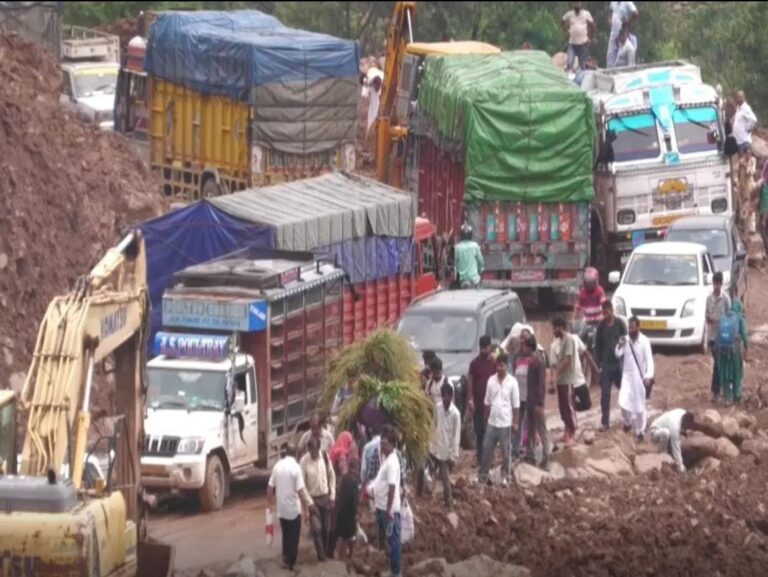
Srinagar (The Azadi Times) – The 270-kilometer-long Srinagar–Jammu National Highway, the only all-weather road connecting the Kashmir Valley with the Jammu region of Jammuand Kashmir, continues to operate on a one-way traffic system.
According to traffic officials, vehicles are being allowed to move from Jammu towards Srinagar today, while the opposite direction remains restricted due to incomplete restoration work at Thand area along the highway.
Officials urged travelers to strictly adhere to advisories, maintain lane discipline, avoid overtaking, and ignore rumors circulating about highway conditions.
Other Key Routes
Traffic on the Mughal Road, which also connects the Valley with Jammu province, and the Srinagar–Leh highway, linking central Kashmir with Ladakh, is moving as per official advisories.
However, due to heavy pressure from fruit-laden trucks during the peak harvest season, traffic between Herpora and Peer Ki Gali on the Mughal Road has slowed considerably.
The public has been advised to check real-time updates via the traffic police’s official Twitter and Facebook pages, or by contacting traffic control units in Srinagar, Jammu, and Ramban before starting their journey.
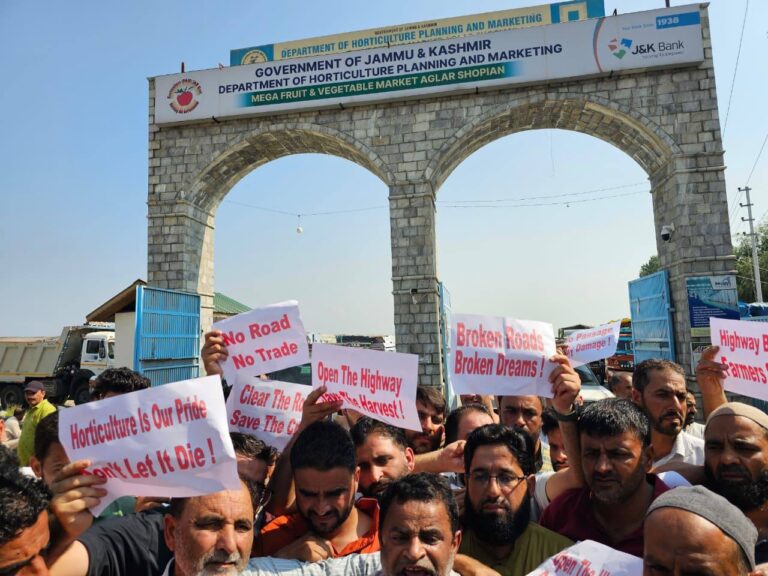
Srinagar (The Azadi Times) – Fruit growers across the Kashmir Valley shut down all major fruit markets on Monday, accusing authorities of failing to ensure the smooth movement of apple-laden trucks on the Srinagar–Jammu National Highway.
The shutdown affected Asia’s second-largest fruit market in Sopore, where emotional scenes were witnessed as orchardists broke down, lamenting that their year-long labor was going to waste.
Many farmers alleged that their trucks, carrying tons of apples, have been stranded for days on the national highway, while vehicles transporting iron and other commodities are being allowed to pass without obstruction.
“If the Chief Minister cannot even ensure the free movement of fruit trucks, he has no right to remain in office. He should resign,” said Fayaz Ahmad Malik, President of the Sopore Fruit Mandi Association, addressing protesters in Sopore.
Malik further accused local legislators of complete silence, stating that not a single MLA has spoken out in support of the farmers’ plight.
Threat of Valley-Wide Strike
Growers warned that unless the highway is fully restored within the next 48 hours, they will call for a valley-wide shutdown that could paralyze the region’s fragile economy.
Fruit merchants said the blockade has already caused crores of rupees in losses, with apples rotting inside stranded trucks. “Our livelihood is dying on the road while the government watches silently,” one grower said, his eyes filled with tears.
Sopore and Beyond
All major mandis in the Valley – including Sopore, Handwara, Shopian, Kulgam, and Anantnag – remained shut on September 14 and 15 in response to the growers’ strike call.
The fruit industry is a backbone of Kashmir’s economy, employing hundreds of thousands of people and generating significant export revenue. Farmers fear that continued disruption at this critical harvest time could devastate the sector.
The crisis underscores the ongoing challenges faced by Kashmir’s orchardists, who not only struggle with fluctuating markets and climate conditions but also accuse authorities of indifference to their pressing needs.
Azad Kashmir braces for an unprecedented lockdown on 29 September as the Jammu Kashmir Joint Awami Action Committee (JKJAAC) announces an indefinite shutdown to press its 38-point charter of demands. Stay tuned here for live, verified updates from public mobilization to government response.
Islamabad Approves Deployment of 2,000 Police Officers to Azad Kashmir Ahead of 29 September Shutdown
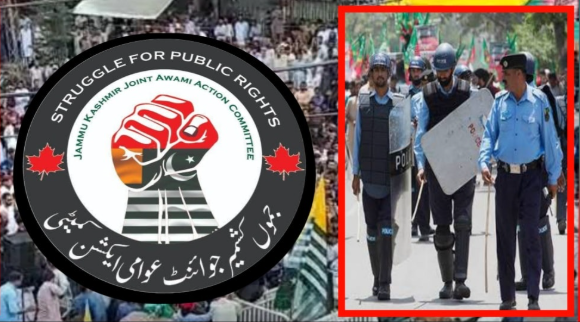
Islamabad has approved the deployment of 2,000 police officers to Azad Jammu & Kashmir ahead of the 29 September shutdown called by the Jammu Kashmir Joint Awami Action Committee (JKJAAC). The move comes as AJK Police continue their strike, leaving concerns about maintaining law and order during the protests.
The force will include SSPs, SPs, DSPs, Inspectors, Sub-Inspectors, constables, lady constables, and officers from divisions such as CTD, Traffic, Special Branch, Law & Order, and Safe City.
JKJAAC has condemned the deployment, describing it as “an external attempt to suppress the peaceful and unarmed people of Kashmir,” while government officials maintain it is a preventive measure to avoid any escalation of unrest.
JKJAAC: “This Is an Attack on Kashmir” – Sardar Umar Nazir Responds to Deployment of Islamabad Police
The Jammu Kashmir Joint Awami Action Committee (JKJAAC) has sharply condemned Islamabad’s decision to deploy 2,000 police officers to Azad Jammu & Kashmir ahead of the 29 September shutdown.
In a statement released on social media, Sardar Umar Nazir, a core committee leader of JKJAAC, accused Pakistan of preparing to “attack the peaceful and unarmed people of Kashmir” by sending external security forces.
“Kashmiris are a hospitable nation. In 1955, we welcomed guests from Punjab with generosity. Today, we will revive the struggle and resistance of our forefathers.”
He added that the “arrival of Pakistani forces will be considered an external attack on Kashmir”, aimed at crushing a peaceful movement for basic rights. Nazir urged overseas Kashmiris to stage diplomatic protests worldwide against what he described as “aggression and oppression.”
JKJAAC had earlier cautioned that any attempt to suppress demonstrations through outside security forces would be treated as an act of aggression against the Kashmiri people.
Police Move to Arrest Sardar Aman Kashmiri While Returning from Mirpur
On his return from Mirpur, AJK Police reportedly attempted to arrest Sardar Aman Kashmiri, widely regarded as a strong voice of the Kashmiri people. Aman has been at the forefront of raising issues of governance and public rights. The attempt drew swift condemnation from locals, who see the move as an effort to silence dissent ahead of the planned September 29 lockdown.
PTI AJK Boycotts All-Parties Conference as Leaders Call JKJAAC Protest an ‘Indian Conspiracy’
In a major political development ahead of the September 29 shutdown announced by the Jammu Kashmir Joint Awami Action Committee (JKJAAC), an all-parties conference was held on September 16 in Pakistan-administered Jammu and Kashmir. Most political groups attended the meeting, where the JKJAAC-led protest was denounced as an “Indian conspiracy,” with leaders using unusually harsh language against the movement.
The Pakistan Tehreek-e-Insaf (PTI) AJK chapter, under the leadership of former Prime Minister and current party president Sardar Abdul Qayyum Niazi, boycotted the conference. According to sources, PTI has now formally aligned itself with the action committee a move seen as a significant turning point in the ongoing political standoff.
PTI AJK Backs End of Perks, Demands Judicial Probe into ‘Cypher’
As the Jammu Kashmir Joint Awami Action Committee’s (JKJAAC) 29 September lockdown call grips the region, political activity continues to intensify.
Former Prime Minister Sardar Abdul Qayyum Niazi announced that he would surrender his own perks and privileges, urging his parliamentary party to follow suit. He called on the government to legislate on the matter, assuring that PTI Azad Kashmir would be the first to support reforms ending official entitlements.
At the same time, PTI Azad Kashmir stressed that in last night’s late-hour meeting of PML-N, PPP, and other parties, the issue of the so-called “cypher” was discussed. The party has demanded that a judicial inquiry commission comprising senior judges from the higher judiciary be formed to investigate the matter transparently.
JKJAAC Warns Telecom Firms Against Service Suspension on 29 September Lockdown
Sardar Umar Nazir of the Jammu Kashmir Joint Awami Action Committee issued a sharp warning to telecom operators, saying: “If mobile companies suspend our services on 29 September, we will head towards your franchises and even your towers. Don’t say you were not warned.”
Mobile and internet networks in Pakistan-administered Kashmir are regulated by the Pakistan Telecommunication Authority (PTA), leaving the AJK government with no direct control over service shutdowns.
Sardar Umar Nazir: ‘No fight with the army, our struggle is with those who exploited us for 78 years’
At the Pothi & Paradat: Right to Ownership and Governance conference in Rawalakot, Sardar Umar Nazir strongly criticized ruling leaders in Azad Kashmir who, he said, are opposing the Jammu Kashmir Joint Awami Action Committee (JKJAAC).
He accused them of trying to “hide behind the army” by creating a false security scare. “There is no fight between us and the army,” he declared. “Our fight is with the group of ’53’ and those who have exploited us for 78 years.”
JKJAAC Convenes Emergency Meeting at Undisclosed Location
According to The Azadi Times, reports surfaced today from the social media accounts of the Jammu Kashmir Joint Awami Action Committee’s (JKJAAC) core leaders that an emergency meeting has been called at an undisclosed location. However, no official statement or communiqué has been issued so far regarding the meeting.
JKJAAC Emergency Meeting Declaration
The Jammu Kashmir Joint Awami Action Committee (JKJAAC) today issued an official declaration following its emergency meeting at a secret location, attended by core committee members from across the state. Key highlights:
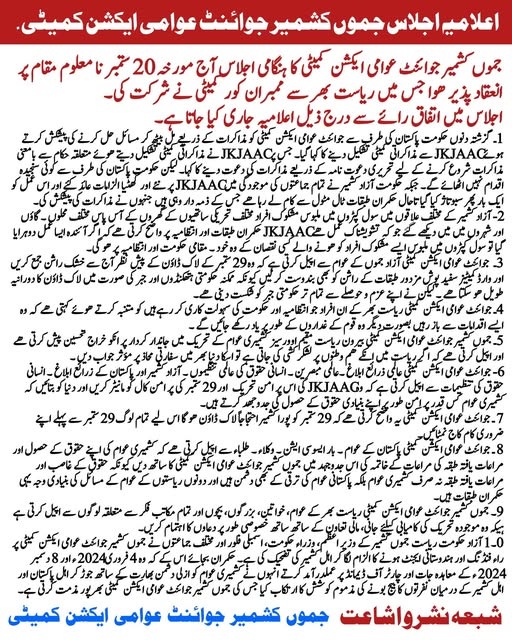
Press release issued by the Jammu Kashmir Joint Awami Action Committee in reaction to recent events, written in Urdu.
Dialogue Delay: Despite forming a negotiation committee as requested by Pakistan’s government, no formal talks have begun. JKJAAC holds the ruling elite responsible for repeated delays.
Security Alert: Suspicious plain-clothed individuals spotted near activists’ homes. JKJAAC warns authorities that any harm to these individuals in future incidents will be their responsibility.
Preparation for September 29: Citizens are urged to store dry rations and ensure provisions for vulnerable families, in anticipation of a potential prolonged lockdown.
Warning to Government Facilitators: Individuals aiding government or administrative actions against the movement are warned they will be remembered as traitors.
Overseas Kashmiris: JKJAAC commends the global Kashmiri community and urges them to respond diplomatically if repression occurs at home.
International Media Appeal: Human rights organizations, media, and observers are called upon to monitor the peaceful movement and the upcoming September 29 protest.
Protest Lockdown: A complete protest lockdown is announced on September 29; all essential work should be completed beforehand.
Call for Solidarity: JKJAAC appeals to Pakistanis, lawyers, students, and citizens from all walks of life to support the Kashmiri struggle financially, physically, and spiritually.
Condemnation of Azad Government: The committee strongly condemns the Prime Minister and ministers of the Azad Government for defaming the movement with false accusations and failing to implement earlier agreements and the Charter of Demands.
The JKJAAC urges everyone to stand united and face all challenges with courage and determination.
Political Gathering in Rawalakot
A few days before the September 29 lockdown call by the Jammu Kashmir Joint Awami Action Committee (JKJAAC), ruling political parties organized a public gathering today at Sabir Shaheed Stadium, Rawalakot.
On social media, some users alleged that many participants were brought from Pakistan, sharing photos of individuals carrying party flags and banners who appeared to be from outside the region. Locals also commented that several chairs remained empty during the event.
Meanwhile, members and supporters of the Jammu Kashmir Awami Action Committee described the gathering as an attempt to counter their September 29 shutdown call, framing it as a move against their campaign.
Talks Collapse After 13-Hour Session — JKJAAC Confirms September 29 Lockdown
After nearly 13–14 hours of marathon talks in Muzaffarabad, negotiations between the Jammu & Kashmir Joint Awami Action Committee (JKJAAC) and government delegations failed to produce a settlement, leaving in place the JKJAAC’s call for a territory-wide lockdown on 29 September and prompting a heavy security build-up across parts of Azad Jammu & Kashmir (AJK).
JKJAAC negotiators met with a federal-level delegation that included the Federal Minister for Kashmir Affairs and Gilgit-Baltistan, Ameer Muqam, and other officials in a bid to defuse the crisis. Government sources said a majority of the committee’s 38-point demands were discussed during the marathon session, but the talks ultimately broke down amid disagreement over implementation and political provisions the JKJAAC insists on.
MUZAFFARABAD — Pakistan-administered Kashmir: The Government of Azad Jammu and Kashmir (AJK) has requested urgent security support from Islamabad as the territory braces for major protests on 29 September. In a controversial move, the Federal Government has approved the deployment of 2,000 officers and personnel from Islamabad Police to maintain law and order in the region.
The decision comes at a time when the AJK Police are themselves on strike, leaving the local administration unable to guarantee security during demonstrations called by the Jammu Kashmir Joint Awami Action Committee (JKJAAC).
Officials confirmed that the deployment will cover senior command staff, operational officers, and female constables, with the force instructed to intervene if the local police refuse to take action or if demonstrations spiral out of control.
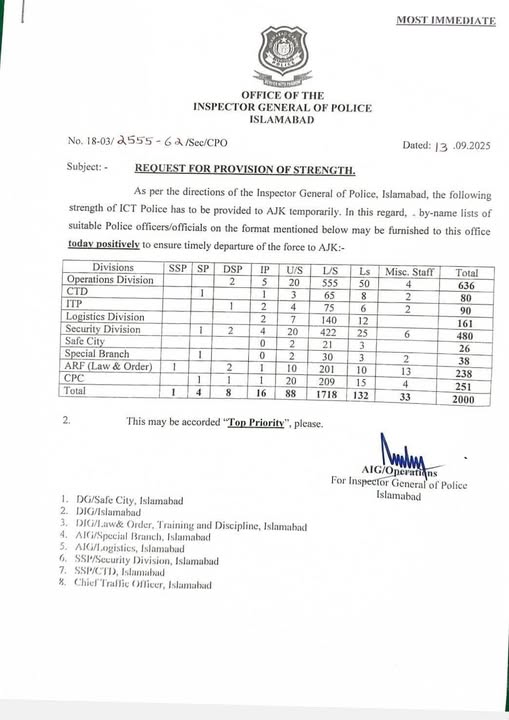
Official document circulating on social media showing the Islamabad Police deployment plan with details of 2,000 personnel.
Under directives issued by Islamabad’s Inspector General of Police, a large-scale deployment plan is being finalized to reinforce security across the capital. The contingent, comprising nearly 2,000 personnel, will include one Senior Superintendent of Police (SSP), four Superintendents of Police (SPs), eight Deputy Superintendents of Police (DSPs), six Inspectors, 88 Sub-Inspectors and Assistant Sub-Inspectors, 1,718 head constables and constables, 132 lady constables, and 33 support staff.
According to officials, the force will be drawn from various divisions of Islamabad Police, including 636 personnel from the Operations Division, 480 from the Security Division, 80 from the Counter-Terrorism Department (CTD), 90 from Traffic Police, 161 from the Logistics Division, 238 from Law and Order, 251 from the CPC Division, 38 from the Special Branch, and 26 from the Safe City Project. Authorities confirmed that the combined force will be dispatched in phases, with all divisions directed to finalize their deployment lists without delay.
JKJAAC: “This Is an Attack on Kashmir”
The move has been condemned by the Jammu Kashmir Joint Awami Action Committee (JKJAAC), which has organized strikes and demonstrations in Azad Kashmir over economic and political grievances.
In a statement posted on social media, Sardar Umar Nazir, a JKJAAC core committee leader, accused Pakistan of preparing to “attack the peaceful and unarmed people of Kashmir” by sending external police forces.
He wrote:
“Kashmiris are a hospitable nation. In 1955, we welcomed guests from Punjab with generosity. Today, we will revive the struggle and resistance of our forefathers.”
He added:
“The proud people of Jammu and Kashmir will consider the arrival of Pakistani forces as an external attack on Kashmir, aimed at crushing their peaceful struggle for basic rights. Overseas Kashmiris must protest diplomatically across the world against this aggression and oppression.”
The JKJAAC had previously warned that if external security forces were brought in to suppress protests, it would be treated as an act of aggression against the Kashmiri people.
The AJK government argues that the deployment is a preventive measure. With police on strike and a large-scale protest imminent, officials feared a complete breakdown in law and order.
September 29 has been marked by JKJAAC as a day of shutdown, with the group calling for protests across the territory. The demonstrations are expected to draw significant participation amid widespread public frustration over rising costs, unemployment, and demands for political reforms.
Analysts warn that while the deployment may help stabilize the situation in the immediate term, it also risks deepening the ongoing political crisis in the longer run. For the government, the additional police presence is viewed as essential for maintaining order and preventing the outbreak of violence. Yet for the Jammu and Kashmir Joint Awami Action Committee (JKJAAC), the move bolsters their argument that Islamabad is more intent on suppressing Kashmiri dissent than addressing genuine grievances.
Among the public, concerns are growing that the heavy police presence could trigger direct confrontation between demonstrators and federal forces — a scenario that could quickly escalate into violence. The international dimension adds further complexity: with Kashmiri diaspora communities active across Europe, the Middle East, and North America, JKJAAC’s appeal for overseas protests has the potential to place Pakistan under heightened diplomatic scrutiny.
Gilgit-Baltistan: In a remote corner of Gilgit-Baltistan, two siblings, Mohammad Shiraz and Muskan, have turned their passion for content creation into a force for social change. Known for their vlogs showcasing the simplicity and charm of rural life, these young YouTubers have already captivated audiences across Pakistan and beyond. Yet, their influence now extends far beyond digital entertainment — into the realm of community development and education.
From Rural Challenges to Digital Fame
The siblings’ journey began with a simple goal: to share the daily life, culture, and traditions of their village. Through their lens, viewers witnessed the rugged beauty of Gilgit-Baltistan and the warmth of its people. However, the vlogs also revealed stark realities — particularly the challenges faced by local children in accessing education.
Shiraz’s father had previously highlighted the condition of the village school, which lacked proper classrooms, desks, and basic learning materials. Many children were forced to study under the open sky, without shoes or proper clothing, and with little hope for a safe, conducive learning environment.
Turning Fame Into Social Impact
Recognizing the potential to create meaningful change, Shiraz and Muskan, along with their family, decided to invest their YouTube earnings into building a modern school. Their initiative transformed the community’s educational landscape.
The new facility now includes:
Spacious classrooms equipped with basic learning tools
Safe recreational areas for children
Adequate seating and study resources
A welcoming environment designed to nurture both academic and social growth
In a recent vlog, Shiraz remarked, “If YouTubers work with dedication and consistency, they can use their earnings to serve their communities and make a lasting impact.”
Community and Social Media Response
The response on social media has been overwhelming. Viewers praised the initiative, with comments such as:
“Mashallah! This shows that with power comes responsibility.”
“We supported the right people to become famous.”
“The true purpose of success is to make life easier for others.”
“Parents like these are an example for the entire nation.”
Education as a Catalyst for Change
This story highlights the transformative power of education and youth initiative. By leveraging digital fame for social good, Shiraz and Muskan provide a model for responsible digital entrepreneurship. They demonstrate how young individuals, even from small rural areas, can influence society positively and create opportunities for others.
Their school has already begun impacting the lives of dozens of children, providing them not only with a safe space to learn but also instilling hope for a brighter future. The initiative also reinforces the idea that technology and creativity can bridge gaps in infrastructure and social services, particularly in underserved regions.
A Lesson in Responsibility and Leadership
Shiraz and Muskan’s story is a reminder that fame and success carry responsibility. In a world where social media often highlights superficial content, these young creators have shown that it can also be a tool for empowerment, education, and societal growth.
For Gilgit-Baltistan and Pakistan at large, their efforts shine a light on the potential of youth-led initiatives to address local challenges. The narrative is not only inspiring but also emphasizes the importance of community-centered thinking, perseverance, and ethical leadership.
Looking Ahead
As the siblings continue their journey, their story has become more than a viral sensation. It is a symbol of hope, resilience, and the transformative impact of youth in the digital age. Their work underscores the belief that with determination, creativity, and sincerity, even the youngest members of society can enact meaningful change.
Hunza Valley, nestled in the northern reaches of Gilgit-Baltistan, is often described as paradise on earth. Snow-clad peaks, glacial rivers, apricot blossoms, and winding mountain roads make it one of South Asia’s most photographed destinations. But for travelers, whether Pakistani families escaping the chaos of cities or international visitors exploring the Himalayas and Karakoram, Hunza is far more than a scenic backdrop.
The heart of Hunza’s experience lies in its hospitality and food. Where you stay and what you eat become part of the story. From the luxury of heritage forts and boutique resorts to the warmth of family-run guesthouses, the Hunza Valley offers options for every budget and every kind of traveler. Meanwhile, its cuisine — shaped by centuries of survival in the mountains — remains simple, organic, and deeply rooted in community traditions.
This guide explores the best hotels, guesthouses, and restaurants in Hunza, while also reflecting on the opportunities and challenges of sustainable tourism in this fragile Himalayan frontier.
Luxury Hotels in Hunza
For those who wish to experience Hunza without compromising on comfort, a few establishments have become landmarks in themselves.
Serena Altit Fort Residence: Adjacent to the centuries-old Altit Fort, this hotel is not just a place to sleep, but a journey into Hunza’s history. The stone architecture, local woodwork, and curated cultural programs make it a living museum. Guests often describe it as a blend of “heritage and hospitality,” where every corner whispers stories of Hunza’s past.
PC Legacy Hunza (Pearl-Continental Group): Overlooking the mighty Rakaposhi and Ultar Sar, PC Legacy offers a more modern luxury. With conference halls, spas, and fine dining, it attracts business travelers, dignitaries, and high-profile guests. Yet beyond its glass windows and polished halls, the real attraction remains the awe-inspiring mountains that remind visitors of Hunza’s grandeur.
Mid-Range Hotels for Families and Groups
Most domestic tourists, especially families, prefer mid-range options where affordability meets comfort.
Hilltop Hunza Hotel: Perched above Karimabad, this hotel has long been a favorite. Its proximity to Baltit Fort and sweeping views of the valley make it a hub of activity. Travelers gather in its café, exchanging stories over cups of Hunza tea — a place where cultures meet and friendships are made.
Mulberry Hotel: A relatively new addition but already popular, the Mulberry blends modern amenities with local aesthetics. Families praise its cozy atmosphere, while younger travelers appreciate the balance between tradition and modernity.
Budget Hotels and Homestays in Hunza
Hunza’s heart beats strongest in its villages, and budget stays allow visitors to experience that authenticity.
Guesthouses in Gulmit and Passu: These family-run places are more than affordable accommodation; they are windows into Hunza’s daily life. Guests often share meals with hosts, learning about farming, traditions, and stories passed down for generations. Many international backpackers describe these stays as the most memorable part of their journey.
Community-led Eco-lodges: Especially in Upper Hunza, young entrepreneurs and activists have launched eco-tourism projects. These lodges focus on sustainability, using local materials and renewable energy. Visitors not only rest in comfort but also contribute to preserving Hunza’s fragile ecology.
👉 Travel Tip: Hunza’s popularity peaks from May to October. Hotels — from luxury resorts to village guesthouses — often book out weeks in advance. If you want to wake up to the sound
Hunza Valley hotels details
The experience of Hunza is never complete without choosing the right stay — because in this valley, accommodation is not just about a bed, it’s about stories, people, and views that linger long after the journey ends. Hunza’s hospitality is as diverse as its landscape; each place reflects a slice of local life history, tradition, and the resilience of its people.
Category
Hotel/Guesthouse
Location
Key Features
Best For
Luxury Stays
Serena Altit Fort Residence
Altit, Karimabad
Heritage fort setting, curated dining, cultural programs
International tourists, heritage lovers
PC Legacy Hunza (Pearl-Continental)
Near Karimabad
Modern luxury, conference halls, spa, fine dining, views of Rakaposhi & Ultar Sar
Business travelers, high-profile guests
Mid-Range Hotels
Hilltop Hunza Hotel
Karimabad
Panoramic view of Baltit Fort, on-site café
Families, groups
Mulberry Hotel
Karimabad
Modern rooms with local design elements, family-friendly
Domestic tourists, couples
Budget & Homestays
Passu Guesthouses
Passu, Upper Hunza
Family-run, clean rooms, home-cooked food, community feel
Backpackers, students, researchers
Eco-Lodges (Community-Run)
Gojal & Upper Hunza
Youth-led eco-tourism, sustainable stays, cultural immersion
Eco-travelers, responsible tourism seekers
Key Locations for Visitors in Hunza
Photo: Hunza Valley
Karimabad: The Heart of Hunza
If Hunza had a beating heart, it would be Karimabad. This small yet vibrant town is the cultural and tourism hub of the valley. With the majestic Baltit Fort and Altit Fort towering above, Karimabad tells stories of Hunza’s royal past while welcoming modern-day travelers. Its narrow lanes are dotted with hotels, cozy cafés, bookshops, and handicraft stores where visitors can purchase handmade shawls, carpets, and gemstones.
For many tourists, Karimabad is the first stop after entering Hunza — a place where history, hospitality, and breathtaking views of Rakaposhi and Ultar Sar blend together. Whether you’re staying in a luxury resort or a simple guesthouse, waking up to the sunrise over Karimabad’s snow-capped peaks is an experience you’ll never forget.
Gulmit and Passu: The Charm of Upper Hunza
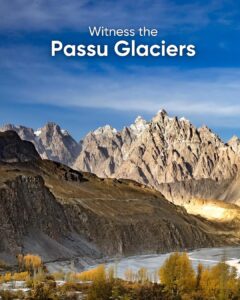
Paso Glaciers
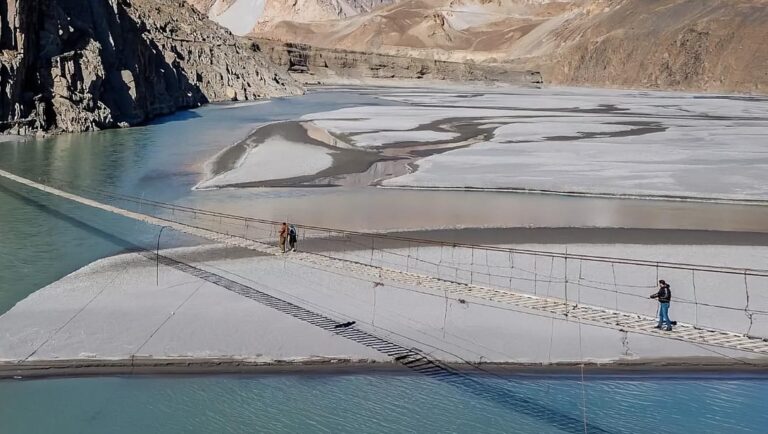
Heading deeper into Upper Hunza, Gulmit and Passu offer a quieter, more intimate experience compared to Karimabad. Popular among international backpackers and adventure travelers, these areas are surrounded by glaciers, suspension bridges, and of course, the iconic Passu Cones — a mountain formation that has become a symbol of Hunza.
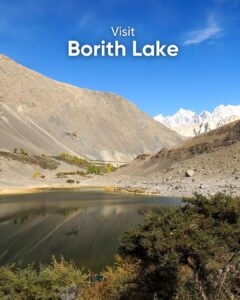
Borith Lake
Gulmit is also home to women-led initiatives and community-driven cafés where visitors can enjoy apricot tea or traditional chapshuro while learning about local culture. Staying in a homestay here allows you to experience genuine Hunza hospitality — families opening their doors, sharing stories, and serving food prepared from their own farms.
Attabad Lake and Beyond
Not too long ago, Attabad Lake was created by a devastating landslide in 2010. Today, it stands as one of Pakistan’s most photographed tourist destinations. The turquoise-blue water stretches across the valley, reflecting snow-capped peaks on calm days.
Around the lake, new hotels, restaurants, and even luxury resorts have sprung up, making it a favorite stop for families and honeymooners. Visitors can enjoy boating, jet skiing, or simply sitting by the water, soaking in the surreal beauty of a place that rose from tragedy. Attabad has truly transformed into a symbol of resilience and a must-visit on any Hunza itinerary.
Food in Hunza: A Taste of the Mountains
Hunza’s cuisine is not just food; it is heritage served on a plate. Rooted in centuries-old traditions, Hunza food reflects the valley’s mountain lifestyle — organic, simple, and nourishing. For travelers, tasting local dishes is as essential as visiting its forts or lakes.
Signature Dishes You Must Try
Chapshuro – Often called the Hunza pizza, this savory bread is filled with minced meat, onions, and spices, then baked on hot stones.
Dawdo Soup – A hearty noodle soup cooked with fresh vegetables and meat, perfect for cold mountain evenings.
Harissa – A slow-cooked blend of wheat and meat that locals enjoy in winter.
Molida – A festive dish made by mixing bread with apricot oil and butter, reflecting Hunza’s deep apricot culture.
Modern Adaptations
While Hunza’s traditional food continues to thrive, the valley’s growing tourism has introduced a wave of modern adaptations. Today, travelers can find restaurants serving everything from Italian pasta to Chinese noodles — often prepared alongside Hunza classics. Cafés in Karimabad and Gulmit now serve fusion menus, combining international flavors with local produce like apricot kernels and yak cheese.
👉 Travel Tip: Don’t leave Hunza without tasting dried apricots and walnut cakes. These organic snacks are not only delicious but also perfect souvenirs to carry back home.
Restaurants and Cafés Worth Visiting in Hunza
Hunza’s food culture is as colorful as its landscapes. Beyond traditional home kitchens, the valley is now home to restaurants and cafés that reflect both global flavors and local resilience. Dining here is not just about eating — it’s about experiencing stories of empowerment, community, and cultural pride.
Café De Hunza (Karimabad) – No trip to Hunza is complete without a stop at Café De Hunza. Famous for its walnut cake and freshly brewed coffee, it has become a landmark for both domestic and international travelers. Its cozy interior and terrace views of the valley make it a perfect spot to unwind after exploring Karimabad’s forts.
KhaBasi Restaurant (Altit Serena) – Located inside Serena’s Altit Fort Residence, KhaBasi is where tradition meets fine dining. The restaurant serves curated Hunza dishes with a modern touch, offering travelers a chance to taste authentic recipes in a heritage setting. Dinner here feels like stepping back in time, surrounded by centuries-old stone walls and mountain views.
Bozlanj Café (Gulmit) – A women-led initiative in Upper Hunza, this café is more than just a place to eat. Run by local Wakhi women, it serves traditional dishes like mamtu (dumplings) and sharbat (apricot drink). For international travelers, Bozlanj is not just about food — it’s about supporting empowerment and experiencing genuine hospitality.
Yak Grill (near Passu) – For adventurous foodies, Yak Grill offers something truly unique: dishes made from local yak meat. From burgers to traditional platters, this restaurant has gained popularity among travelers eager to taste something they won’t find elsewhere. Located near the dramatic Passu Cones, it pairs good food with unforgettable scenery.
👉 Travel Tip: Many of these cafés also sell locally produced goods — dried apricots, handmade crafts, or natural oils. Buying from them directly supports Hunza’s communities.
Hunza’s hospitality is not just about beds and meals — it is about heritage, resilience, and community. From luxury resorts to modest homestays, and from walnut cake to chapshuro, Hunza offers experiences that are deeply human.
For international visitors, it is a gateway into one of South Asia’s most breathtaking landscapes. For national travelers, it is a reminder of cultural pride. For Hunza’s people, it is home — a home they continue to protect against environmental threats and political uncertainties.
Hunza Valley remains more than a tourist destination; it is a living story of beauty, resilience, and hospitality at the edge of the Himalayas.
Doha – Qatar has strongly condemned a recent attack that coincided with discussions over a U.S.-backed proposal on easing the Gaza blockade, calling it an “insult to mediators” and a blow to international peace efforts.
Qatari officials warned that such actions undermine ongoing negotiations and stressed that Doha “reserves the right to respond” if diplomatic efforts continue to be disregarded.
According to diplomatic sources, Qatari Foreign Minister Sheikh Mohammed bin Abdulrahman Al-Thani addressed the United Nations Security Council this week, expressing respect for ongoing mediation efforts aimed at halting bloodshed in Gaza.
The Foreign Minister is also scheduled to hold high-level talks with U.S. President Donald Trump and Secretary of State Mike Pompeo in Washington today. Discussions are expected to focus on the Gaza blockade, regional stability, and continued U.S.-Qatari cooperation in peace mediation.
Arab League Calls Urgent Summit in Doha
Meanwhile, the Arab League has announced an emergency two-day meeting in Doha on September 14 and 15, bringing together regional leaders to coordinate a joint response. The extraordinary summit will review the implications of the latest attack, evaluate mediation strategies, and discuss the future of peace negotiations in the Middle East.
Arab diplomats say the meeting will underline regional solidarity while also highlighting the importance of U.S. engagement in mediating between Israel, Palestine, and Arab states.
“An Attempt to Undermine Peace Efforts”
Qatari officials have described the incident as an attempt to damage mediation channels at a critical time. “This is an insult to international mediators and an attack on peace itself,” one official said. “Despite this setback, Qatar remains committed to dialogue and diplomacy.”
Observers say the timing of the incident—just as the Gaza blockade proposal was under discussion—risks complicating already fragile negotiations.
The emergency Arab League meeting in Doha is expected to issue a joint communiqué reaffirming support for Palestinian rights, rejecting escalations, and backing continued mediation. Analysts believe the outcome will signal whether Arab states can present a united front in peace efforts or whether divisions will persist.
For Qatar, which has played a central role in regional mediation, the coming days will test its diplomatic clout and its ability to balance dialogue with a firm stance against actions it views as destabilizing.
The Azadi Times will continue monitoring developments from Doha, Washington, and Gaza as regional and international leaders push to prevent further escalation and keep diplomatic channels open.
MUZAFFARABAD, Azad Jammu and Kashmir – In a revealing interview, Syed Manzoor Hussain Gilani, the former Chief Justice of the Supreme Court of Azad Jammu and Kashmir (AJK), has laid bare the profound and unique constitutional ambiguities that define the region’s relationship with Pakistan, describing it as a system without parallel anywhere in the world.
Speaking to a local channel, the former top judge dissected the legal and political framework of Pakistan-administered Kashmir, presenting a picture of a territory that is governed as a de facto province but is constitutionally not a part of Pakistan, leaving its inhabitants in a state of political limbo.
The core of the paradox, as explained by Justice Gilani, stems from two official notifications issued by the Government of Pakistan in 1972 and 1988. These documents explicitly state that Azad Kashmir is not considered part of Pakistan’s territory under the country’s constitution.
“Yet,” Gilani notes, “the system is run as much as possible like a province.” This creates a contradictory reality where the federal government in Islamabad wields all the powers it holds over other provinces—and even more—over Azad Kashmir, but without granting the region the corresponding status or representation.
“This is an antagonistic situation,” Gilani stated. “It’s governed like a province, treated as a federating unit, but it’s not actually a federating unit… There’s no territory in the world like Azad Kashmir. This kind of system doesn’t exist anywhere else.”
The Illusion of Autonomy and the Reality of Control
The AJK has its own constitution, a president, a prime minister, and a legislative assembly. However, Gilani argues this autonomy is largely superficial. Key levers of power remain firmly with Islamabad.
Judicial and Bureaucratic Control: The appointment of high-level judges and senior bureaucrats is made by the federal government. Many officials are sent on deputation from Pakistan, meaning the administrative machinery is not answerable solely to the local population but to the central authority.
No Representation at the Center: This is what Gilani identifies as the region’s “biggest loss.” While Pakistan’s provinces elect representatives to the National Assembly and Senate, giving them a voice in federal legislation and a platform to advocate for provincial interests (like water rights), Azad Kashmir has no such representation.
The Military and Legal Framework: Laws governing critical areas like defense are made by the Pakistani parliament, where AJK has no say. “We have no say in that. That’s our biggest issue,” Gilani emphasized.
The Citizenship Conundrum
Perhaps the most striking revelation for many will be the clarification on citizenship. Justice Gilani explicitly stated that the native people of Azad Kashmir are not citizens of Pakistan.
“You might be surprised to hear this,” he said. “The people living in Azad Kashmir aren’t actually citizens of Pakistan.”
He drew a critical distinction: those who migrated from Indian-administered Jammu and Kashmir to various parts of Pakistan are granted Pakistani citizenship and voting rights. However, those born and living within AJK itself hold a different status. They vote for the AJK Assembly but not for Pakistan’s national or provincial legislatures.
Their Pakistani-issued National Identity Cards and passports, Gilani clarified, are documents of identity, not proof of nationality. “It’s about identity. That’s your identity, not your nationality,” he explained, comparing it to passports issued to Afghan or Rohingya refugees.
A Proposed Solution: Provisional Integration
Addressing the common argument that integration is impossible due to the region’s disputed international status, the former Chief Justice offered a pragmatic solution.
He pointed to India’s handling of Jammu and Kashmir prior to 2019, where the former state had its own constitution but was integrated into India’s federal framework with representation in the national parliament.
“The simple solution is that the existing constitution of Azad Kashmir should be kept with suitable amendments,” he proposed. By adopting relevant provisions from Pakistan’s constitution concerning provinces, AJK could be granted provisional representation in the Pakistani parliament and a seat on critical federal bodies like the Council of Common Interests (CCI).
This, he argued, would not prejudice the final status of Kashmir, which remains subject to a UN-mandated plebiscite. “Rights don’t get disputed—they’re either disputed or undisputed… Until the Kashmir issue is resolved, we should be given those rights and that status.”
He contrasted this with India’s approach, where the people of Jammu and Kashmir were brought “at par with the rest of the Indian nation” in terms of rights, while the territory itself remained disputed. “We are not at par with the rest of the Pakistani nation… We are Pakistanis. None of us consider India as an option. But we are not accepted as independent either.”
A Call for Political Will
Justice Gilani expressed frustration at the lack of political initiative from local leaders to address this constitutional ambiguity, suggesting they are complicit in maintaining a status quo that benefits Islamabad’s control.
“Pakistan favors whoever benefits them the most… But they just sit quietly and don’t take any action,” he remarked.
His interview serves as a powerful legal critique, highlighting that beyond the rhetoric of solidarity lies a complex and unresolved constitutional relationship that denies the people of Azad Kashmir the full rights of participation and leaves the region’s administration in a unique, and arguably disadvantaged, position on the world stage.
In the rugged, politically sensitive terrains of the Himalayas, a quiet digital revolution is underway. Led by a new generation of women, social media is becoming a powerful tool for expression, economic opportunity, and social change.
SRINAGAR/LADAKH/GILGIT — For decades, narratives from regions like Jammu & Kashmir, Ladakh, Gilgit-Baltistan (GB), and Azad Jammu & Kashmir (AJK) have often been dominated by geopolitical headlines. But beneath the surface of conflict and dispute, a transformative movement is growing—one powered by the smartphones and unwavering spirit of women.
From fashion bloggers in Srinagar to tourism entrepreneurs in Leh, these digital natives are harnessing platforms like Instagram, Facebook, and YouTube to reclaim their stories, showcase their heritage, and inspire a generation. They are not just influencers; they are modern-day pioneers on the digital frontier.
Shazia Bhatt: Weaving Kashmiri Tradition into Global Fashion
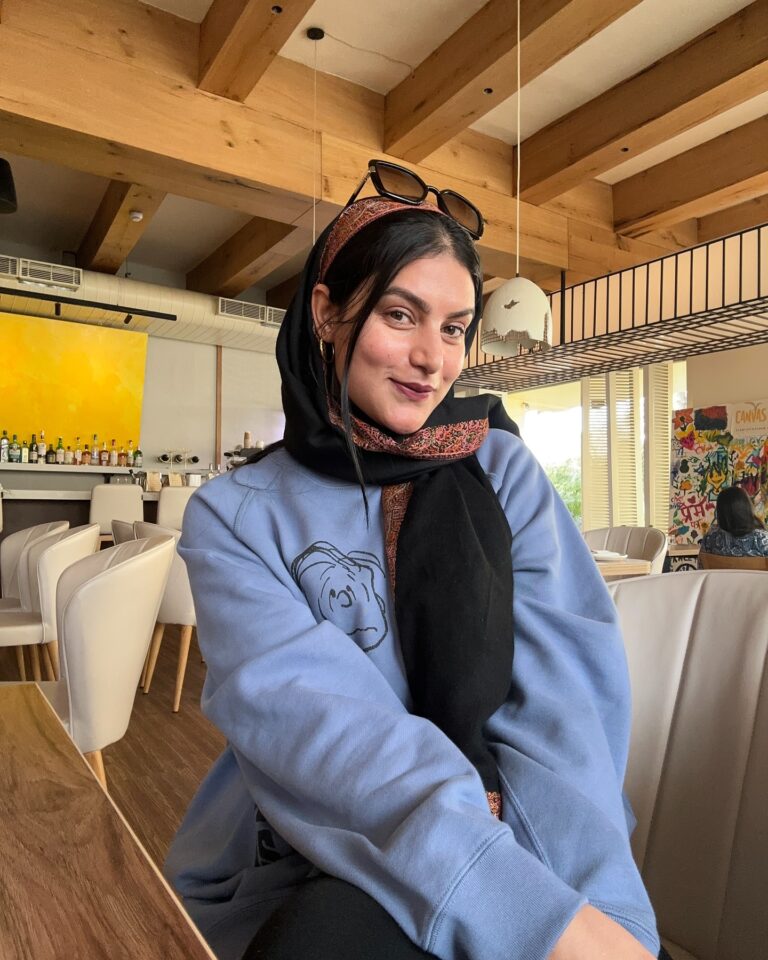
Photo: Shazia Bhatt
In the heart of Srinagar, Shazia Bhatt has built a thriving digital empire centered on fashion. With over 137,000 Instagram followers, her platform is a vibrant blend of intricate Kashmiri embroidery, traditional Pherans, and contemporary style.
“Fashion is our soft power,” Bhatt says. “When I wear a Kani shawl in a new way, it’s not just a post. It’s a statement that our culture is alive, evolving, and relevant to the world.”
Her content, characterized by high-quality visuals against the backdrop of Dal Lake and apple orchards, does more than just trend; it challenges stereotypes and provides a lucrative business model for local artisans she often collaborates with.
Seema Batool: Gilgit-Baltistan’s First Female Vlogger
Photo: Seema Batool
Seema Batool from Gilgit-Baltistan recognized the power of video early on. As one of the region’s first female vloggers, she turned her camera on the everyday—documenting the breathtaking landscapes, unique local cuisine, and rich cultural festivals of GB for a global audience.
“My goal was simple: to show the world who we truly are beyond the maps and politics,” Batool explains. “Our valleys, our laughter, our traditions—this is the story I want to tell.”
Her vlogs serve as a digital tourism portal, enticing adventurers and culturally curious viewers to learn about a region often omitted from mainstream travel guides.
Aqsa Masrat: Kashmir’s Youngest Digital Star
Photo: Aqsa Masrat
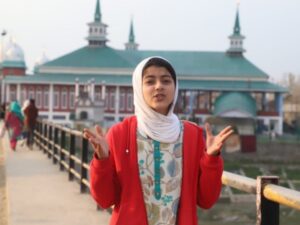
Aqsa Masrat, a 10-year-old social media sensation from Kashmir, has captured international attention for her impactful digital presence. She uses social media platforms to discuss issues affecting youth, education, and the role of technology in connecting communities across conflict-affected regions.
Recently, Aqsa was invited to speak at the University of South Carolina, USA, where she will share her insights on the role and impact of social media, demonstrating how young voices from Kashmir are leveraging digital platforms to influence global audiences and advocate for social awareness.
Her achievements underscore the growing influence of Kashmiri youth in digital spaces and highlight the potential of social media as a tool for education, empowerment, and global dialogue.
Thinlas Chorol: Empowering Women Through Tourism in Ladakh
Photo: Thinlas Chorol
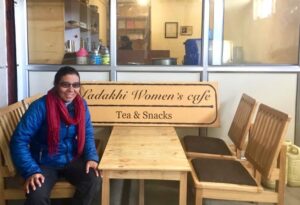
In the high-altitude desert of Ladakh, Thinlas Chorol’s influence is measured not just in followers, but in tangible impact. As the founder of the Ladakhi Women’s Travel Company, she used her platform to pioneer sustainable, women-led tourism.
Chorol’s work trains local women as trekking guides and homestay operators, providing them with economic independence. Her social media is a window into this initiative, showcasing the breathtaking journeys tourists can have while directly empowering the Ladakhi community.
“It’s about agency,” Chorol states. “We are showing that the women of Ladakh are not just keepers of culture but are also capable leaders of our economic destiny.”
Masrat Zahra: Bearing Witness Through a Lens
Photo: Masrat Zahra
Perhaps no one embodies the courage of this new wave more than Masrat Zahra, an award-winning photojournalist from Kashmir. In a field dominated by men and fraught with danger, Zahra’s camera tells the human stories behind the headlines.
Her powerful photographs, which have earned her international accolades like the Anja Niedringhaus Courage in Photojournalism Award, focus on the lived experiences of women and civilians, offering a poignant, often overlooked perspective on life in the valley.
“Photojournalism is my form of activism,” Zahra says. “It is about making the invisible, visible.”
The Rise of Kashmiri Women Influencers: Redefining Voice, Culture, and Economy
The rise of these women points to a larger trend: the democratization of voice. In regions like Kashmir, Gilgit-Baltistan, Ladakh, and Azad Jammu & Kashmir, where traditional media often faces restrictions and limited reach, social media has become an unexpected yet powerful platform for empowerment. Social media algorithms, often criticized for their opacity, have inadvertently provided these women with unprecedented visibility, allowing them to tell their stories, highlight social issues, and engage directly with a global audience.
Economic Empowerment
Beyond visibility, these women are carving out tangible economic opportunities. Through brand partnerships, digital marketing, sponsored content, and e-commerce ventures, they are creating new, independent revenue streams. This shift is challenging traditional economic structures, enabling women in remote regions to achieve financial independence and redefine what it means to be an entrepreneur in South Asia. The impact is profound: they are no longer passive participants but active creators shaping the digital economy around them.
Cultural Preservation
These influencers are also acting as digital archivists, preserving Kashmir’s rich cultural heritage. By showcasing local languages, traditional crafts, artisanal techniques, music, and folklore, they ensure that centuries-old traditions are celebrated and shared with audiences worldwide. Each post, vlog, or photo becomes a bridge between past and present, enabling a global audience to experience the region’s unique identity and cultural richness in real-time.
Social Impact
Socially, their visibility is revolutionary. By simply being public, successful, and unapologetically themselves, they challenge deeply entrenched gender norms. They inspire other young women to pursue their ambitions, pursue education, and express themselves freely in spaces historically dominated by men. Their courage resonates widely, creating a ripple effect of empowerment and confidence among local youth who may otherwise feel constrained by societal expectations.
Challenges on the Ground
The path is not without obstacles. These influencers navigate a range of challenges, including:
Unreliable internet connectivity and frequent shutdowns that disrupt content creation.
Social scrutiny and pressure to conform to conservative expectations.
Geopolitical tensions that create uncertainty and affect daily life.
Yet despite these hurdles, their persistence is unwavering. They are not waiting for permission to share their stories—they broadcast them with every post, video, and photograph, turning personal expression into collective empowerment.
The Future is Female—and Digital
The movement led by women like Shazia, Seema, Aqsa, Thinlas, and Masrat is irreversible. They have cracked the code on leveraging digital tools for real-world change. As connectivity improves with 4G and the promise of 5G in remote areas, their voices will grow louder, their communities will expand, and their societal impact will deepen.
In the digital age, their stories prove that the most powerful tool for transformation is not a headline—it is a well-composed photograph, a beautifully shot vlog, and the courage to share it with the world. These women are redefining influence, blending culture, economics, and social change in ways that inspire not just their region, but the global community.