
Pakistan‑administered Azad Jammu & Kashmir (AJK) presents a complex economic and industrial landscape shaped by geography, demographics, political subordination, and historical under‑development. While official records indicate a modest industrial presence, broader socio‑economic dynamics reveal contradictions that constrain meaningful economic growth and employment for its nearly 4.5 million people.
Limited Industrial Base and Electricity Connections
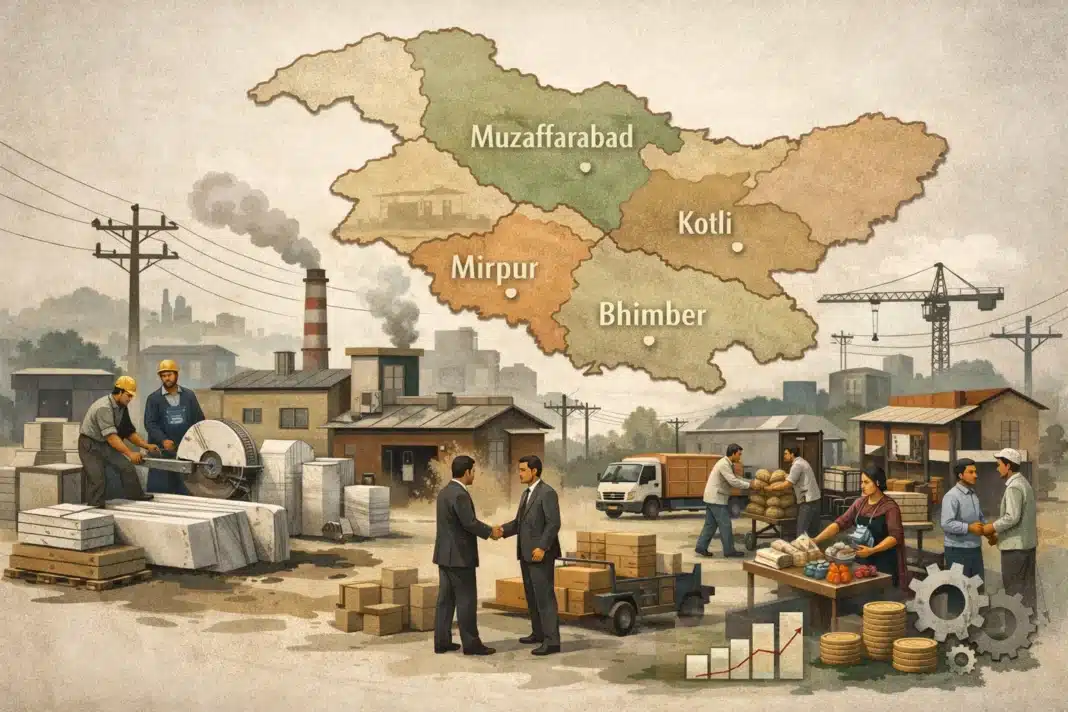
Government data shows that AJK has 2,312 industrial electricity connections, with the highest concentration in Mirpur (930 connections), followed by Kotli (556), Bhimber (413), and Muzaffarabad (182). Other districts such as Poonch (105), Bagh (62), Sudhnoti (43), Neelum (11) and Jhelum Valley (10) have far fewer industrial connections. Notably, Haveli district had one industrial connection in the past, which has since been discontinued. (Data source: local industrial registry)
Despite these connections, most linked activities are small‑scale or block factories, such as wood workshops, marble cutting, printing presses, and local cottage enterprises. Relatively few units operate with more than four workers, indicating a prevalence of micro‑enterprises rather than industrial hubs.

The Azadi Times
No state grants. No corporate lobby. Just ground‑truth reporting from Kashmir & beyond
You make this possible.
According to broader development profiles, the total number of industrial units historically recorded in AJK was about 1,743, with potential sectors including food processing, furniture, textiles, plastic products, and hydro‑power related activities being encouraged under government policy to boost local industry. This includes the establishment of industrial estates across multiple districts with basic infrastructure support.
Economic Structure and Employment Patterns
AJK’s economy remains heavily reliant on remittances, services, and agriculture, with industrial activity remaining a smaller, supplementary contributor. Small manufacturing, handicrafts, and cottage industries form a crucial part of rural livelihoods, with many units focused on food and beverage processing, textiles, woodworking, and artisan crafts—a pattern corroborated by independent economic surveys.
While official records may highlight thousands of registered industrial units, the reality on the ground often reflects low employment density and limited productivity. Many registered units exist only on paper or operate informally, and reliance on imported raw materials and unstable electricity supply hinders expansion of local manufacturing.


Across AJK, only a small fraction of the population engages in formal industrial employment, with the majority working in services, agriculture, or seeking overseas work—especially in Gulf and European labour markets. Trade, private education, health services, and government jobs remain the most consistent employment sources for local residents.
Fiscal Limitations, Taxation and Budget Dependence
AJK has a constrained fiscal base. Of an estimated 4.5 million population, only about 84,044 individuals are documented as direct taxpayers. Much of the tax collection regime is complicated by the region’s constitutional and political status: major tax streams, such as income tax and sales tax, are collected by Pakistan’s Federal Board of Revenue (FBR), with only limited revenue retained locally. Tax returns to AJK under budgetary transfers lack predictability due to controversial status debates and financial dependencies on Islamabad.
Local budgets are heavily reliant on federal transfers and aid, particularly to cover salaries and administrative expenditures. If these transfers are interrupted, basic governance functions, including public sector wages, become unsustainable—a reality that underscores the extent to which AJK’s economic sovereignty is limited.
Social and Structural Contradictions in Development
The dominant narrative in AJK’s political economy reflects an undeveloped, import‑dependent society in which local elites and trading intermediaries often capture economic rents with limited trickle‑down. While some local capitalists have earned wealth through recruitment agencies, overseas labour placement, and property speculation, the broader workforce remains marginalized, receiving low wages or working in informal, unregulated conditions.
This pattern reflects what some political analysts describe as a dual character of the working class—caught between being part of remittance‑dependent labour abroad and partially complicit in local exploitation when returning as middle‑class actors. Such contradictions reveal deeper structural challenges rather than simple economic stagnation.
Hydropower and Potential for Growth
AJK’s geography offers significant hydropower potential, with rivers such as the Jhelum and Neelum, and major projects like the upcoming Azad Pattan Hydropower Plant indicating latent capacity for energy supply and export. Yet, converting this potential into broad‑based industrial growth and value‑added manufacturing remains an obstacle given existing infrastructure bottlenecks and dependency dynamics.
Beyond Industrial Numbers: Political Economy and Objectives
Some activists and scholars argue that the dominant power structures in AJK are not defined by the local legislative assembly but by external geopolitical and economic influences that shape resource allocation and political leverage. In this view, asserting “people’s rule” requires not only institutional reform but also a fundamental reconfiguration of power away from colonial‑era dependencies toward local autonomy—an emphasis on socio‑economic empowerment rather than symbolic political gestures.
Conclusion
AJK’s industrial landscape offers a mixed picture: while official records point to thousands of registered units and multiple sectoral presences, the reality is one of small scale, low employment density, and structural dependency. Economic vitality, therefore, hinges less on raw industrial statistics and more on integrated policy reform, infrastructure investment, and shifting power dynamics that can translate human potential into sustainable, equitable growth.