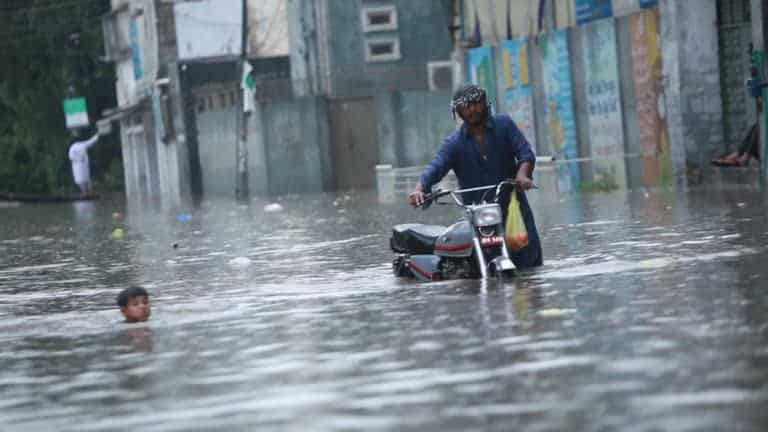

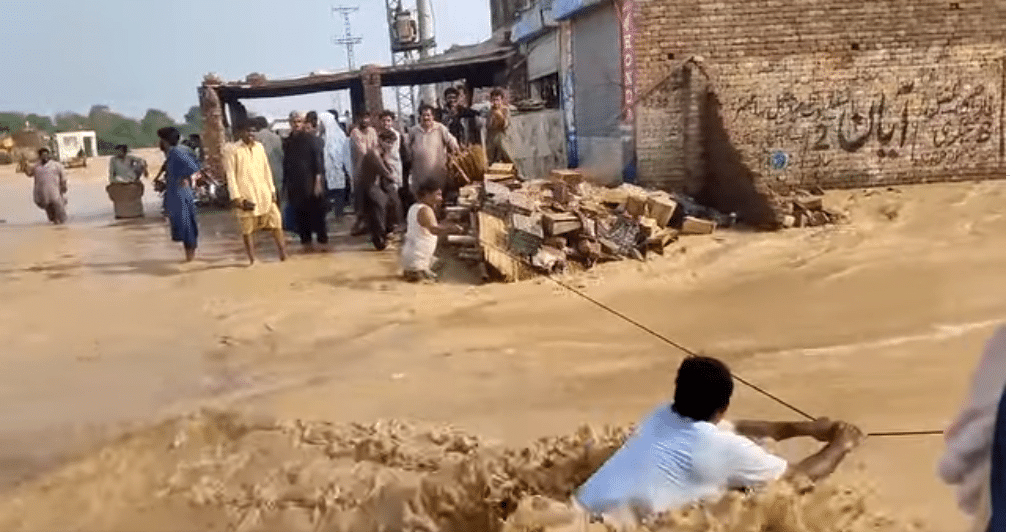

ISLAMABAD – Vast swathes of Pakistan are underwater, in a grim replay of a climate-driven nightmare that the country has scarcely recovered from. For weeks, unrelenting monsoon rains have unleashed catastrophic flooding, killing more than 1,500 people, displacing nearly four million, and laying waste to infrastructure and agriculture in a disaster officials are calling the worst since the devastating 2022 deluge.
From the agricultural heartlands of Punjab to the financial capital of Karachi and the remote valleys of the KPK, the scale of the destruction is staggering. The floods have laid bare the stark vulnerabilities of a nation grappling with political and economic instability while standing on the frontline of the global climate crisis.
A Nation Submerged, A Crisis Unfolding

The Azadi Times
No state grants. No corporate lobby. Just ground‑truth reporting from Kashmir & beyond
You make this possible.
The crisis began in earnest in mid-August, as what meteorologists termed a “monsoon on steroids” parked itself over Pakistan. The Pakistan Meteorological Department (PMD) reported rainfall nearly 40% above the 30-year average, overwhelming river systems and bursting embankments.
Satellite imagery shows a country drowning; the Indus River system has swollen into a miles-wide inland sea, swallowing villages and farmland whole. The National Disaster Management Authority (NDMA) reports that critical bridges, roads, and nearly 2,000 health facilities have been damaged or destroyed, severely hampering rescue efforts.
“We are racing against time,” a weary NDMA spokesman told reporters. “The immediate priority is rescuing those still stranded and getting life-saving aid to the displaced. But the water is everywhere. Access is our biggest challenge.”



In the aftermath, a second disaster is brewing. Health officials in Sindh province report a rapid rise in water-borne diseases like cholera, acute diarrhea, and mosquito-borne dengue and malaria, as millions are forced to drink contaminated water and live in crowded, unsanitary relief camps.
The Provinces: A Tapestry of Devastation
Each region tells a different story of the same catastrophe.

In Punjab, the nation’s agricultural engine, the Chenab, Ravi, and Sutlej rivers breached their banks, inundating key districts. Farmers stood helplessly as torrents washed away entire fields of cotton and sugarcane—crops vital to both their livelihoods and Pakistan’s fragile economy. The UN’s Food and Agriculture Organization (FAO) warns of a “catastrophic” impact on food security, with losses estimated in the billions of dollars.
In Sindh, the situation is dire. The southern province, still recovering from previous floods, has been hit with particular ferocity. In the megacity of Karachi, a malfunctioning drainage system collapsed under the biblical downpour, turning streets into rivers and stranding thousands. Further north, in rural Sindh, communities were washed away as the Indus overflowed, their mud-brick homes dissolving into the muddy water.
“The water took everything: my home, my animals, my wheat stores,” said Ghulam Sarwar, a farmer sitting on a raised highway in Dadu, now an island in a sea of floodwater. “We have nothing but the clothes we fled in.”
The mountainous terrain of Khyber Pakhtunkhwa (KP) saw a different kind of destruction. Here, the rains triggered violent flash floods and landslides that ripped through villages. The Swat Valley, a scenic tourist destination, now bears the scars of eroded riverbanks and collapsed roads. Residents speak of a wall of water arriving in the dead of night with little warning.
Balochistan, Pakistan’s largest and most impoverished province, has been effectively cut off. Flash floods severed road links, isolating entire communities. For the pastoralist communities who have lost their herds, the economic devastation is total and potentially irreversible.
Response and Recrimination
The government of Prime Minister Shehbaz Sharif has declared a national emergency and deployed the military, its primary disaster-response force, to lead rescue operations. Mr. Sharif has embarked on tours of the affected areas and issued urgent appeals for international assistance.
“The Pakistani people are facing a monsoon of suffering,” he stated in a televised address. “We are doing all we can, but the magnitude of this calamity is greater than any one country can handle.”
The international community has begun to respond. Aid flights from China, Turkey, and the UAE have landed in Islamabad carrying tents, food, and medicines. The United Nations is launching a formal flash appeal for funds.
Yet, on the ground, there is a palpable sense of anger and frustration. Survivors and local officials accuse the central government of a slow and disorganized response, alleging that aid is being distributed along political lines. Many question why lessons from the 2022 floods, which killed over 1,700 people, were not better applied.
“Where is the investment in early warning systems? Where are the dams? Where are the strengthened embankments?” asked Mariam Solangi, a climate activist in Hyderabad. “We mourn the lives lost, but we must also call this what it is: a failure of governance and foresight.”
The Unavoidable Truth: A Climate Crucible
Beyond the immediate crisis lies an inescapable and deeply unfair truth: Pakistan is paying a deadly price for a climate crisis it did little to create.
The country contributes less than 1% to global greenhouse gas emissions, yet consistently ranks among the world’s most climate-vulnerable nations. Scientists from the World Weather Attribution group, who analyzed the 2022 floods, found that climate change likely made the extreme rainfall more intense and more probable.
“This is not just a natural disaster; it is a man-made climate catastrophe,” explains Dr. Ayesha Qureshi, a climate policy expert at Islamabad’s Quaid-i-Azam University. “The warming Indian Ocean is fueling more intense monsoon systems, and our glaciers in the north are melting at an alarming rate. We are living the predictions of climate models today.”
The question now is what comes next. As the waters eventually recede, they will leave behind a country facing a reconstruction bill estimated at over $10 billion—a sum Pakistan’s debt-ridden economy can ill afford. The world’s attention, fleeting as it is, will move on.
But for the millions of Pakistanis starting from zero, and for a government trapped between recovery and resilience, the 2025 floods are a searing indictment of global inaction on climate change and a stark warning that for some nations, the future is already here.