

GAZA CITY — Israeli air and ground forces launched a series of attacks across the Gaza Strip on Sunday, shattering a fragile sense of calm and dimming hopes for the durability of a U.S.-brokered ceasefire agreed earlier this month.
According to Gaza residents and Israeli media reports, heavy bombardments and gunfire were heard in the southern cities of Rafah and Khan Younis. Eyewitnesses told Reuters that Israeli tanks advanced near the eastern town of Abasan, with explosions reported throughout the southern belt of the enclave.
The latest escalation marks one of the most significant breaches of the ceasefire since it came into effect on October 11, following more than two years of intense warfare between Israel and Hamas.

The Azadi Times
No state grants. No corporate lobby. Just ground‑truth reporting from Kashmir & beyond
You make this possible.
Airstrikes and Civilian Casualties
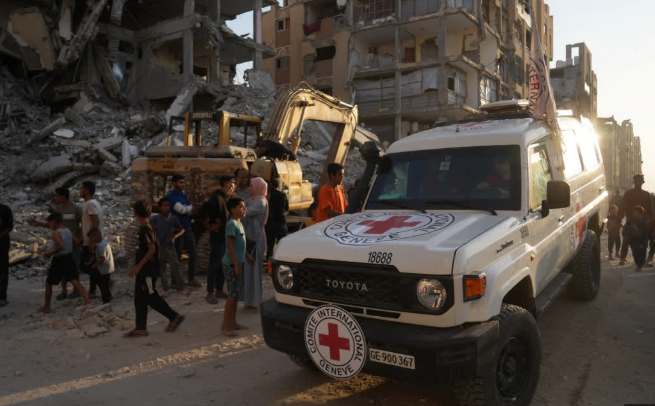
The Gaza Civil Defense Department confirmed that at least 21 Palestinians were killed in Sunday’s airstrikes targeting several densely populated areas, including Suwida in central Gaza. Officials said that “many of those killed were ordinary civilians,” with rescue teams struggling to retrieve bodies from the debris.
Earlier in the day, health authorities reported the deaths of two Palestinians in northern Gaza’s Jabalia area, where Israeli strikes reportedly hit residential zones.
“These attacks come at a time when people were beginning to hope for stability,” said a Gaza-based humanitarian worker, who described the renewed bombardment as “a tragic reminder that peace in Gaza remains painfully elusive.”


Israel Blames Hamas for Renewed Hostilities
The Israeli military accused Hamas of reigniting the conflict, alleging that the group launched multiple attacks against Israeli forces stationed within the Gaza perimeter.
According to an Israeli army spokesperson, the assaults included a rocket attack and a sniper incident, both of which targeted troops in Israeli-controlled sectors inside Gaza. “These are clear violations of the ceasefire agreement,” the spokesperson said, emphasizing that the military “will respond to any threat to Israeli soldiers or civilians.”
Israeli media outlet The Times of Israel claimed that airstrikes in Rafah were carried out after militants allegedly attacked Israeli troops in the area. However, the report did not provide independent verification of the claim or identify its source.

When contacted for confirmation, a spokesperson for the Israeli government referred inquiries to the military. The Israel Defense Forces (IDF) declined to comment further on the operation or its objectives.
Hamas Accuses Israel of Breaking Ceasefire
In response, senior Hamas official Izzat al-Rishq denied that the group initiated any hostilities, accusing Israel of repeatedly breaching the terms of the ceasefire. “Hamas remains committed to maintaining the truce,” he said, “but Israel continues its aggression through airstrikes and ground incursions.”
Al-Rishq warned that continued Israeli violations could “undermine all efforts toward stability and lead the region into another cycle of violence.”
Political analysts note that both sides appear to be using the ceasefire to consolidate their strategic positions. “Each new flare-up tests the boundaries of the ceasefire,” said a Middle East analyst based in Amman. “For Israel, these operations are justified as preemptive defense; for Hamas, they symbolize resistance. But for civilians, the cost is always unbearable.”
A Fragile Peace Under Strain
The current truce, brokered with U.S. mediation earlier this month, had been viewed with skepticism from the outset. With trust between both sides nearly eroded after years of bloodshed, observers warn that even minor incidents risk escalating into full-blown confrontation.
In Gaza, where two million residents remain trapped under blockade, the latest violence has deepened humanitarian fears. Hospitals already strained by shortages of medicine and fuel are now treating a new influx of wounded civilians.
“This renewed fighting underscores the fragility of the ceasefire and the absence of a long-term political solution,” said a senior United Nations official familiar with the situation. “Without genuine dialogue, Gaza will continue to swing between temporary pauses and devastating violence.”
As night fell over Gaza, the sound of explosions continued to echo through Rafah and Khan Younis — a stark reminder that even after repeated rounds of mediation, the road to peace in the besieged territory remains uncertain.