No state backing. No paywalls. Just truth. Support Kashmir's independent voice. Join 2,400+ patrons who fund independent voices.
Zero Paywalls
Reader Funded
Award Winning
Secure Payment
Encrypted
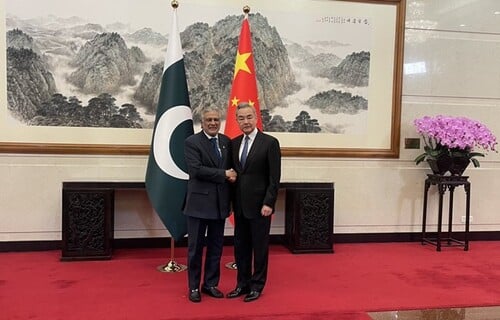
Muzaffarabad: Pakistan and China have jointly announced a five-point formula aimed at restoring peace and stability in the Gulf and the wider Middle East, as regional tensions continue to raise concerns about security, energy supply routes, and humanitarian conditions.
According to Pakistan’s Foreign Office, the framework emerged during a meeting in Beijing between Pakistan’s Deputy Prime Minister and Foreign Minister Ishaq Dar and China’s Foreign Minister Wang Yi, where both sides reviewed the evolving situation in the Middle East and the Gulf region.
The proposal reflects growing international concern about escalating tensions involving Iran, Gulf states, and broader geopolitical actors, with both countries emphasizing diplomacy and international law as the primary tools for conflict resolution.
No state backing. No paywalls. Just truth. Support Kashmir's independent voice. Join 2,400+ patrons who fund independent voices.
As part of the proposed framework, Pakistan and China have called for an immediate ceasefire in conflict-affected areas, urging all parties to prevent further escalation.
The statement stresses the importance of ensuring unhindered humanitarian assistance to populations affected by conflict, highlighting the urgent need to address civilian suffering and maintain access to basic services.
Regional observers note that continued instability in the Middle East has raised concerns about humanitarian crises, displacement, and disruption of essential infrastructure.
The second key element of the five-point proposal calls for the initiation of peace negotiations, emphasizing respect for the sovereignty, territorial integrity, and national independence of states in the region.
Pakistan and China reiterated that dialogue and diplomacy remain the only viable path toward resolving disputes, encouraging all stakeholders to avoid the use or threat of force during negotiations.
The development comes amid ongoing diplomatic efforts involving regional and global actors seeking de-escalation in the Middle East.
Another central point in the framework highlights the importance of protecting civilians and non-military infrastructure during armed conflict.
Pakistan and China have urged all sides to adhere strictly to international humanitarian law, calling for an end to attacks on civilian populations and essential infrastructure, including energy facilities, water desalination plants, electricity systems, and peaceful nuclear installations.
Analysts suggest that safeguarding critical infrastructure remains crucial for preventing long-term economic and humanitarian damage across the region.
The proposal also addresses the strategic importance of maritime routes, particularly the Strait of Hormuz, a key global corridor for oil and commercial shipping.
Both countries have called for the protection of vessels and crew operating in the region and emphasized the need to ensure the safe and uninterrupted flow of trade and energy supplies.
Disruptions in the Strait of Hormuz have historically impacted global energy markets, making maritime stability a priority for many countries dependent on oil imports.
The final component of the five-point formula emphasizes the role of the United Nations Charter and the importance of multilateral cooperation in achieving lasting peace.
Pakistan and China highlighted the need to strengthen international consensus and support diplomatic agreements based on international law, with the aim of establishing a comprehensive and sustainable peace framework.
Diplomatic observers note that multilateral approaches are increasingly seen as necessary in addressing complex regional conflicts that involve multiple state and non-state actors.
The announcement follows increased diplomatic engagement between regional and international actors, including discussions regarding potential negotiations involving Iran and other stakeholders.
While no immediate breakthrough has been announced, the joint proposal signals continued diplomatic momentum toward de-escalation in the Middle East, a region that remains central to global geopolitical and economic stability.
Observers say the coming weeks may determine whether diplomatic initiatives can translate into tangible steps toward reducing tensions and preventing further conflict escalation.
Trending Topics


The Azadi Times is an independent digital news platform based in Muzaffarabad, Kashmir, dedicated to credible journalism, in-depth reporting, and global analysis. We cover Kashmir, South Asia, and international affairs with a commitment to truth, editorial integrity, and public accountability.
Get important news delivered directly to your inbox and stay connected!
© 2026 The Azadi Times. All Rights Reserved.