
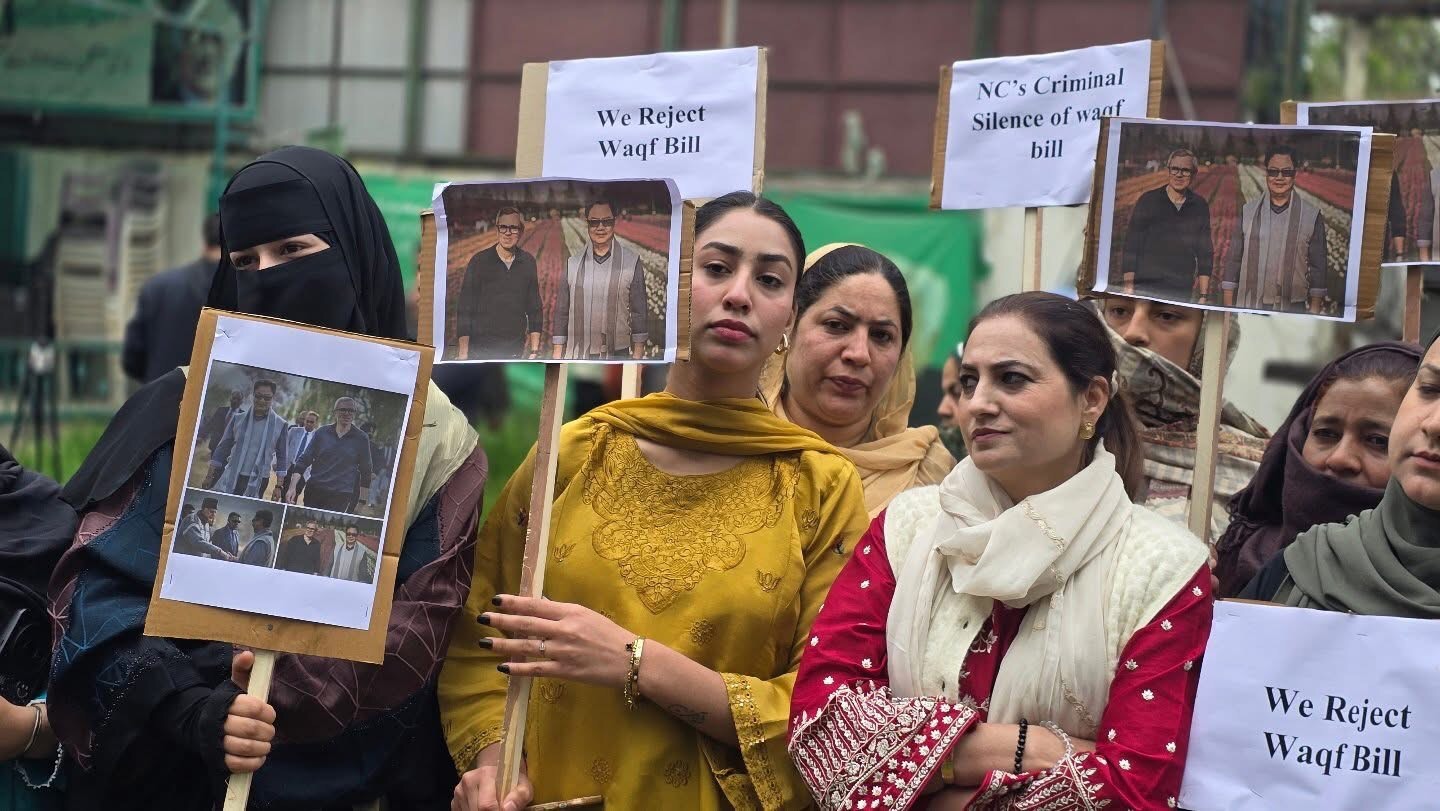

Srinagar, (IaJK)– Protests erupted in Srinagar on Friday as leaders and workers of the People’s Democratic Party (PDP) staged a demonstration against the recently introduced Waqf Bill. Holding placards that read “Waqf Bill Nahin, Nahin,” protesters voiced their strong opposition to the controversial legislation.
The demonstrators accused the National Conference (NC) of maintaining silence on the issue and failing to take a stand against the bill, which they claim undermines the rights of Muslims in India-administered Kashmir.
PDP senior leader Khurshid Alam, while addressing the media, said, “Today, we are protesting against the Waqf Bill, but the police stopped us from voicing our concerns.” Alam criticized the manner in which the bill was passed in the Indian Parliament, alleging that it was done “in the dead of the night.” He argued that the bill, in its current form, is unacceptable to the Muslim community across the country.

Alam took a jibe at the National Conference for its silence on the matter, calling their response “criminally silent.” He continued, “The BJP’s attitude toward Muslims is condemnable, but the National Conference’s silence on this issue is deeply disappointing.” He stressed that Muslims in Jammu and Kashmir, a Muslim-majority region, had placed their trust in the region’s political leadership, but the Speaker had reportedly silenced voices raised against the bill. “NC’s members only staged a drama in the Assembly,” Alam added.
The protests were not limited to the PDP alone. The United J&K Ulema Council, in line with its earlier stance, called for a complete rejection of the Waqf Amendment Act of 2025. The Council’s members, including imams from major mosques, shrines, and religious establishments, took part in the protests, demanding the immediate withdrawal of the legislation. The religious leaders argued that the bill poses a significant threat to the religious and historical significance of Waqf properties.
In a powerful statement, the Ulema Council condemned the continuous house arrest of Mirwaiz Umar Farooq, a prominent religious leader, and criticized the government’s actions as authoritarian and anti-democratic. They stated that the government’s approach was deeply offensive to the people of Kashmir and called it entirely unacceptable.
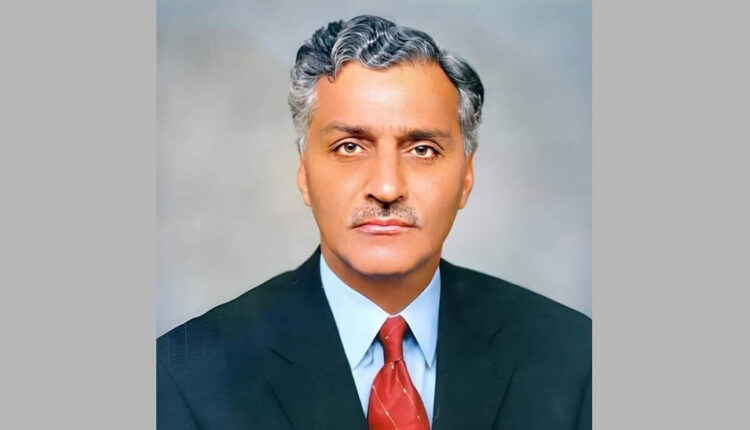


The Waqf Amendment Bill 2025, which has sparked this wave of opposition, introduces major changes to the management and administration of Waqf properties. Several provisions have raised concerns among the Muslim community, particularly regarding the reduction of Muslim-led Waqf Board powers and the increase of non-Muslim and government officials’ influence over religious properties.
Critics of the bill argue that the inclusion of non-Muslim individuals in central and state Waqf Boards, along with the removal of the requirement for a Muslim CEO, could undermine the religious and charitable role that Waqf properties have traditionally played in the Muslim community. They also pointed out that the bill grants district magistrates the authority to decide whether a property should be considered a Waqf, potentially creating an avenue for one-sided decisions, especially concerning disputed properties.
The repeal of Section 40 of the Waqf Act of 1995 is another contentious point. This section had safeguarded the recognition of Waqf properties, which could now be subject to greater uncertainty.


As protests continue to gather momentum across Kashmir, including in the regions of Jammu, Chenab Valley, and the Leh-Kargil areas, the demand for the repeal of the Waqf Amendment Bill is growing louder. Religious leaders and political figures alike are calling for an end to what they describe as a direct attack on the community’s rights, with many warning that the law could disrupt the historical and spiritual fabric of the region.
While the Indian government remains silent on the growing opposition, the protests in Kashmir signal a wider demand for political and religious autonomy and a deep-rooted desire to preserve the region’s identity.