
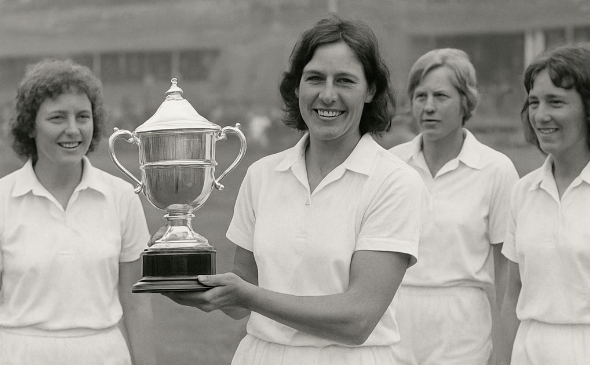

It is a question that reveals a fascinating and often overlooked chapter in sporting history: “Pehla women’s ODI World Cup kab khela gaya tha?” (When was the first women’s ODI World Cup played?).
The answer is 1973.
But this simple date belies a revolutionary truth. The first-ever Cricket World Cup to be played in the One Day International (ODI) format was not the men’s tournament of 1975, but the women’s championship two years prior. In a stunning precedent, a group of pioneering women cricketers took to the global stage and forever altered the landscape of the sport, crafting a legacy of resilience that continues to inspire today.

This is the story of that groundbreaking 1973 World Cup.
The Birth of a Global Tournament: Context and Ambition
In the early 1970s, women’s cricket was largely amateur, operating with minimal funding and public recognition. The idea of a world cup was audacious. The driving force behind it was Rachael Heyhoe Flint, the charismatic and determined captain of England. Alongside businessman and cricket enthusiast Sir Jack Hayward, who provided the crucial financial backing of £40,000, Heyhoe Flint turned a visionary idea into a tangible reality.
The tournament was officially named the Prudential World Cup, after its sponsor, and was hosted in England across June and July of 1973. Its very existence was a statement: women’s cricket deserved a world platform.


The Contenders: A Truly International Field
Seven teams participated in this inaugural event, a mix of national sides and composite teams, reflecting the developing state of the global game:
England
Australia
New Zealand
Trinidad and Tobago
Jamaica
Young England (An England ‘A’ team)
International XI (A composite team of players from other nations)

The format was a round-robin league, where each team played the others once. The top two teams would then contest the final.
The Final: England Triumphs at Edgbaston
After 22 matches, the tournament reached its climax at Edgbaston in Birmingham. England, led by Heyhoe Flint, faced off against the formidable Australia, captained by Margaret Jennings.
In a tense and low-scoring affair, England batted first and posted a modest 134 for 3 in their 60 overs (a testament to the era’s longer format). Australia, in response, was stifled by a disciplined English bowling attack and fell short, scoring 124 for 9 in their allotted overs.
England won by 9 runs, etching their names into history as the first-ever World Cup champions. Enid Bakewell was the star of the final, scoring an unbeaten 118 and taking two crucial wickets.
A Landmark Achievement: Two Years Ahead of the Men
This victory was monumental, but the tournament’s greatest legacy is its place in cricket history.
| Feature | Women’s World Cup | Men’s World Cup |
|---|---|---|
| First Edition | 1973 | 1975 |
| First Host | England | England |
| First Champion | England | West Indies |
| Format Pioneer | First-ever ODI World Cup | Followed the women’s format |
This timeline is not a trivial fact; it is a central part of the narrative. It underscores that women cricketers were not just participants but were pioneers of the ODI World Cup format itself. They proved the model’s viability and global appeal on the world stage first.
The Evolution: From 1973 to the Modern Era
The 1973 tournament laid the foundation for what is now a premier ICC event. The journey, however, was long:
1978 (India): The first World Cup hosted outside England.
2005 (South Africa): The first World Cup final to be televised globally by ESPN, a major turning point for visibility.
2017 (England): A watershed moment. The final at Lord’s against India was a sell-out, watched by millions worldwide, and marked a new era of professional recognition and commercial investment.
2022 (New Zealand): Australia continued its dynasty, winning its seventh title, showcasing the incredible depth and skill of the modern game.
Expert Commentary: The Lasting Impact
“The 1973 World Cup was an act of sheer willpower,” says Dr. Rafaelle Nicholson, a leading historian on women’s cricket. “It wasn’t handed to the women by a rich governing body. They had to find a sponsor, organize the teams, and prove there was an audience. Their success did more than just crown a champion; it forced the cricketing establishment to take notice. It was the catalyst that eventually led to the ICC taking over the administration of the women’s game, which was the crucial step towards professionalism.”
Conclusion: A Legacy Forged in 1973
So, when the query “pehla women’s ODI World Cup kab khela gaya tha” is searched, the answer is more than a date. 1973 represents a landmark of sporting equality, entrepreneurial spirit, and cricketing excellence.
The pioneers of that first tournament played not just for a trophy, but for the future. They played for the young girls in Mumbai, Sydney, and London who today can dream of a career in cricket, of playing in packed stadiums and for a global audience of millions. The roar of the crowd at the 2025 Women’s World Cup final will, in many ways, be a long-delayed echo of the applause that first rang out at Edgbaston in 1973—a testament to the courage of those who dared to go first.