
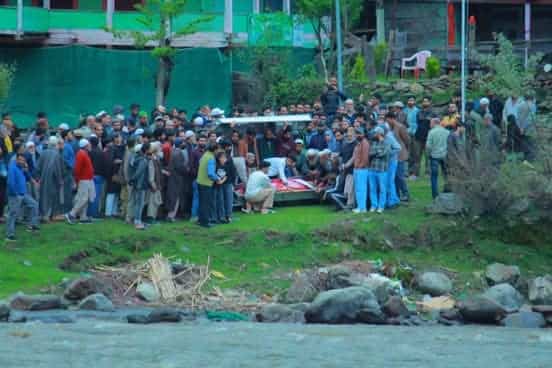

On a crisp Saturday afternoon in late April 2026, mourners gathered on both banks of the Kishanganga River — known as the Neelum across the border — in the remote Keran sector of north Kashmir. They had come not to celebrate, but to bid farewell to a man they could not touch.
Raja Liyaqat Ali Khan, a 50-year-old revenue official serving as Naib Tehsildar in Ganderbal district, had died of cardiac arrest after four days of treatment at Srinagar’s Sher-i-Kashmir Institute of Medical Sciences. His body was brought home to Keran, a village split in two by one of the world’s most heavily militarised boundaries: the 740-kilometre Line of Control (LoC) that divides Kashmir between India and Pakistan.
What unfolded next was not merely a funeral. It was a stark, visceral reminder of how political borders sever the most fundamental human bonds — and how, even in death, families remain prisoners of geography.
The Scene
As Khan’s coffin was carried to the river’s edge, relatives on the opposite bank — in Pakistan-administered Kashmir — stood just a few hundred yards away, close enough to see his face when mourners uncovered it for a final glimpse, yet too far to offer a shoulder, to whisper a prayer, or to place a kiss upon his forehead.
Shagufta Bano, Khan’s sister, who had migrated to Pakistan-administered Kashmir in 1990 and now lives in a refugee camp in Muzaffarabad, spoke through tears: “What kind of division is this? I could not even kiss my brother’s forehead, and he left this world.”
Her brother, Raja Nisar Khan, added: “My brother’s funeral procession was coming from across the river, and we stood on this side, crying and wailing. I could not give him a shoulder. I could not see his face one last time. We are tired of seeing this pain, this separation. The world must resolve this issue so that sons can meet fathers, daughters can embrace mothers, and sisters can reunite with brothers.”
The coffin was raised high on a traditional cot so those across the water could see. On the Pakistan-administered side, mourners gathered at the Dak Bungalow lawns, wailing as the funeral prayers were offered around 6 PM PST on the Indian-administered side — visible, audible, yet unreachable.
A Family Torn by History
Khan’s story is not unique in Keran. It is, tragically, representative of thousands of families along the LoC whose lives were permanently altered by the armed unrest that swept through Kashmir in the early 1990s.
When militancy erupted in 1990, Khan’s father, Raja Izhar Khan, along with one of his two wives and eleven children, migrated to Pakistan-administered Kashmir — like hundreds of other families fleeing the violence in border areas. Liyaqat and his mother remained behind. He was raised by his uncle, Raja Sharafat Khan, a retired additional deputy commissioner, completed his education, joined the revenue department, and built a life on the Indian-administered side.
Khan is survived by his wife and four children, the eldest currently pursuing a bachelor’s degree. Almost all his maternal and paternal relatives — including three brothers and two sisters from his mother, and six brothers from his father’s second marriage — now live across the LoC. His mother, uncle, and stepbrothers are among the few relatives who remain on the Indian-administered side.
The village of Keran, home to approximately 4,000 people, is a microcosm of this division. Nearly every family here has been split by the LoC. Wajahat Khan, a resident, told reporters that around 300 families migrated from Keran in 1990 and settled in Pakistan-administered Kashmir, leaving behind relatives who have not seen them in decades.
The Line of Control
The Line of Control is not merely a military boundary. It is, as Kashmiri commentators have described it, “an unhealed human wound” — a 740-kilometre scar that runs through homes, fields, ancestral graves, and kinship networks.
Unlike most international borders, the LoC was never intended to be permanent. It emerged from the 1949 ceasefire line following the first India-Pakistan war over Kashmir, and was redesignated as the Line of Control after the 1971 war and the Simla Agreement. For decades, there has been a lingering sense among Kashmiris that this line was never meant to solidify into a permanent division.
Keran occupies a particularly poignant position in this geography. The Kishanganga River, narrow enough in places to shout across, serves as the de facto border. For years after the 2003 ceasefire agreement between India and Pakistan, divided families would gather along these riverbanks to exchange news, wave to one another, shout across the waters, and even toss letters and small parcels tied to stones — a fragile, absurd, yet deeply human bridge across an imposed divide.
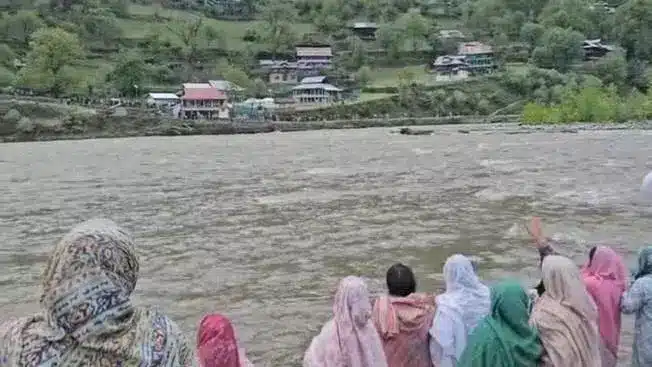
Raja Basharat, another of Khan’s brothers who now lives in Muzaffarabad, recalled those earlier years: “We would only sit by the river and look at each other. When we heard of our brother’s death, we immediately left for Keran. We knew we could not join the funeral, but we were desperate for one last glimpse.”
He added: “When the funeral was happening on the other side, our sisters were beating their heads against stones, crying. Our mother was crying on that side, but she could not embrace her sons… At the very least, there should be a right to be together after death.”
The Silence After 2019
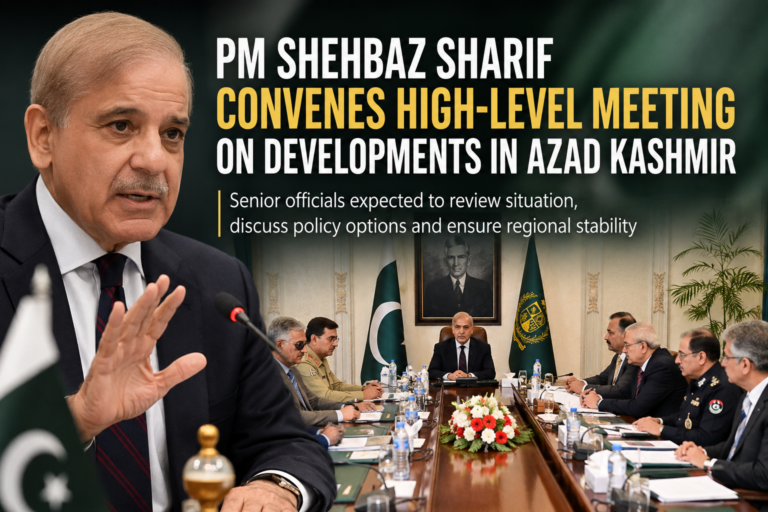
Those informal contacts have largely disappeared since August 2019, when India revoked Article 370 — which had granted special autonomous status to Jammu and Kashmir — and reorganised the region into two union territories. The move was accompanied by a security crackdown, communications blackouts, and a deepening chill in India-Pakistan relations.
The cross-LoC bus service, known as Karwaan-e-Aman, which began in 2005 as a rare humanitarian bridge, has been suspended. Cross-LoC trade, initiated in 2008 along routes including Uri–Muzaffarabad and Poonch–Rawalakot, was halted in 2019 over allegations of misuse for smuggling.
A 2021 study by the Bureau of Research on Industry and Economic Fundamentals (BRIEF) found that 4,229 families — including traders, truckers, labourers, and service providers — were severely affected by the trade suspension.
Today, even waving across the river is avoided. “You cannot imagine the level of fear that prevails there now. People avoid even waving hands, fearing they may later be questioned by security agencies,” said Raja Arif, a cousin of the deceased.
Muhammad Yasir, another relative, explained the bureaucratic impossibility of crossing: “There were some crossing points, but they required LoC permits. The process is extremely lengthy and complicated, involving extensive verification. When someone dies, you can wait a maximum of 24 hours — and obtaining a permit in that time is impossible.”

For years, families relied on letters tied to stones thrown across the river. Social media and WhatsApp have since provided a digital lifeline — but they cannot replace physical presence at life’s most consequential moments: births, marriages, illnesses, and deaths.
A Humanitarian Crisis in Plain Sight
The Keran funeral resonated far beyond the riverbank. On social media, the images triggered an outpouring of grief and reflection. Asif Maqbool, a resident of Kupwara, wrote on X: “The grieving family, separated by a few metres of border, saw their loved one’s coffin but could not see his face. In divided Jammu and Kashmir, not only families are divided — grief and last rites are divided too.”
Prime Minister of Pakistan-administered Kashmir, Faisal Mumtaz Rathore, described the incident as “yet another reminder of the humanitarian crisis that has afflicted Kashmiris since 1947,” adding that “this dividing line does not just cut through land; it separates families and deepens human suffering.”
Renowned Kashmiri analyst Naila Altaf Kayani echoed these sentiments: “The coffin was brought to the river not for a final embrace, but for a final glimpse. Some borders do not just divide land — they break hearts.”

A poster shared by a Muzaffarabad-based group captured the accumulated weight of decades: “It wasn’t just a dead body that arrived today; it was thirty-seven years of separation, helplessness, and silent screams standing at the ceasefire line.”
The Broader Context: A Region on Edge
The Keran funeral occurs against a backdrop of renewed tensions between India and Pakistan. In April 2025, the Pahalgam massacre — in which 26 tourists were killed in a terror attack in south Kashmir’s Baisaran Valley — triggered a military escalation. Operation Sindoor, launched by India on May 7, 2025, resulted in intense artillery exchanges along the LoC, killing at least 21 Indian civilians, including 12-year-old twins in Poonch, and injuring dozens more.
The aftermath saw India revoke visas for Pakistani nationals, including long-term spousal permits, leading to midnight raids and deportations of Pakistani-origin women who had lived in Kashmir for decades — some for 40 years or more.
The Indus Waters Treaty was put in abeyance by India; Pakistan threatened to suspend all bilateral agreements, including the Simla Agreement.
In this climate, the already limited mechanisms for cross-LoC humanitarian contact have been further eroded. What remains is a silence broken only by artillery fire, drone surveillance, and the occasional, unbearable spectacle of a family waving goodbye to a coffin they cannot touch.
The Unanswered Question
The Keran funeral raises a fundamental question that neither New Delhi nor Islamabad has adequately addressed: If the people on either side of the LoC are claimed as citizens — India continues to reserve 24 assembly seats for Pakistan-administered Kashmir, and has even proposed a Lok Sabha seat for the region — how can they be denied the most basic right to connect, communicate, and grieve together?
As one commentator noted: “How can a state claim political representation over a population while denying them the basic right to connect, communicate, and engage with the rest of the polity?”
For the families of Keran, this is not an abstract constitutional debate. It is the reality of watching a brother’s coffin from across a river, of mothers who cannot embrace their sons, of sisters who cannot kiss their brother’s forehead one final time.
The River Remains
Raja Liyaqat Ali Khan was laid to rest in his ancestral village graveyard, a few hundred yards from the river that had defined his family’s separation. His relatives on the other side watched until the funeral was over, until the body was taken for burial, until the last glimpse was exhausted.
The Kishanganga or Neelum River will continue to flow through Keran, as it has for millennia. The LoC will remain, as it has for nearly eight decades. And the families divided by both will continue to age, to marry, to die — and, when they can, to gather on opposite banks, shouting across the water, waving at silhouettes, throwing letters tied to stones, and, when fate is most cruel, watching coffins they cannot touch.
In an age of global connectivity, where video calls span continents in seconds, Kashmir remains a painful contradiction. The technology exists to bridge any distance — except the one that politics insists must remain.
As Raja Basharat put it: “This is not the Line of Control. It is a dagger that has been plunged into our hearts for decades.”