
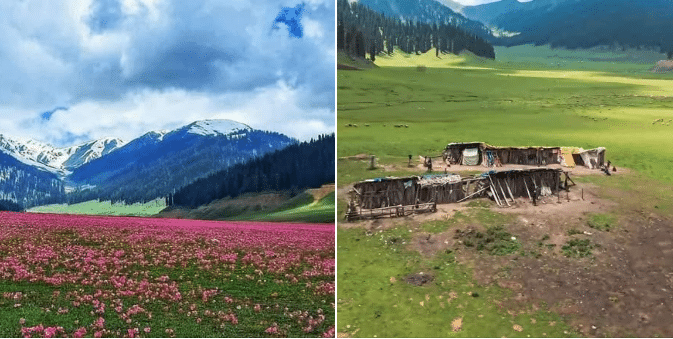

Deep within the frontier folds of North Kashmir, where the Himalayas rise to meet the Line of Control, lies a valley so vast, so pristine, and so fiercely protected by geography that it has remained largely invisible to the world. Bangus Valley locally known as Bungus is not merely a destination.
It is a reminder of what Kashmir looked like before tourism, before concrete, before the world discovered Gulmarg and Pahalgam. For The Azadi Times, telling this story is not about promoting a travel package. It is about reclaiming a narrative one that begins not with conflict, but with the land itself.
Bangus Valley Shaped by Geography and Silence
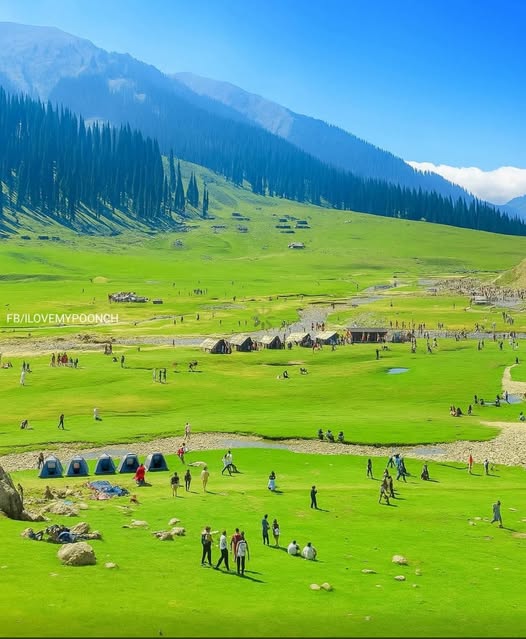
Bangus Valley sits at an altitude of approximately 10,000 feet above sea level, nestled within the Handwara sub-district of Kupwara in Indian-administered Kashmir. Spread across an estimated 300 square kilometres, the valley is a linear elliptical bowl aligned along an east-west axis, surrounded by the Rajwar and Mawar ranges to the east, the Shamasbury and Dajlungun Mountains to the west, and the Chowkibal and Karnah Guli to the north. It is divided into two principal meadows: Bodh Bangus, the larger valley, and Lokut Bangus, a smaller sister valley on the north-eastern side.
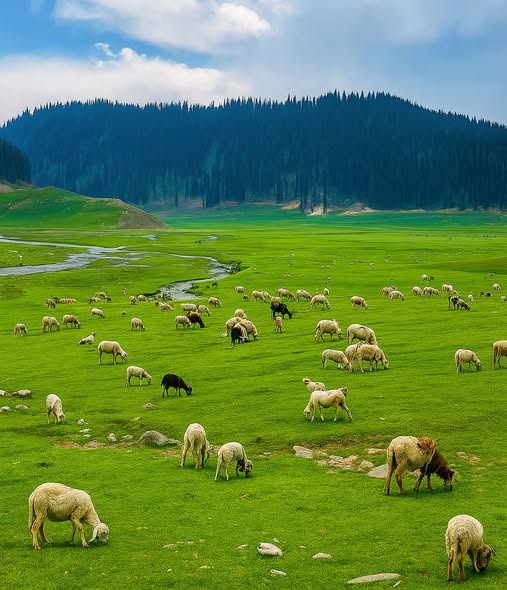
What makes Bangus extraordinary is not just its scale, but its ecological character. The valley is a rare combination of mountain biome, grassland, and Taiga — a coniferous forest belt that transitions into wild alpine meadows.
Streams cut through the valley floor, fed by snowmelt from peaks that rise to 4,500 metres, and the meadows themselves are carpeted with wildflowers in summer — buttercup, iris, gentian, and primula among them. There are over a hundred meadows within the greater Bangus area, and the valley is roughly 25 kilometres long and 5 kilometres wide.


But the most striking feature of Bangus Valley is its emptiness. Approximately 100 to 200 tourists visit the valley each year. By comparison, Gulmarg receives over a million. Bangus is statistically invisible in Kashmir’s tourism data, and that invisibility is not accidental. It is the product of geography, military reality, and bureaucratic friction — the very forces that have kept development at zero.
Distance from Srinagar: How Far, How Long, and Why It Matters
The most common question from travellers is simple: how far is Bangus Valley from Srinagar? The answer depends on which source you consult, and that variance itself tells a story. Official estimates range from 72 kilometres to 150 kilometres, with most credible travel guides settling on approximately 90 to 128 kilometres.
The discrepancy arises from the fact that there is no single paved highway leading directly to Bangus. The valley is approached through a network of rural roads, army checkpoints, and forest tracks that shift with weather and security conditions.


The most practical route for travellers is via Srinagar → Baramulla → Kupwara → Bangus Valley. Srinagar to Kupwara is approximately 95 kilometres and takes about three hours on a decent highway. From Kupwara, the remaining 50 kilometres to Bangus Valley takes another three to four hours on a road that ranges from broken tarmac to dirt track to what one guide bluntly describes as “is this actually a road?”. A 4×4 SUV is not optional — it is mandatory.
There are three principal access routes: one via Mawer in Handwara, one via Rajwar in Handwara, and one via Chowkibal in Kupwara. The Kupwara-Chowkibal route is considered the most scenic, connecting through Drangyari and the T-Pee Post. Hiring a local driver in Kupwara who knows the route is strongly recommended; expect to pay between ₹3,000 and ₹5,000 for a day trip.
The nearest airport is Sheikh ul-Alam International Airport in Srinagar, approximately 90 kilometres from Kupwara. The nearest railhead is at Baramulla, 64 kilometres from Kupwara. No shared taxis run this route, so private transport is essential.
The Permit: A Frontier Valley’s Bureaucratic Gate
Bangus Valley is not a place you simply decide to visit. It sits near the Line of Control with Pakistan, and access is regulated by the Indian military and district administration. Indian tourists require a special permit issued by the Deputy Commissioner’s office in Kupwara. The process is straightforward but non-negotiable: visit the DC office with ID proof (Aadhaar or passport), fill out a permit application stating your dates and group size, and wait for processing — which can take anywhere from the same day to two days, depending on the security situation and office workload. The permit specifies your travel dates and cannot be extended on the spot.
For foreign nationals, the situation is more complex. As of recent years, foreign tourists have been restricted from the area due to its proximity to the LoC. This may change, but travellers should verify current regulations with the J&K tourism office before planning. The Kupwara administration has also introduced an online e-pass system at epass.kupwara.co.in for certain categories of visitors.
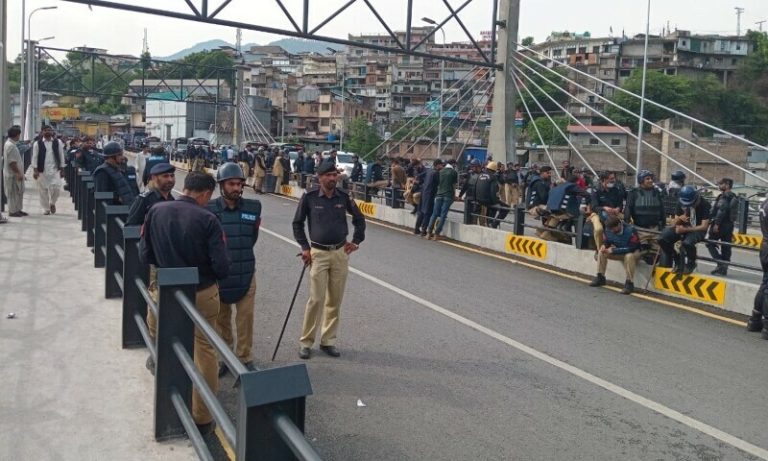
Expect two to three army checkpoints between Kupwara and Bangus Valley. At each checkpoint, you will be required to show your permit and ID. This is not a formality to be resented. It is part of the valley’s reality — a reality that The Azadi Times exists to document without sensationalism, and without erasing the human beings who live within it.
The Gujjar and Bakarwal: Custodians of the Meadow
Long before permits and checkpoints, Bangus Valley was — and remains — the summer pasture of the Gujjar and Bakarwal nomadic communities. These pastoralists have grazed their flocks in the meadows of Bangus for centuries, migrating seasonally between the warmer plains of Jammu in winter and the high pastures of Kashmir in summer. The Bakerwal, who are landless nomadic pastoralists, oscillate cyclically with their livestock and household goods between these two worlds, setting up makeshift tents known as khotas in the core zone of the valley.
Their presence is not a tourist attraction. It is a way of life that predates the modern state by generations. The Gujjar and Bakarwal communities in Jammu and Kashmir number more than 1.5 million, with approximately 500,000 being nomadic. In Bangus, they are the valley’s true custodians — the people who know its streams, its grazing patterns, and its moods. Any responsible visit to Bangus must begin with respect for their presence and their rights.
When to Go: The Wildflower Window
Bangus Valley is accessible only from late June to early September. July is peak wildflower season, when the valley floor is carpeted in colours that would make a Mughal garden jealous. Daytime temperatures range from 15 to 22 degrees Celsius, while nights drop to 5 to 8 degrees. June may still have lingering snow on higher sections, and September offers cooler days, fewer flowers, but stunning autumn light.
From November to May, snow closes the road and buries the valley under two to four metres of white. Access is impossible. October is a closing window — possible but unpredictable.
What to Do: Camping, Stargazing, and Walking the Meadow Circuit
There are no hotels, no restaurants, no shops, and no marked trails in Bangus Valley. Accommodation is camping only. The only way to properly experience the valley is to pitch a tent near a stream, cook over a portable stove, and watch the sky.
The night sky at 3,000 metres with zero light pollution is extraordinary. The Milky Way is not a metaphor here — it is a physical presence. For photographers, the golden hours at sunrise and sunset are unmatched, and the alpine flowers are best captured in mid-morning light.
The full Greater Bangus meadow circuit is a 10 to 15 kilometre walk, depending on the route. The valley rewards slow exploration: walking through Bodh Bangus and Lokut Bangus, following shepherd trails, and sitting with the silence that only high meadows can offer.
A Valley at the Edge of Two Worlds
Bangus Valley exists in a paradox. It is one of the most beautiful places in Kashmir, yet almost no one goes there. It is administered by Indian authorities in Kupwara, yet its meadows have been the seasonal home of Gujjar and Bakarwal herders for centuries. It is a tourist destination on paper, yet it has no infrastructure, no hotels, and no commercial tourism economy. The J&K government has spoken of developing Bangus as an off-beat tourism destination, with proposals for land identification and forest clearances, but as of now, the valley remains untouched by the development that has transformed other parts of Kashmir.
For The Azadi Times, Bangus Valley is more than a travel story. It is a story about what Kashmir is when you strip away the labels — Indian-administered, Pakistan-administered, disputed, militarised. It is a story about a meadow that does not care about borders, a stream that flows regardless of checkpoints, and a community of herders who have survived every empire that has claimed this land.
If you go to Bangus, go with humility. Go with the understanding that you are a guest in a place that belongs first to the Gujjar and Bakarwal, second to the wildflowers and the streams, and only third to the permit that allows you to enter. Go with a local guide, carry your waste out, and leave the meadow as you found it — wild, silent, and free.