Monday, March 30, 2026
15.1 C
Srinagar
Home Blog Page 128

Kashmir in Winter: The Ultimate Guide Best Time to Visit Kashmir for Snowfall and Winter Activities

Kashmir, often referred to as “Paradise on Earth,” is a destination that enchants visitors with its timeless beauty. While its lush green meadows, pristine rivers, and blossoming gardens are stunning in summer, the winter season offers something truly extraordinary a snow-covered wonderland that feels like stepping into a fairytale. For snow enthusiasts alike who wants to visit Kashmir for snowfall adventure, witnessing Kashmir blanketed in snow is an unforgettable experience. The sight of fresh snowfall, the serene silence of snow-covered mountains, and the crisp chill in the air create a surreal atmosphere that captivates the heart.

But when is the best time to visit Kashmir for snowfall? Timing your trip right is crucial to ensure you don’t miss out on the region’s snowy glory. In this article, we’ll explore the ideal months for snowfall, the top destinations to visit, and the unique experiences you can enjoy during this season. Get ready to plan your perfect winter escape to one of the most beautiful destinations in the world!

Why Winter Kashmir Visit is Special

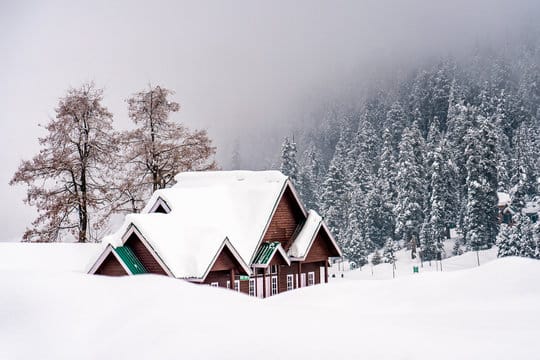
Winter in Kashmir, which spans from December to February, transforms the valley into a mesmerizing spectacle. The beauty of the region is amplified by the blanket of snow that covers every corner, from the towering Himalayan peaks to the quaint villages nestled in the valleys. Skiing in Gulmarg, riding a shikara on a frozen Dal Lake, or simply building a snowman with your loved ones these experiences are what make winter in Kashmir unforgettable.

Snowfall in Kashmir isn’t just a visual treat; it’s also an invitation to explore a wide range of winter activities. Adventure seekers can hit the slopes in Gulmarg, one of Asia’s premier ski destinations, while nature lovers can enjoy serene walks through snow-covered forests in Pahalgam. For those looking for relaxation, cozying up in a houseboat on a frosty morning or sipping hot Kahwa tea against a snowy backdrop is pure bliss.

Winter Season in Kashmir
The winter months in Kashmir typically span from November to March, with snowfall being the highlight. The region experiences cold temperatures, often dipping below freezing, and snow starts to fall in the higher altitudes of the Himalayas. Lower altitudes like Srinagar begin to see snowfall around mid-December, making this the most sought-after time for snow lovers.

Best Time to Visit Kashmir for Snowfall

November
While November marks the beginning of the winter season in Kashmir, it’s not the best month to experience heavy snowfall. However, the first signs of snow can appear, especially in the higher mountain ranges like Gulmarg and Sonamarg. If you’re looking to avoid crowds but still want a hint of snow, November might be the ideal time.

December
December is the start of the peak winter season in Kashmir. By this time, the weather has turned quite cold, and snowfall starts in earnest. Srinagar, Pahalgam, and Gulmarg begin to see substantial snow accumulation, with resorts and hill stations becoming a winter wonderland. This month offers the chance to see the region covered in a blanket of snow without the extreme cold of January.

January
For many, January is the best time to visit Kashmir for snowfall. The region experiences heavy snowfalls, especially in places like Gulmarg, which is a popular destination for skiing. The weather is at its coldest, and the picturesque snowfall creates a surreal atmosphere, with iconic spots like Dal Lake turning into a frozen expanse. However, travelers should be prepared for freezing temperatures, and it’s advisable to pack accordingly.

February
February is a great time for winter sports enthusiasts. The heavy snowfall continues, and temperatures remain low, making it the ideal time for activities like skiing and snowboarding, particularly in Gulmarg. The snowfall also provides excellent photo opportunities, as the entire region is covered in thick layers of snow. February is often considered the peak of winter tourism in Kashmir.

March
March marks the end of the peak winter season, with the snow beginning to melt. While you might still witness snowfall in the higher altitudes, the lower altitudes, including Srinagar, will begin to see the onset of spring. March offers a quieter, more relaxed atmosphere compared to the busy peak months of January and February.

Best Time and Places to Visit in Kashmir for Snowfall

MonthWeatherTop Places for SnowfallActivities/Highlights
Late DecemberCold, Snow Begins (-2°C to 5°C)Gulmarg, Pahalgam, SonamargWitness the first snowfall, scenic views, snow play, and photography.
JanuaryPeak Snowfall (-5°C to 3°C)Gulmarg, Pahalgam, SrinagarSkiing, snowboarding in Gulmarg, frozen Dal Lake, and houseboat stays.
Early FebruaryHeavy Snow (-4°C to 6°C)Gulmarg, Sonamarg, PahalgamSnow trekking, sledding, and enjoying snow-covered landscapes.
Late FebruaryMild Snow (-2°C to 8°C)Gulmarg, Sonamarg (higher altitudes)Last snowfall of the season, serene views, and fewer crowds.


Best Places to Experience Snowfall in Kashmir

Gulmarg
Often called the “Meadow of Flowers” in summer, Gulmarg transforms into a white paradise during the winter. Known for its ski resorts, Gulmarg attracts tourists from all over the world who come for winter sports. The snowfall in Gulmarg can be heavy, especially in January and February. It’s an ideal place for those who enjoy skiing, snowboarding, and other snow-related activities.

Srinagar
The capital city of Jammu & Kashmir, Srinagar, is famous for its frozen Dal Lake and the iconic houseboats. Snowfall in Srinagar is generally lighter compared to Gulmarg, but the city’s beauty in winter is unparalleled. Srinagar also offers cultural experiences, including visits to Mughal gardens, the Shankaracharya Temple, and the bustling markets.

Sonamarg
Located in the northeast of Srinagar, Sonamarg is known for its rugged terrain and snow-capped peaks. This less-visited gem offers spectacular views and snowfall, particularly in January and February. It’s perfect for tourists who seek peace and solitude away from the more crowded destinations.

Pahalgam
A popular trekking and pilgrimage destination, Pahalgam offers a unique winter experience. The picturesque town is blanketed with snow, and the surrounding pine forests create a magical setting. Pahalgam is also an excellent base for those interested in exploring nearby valleys and mountains.

Betaab Valley
Named after the Bollywood movie “Betaab,” this valley is a stunning sight when covered in snow. Located near Pahalgam, it offers great photographic opportunities, with snow-covered peaks and lush landscapes.

Unique Winter Experiences in Kashmir

Winter in Kashmir offers a treasure trove of unforgettable experiences that blend adventure, tranquility, and cultural richness. One of the highlights is skiing and snowboarding in Gulmarg, a world-renowned destination with powdery slopes and breathtaking views of the Himalayas. For those less inclined toward adventure, a stroll across the partially frozen Dal Lake is nothing short of magical, with snow-covered houseboats and the stillness of icy waters providing a serene backdrop.
Another must-try experience is savoring warm Kashmiri cuisine, such as Rogan Josh, Harissa, and the fragrant saffron-infused Kahwa tea, which is especially comforting in the chilly weather. Snow trekking through the pristine landscapes of Pahalgam or capturing the picturesque beauty of Sonamarg draped in snow is a treat for photographers and nature lovers.

Even simple pleasures like playing in the snow, building snowmen, or cozying up in a traditional Kashmiri houseboat add to the charm of winter in Kashmir.

Best winter activities in Jammu and Kashmir

Here’s a table outlining some of the best winter activities in Jammu and Kashmir:

ActivityDescriptionLocation
SkiingExperience thrilling descents on snowy slopes.Gulmarg
SnowboardingEnjoy riding down the slopes on a snowboard.Gulmarg
SleddingFun for all ages, using sleds to slide down snowy hills.Pahalgam
Ice SkatingGlide across frozen lakes for a unique experience.Dal Lake
Snow TrekkingExplore snow-covered landscapes on guided treks.Sonamarg
Winter PhotographyCapture stunning winter landscapes and snow-laden trees.Various locations
Traditional CuisineEnjoy local winter delicacies like Rogan Josh and Yakhni.Srinagar
Visit Snow FestivalsExperience local culture and festivities during winter fairs.Various locations


Why Chose the Best Time to Visit Kashmir for Snowfall

Choosing the best time to visit Kashmir for snowfall ensures you experience the region at its magical best. Visiting during the peak snowfall season, typically from late December to early February, allows you to witness the enchanting transformation of the valley into a winter wonderland. The pristine white landscapes, snow-laden trees, and frozen lakes create an atmosphere straight out of a fairytale.

Proper timing also guarantees that you can enjoy thrilling winter activities like skiing, snowboarding, and sledding in Gulmarg, as well as peaceful snow treks in Pahalgam. Planning your visit during this period ensures access to all major destinations, as roads and attractions remain open despite the snow.

Most importantly, it lets you experience the true charm of Kashmir in winter, from cozying up in traditional houseboats to sipping warm Kahwa tea amidst snow-capped mountains. By choosing the right time, you ensure your trip is both memorable and filled with breathtaking experiences.

Essential Travel Tips for Visiting Kashmir in Winter

Clothing and Gear
Kashmir’s winter temperatures can be extremely cold, so packing appropriate clothing is essential. Ensure you bring thermal wear, insulated jackets, waterproof shoes, and gloves. If you plan to indulge in winter sports, make sure to rent or purchase skiing gear from local rental shops.

Travel Insurance
It’s wise to purchase travel insurance that covers winter sports and potential disruptions due to heavy snowfall or other weather-related issues. Road closures or delays due to snow can sometimes affect travel plans.

Book in Advance
Due to the popularity of the winter season, it’s advisable to book your accommodation and tours in advance. Hotels, resorts, and houseboats in Srinagar and Gulmarg can get fully booked quickly, especially during the peak months of January and February.

Local Cuisine
No trip to Kashmir is complete without sampling its rich and flavorful cuisine. Warm dishes like “Kahwa” (a traditional green tea) and “Gushtaba” (meatballs in gravy) are perfect for the chilly weather. Make sure to explore the local restaurants and enjoy the region’s famous delicacies.

FAQs About Visiting Kashmir in Winter

  1. What is the best time to visit Kashmir for snowfall?
    • The best time to experience snowfall in Kashmir is from late December to early February, with January typically offering the heaviest snowfall.
  2. What activities can I enjoy in Kashmir during winter?
    • Popular winter activities include skiing, snowboarding, sledding, ice skating, snow trekking, and enjoying local cuisine.
  3. Is it safe to visit Kashmir in winter?
    • Yes, Kashmir is generally safe for tourists during winter, but it’s important to stay updated on weather conditions and travel advisories.
  4. What should I pack for a winter trip to Kashmir?
    • Pack thermal wear, insulated jackets, waterproof shoes, gloves, and any necessary winter sports gear.
  5. How cold does it get in Kashmir during winter?
    • Temperatures can drop below freezing, especially in January, with average lows ranging from -5°C to 3°C.
  6. Are houseboats available in Srinagar during winter?
    • Yes, many houseboats remain operational in winter, providing a cozy and unique accommodation experience.
  7. What are the top places in Kashmir for snowfall?
    • Key locations for experiencing snowfall include Gulmarg, Pahalgam, Srinagar, and Sonamarg.
  8. Can I enjoy traditional Kashmiri cuisine in winter?
    • Absolutely! Winter is a great time to savor warm dishes like Rogan Josh, Harissa, and Kahwa tea.
  9. Are there any winter festivals in Kashmir?
    • Yes, various winter festivals showcase local culture, crafts, and activities, providing a festive atmosphere for visitors.
  10. What travel insurance should I consider for a winter trip to Kashmir?
    • Look for insurance that covers winter sports and weather-related disruptions, such as road closures due to snow.

Conclusion: When to Visit Kashmir for Snowfall

The best time to visit Kashmir for snowfall depends on what kind of experience you’re looking for. If you want to witness the region in its full winter glory, with heavy snow and a festive atmosphere, then January and February are ideal.

However, if you prefer a quieter experience with light snowfall, December and March are excellent options. No matter when you visit, Kashmir’s winter wonderland will leave you with memories to cherish forever.

Complete Lists of Jammu and Kashmir Chief Ministers & Prime Ministers | A Historical Overview

    0

    In India-administered Jammu and Kashmir, the political and constitutional framework underwent a pivotal change in 1965 when the position of Prime Minister was abolished. This post was replaced with the Chief Minister (CM), aligning Jammu and Kashmir with the governance structure followed in other Indian states. The change symbolized a deeper integration of the region into the Indian Union under the Government of India.

    On the other hand, Pakistan-administered Azad Kashmir continues to retain the position of Prime Minister. However, Pakistan made a notable move in 2009 by separating Gilgit-Baltistan from Azad Kashmir and granting it semi-autonomous provincial status, introducing its own governance structure.

    Over the years, the region of Jammu and Kashmir has seen diverse political leadership, with several influential leaders taking on the role of Chief Minister (CM). These leaders have played critical roles in shaping the political, social, and economic framework of the state. In this article, we present a comprehensive list of Jammu and Kashmir Chief Ministers, offering insights into their tenures and contributions to the governance of this historically significant region.

    Historical Evolution of the Chief Minister’s Post

    The position of Chief Minister in Jammu and Kashmir was officially introduced on 30 March 1965, when Ghulam Mohammed Sadiq became the first Chief Minister. Before this transition, the region was governed by a Prime Minister, a unique title reflecting Jammu and Kashmir’s semi-autonomous status under Article 370.

    The constitutional amendments in 1965 replaced the post of Prime Minister with Chief Minister, aligning it with the governance model followed in Indian states. Since then, several leaders from different political parties, including the Jammu and Kashmir National Conference (JKNC), Indian National Congress (INC), and People’s Democratic Party (PDP), have taken on the role.

    Comprehensive List of Jammu and Kashmir Chief Ministers

    Here’s a detailed list of all the Chief Ministers of Jammu and Kashmir, along with their tenures and political affiliations:

    NameTenurePolitical Party
    Ghulam Mohammed Sadiq30 March 1965 – 12 December 1971Indian National Congress
    Syed Mir Qasim12 December 1971 – 25 February 1975Indian National Congress
    Sheikh Abdullah25 February 1975 – 8 September 1982Jammu and Kashmir National Conference
    Farooq Abdullah8 September 1982 – 2 July 1984Jammu and Kashmir National Conference
    Ghulam Mohammad Shah2 July 1984 – 6 March 1986Jammu and Kashmir Awami National Conference
    Farooq Abdullah7 November 1986 – 19 January 1990Jammu and Kashmir National Conference
    President’s Rule19 January 1990 – 9 October 1996N/A
    Farooq Abdullah9 October 1996 – 18 October 2002Jammu and Kashmir National Conference
    Mufti Mohammad Sayeed2 November 2002 – 2 November 2005Jammu and Kashmir Peoples Democratic Party
    Ghulam Nabi Azad2 November 2005 – 11 July 2008Indian National Congress
    President’s Rule11 July 2008 – 5 January 2009N/A
    Omar Abdullah5 January 2009 – 1 March 2015Jammu and Kashmir National Conference
    Mufti Mohammad Sayeed1 March 2015 – 7 January 2016Jammu and Kashmir Peoples Democratic Party
    Mehbooba Mufti4 April 2016 – 19 June 2018Jammu and Kashmir Peoples Democratic Party
    President’s Rule19 June 2018 – 31 October 2019N/A
    Lieutenant Governor’s Rule31 October 2019 – 16 October 2024N/A
    Omar Abdullah16 October 2024 – PresentJammu and Kashmir National Conference

    Prime Minister Post in Jammu and Kashmir

    The position of Prime Minister in Jammu and Kashmir existed from 1948 to 1965, during the period when the state enjoyed special autonomy under Article 370 of the Indian Constitution. The Prime Minister served as the head of the government in Jammu and Kashmir, while the ceremonial head of state was referred to as the “Sadr-e-Riyasat” (President of the State).

    This unique arrangement changed in 1965 when constitutional amendments brought Jammu and Kashmir in line with the rest of India. The titles of Prime Minister and Sadr-e-Riyasat were replaced with Chief Minister and Governor, respectively. These changes were implemented under the leadership of Ghulam Mohammed Sadiq, who became the first Chief Minister after serving as the last Prime Minister.

    List of Prime Ministers of Jammu and Kashmir

    NameTenurePolitical Party
    Mehr Chand Mahajan15 October 1947 – 5 March 1948Independent
    Sheikh Abdullah5 March 1948 – 9 August 1953Jammu and Kashmir National Conference
    Bakshi Ghulam Mohammad9 August 1953 – 12 October 1963Jammu and Kashmir National Conference
    Khwaja Shamsuddin12 October 1963 – 29 February 1964Jammu and Kashmir National Conference
    Ghulam Mohammed Sadiq29 February 1964 – 30 March 1965Indian National Congress


    Why Is the CM List Important for Jammu and Kashmir?

    Understanding the list of Chief Ministers and their tenures is crucial in analyzing the region’s political landscape. Each leader left an imprint on the state, whether in the form of political reform, the management of regional conflicts, or efforts toward improving the economy and infrastructure. The political shifts, alliances, and leadership changes in Jammu and Kashmir have played an important role in shaping the state’s identity and future trajectory.

    Political Changes and Current Status

    In 2019, the special status of Jammu and Kashmir under Article 370 was revoked, leading to its reorganization into two separate Union Territories—Jammu and Kashmir and Ladakh. This move abolished the legislative assembly temporarily, and the governance was placed under a Lieutenant Governor’s administration.

    However, in 2024, elections were held, restoring the legislative assembly in Jammu and Kashmir. Omar Abdullah of the Jammu and Kashmir National Conference (JKNC) assumed office as the Chief Minister on 16 October 2024, marking the revival of democratic governance in the region.

    The complex nature of Jammu and Kashmir’s politics, shaped by factors such as nationalism, separatism, autonomy, and socio-economic development, has made it one of the most politically sensitive regions in South Asia.

    The list of Jammu and Kashmir CM names provides not only a historical record of leadership but also a lens through which we can understand the broader political struggles and aspirations of the Kashmiri people.

    From the initial years after integration to the current governance system under the Union Territory status, the evolution of political leadership in Jammu and Kashmir reflects the region’s resilience, diversity, and aspirations. By understanding the tenure of these leaders, we gain a deeper understanding of the region’s ongoing transformation.

    Why Should We Know About Jammu Kashmir CM and PM?

    Understanding the Jammu Kashmir CM List and Kashmir Prime Minister List is crucial for several reasons, especially when considering the region’s unique political and historical context. Here’s why it’s important to learn about these figures and positions:

    1. Historical Significance

    • The role of the Prime Minister of Jammu Kashmir in the early years of the region’s history was pivotal in shaping the autonomy of Jammu and Kashmir. The political leaders who held the position played a significant part in the region’s integration with India after partition. Knowing about them helps us understand the origins of Jammu and Kashmir’s political identity.

    2. Impact on Regional Politics

    • The Chief Ministers of Jammu and Kashmir have played a crucial role in the state’s political landscape. From Sheikh Abdullah’s leadership in the early years to the Mufti Mohammad Sayeed and Mehbooba Mufti era, each leader brought a unique vision for the development and governance of the region. Understanding the political evolution of these leaders helps us appreciate the region’s complex political narrative.

    3. Constitutional Changes and Reforms

    • The shift from the Prime Minister to Chief Minister in 1965 marked a significant constitutional change. Knowing this shift provides insight into how Jammu and Kashmir’s governance evolved over time and how it adapted to India’s political system. This transition helps us understand the broader national and international implications of political decisions in the region.

    4. Understanding the Reorganization of Jammu and Kashmir

    • The revocation of Article 370 in August 2019 marked a significant turning point for Jammu and Kashmir, leading to the dissolution of the Chief Minister’s office. By knowing the previous CMs and PMs, we gain a better understanding of the major changes that followed the reorganization of the state and the current status of Jammu and Kashmir as a Union Territory.

    5. Preserving the Region’s Political Legacy

    • Learning about the leaders who held these positions allows us to preserve and reflect on the region’s political heritage. Whether one agrees with the policies and actions of these leaders or not, it is important to recognize their contributions and the challenges they faced. It also helps us in evaluating the future trajectory of the region’s political development.

    6. Informed Discussions on Kashmir’s Future

    • For anyone discussing the future of Jammu and Kashmir, whether in the context of autonomy, governance, or constitutional rights, having knowledge of the Jammu Kashmir CM List and the Kashmir Prime Minister List is essential. It provides a foundation for understanding how governance has been shaped by past leaders and how it continues to impact the region’s political discourse.

    7. Cultural and Political Awareness

    • The political leaders of Jammu and Kashmir have not only influenced the region’s politics but also its cultural landscape. Their decisions impacted everything from local traditions and education to development and security. By learning about these figures, we gain a deeper understanding of how political decisions can shape both a state’s culture and its people.

    Frequently Asked Questions (FAQs) about Jammu Kashmir CM and Prime Minister 

    1. What is the Jammu Kashmir CM List?

    • The Jammu Kashmir CM List refers to the list of individuals who have held the position of Chief Minister in the region of Jammu and Kashmir. The Chief Minister is the head of the government and is responsible for the administration of the region.

    2. Who are the past Chief Ministers of Jammu and Kashmir?

    • The Jammu Kashmir CM List includes notable figures such as Sheikh Abdullah, Farooq Abdullah, Ghulam Mohammad Sadiq, and others who have served as the Chief Ministers in the region over the years. The most recent CM was Mehbooba Mufti, who served as the first woman CM of Jammu and Kashmir before the state’s special status was revoked in 2019.

    3. What is the Kashmir Prime Minister List?

    • The Kashmir Prime Minister List includes the individuals who have held the position of Prime Minister of Jammu and Kashmir during its time as a princely state before the Indian Constitution was fully implemented there. Notably, the Prime Minister position was later replaced by the position of Chief Minister.

    4. Who was the first Prime Minister of Jammu Kashmir?

    • The first Prime Minister of Jammu Kashmir was Mehr Chand Mahajan. He served as the Prime Minister from 1947 until 1965, when the position was abolished and replaced with the Chief Minister title.

    5. How did the position of Prime Minister in Kashmir change?

    • The position of Prime Minister of Jammu and Kashmir was abolished after the adoption of the 1965 Jammu and Kashmir Constitution, where the title of Chief Minister was introduced to replace the Prime Minister.

    6. How many Chief Ministers have served in Jammu Kashmir?

    • Over the years, several individuals have held the post of Chief Minister of Jammu and Kashmir. Notable CMs include Sheikh Abdullah, Farooq Abdullah, Ghulam Mohammad Sadiq, Mufti Mohammad Sayeed, and Mehbooba Mufti.

    7. What happened after the revocation of Article 370?

    • After the revocation of Article 370 in August 2019, Jammu and Kashmir was reorganized into two Union Territories (Jammu & Kashmir, and Ladakh). The position of Chief Minister no longer exists in Jammu and Kashmir as it is now governed directly by a Lieutenant Governor appointed by the President of India.

    8. What is the significance of the Kashmir CM and PM lists?

    • The Kashmir CM List and Kashmir Prime Minister List hold historical and political significance as they reflect the governance system before and after the integration of Jammu and Kashmir into India, along with the subsequent changes in the region’s political structure.

    9. Is the Chief Minister of Jammu and Kashmir position currently vacant?

    • Since the revocation of Article 370, the position of Chief Minister of Jammu and Kashmir is effectively non-existent, with governance now being handled by a Lieutenant Governor appointed by the central government.

    The Ultimate List of Districts Across Jammu & Kashmir, Gilgit-Baltistan, AJK & Ladakh

    0

    Jammu and Kashmir is divided into a number of districts that highlight its diverse geography, demographics, and administrative importance. Understanding the districts of Jammu and Kashmir is crucial for anyone seeking to explore the region’s administrative setup, tourism potential, or cultural diversity. However, the complexity deepens when we consider the region’s unique political and geographical challenges.

    Currently, Jammu and Kashmir is divided between three countries: India, Pakistan, and China. The United Nations has called for a plebiscite to allow Kashmiris the right to determine their future. This has made the region a contentious territory, with multiple countries asserting claims over different parts of it.

    Due to this geopolitical dispute, it becomes challenging to understand the history, geography, and administrative divisions of the region. Jammu and Kashmir’s districts are spread across different territories, including Gilgit-Baltistan, Ladakh, Jammu, and Kashmir Valley, with varying numbers and boundaries in each area.

    For students preparing for competitive exams, historians, or geography enthusiasts, the lack of clarity around the exact number of districts often creates confusion. In this article, we aim to provide a comprehensive breakdown of the districts in all regions of Jammu and Kashmir, offering a clear and factual understanding of its administrative divisions.

    How Many Districts Are There in Jammu and Kashmir?

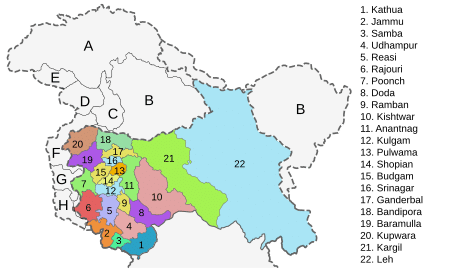
    The state of Jammu and Kashmir, now divided into three regions, consists of a total of 51 districts. These districts are distributed among three countries: India, Pakistan, and China. The divisions are further categorized into Jammu Division and Kashmir Division within India, while the regions of Gilgit-Baltistan and Azad Kashmir fall under Pakistan, and Ladakh is also a region under Indian administration.

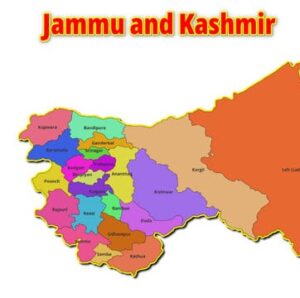
    Map of Jammu Kashmir Districts
    Map of Jammu Kashmir Districts
    • Jammu comprises 10 districts.
    • Kashmir also comprises 10 districts.
    • Ladakh comprises 7 districts (5 New).
    • Azad Kashmir comprises 10 districts.
    • Gilgit Baltistan comprises 14 districts.

    Jammu Region Districts

    The Jammu region, often referred to as the “City of Temples” due to its countless ancient shrines and religious landmarks, is a significant part of the Union Territory of Jammu and Kashmir. Nestled in the foothills of the Himalayas, this region serves as the winter capital of the territory and boasts a unique blend of cultural, historical, and natural attractions.

    Geographically diverse, Jammu is characterized by its fertile plains, scenic valleys, and hilly terrains that merge into the majestic Pir Panjal Range. The region is also home to some of India’s most revered pilgrimage sites, such as the Vaishno Devi Shrine and the Raghunath Temple, drawing millions of devotees every year.

    Historically, Jammu has played a pivotal role in the political and cultural development of the region. It has been the seat of the Dogra dynasty, whose influence is evident in the region’s art, architecture, and traditions. Today, Jammu continues to serve as a critical economic and cultural hub, connecting the northern plains of India to the Himalayan ranges.

    Administratively, the Jammu region comprises 10 districts, each with its own distinctive features and attractions.

    Below is the detailed list of districts in the Jammu region of Jammu & Kashmir, divided by their respective divisions:

    List of Districts in Jammu

    S. No.District NameKey Highlights
    1JammuWinter capital; cultural and economic hub
    2KathuaKnown for Jasrota Fort and heritage sites
    3SambaIndustrial district with historical significance
    4UdhampurHome to Patnitop and Vaishno Devi shrine
    5ReasiFamous for Shiv Khori and Bhimgarh Fort
    6PoonchScenic beauty and Mughal Road connection
    7RajouriLush valleys and historical landmarks
    8DodaKnown for adventure tourism and trekking
    9KishtwarKishtwar National Park and scenic beauty
    10RambanHome to the Chenab Bridge, a marvel of engineering

    Overview of Kashmir Region Districts

    The Kashmir region, often referred to as “Paradise on Earth”, is renowned for its breathtaking natural beauty, rich cultural heritage, and historical significance. Nestled in the lap of the Himalayas, the Kashmir Valley is surrounded by snow-capped mountains, lush green meadows, and pristine water bodies, making it one of the most picturesque regions in the world.

    Geographically, Kashmir is defined by its stunning landscapes, including the Dal Lake, Wular Lake, and the Mughal Gardens, which serve as iconic tourist attractions. Its temperate climate, with snowy winters and pleasant summers, further enhances its appeal.

    Culturally, the region is a melting pot of traditions, art, and crafts. From the intricate Pashmina shawls to the famous Kashmiri carpets, the valley is a treasure trove of handicrafts and artistry. Kashmiri cuisine, including dishes like Rogan Josh and Gushtaba, reflects the unique blend of influences the region has absorbed over centuries.

    Historically, the Kashmir region has been a center of learning, spirituality, and trade. Its history is deeply interwoven with the rise and fall of empires, from the Mughals to the Dogras. Today, it remains a symbol of resilience and cultural pride, despite its complex political situation.

    The Kashmir region is administratively divided into 10 districts, each with its own unique charm and significance.

    Below is the detailed list of districts in the Kashmir region of Jammu & Kashmir, divided by their respective divisions:

    List of Districts in the Kashmir Region

    S. No.District NameKey Highlights
    1SrinagarSummer capital; famous for Dal Lake and Mughal Gardens
    2AnantnagKnown for Pahalgam, Amarnath Yatra, and Lidder River
    3BaramullaGateway to the Kashmir Valley; scenic landscapes
    4PulwamaKnown for saffron fields and apple orchards
    5BudgamFamous for Doodhpathri and Yusmarg meadows
    6KupwaraBorder district with pristine valleys like Bangus
    7BandiporaHome to Wular Lake, Asia’s largest freshwater lake
    8GanderbalFamous for Sonamarg and Naranag Temple ruins
    9KulgamKnown for its natural springs and apple orchards
    10ShopianOften called the ‘Apple Bowl of Kashmir’ for its premium apple production


    Overview of Ladakh Region Districts

    The Ladakh region, often called the “Land of High Passes”, of Jammu Kashmir is a stunning high-altitude desert known for its surreal landscapes, rich cultural heritage, and strategic significance. Nestled between the Karakoram and Himalayan mountain ranges, Ladakh is one of the most remote and breathtaking region of Jammu Kashmir, attracting adventurers, nature enthusiasts, and spiritual seekers alike.

    Geographically, Ladakh is characterized by its rugged mountains, crystal-clear rivers, and unique terrain. Its stark beauty is highlighted by attractions like Pangong Lake, Nubra Valley, and Tso Moriri Lake, which have become iconic destinations for travelers. The region’s high-altitude passes, such as Khardung La, add to its allure for adventure lovers.

    Culturally, Ladakh is a vibrant blend of Tibetan Buddhism and local traditions, reflected in its monasteries, festivals, and lifestyle. Monasteries such as Hemis, Thiksey, and Diskit are not only places of worship but also architectural marvels that preserve the spiritual and artistic heritage of the region. The people of Ladakh, known for their warm hospitality, continue to practice age-old customs and traditions, making the region a living cultural museum.

    Administratively, Ladakh was carved out as a separate Union Territory of India in 2019, distinct from Jammu and Kashmir. It is divided into two districts: Leh and Kargil, each with its own historical, cultural, and geographical significance.

    Leh, the larger of the two districts, is a bustling town that serves as the gateway to Ladakh’s wonders. Kargil, on the other hand, is known for its historical importance during the Kargil War and its serene beauty.

    Below is the detailed list of districts in the Ladakh region of Jammu & Kashmir, divided by their respective divisions:

    List of Districts in the Ladakh region

    S. No.District NameKey Highlights
    1LehLargest district; home to Pangong Lake, Khardung La, and monasteries like Hemis and Thiksey
    2KargilKnown for its historical significance during the Kargil War, Suru Valley, and Nun Kun Peaks
    3Nubra (Proposed)Famous for Nubra Valley, Hunder Sand Dunes, and Diskit Monastery
    4Zanskar (Proposed)Known for remote trekking trails, Zanskar River, and ancient monasteries like Phuktal
    5Drass (Proposed)Coldest inhabited place in India, gateway to Ladakh, and site of the Kargil War Memorial
    6Changthang (Proposed)Known for its nomadic culture, Tso Moriri Lake, and vast high-altitude plains
    7Turtuk (Proposed)Border village with cultural significance and stunning apricot orchards


    Districts of Azad Kashmir Region

    Azad Jammu and Kashmir (AJK), often referred to simply as Azad Kashmir, is an autonomous region of Jammu Kashmir. It shares its borders with the Pakistan-administered region of Gilgit-Baltistan, as well as Indian-administered Jammu and Kashmir, making it a geopolitically significant region. Azad Kashmir is renowned for its mesmerizing landscapes, historical heritage, and cultural richness, which attract tourists, scholars, and researchers from around the world.

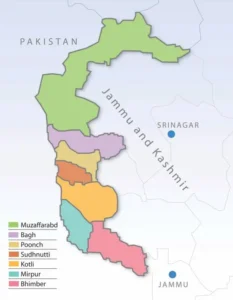
    Districts map of Azad Jammu Kashmir (Pakistan-administered).
    Districts map of Azad Jammu Kashmir (Pakistan-administered).

    The region is characterized by its mountainous terrain, with the Himalayas and Pir Panjal ranges forming natural boundaries that create dramatic landscapes. The serene Neelum Valley, the scenic Rawalakot, and the lush green Banjosa Lake are just a few of the region’s many picturesque locations. The climate in Azad Kashmir is varied, ranging from mild summers to heavy snowfall in the winter, making it a year-round tourist destination. The region’s natural beauty is complemented by its rich cultural traditions, local cuisine, and vibrant festivals.

    Azad Kashmir holds an important place in Pakistan’s history and governance. It functions as an autonomous administrative unit, with its own government, legislature, and judiciary, under the broader jurisdiction of Pakistan. The region’s socio-political landscape is shaped by its historical ties with both Pakistan and India, and its residents maintain strong cultural and familial links across the border.

    Administratively, Azad Kashmir is divided into 10 districts, each with its own unique features, from the bustling city of Muzaffarabad, the capital, to the serene, less-explored valleys in the north. The region is known for its strong sense of community, with local populations dedicated to agriculture, trade, and crafts, alongside the growing tourism sector.

    The districts of Azad Kashmir offer a range of experiences for travelers and locals alike. Some regions are known for their historic significance, such as Mirpur, while others are renowned for their natural beauty, like Bagh and Poonch. The region’s districts are an excellent reflection of its blend of modern-day influences and traditional cultural practices.

    Below is the detailed list of districts in the Azad Kashmir region of Jammu & Kashmir.

    List of Districts in Azad Jammu and Kashmir (AJK)

    S. No.District NameKey Highlights
    1MuzaffarabadThe capital of Azad Kashmir, known for its scenic views of the confluence of the Neelum and Jhelum rivers.
    2MirpurKnown for its large diaspora in the UK and famous for the Mangla Dam and scenic surrounding areas.
    3RawalakotOften referred to as the ‘Pearl Valley,’ it is known for its natural beauty, including Toli Pir and Banjosa Lake.
    4BaghFamous for its lush valleys, including the stunning Ganga Choti and Bagh’s cultural heritage.
    5PoonchKnown for its historical significance and beautiful areas like Toli Pir, and the Poonch River.
    6KotliAn important commercial and administrative hub, with scenic valleys and a rich cultural history.
    7NeelumKnown for its breathtaking valleys and beautiful spots like Arang Kel and Sharda.
    8BhimberA district rich in history, known for the famous Chak Fort and a thriving agricultural base.
    9Hattian BalaKnown for its scenic beauty and the famous Domel area, offering panoramic views of the surrounding mountains.
    10HaveliA district with cultural and historical importance, known for the scenic beauty of its forests and mountainous landscapes.


    Overview of Gilgit-Baltistan Region

    Located at the junction of the Karakoram, Himalayas, and Hindu Kush mountain ranges, Gilgit-Baltistan is home to some of the world’s highest peaks, including K2, the second-highest mountain on Earth. The region is a paradise for adventure enthusiasts, trekkers, mountaineers, and nature lovers, drawing tourists from all over the world to explore its rugged beauty.

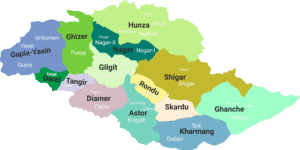
    Districts in Gilgit Baltistan Map
    Districts in Gilgit Baltistan Map

    The region’s geography is as diverse as it is striking, featuring lush green valleys, dense forests, pristine lakes, and snow-capped mountains. GB is home to Hunza Valley, Skardu, Naltar Valley, Khunjerab Pass, and Fairy Meadows, each offering unique natural beauty and cultural significance.

    Culturally, Gilgit-Baltistan is a melting pot of various ethnicities, including Shina, Balti, Burushaski, and Khowar, with each group maintaining its own language, customs, and traditions. The region is predominantly Muslim, with a strong tradition of religious practices and festivals. Shia Islam holds prominence in Baltistan, while Nurbakhshia, Ismaili, and Sunni traditions are also present, particularly in areas like Hunza and Nagar.

    Historically, Gilgit-Baltistan has been a crossroads of Central Asian, South Asian, and Tibetan cultures. The region was once part of the larger princely state of Jammu and Kashmir before its incorporation into Pakistan after the 1947 partition. Today, GB functions as an administrative region of Pakistan, though it remains a disputed area under the broader Kashmir conflict, with both India and Pakistan asserting claims over it.

    Below is the detailed list of districts in the Gilgit Baltistan region of Jammu & Kashmir.

    Gilgit-Baltistan Districts List

    S. No.District NameKey Highlights
    1GilgitThe administrative capital of GB; known for its vibrant culture and historic sites like the Kargah Buddha.
    2SkarduGateway to the Karakoram Range; known for scenic spots like Shangrila Resort, Satpara Lake, and Deosai National Park.
    3HunzaFamous for its idyllic landscapes, Hunza Valley, and landmarks like Altit Fort and Baltit Fort.
    4NagarLocated across from Hunza, known for Nagar Valley and the stunning Rakaposhi mountain.
    5GhizerKnown for lush valleys like Phander Valley and Gupis Valley, as well as the beautiful Shandur Lake.
    6DiamerFamous for the Diamer-Basha Dam and the awe-inspiring Nanga Parbat mountain.
    7AstoreKnown for its rugged beauty, including Astore Valley and the majestic Ratti Gali Lake.
    8BaltistanHome to the Baltoro Glacier, K2, and Skardu, the region offers unparalleled beauty.
    9ShigarKnown for its pristine valleys, including Shigar Fort and views of K2 from Shigar Valley.
    10KharmangA relatively less explored area, known for its cultural diversity and scenic Kharmang Valley.


    District Map of Jammu and Kashmir

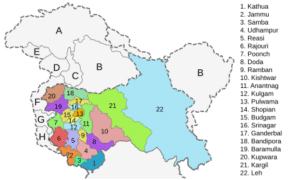
    For a better understanding of the geographical layout, here is an outline of how these districts are positioned.

    List of Districts of Jammu Kashmir
    List of Districts of Jammu Kashmir

    List of all Districts in Jammu and Kashmir

    Below is the total list of districts in Jammu and Kashmir, including Gilgit-Baltistan (GB), Azad Jammu and Kashmir (AJK), and Ladakh:

    RegionDistricts
    Jammu Region (Indian-administered)Jammu, Samba, Kathua, Udhampur, Reasi, Poonch, Rajouri, Doda, Ramban, Kishtwar, Kulgam, Anantnag, Pulwama, Shopian, Srinagar, Baramulla, Budgam
    Kashmir Region (India-administered)Srinagar, Baramulla, Anantnag, Pulwama, Kulgam, Shopian, Budgam, Kupwara
    Gilgit-Baltistan (Pakistan) (PaJK)Gilgit, Skardu, Hunza, Nagar, Ghizer, Diamer, Astore, Baltistan, Shigar, Kharmang
    Azad Jammu and Kashmir (AJK) (PaJK)Muzaffarabad, Mirpur, Rawalakot, Bagh, Poonch, Kotli, Neelum, Bhimber, Hattian Bala, Haveli
    Ladakh Region (India-administered)Leh, Kargil

    This table provides an overview of the districts across all the regions of Jammu and Kashmir, including both Indian-administered and Pakistani-administered areas.

    Frequently Asked Questions (FAQs)

    1. How many districts are there in Jammu and Kashmir?

    Jammu and Kashmir comprise 51 districts, in all the regions of Jammu Kashmir Including GB, AJK, and Ladakh.

    2. Which is the largest district in Jammu and Kashmir?

    Leh was previously the largest district in terms of area, but post the bifurcation in 2019, the largest district in Jammu and Kashmir is Doda.

    3. What are the main districts for tourism in Jammu and Kashmir?

    Tourism hotspots include Srinagar, Anantnag, Baramulla, and Ganderbal in Kashmir Division, while Jammu, Udhampur, and Kishtwar are popular in Jammu Division.

    Stay tuned to our Kashmiriyat section for more in-depth articles on the region’s culture, history, and current affairs.

    The Languages of Jammu, Kashmir, Gilgit-Baltistan, and Ladakh: A Rich Tapestry of Cultures and Traditions

    0

    The regions of Jammu and Kashmir, Gilgit-Baltistan, and Ladakh are known for their unique geographical locations, rich history, and vibrant cultures. One of the most fascinating aspects of these regions is their linguistic diversity. These areas, situated in the northernmost parts of South Asia, boast a variety of languages and dialects spoken by their diverse populations. The linguistic landscape reflects not only the historical influence of various empires but also the cultural exchanges and migrations that have shaped these areas over centuries.

    In this comprehensive article, we will explore the languages spoken in Jammu and Kashmir, Gilgit-Baltistan, and Ladakh, highlighting the rich cultural heritage and historical significance of these languages.

    The Importance of Our Language

    Language is a reflection of a nation’s identity and culture. It not only serves as a means of expressing our thoughts and emotions but also preserves and conveys our history, traditions, and values. Learning and promoting our native language is important because it connects us with our past, ancestors, and civilization.

    Each language carries unique words and expressions that reflect a particular societal and cultural context. Moreover, language fosters unity within a community and is essential for effective communication. Understanding the significance of preserving and nurturing our language is vital, as it allows us to safeguard our cultural heritage and pass it on to future generations.

    History of Kashmir Languages

    The history of languages in Kashmir is a testament to the Kashmir’s rich cultural and historical evolution. The earliest language of Kashmir was Sanskrit, which was extensively used in religious texts, especially those related to Hinduism and Kashmir Shaivism. Sanskrit flourished during the early period of Kashmir’s history, with notable works like the Rajatarangini, a historical chronicle written by Kalhana in the 12th century, being composed in this classical language. Sanskrit served as the language of knowledge, philosophy, and spiritual discourse in Kashmir for centuries.

    As Kashmir transitioned to a center of Buddhist culture and learning, languages such as Prakrit and Apabhramsha came into use. These languages, more accessible to the common people than Sanskrit, became prominent during the era of Buddhism and the spread of Shaivism. However, the dominance of Sanskrit continued for a long period due to the region’s Hindu rulers and intellectual circles.

    The Kashmiri language, as we know it today, evolved from the Prakrit languages and is a member of the Dardic language family. By the 8th century CE, Kashmiri began to emerge as a distinct language. The development of Kashmiri was influenced by various cultures, especially after the arrival of Islam in the region during the 14th century. With the rule of Muslim Sultanates, the Kashmiri language was significantly influenced by Persian, which became the language of administration, poetry, and literature. Persian’s impact on Kashmiri vocabulary and literary traditions is evident even today.

    In the 19th century, Urdu gained prominence in Kashmir as the region came under British rule. It became an important medium for communication, especially in the administrative and educational sectors, and gradually became one of the official languages of the region. Alongside Kashmiri, Dogri and Pahari dialects emerged as prominent languages in the Jammu region, which also share some similarities with Kashmiri but have distinct linguistic features.

    In the higher regions of Ladakh, the Ladakhi language, which belongs to the Tibetic language family, began to flourish. Balti, a closely related dialect, is spoken in parts of the Kargil district. These languages represent the Tibetan influence in the region and have continued to be an integral part of Ladakh’s culture.

    Thus, the languages of Kashmir, influenced by historical, cultural, and religious changes, reflect the rich diversity of the region, serving as a bridge between its ancient past and modern identity.

    Languages Spoken in Jammu and Kashmir

    Jammu and Kashmir, prior to its reorganization in 2019, was one of the most linguistically diverse regions in South Asia. While Hindi and Urdu were the official languages, there were numerous other languages and dialects spoken across the state, particularly in rural areas.

    1.1 Kashmiri (Koshur)

    • Region: Primarily spoken in the Kashmir Valley.
    • Family: Dardic (Indo-Aryan)
    • Speakers: Over 5 million
    • Description: Kashmiri is the most prominent language spoken in the Kashmir Valley and is an official language of Jammu and Kashmir. It is a Dardic language, which is a subgroup of the Indo-Aryan languages. Kashmiri has a long literary tradition, with works spanning poetry, prose, and religious texts. It has also been influenced by Sanskrit, Persian, and Arabic due to historical invasions and cultural exchanges.

    1.2 Dogri

    • Region: Predominantly spoken in the Jammu region.
    • Family: Indo-Aryan
    • Speakers: Approximately 3 million
    • Description: Dogri is another official language of Jammu and Kashmir. It belongs to the Western Pahari group of languages and is spoken widely in Jammu and the surrounding areas. Dogri has a rich folk tradition, including songs and poetry. It was recognized as a scheduled language of India in 2003 and has an emerging literary presence.

    1.3 Urdu

    • Region: Widely spoken across the region, especially in urban centers.
    • Family: Indo-Aryan
    • Speakers: Millions
    • Description: While Urdu is widely spoken in the region and is the second official language of Jammu and Kashmir, it has a significant role in the cultural and educational domains. Historically, it developed as a syncretic language during the Mughal period and became the language of administration under Muslim rulers. It is extensively used in media, literature, and education.

    1.4 Pahari

    • Region: Spoken in hilly areas of Jammu and parts of Kashmir.
    • Family: Indo-Aryan
    • Speakers: Approximately 2 million
    • Description: Pahari is a group of languages spoken by people in the hilly areas of Jammu. It includes multiple dialects such as the Rajouri Pahari and Mirpuri Pahari. Pahari speakers share cultural and linguistic similarities with Dogri, and the two languages are often mutually intelligible.

    1.5 Balti

    • Region: In certain pockets of Jammu and Kashmir near the Ladakh region.
    • Family: Tibetic
    • Speakers: Few thousand
    • Description: Balti is a Tibetic language spoken by the people in the northern areas of the region. It is closely related to Tibetan and has some linguistic influence from Urdu and Persian due to historical connections.

    1.6 Gojri

    • Region: Jammu and Kashmir, especially among the Gujjar community.
    • Family: Indo-Aryan
    • Speakers: Over a million
    • Description: Gojri is primarily spoken by the Gujjar people, an ethnic group found in the Jammu and Kashmir regions. It shares close relations with the Dogri language but has its own distinct characteristics.

    Languages Spoken in Gilgit-Baltistan

    Gilgit-Baltistan, located in the northernmost part of Pakistan, is home to a diverse range of languages due to its unique geographical and cultural mix. The region lies at the confluence of multiple linguistic and cultural influences, including Tibetan, Indo-Aryan, and Iranic-speaking populations.

    2.1 Shina

    • Region: Gilgit, Diamer, and parts of Astore in Gilgit-Baltistan.
    • Family: Dardic (Indo-Aryan)
    • Speakers: Over 500,000
    • Description: Shina is the most widely spoken language in Gilgit-Baltistan. It is a Dardic language and is mainly spoken in the Gilgit and Diamer regions. Shina has many dialects and has a rich oral tradition, with poetry and folk songs.

    2.2 Balti

    • Region: Baltistan region of Gilgit-Baltistan.
    • Family: Tibetic
    • Speakers: Over 250,000
    • Description: Balti is a Tibetic language spoken by the people in the Baltistan region of Gilgit-Baltistan. It shares a close relation to Tibetan and is written in the Urdu script. Balti is used in everyday communication as well as in religious contexts by the local Shia Muslim population.

    2.3 Burushaski

    • Region: Hunza and Nagar valleys in Gilgit-Baltistan.
    • Family: Language isolate (not related to any known language family)
    • Speakers: Approximately 100,000
    • Description: Burushaski is a unique language that does not belong to any recognized language family, making it one of the most linguistically isolated languages in the world. It is spoken in the Hunza, Nagar, and parts of the Yasin valley in Gilgit-Baltistan.

    2.4 Wakhi

    • Region: Gojal in Gilgit-Baltistan.
    • Family: Eastern Iranian
    • Speakers: Around 40,000
    • Description: Wakhi is an Eastern Iranian language spoken by the Wakhi people, primarily in the Gojal Valley of Gilgit-Baltistan. It is closely related to languages spoken in Tajikistan, Afghanistan, and China’s Xinjiang region.

    2.5 Khowar

    • Region: Chitral, a neighboring area of Gilgit-Baltistan.
    • Family: Dardic (Indo-Aryan)
    • Speakers: Over 500,000
    • Description: Khowar is spoken by the people of Chitral in the northern parts of Pakistan, but it is also found in Gilgit-Baltistan. It is closely related to Shina and is an important language for the Dardic-speaking communities in the region.

    Languages Spoken in Ladakh

    Ladakh, the land of high passes, is a region of Jammu and Kashmir that borders Tibet and is characterized by a significant Tibetan cultural influence. The linguistic landscape of Ladakh is dominated by Tibetic languages, but there are also traces of languages from neighboring areas such as Kashmir and Himachal Pradesh.

    3.1 Ladakhi (Ladakhi Tibetan)

    • Region: Ladakh, especially Leh and Kargil districts.
    • Family: Tibetic
    • Speakers: Over 150,000
    • Description: Ladakhi is the principal language of Ladakh and is part of the Tibetic language family. It is spoken predominantly by Buddhists in the Leh district and is closely related to other Tibetic languages like Tibetan. The language is written in the Tibetan script and has a rich tradition of literature, including Buddhist texts.

    3.2 Balti

    • Region: Ladakh, specifically in the Kargil district.
    • Family: Tibetic
    • Speakers: Thousands
    • Description: As mentioned earlier, Balti, a Tibetic language, is spoken in the Kargil district of Ladakh as well, similar to the Baltistan region in Gilgit-Baltistan. It is mutually intelligible with Ladakhi but has some distinct differences in pronunciation and vocabulary.

    3.3 Purgi

    • Region: Purgi-speaking areas are located in the lower parts of Ladakh.
    • Family: Tibetic
    • Speakers: Fewer than Ladakhi
    • Description: Purgi is a dialect of the Tibetic language spoken by the people of the Purgi region of Ladakh. It is a variant of Ladakhi and is spoken in the villages located in the southeastern part of Ladakh.

    3.4 Urdu and Hindi

    • Region: Urban centers and among the Muslim population of Ladakh.
    • Family: Indo-Aryan
    • Speakers: Widely spoken
    • Description: Urdu and Hindi are also spoken widely in Ladakh, especially in urban areas like Leh and Kargil. The Muslim population of Ladakh uses these languages, and they are commonly used in administrative and educational settings.

    From the melodious Kashmiri spoken in the valley to the vibrant Dogri of Jammu and the Tibetic tones of Ladakhi, Jammu Kashmir is a linguistic hub. Below is a detailed list of the prominent languages spoken across Jammu and Kashmir, showcasing the cultural richness of this beautiful land.

    List of Languages Spoken Across Jammu Kashmir

    LanguageRegion/DialectNotes
    KashmiriKashmir ValleyThe most widely spoken language in the valley, part of the Dardic group.
    UrduThroughout Jammu and KashmirOfficial language; used in administration and education.
    DogriJammu RegionRecognized in the Indian Constitution; widely spoken in the Jammu plains.
    PahariPir Panjal, Jammu, and KashmirA group of dialects spoken in mountainous areas.
    LadakhiLadakh RegionA Tibetan dialect primarily spoken in Leh and Kargil.
    BaltiLadakh (Kargil)A Tibetic language spoken in parts of Baltistan and Kargil.
    ShinaGurez, Drass, and LadakhA Dardic language spoken in remote northern areas.
    PunjabiJammu and Border RegionsSpoken by communities near the Punjab border.
    GojriGujjar CommunitiesCommon among Gujjar and Bakarwal tribes across Jammu and Kashmir.
    HindiUrban Areas of JammuSpoken and understood in urban areas, especially for trade.
    EnglishOfficial UseWidely used in administration, education, and communication.
    PashtoTribal and Border RegionsSpoken by small communities in Jammu and border areas.
    Ladakhi UrduLadakhA mix of Urdu and Ladakhi spoken for intercommunication.
    SanskritReligious and Cultural UseRarely spoken but holds cultural significance.
    BhadarwahiBhadarwah Region, JammuA regional dialect of the Pahari language.
    SaraziDoda and Kishtwar, JammuA lesser-known dialect spoken in mountainous regions.


    The Presidents of Azad Jammu and Kashmir: A Complete History and Leadership Overview

    0

    Editorial Staff: Azad Jammu and Kashmir (AJK), a self-governing administrative region in Asia, has a rich and complex political history. The region, which borders Indian-administered Jammu and Kashmir, was established following the first war between India and Pakistan in 1947-1948, and its leadership structure has evolved over the years. At the helm of AJK’s political framework is the position of the President of Azad Kashmir, an office that plays a pivotal role in the governance of the region.

    In this article, we will provide a comprehensive look at the Presidents of Azad Jammu and Kashmir, exploring their roles, the history of the office, and the political landscape that shaped their leadership. Additionally, we will review the significant contributions and challenges faced by these leaders throughout the years.

    The Role of the President of Azad Jammu and Kashmir

    The President of Azad Jammu and Kashmir serves as the ceremonial head of state in AJK. The President’s duties are largely symbolic, with the Prime Minister of Azad Kashmir holding the executive authority and making most of the key decisions regarding governance. The President, however, has important constitutional roles, including:

    • Appointing the Prime Minister: After general elections, the President appoints the leader of the majority party as the Prime Minister of AJK.
    • Representing AJK at the national level: The President often represents Azad Jammu and Kashmir in dealings with the government of Pakistan.
    • Constitutional Safeguard: The office serves as a safeguard to ensure the region’s autonomy within the broader framework of Pakistan.

    While the President’s role is largely ceremonial, it is significant in the context of AJK’s political structure, where leadership balances the influence of Pakistan and the region’s need for self-governance.

    Powers of the President of Azad Jammu and Kashmir

    The President of Azad Jammu and Kashmir holds a ceremonial and constitutional role, with powers primarily defined under the AJK Interim Constitution Act, 1974. As the head of the state, the President represents Azad Kashmir in official matters but operates largely within the framework set by the constitution.

    Executive authority is exercised by the Prime Minister and the Cabinet, while the President’s duties include appointing the Prime Minister (from the majority party), assenting to legislation passed by the Legislative Assembly, and addressing matters related to the judiciary. Additionally, the President plays a symbolic role in representing the region in domestic and international matters, especially regarding the Kashmir issue.

    The Early History of Azad Jammu and Kashmir Leadership

    Following the partition of British India in 1947, the princely state of Jammu and Kashmir, which was a Muslim-majority region ruled by a Hindu Maharaja, found itself in the midst of a geopolitical struggle. The region was divided into two parts: one administered by India and the other by Pakistan, which came to be known as Azad Jammu and Kashmir.

    After the ceasefire in 1948, the region of Azad Jammu and Kashmir was formally established, and it remained under Pakistan’s administration but retained a degree of autonomy. The leadership structure of AJK evolved to accommodate the growing needs for governance and self-representation, with the President becoming the head of state.

    The Presidents of Azad Jammu and Kashmir

    The following is a list of Presidents of Azad Jammu and Kashmir, highlighting their terms in office and some key developments during their presidencies:

    1. Sardar Ibrahim Khan (1947-1952)

    Sardar Ibrahim Khan was the first President of Azad Jammu and Kashmir, holding office from the region’s formation in 1947 until 1952. He played a crucial role in the early days of Azad Kashmir’s establishment, helping to shape its governance and securing a political structure within the broader context of Pakistan’s policies toward the region.

    • Key Contributions: Sardar Ibrahim was instrumental in leading the government during the early days of AJK’s creation, steering it through its initial years of development.

    2. Sardar Mohammad Anwar Khan (1952-1960)

    Sardar Mohammad Anwar Khan succeeded Ibrahim Khan as President and served a significant term in office. His tenure saw the consolidation of administrative structures in the region and a focus on economic recovery after the effects of the partition.

    • Key Contributions: He worked toward improving AJK’s relations with Pakistan and also focused on social development projects within the region.

    3. Sardar Mohammad Akbar Khan (1960-1965)

    Sardar Mohammad Akbar Khan took office in 1960, continuing to advance the political and administrative stability of AJK. His leadership coincided with heightened tensions between India and Pakistan over the Kashmir issue.

    • Key Contributions: His term focused on supporting Pakistan’s stance on the Kashmir conflict and aligning Azad Kashmir’s politics with national policies.

    4. Sardar Mohammad Yaqoob Khan (1965-1970)

    Serving from 1965 to 1970, Sardar Mohammad Yaqoob Khan played a pivotal role in dealing with the aftermath of the 1965 India-Pakistan war, where the Kashmir issue once again became central to both countries’ policies.

    • Key Contributions: Khan’s presidency was marked by continued efforts to assert Azad Kashmir’s political autonomy while remaining aligned with Pakistan’s strategic interests.

    5. Sardar Ghulam Sadiq Khan (1970-1975)

    During his presidency, Sardar Ghulam Sadiq Khan focused on governance reform and introduced several developmental initiatives. He also worked toward further integration of Azad Kashmir with Pakistan’s economic framework.

    • Key Contributions: Khan was committed to infrastructure and social welfare projects, attempting to bring long-term benefits to the population of AJK.

    6. Sardar Muhammad Abdul Qayyum Khan (1975-1985)

    Sardar Muhammad Abdul Qayyum Khan held office for an extended period, and his tenure is often regarded as one of the most influential in AJK’s history. He had a significant impact on the political dynamics of the region and is considered a prominent figure in Azad Kashmir’s modern history.

    • Key Contributions: His presidency was defined by his efforts to advocate for the Kashmir cause at both national and international levels, and he pushed for the region’s increased political autonomy.

    7. Sardar Muhammad Anwar Khan (1985-1990)

    Sardar Muhammad Anwar Khan’s second tenure began in 1985, following a period of political instability. His leadership was defined by the growth of Azad Kashmir’s infrastructure, particularly in the field of education and health.

    • Key Contributions: He worked to stabilize the regional political structure and oversaw a period of relative calm in terms of internal governance.

    8. Sardar Ghulam Sadiq Khan (1990-1996)

    Sardar Ghulam Sadiq Khan’s second term from 1990 to 1996 saw a focus on the development of basic services and further integration with Pakistan’s national economy.

    • Key Contributions: Under his leadership, there was a continued push for regional development while maintaining the political cohesion of Azad Kashmir with Pakistan.

    9. Sardar Muhammad Iqbal Khan (1996-2001)

    Sardar Muhammad Iqbal Khan’s presidency coincided with significant political changes in Pakistan and Azad Kashmir. His term focused on maintaining peace in the region amidst heightened tensions between India and Pakistan, particularly during the Kargil conflict of 1999.

    • Key Contributions: He emphasized the importance of unity in Azad Kashmir while navigating the political challenges posed by the ongoing Kashmir dispute.

    10. Sardar Yaqoob Khan (2001-2006)

    Sardar Yaqoob Khan’s presidency witnessed the aftermath of the 2005 earthquake in Azad Kashmir. His tenure was marked by his leadership during the reconstruction process, which involved rebuilding the region’s infrastructure and providing relief to the displaced population.

    • Key Contributions: Khan’s leadership during the 2005 earthquake and the subsequent recovery efforts is considered one of the most notable aspects of his presidency.

    11. Sardar Mohammad Masood Khan (2016-Present)

    Sardar Mohammad Masood Khan assumed office as the President of Azad Jammu and Kashmir in 2016. Known for his diplomatic expertise, Masood Khan has been a vocal advocate for the Kashmiri people’s right to self-determination and has emphasized the need for international recognition of the Kashmir issue.

    • Key Contributions: President Masood Khan has worked extensively on raising global awareness about the Kashmir issue, particularly in international forums such as the United Nations. His presidency has been marked by advocacy for peace, stability, and the rights of the Kashmiri people.

    President of Azad Jammu Kashmir List

    This table provides a detailed list of all the presidents, their tenure, and notable achievements, showcasing their dedication to the cause of Kashmir and the welfare of its people.

    #NameTenureNotes
    1Sardar Muhammad Ibrahim Khan24 October 1947 – 13 May 1950First president, key figure in the freedom movement.
    2Mirwaiz Yusuf Shah14 May 1950 – 17 June 1951Religious leader and president.
    3Colonel Syed Ali Ahmed Shah17 June 1951 – 30 May 1952Former military officer.
    4Sardar Muhammad Abdul Qayyum Khan1 June 1952 – 30 May 1956Influential political leader in Azad Kashmir.
    5K. H. Khurshid1 June 1956 – 30 April 1959Former secretary to Muhammad Ali Jinnah.
    6Sardar Muhammad Ibrahim Khan1 May 1959 – 5 August 1964Second term as president.
    7Sardar Abdul Qayyum Khan7 August 1964 – 5 June 1965Key leader of the Kashmir liberation movement.
    8Sardar Muhammad Ibrahim Khan5 June 1965 – 31 August 1969Third term as president.
    9Syed Nazir Hussain Shah1 September 1969 – 12 April 1974Transitional leadership.
    10Sardar Muhammad Abdul Qayyum Khan13 April 1974 – 15 November 1978Played a major role in the Azad Kashmir constitution.
    11Khan Abdul Hameed Khan15 November 1978 – 29 June 1983Administrative reforms introduced.
    12Sardar Sikandar Hayat Khan30 June 1983 – 31 December 1985Focused on economic and social development.
    13Sardar Muhammad Abdul Qayyum Khan1 January 1986 – 30 June 1990Final term as president.
    14Sardar Sikandar Hayat Khan1 July 1990 – 31 December 1991Leadership during critical times.
    15Mumtaz Hussain Rathore1 January 1992 – 29 July 1992Political activism and governance.
    16Sardar Sikandar Hayat Khan30 July 1992 – 31 December 1996Served multiple tenures due to strong support.
    17Major General (R) Sardar Anwar Khan25 August 2001 – 24 August 2006Former military leader as president.
    18Raja Zulqarnain Khan25 August 2006 – 24 August 2011Focused on governance and reforms.
    19Sardar Muhammad Yaqoob Khan25 August 2011 – 24 August 2016Worked on public welfare and infrastructure.
    20Sardar Masood Khan25 August 2016 – 24 August 2021Advocated for Kashmir’s cause internationally.
    21Barrister Sultan Mahmood Chaudhry25 August 2021 – PresentCurrent president, emphasizing development and diplomacy.


    Challenges Faced by the Presidents of Azad Jammu and Kashmir

    The Presidents of Azad Jammu and Kashmir have faced a myriad of challenges throughout the region’s history. These include:

    • The Kashmir Dispute: The ongoing conflict between India and Pakistan over the Kashmir region has deeply influenced the politics of Azad Kashmir. Every President has had to balance regional autonomy with alignment to Pakistan’s national policies.
    • Internal Governance: Issues of administrative reform, development, and socio-economic stability have always been central to the leadership in AJK.
    • Natural Disasters: The devastating 2005 earthquake in Azad Kashmir remains a significant chapter in the region’s history. Presidents during such times have had to manage relief efforts and long-term rebuilding initiatives.

    The office of the President of Azad Jammu and Kashmir has played a crucial, though largely ceremonial, role in the region’s political structure. From the early days of the region’s formation in 1947 to the modern challenges posed by natural disasters and the Kashmir conflict, the Presidents of Azad Kashmir have navigated complex political landscapes. As the region continues to develop, the leadership of Azad Kashmir will undoubtedly continue to shape its future, both in terms of governance and its position in the ongoing Kashmir dispute.

    200+ Meaningful Shia Boys’ Names for 2024: Discover the Best Islamic Names with Powerful Significance

    0

    A name is more than just a label it’s a symbol of one’s identity, values, and aspirations. In Shia Islam, names are often chosen based on their meanings, historical relevance, and connection to significant figures from Islamic tradition.

    This article will provide an in-depth guide to Shia boys’ names, including Islamic Shia boys’ names, trending names for 2024, and a curated list of popular and meaningful names for your newborn. Whether you’re looking for a traditional name, a modern twist, or one inspired by significant figures in Islamic history, this guide has you covered.

    The Significance of Names in Shia Islam

    In Shia Islam, names hold immense spiritual value. A name is not just a means of identification but a reflection of a person’s destiny and connection to faith. Parents in the Shia community often select names based on their meanings, which could represent virtues like strength, wisdom, piety, and humility. Additionally, many names are derived from prominent Islamic figures—such as the Ahl al-Bayt (the family of the Prophet Muhammad) or the twelve Imams—whose lives and teachings continue to inspire millions of Muslims around the world.

    Shia Muslims believe that the name chosen for a child will shape their identity and guide them throughout their life. As such, parents choose names that carry positive and virtuous meanings, helping to instill these values in their children from a young age.

    Popular Shia Boys’ Names and Their Meanings

    If you’re looking for a name that is deeply rooted in Islamic tradition and carries a powerful meaning, here is a list of some of the most popular Shia boys’ names:

    Traditional Shia Boys’ Names:

    • Ali (علی): Meaning “exalted” or “high,” this name is of great significance in Shia Islam, as it is the name of the first Imam, Imam Ali ibn Abi Talib, the cousin and son-in-law of the Prophet Muhammad.
    • Hassan (حسن): Meaning “handsome” or “good,” this name was borne by Imam Hassan, the second Shia Imam and the grandson of Prophet Muhammad.
    • Hussain (حسین): Meaning “good” or “handsome,” this name is associated with Imam Hussain, the grandson of the Prophet Muhammad and the leader of the Battle of Karbala, a symbol of sacrifice and justice in Islam.
    • Zayn (زین): Derived from the word “zayn” meaning “beauty,” this name was used by Imam Zayn al-Abidin, the fourth Imam in Shia Islam.
    • Jafar (جعفر): Meaning “river,” this name is associated with Jafar al-Sadiq, the sixth Imam of the Shia community, known for his deep knowledge and spirituality.
    • Rida (رضا): Meaning “contentment” or “pleasure,” this name is inspired by Imam Ali al-Rida, the eighth Imam, who was known for his patience and devotion.

    Popular Shia Boys Names List with their meanings

    #NameMeaning
    1AliHigh, exalted, noble
    2HasanHandsome, good
    3HussainSmall, good, handsome
    4AbbasLion, stern, austere
    5JafarStream, rivulet
    6ZainBeauty, adornment
    7MusaProphet Moses, savior
    8MehdiGuided one
    9TaqiPious, God-fearing
    10SadiqTruthful, sincere
    11RezaContentment, satisfaction
    12KazimRestrainer of anger
    13SajjadOne who prostrates often
    14BaqirOne who possesses great knowledge
    15RazaContentment, satisfaction
    16HadiGuide, leader
    17HamzaLion, strength
    18IbrahimProphet Abraham, father of nations
    19SalmanSafe, healthy
    20QasimDivider, distributor
    21AqilIntelligent, wise
    22ZafarVictory, triumph
    23ImranProsperity, long-lived
    24YasinTitle of Surah in the Quran, a name for Prophet Muhammad
    25HarithCultivator, plowman
    26HashimGenerous, destroyer of evil
    27MurtazaThe chosen one
    28BilalMoisture, name of Prophet’s companion
    29AsgharYounger, smaller
    30AkbarGreater, grander


    Modern Shia Boys’ Names:

    • Imran (عمران): Meaning “prosperity,” this name was borne by the father of Maryam (Mary), the mother of Prophet Isa (Jesus), in Islamic tradition.
    • Mustafa (مصطفی): Meaning “chosen one,” this name is often associated with Prophet Muhammad, the final messenger of Islam.
    • Musa (موسی): The name of Prophet Musa (Moses), meaning “saved from the water.”
    • Yasir (یاسر): Meaning “rich” or “prosperous,” this name reflects a sense of financial or spiritual abundance.
    • Kamil (کامل): Meaning “perfect” or “complete,” this name symbolizes excellence in character and faith.

    Stylish Shia boys’ names list

    #NameMeaning
    1AliHigh, exalted, noble
    2HassanHandsome, good
    3HussainSmall, handsome, good
    4MehdiGuided one, savior
    5AbbasLion, courageous
    6SajjadOne who prostrates often
    7ZainBeauty, adornment
    8RazaContentment, satisfaction
    9KazimRestrainer of anger
    10JafarStream, rivulet
    11SalmanSafe, healthy
    12HadiGuide, leader
    13TaqiPious, God-fearing
    14SadiqTruthful, sincere
    15BaqirOne with great knowledge
    16MurtazaThe chosen one
    17HamzaLion, strong
    18MusaProphet Moses, savior
    19HashimGenerous, destroyer of evil
    20YasinTitle of Surah in the Quran, name for the Prophet
    21MuntazirOne who waits, refers to the awaited Imam Mahdi
    22QasimDivider, distributor
    23ImranProsperity, long-lived
    24ZafarVictory, triumph
    25BilalMoisture, name of Prophet’s companion


    These names are frequently chosen for their historical and religious significance, providing not only an identity but also a connection to the spiritual and moral teachings of Shia Islam.

    Trending Shia Boys’ Names for 2024

    As naming trends evolve, parents are increasingly looking for unique yet meaningful names for their children. The year 2024 brings new trends in Shia boys’ names, blending traditional elements with modern influences. Here are some trending Shia boys’ names for 2024:

    Popular Trends for 2024:

    • Unique Spiritual Names: Parents are choosing names that reflect their spiritual beliefs and aspirations for their children. Names like Tariq (meaning “morning star” or “he who knocks”) and Ayyub (meaning “patient” or “to return to God”) are gaining popularity.
    • Historical Names: Many parents are choosing names that connect their children to Islamic history and the lives of the Imams. Names such as Alamdar (meaning “flag bearer” in reference to the Battle of Karbala) and Asghar (meaning “young” or “youthful”) are becoming increasingly popular.
    • Names Signifying Strength and Honor: Names like Zulfiqar (the name of Imam Ali’s sword), Amin (meaning “trustworthy”), and Sadiq (meaning “truthful”) symbolize integrity, trust, and valor—qualities parents want to instill in their children.

    List of trending Shia boys’ names for 2024

    No.NameMeaning
    1AliExalted, high
    2HussainGood, handsome
    3ImranProsperity
    4MustafaChosen one
    5HassanHandsome, good
    6KamilPerfect, complete
    7MusaSaved from the water
    8ZaynBeauty, grace
    9RidaContentment, pleasure
    10JafarRiver
    11YasirProsperous, rich
    12TariqMorning star, he who knocks
    13AyyubPatient, returning to God
    14AlamdarFlag bearer, symbol of Karbala
    15AsgharYouthful, small
    16SadiqTruthful
    17ZulfiqarThe sword of Imam Ali
    18AmirLeader, prince
    19FarisKnight, horseman
    20AzharRadiant, luminous
    21UsmanA name of great historical significance
    22HashimGenerous, destroyer of idols
    23HarisGuardian, watchful
    24RafiExalted, noble
    25IbrahimFather of the faithful (Prophet Abraham)

    Islamic Shia Boys’ Names and Their Significance

    Islamic names, particularly those inspired by figures from the Qur’an and Hadith, hold deep religious significance. For Shia Muslims, naming a child after an Imam, a companion of the Prophet Muhammad, or another significant Islamic figure is seen as a way of honoring that individual’s contribution to Islam.

    Here are some Islamic Shia boys’ names that are widely respected in the community:

    • Hassan: The name of the second Imam, representing virtue, justice, and kindness.
    • Hussain: The name of the third Imam, a martyr of Karbala, known for standing against oppression.
    • Ali: Referring to the first Imam, Ali is a name that signifies leadership, knowledge, and strength.
    • Abbas: The name of the half-brother of Imam Hussain, known for his loyalty and bravery at Karbala.
    • Raza: Derived from Imam Ali al-Rida, signifying contentment and divine approval.
    • Zaki: Meaning “pure,” it’s often used to describe someone spiritually virtuous.

    List of Islamic Shia boys’ names with meanings

    #NameMeaning
    1AliHigh, exalted, noble
    2HassanHandsome, good
    3HussainSmall, handsome, good
    4AbbasLion, courageous
    5MehdiGuided one, savior
    6RezaContentment, satisfaction
    7KazimRestrainer of anger
    8SajjadOne who prostrates often
    9JafarStream, rivulet
    10MurtazaThe chosen one
    11TaqiPious, God-fearing
    12SadiqTruthful, sincere
    13BaqirOne with great knowledge
    14HadiGuide, leader
    15ZainBeauty, adornment
    16MusaProphet Moses, savior
    17SalmanSafe, healthy
    18QasimDivider, distributor
    19HamzaLion, strong
    20IbrahimProphet Abraham, father of nations
    21AqilIntelligent, wise
    22MuntazirOne who waits, refers to the awaited Imam Mahdi
    23ImranProsperity, long-lived
    24HashimGenerous, destroyer of evil
    25YasinTitle of Surah in the Quran, name for the Prophet
    26HarithCultivator, plowman
    27AsgharYounger, smaller
    28AkbarGreater, grander
    29ZafarVictory, triumph
    30BilalMoisture, name of Prophet’s companion


    How to Choose the Right Shia Boys’ Name

    Choosing the perfect name for your child is an important decision. When selecting a Shia boys’ name, consider the following factors:

    • Meaning: The name’s meaning should resonate with you and reflect values that you wish to instill in your child. Names like Hassan (handsome) or Ali (exalted) carry positive associations with beauty and virtue.
    • Cultural and Religious Significance: Many Shia families choose names that are tied to important Islamic figures, such as the Imams or companions of the Prophet Muhammad. These names carry immense spiritual significance.
    • Sound and Pronunciation: The name should be easy to pronounce and flow well with the family surname. Consider how the name will sound in both Arabic and your native language.
    • Uniqueness vs Tradition: While traditional names like Hassan and Ali remain popular, modern names such as Zayn or Tariq offer a fresh twist while still holding onto Islamic roots.

    FAQs: Shia Boys’ Names

    1. What are the most popular Shia boys’ names?

    Some of the most popular Shia boys’ names include Ali, Hassan, Hussain, Imran, Mustafa, and Jafar. These names are deeply rooted in Shia Islamic history and are associated with the revered figures of the Ahl al-Bayt (the family of Prophet Muhammad), including the first Imam, Imam Ali, and his sons Imam Hassan and Imam Hussain.

    2. Why are Shia boys’ names so significant?

    Shia boys’ names are highly significant in Islam because they often reflect virtues such as piety, wisdom, justice, and courage. Many Shia names are derived from the lives of important religious figures like the Imams, the companions of the Prophet Muhammad, and other influential Islamic personalities. Parents choose these names to honor these figures and to inspire similar virtues in their children.

    See Also: 500+ Beautiful Shia Islamic Girl Names with Their Meanings | Find Your Name Meanings

    3. Can I choose a Shia boys’ name from a different culture?

    Yes, you can choose a Shia boys’ name that reflects your cultural background while still adhering to Islamic naming traditions. Many Shia names, such as Ali, Hassan, and Zayn, are used widely across the Muslim world, including in Arabic, Persian, South Asian, and Turkish cultures. Names can often transcend cultural boundaries as long as they carry positive meanings aligned with Islamic teachings.

    4. What are some trending Shia boys’ names for 2024?

    Trending Shia boys’ names for 2024 include Tariq (meaning “morning star” or “he who knocks”), Ayyub (meaning “patient” or “returning to God”), Sadiq (meaning “truthful”), and Azhar (meaning “radiant” or “luminous”). These names blend traditional roots with modern influences, making them ideal choices for parents looking for a fresh yet meaningful name.

    5. How do I know if a name is suitable for my child?

    When choosing a Shia boys’ name, consider the following:

    • Meaning: Ensure the name has a positive and virtuous meaning.
    • Cultural and Religious Significance: Choose a name that connects your child to important Islamic figures and teachings.
    • Pronunciation: Ensure the name is easy to pronounce in both your native language and Arabic.
    • Uniqueness: If you prefer something distinctive, you can choose a name that isn’t overly common but still carries religious or historical significance.

    6. Are there any names that honor the Imams of Shia Islam?

    Yes, many Shia boys’ names honor the Imams of Shia Islam, including:

    • Ali (first Imam)
    • Hassan (second Imam)
    • Hussain (third Imam)
    • Zayn (fourth Imam, Zayn al-Abidin)
    • Jafar (sixth Imam, Jafar al-Sadiq)
    • Raza (eighth Imam, Ali al-Rida)

    These names carry deep spiritual significance and reflect the high moral and ethical standards set by the Imams.

    7. What is the significance of the name Hussain in Shia Islam?

    The name Hussain holds immense significance in Shia Islam, as it is associated with Imam Hussain, the grandson of Prophet Muhammad and the third Shia Imam. Imam Hussain is known for his unwavering stance against tyranny and injustice, particularly during the Battle of Karbala, where he sacrificed his life for the preservation of truth and righteousness. The name symbolizes courage, sacrifice, and standing up for justice.

    8. Can I name my child after a historical figure in Islam?

    Yes, many Shia Muslim families choose to name their children after revered historical figures in Islam. For example, names like Ali, Hassan, Hussain, and Jafar are commonly used to honor the lives and sacrifices of the Prophet Muhammad’s family members, including the Imams and their companions. Such names carry deep religious and cultural significance.

    9. Are Shia boys’ names also popular outside the Shia community?

    Yes, many Shia boys’ names are widely used in other Muslim communities as well. Names like Ali, Hassan, Mustafa, and Musa are not only popular among Shia Muslims but are also common in Sunni Muslim communities and other Islamic traditions. These names have universal appeal due to their strong meanings and historical importance in Islam.

    10. What does the name Zulfiqar represent in Shia Islam?

    The name Zulfiqar is highly revered in Shia Islam as it refers to the sword of Imam Ali, the first Shia Imam. Imam Ali used Zulfiqar in many battles, and it became a symbol of justice, strength, and the fight against oppression. The name is often chosen to honor Imam Ali’s bravery and commitment to standing up for the truth.


    500+ Beautiful Shia Islamic Girl Names with Their Meanings | Find Your Name Meanings

    0

    Choosing a name for a baby is a significant decision for every parent. For Shia Muslim families, the name not only carries deep cultural and spiritual meaning but also reflects their faith and heritage. Shia girls’ names, in particular, often symbolize virtues, piety, and respect for historical figures within Islam. This comprehensive guide will walk you through a list of Shia girls’ names in Urdu, unique names, those with connections to Fatima, and their meanings, helping you make an informed and meaningful choice for your child.

    The Importance of Names in Shia Islam

    In Shia Islam, names are not merely labels. They carry immense significance, reflecting a child’s character, destiny, and connection to the wider Muslim community. Shia names often reflect virtues like beauty, kindness, purity, and faith, as well as connections to the family lineage and history of the Shia community, including figures such as Imam Ali, Lady Fatima, and the Imams.

    For Shia families, the name may also represent a form of respect to prominent Islamic figures who were pivotal in the shaping of the Islamic faith. One such prominent figure, Lady Fatima (the daughter of the Prophet Muhammad and wife of Imam Ali), is frequently honored through the names chosen for girls.

    Shia Girls’ Names in Urdu

    Urdu, being a language widely spoken among Shia Muslims, holds a significant place when it comes to naming children. Many Shia girls’ names are derived from the Arabic language but are written in the Urdu script. Below is a selection of beautiful Shia girls’ names in Urdu, along with their meanings.

    Popular Shia Girls’ Names in Urdu:

    • فاطمہ (Fatima): The name of the daughter of Prophet Muhammad, revered by Shia Muslims.
    • زینب (Zainab): Derived from the name of the Prophet’s granddaughter, Zainab bint Ali, a symbol of resilience and strength.
    • حسینہ (Haseena): Meaning “beautiful” or “one with a radiant face.”
    • رابیہ (Rabiya): A name meaning “spring,” symbolizing freshness and new beginnings.
    • کلثوم (Kulthum): Meaning “one with a full face,” often used for a person with full cheeks, symbolizing grace.
    • عائشہ (Ayesha): Named after the wife of Prophet Muhammad, Ayesha is a popular name with historical importance.

    List of Popular Shia girls’ names in Urdu

    #Name (Urdu)Name (English)Meaning
    1فاطمہFatimaDaughter of Prophet Muhammad (PBUH), pure
    2زینبZainabBeauty, adornment
    3سکینہSakinaPeace, tranquility
    4خدیجہKhadijaFirst wife of Prophet Muhammad (PBUH), early baby
    5زہراZahraRadiant, luminous
    6ربابRababWhite cloud, musical instrument
    7بتولBatoolAscetic, chaste
    8مریمMaryamMother of Prophet Isa (Jesus), virtuous
    9انعمAnumBlessing of Allah
    10نورNoorLight, radiance
    11ہدیہHadiyahGuide to righteousness, gift
    12صفیہSafiyaPure, best friend
    13طاہرہTahiraPure, chaste
    14عابدہAabidaWorshipper
    15مہکMehakFragrance
    16حنانیہHaniyaHappy, delighted
    17زہرہZohraVenus, blossom
    18نایابNayabRare, precious
    19مہنورMahnoorMoonlight
    20علینہAleenaSoft, delicate
    21رقیہRuqayyahGentle, soft-spoken
    22کلثومKulthumDaughter of the Prophet Muhammad (PBUH)
    23زہراءZahraaPure white, radiant
    24ہدیHudaGuidance
    25بشریٰBushraGlad tidings, good news


    These names not only carry religious significance but also have profound meanings, making them ideal choices for parents who want to bestow spiritual significance upon their daughters.

    Unique Shia Girls’ Names

    For those looking for something distinct yet deeply rooted in Shia traditions, here is a list of unique and rare Shia girls’ names that are both meaningful and beautiful:

    • مقدسہ (Muqaddasa): Meaning “pure” or “sacred,” this name signifies a sense of holiness and virtue.
    • ریحانہ (Rihana): Derived from the Arabic word for “fragrance,” this name symbolizes beauty and grace.
    • مریم (Maryam): The name of the mother of Prophet Isa (Jesus), Maryam is revered in Islam for her piety.
    • لبابہ (Lubaba): Meaning “core” or “the best part,” this name represents purity and excellence.
    • فہمیہ (Fahmiyyah): Meaning “intelligent” or “wise,” a name signifying intellect and understanding.
    • نعمہ (Naamah): Meaning “blessed” or “pleasant,” symbolizing a life of happiness and joy.

    These unique names are often chosen for their rarity, beauty, and spiritual depth, making them ideal for parents who wish to bestow something distinct and meaningful upon their daughters.

    Trending Shia Girl Names with Meanings

    #NameMeaning
    1FatimaDaughter of Prophet Muhammad (PBUH), pure
    2ZainabDaughter of Imam Ali, beauty, adornment
    3SakinaTranquility, peace
    4RuqayyahGentle, soft-spoken
    5KhadijaFirst wife of Prophet Muhammad (PBUH), early baby
    6ZahraRadiant, luminous
    7BatoolAscetic, chaste
    8AsmaHigh status, excellence
    9MaryamMother of Prophet Isa (Jesus), virtuous
    10AreebaWise, intelligent
    11ZahraaWhite, pure
    12LailaNight, beauty
    13SaminaPrecious, valuable
    14YasminJasmine flower
    15AaliyahSublime, exalted
    16RababWhite cloud, musical instrument
    17NaqiyahPure, clean
    18KulthumDaughter of the Prophet Muhammad (PBUH)
    19HadiyahGuide to righteousness, gift
    20MadihaPraiseworthy, commendable
    21JawairiyahSmall pearl, lovely
    22AnumBlessing of Allah
    23EimaanFaith, belief
    24NoorLight, radiance
    25AqilaWise, intelligent
    26BushraGlad tidings, good news
    27RidaContentment, satisfaction
    28NajmaStar
    29InayaCare, concern, protection
    30SumaiyahElevated, lofty
    31SafiyaPure, best friend
    32HudaGuidance
    33AreejFragrance, pleasant scent
    34TahiraPure, chaste
    35MuniraIlluminating, radiant
    36FizzaSilver
    37AabidaWorshipper
    38MeherKindness, blessing
    39HaniyaHappy, delighted
    40ZohraVenus, blossom
    41RoohinaSoulful, spiritual
    42LubnaTree with milky-white flowers
    43NayabRare, precious
    44MahnoorMoonlight
    45AmaraEternal, everlasting
    46SaraPure, princess
    47AleenaSoft, delicate
    48NishatEnergy, happiness
    49AasmaExalted, precious
    50MariyahBeloved, purity

    Shia Girls’ Names with Fatima

    Fatima, the daughter of Prophet Muhammad and the wife of Imam Ali, holds immense significance in Shia Islam. Many Shia parents choose to name their daughters after her or use Fatima as part of their names to honor her legacy. Below are some examples of Shia girls’ names with Fatima:

    • فاطمہ زہرا (Fatima Zahra): Zahra, meaning “the luminous” or “the radiant,” is often used to describe the purity and light of Lady Fatima.
    • فاطمہ جمیلہ (Fatima Jameela): Meaning “Fatima, the beautiful,” this name reflects beauty and grace.
    • فاطمہ علیا (Fatima Aliya): Aliya means “exalted” or “high,” a name that combines the nobility of Lady Fatima with grace and grandeur.
    • فاطمہ طیبہ (Fatima Tayyiba): Tayyiba means “pure” or “good,” another epithet describing Lady Fatima’s virtue and purity.

    List of Shia Girls’ Names derived from Fatima 

    #NameMeaning
    1FatimaDaughter of Prophet Muhammad (PBUH), pure
    2Fatimah ZahraRadiant and pure
    3Fatimah BatoolChaste and pure
    4Fatimah SakinaPure and peaceful
    5Fatimah ZainabPure and beautiful
    6Fatimah KhadijaPure and generous
    7Fatimah RuqayyahPure and soft-spoken
    8Fatimah NoorPure and radiant
    9Fatimah EimaanPure and faithful
    10Fatimah HadiyahPure and a guide
    11Fatimah RidaPure and content
    12Fatimah MuniraPure and illuminating
    13Fatimah AaliyahPure and exalted
    14Fatimah YasminPure and fragrant (Jasmine flower)
    15Fatimah BushraPure and bearer of glad tidings
    16Fatimah TahiraPure and chaste
    17Fatimah KulthumPure and noble
    18Fatimah NaqiyahPure and clean
    19Fatimah ZahraaPure and bright white
    20Fatimah MaryamPure and virtuous
    21Fatimah AnumPure and a blessing
    22Fatimah RababPure and serene
    23Fatimah MeherPure and kind
    24Fatimah AmaraPure and everlasting
    25Fatimah NishatPure and happy

    These names not only carry the historical weight of the revered Lady Fatima but also serve as a reminder of her strength, wisdom, and sacrifice.

    Stylish Shia Girls Names

    This list of stylish Shia girls’ names includes modern and trendy options, each with a beautiful meaning rooted in Islamic tradition. Whether you’re looking for a name that signifies beauty, wisdom, or grace, you’ll find plenty of inspiration here to give your little one a name that stands out while honoring your beliefs.

    Stylish Shia Girls Name List

    #NameMeaning
    1AleenaSoft, delicate
    2MahiraSkilled, talented
    3LaibaAngel of heaven
    4ZayanaElegant, beautiful
    5AlizehWind, princess
    6NaimaBlessing, living a soft and pleasant life
    7AreebaWise, intelligent
    8HadiyahGuide, gift
    9ZahraaRadiant, pure
    10MaheenFine, feathery, delicate
    11SaminaPrecious, valuable
    12EshalFlower of heaven
    13InaraShining, illumination
    14AreeshaThrone, built structure
    15ZohraVenus, flower
    16RabailA veil of flowers
    17RimshaBouquet of flowers
    18SumaiyahElevated, lofty
    19LiyanaSoftness, tenderness
    20YasminJasmine flower
    21SofiaWisdom, knowledge
    22AafiyaGood health, free from illness
    23RaniaGazer, queen
    24SairaTraveler, princess
    25HibaGift, blessing
    26AalyaSublime, high status
    27AmiraPrincess, leader
    28LailaNight, beauty
    29ZairaRose, flower
    30NairaShining, radiant


    Islamic Shia Girls’ Name List

    If you are still undecided or seeking inspiration, here is a curated list of Islamic Shia girls’ names that have deep spiritual meanings and are widely accepted in Shia Muslim communities:

    Names Inspired by Islamic History:

    • خدیجہ (Khadijah): The name of the first wife of Prophet Muhammad, known for her strength, intelligence, and support of the Prophet in the early years of Islam.
    • صفیہ (Safiya): Meaning “pure” or “chosen,” the name of another woman companion of the Prophet.
    • آمنہ (Amina): The name of Prophet Muhammad’s mother, symbolizing peace and tranquility.
    • سکینہ (Sakina): Meaning “peace” or “tranquility,” a name symbolizing inner calm and serenity.

    Names from the Qur’an:

    • آیات (Ayat): Meaning “a verse of the Qur’an,” this name has a spiritual significance.
    • نور (Noor): Meaning “light” or “radiance,” a name representing divine guidance.
    • مُصطفیٰ (Mustafa): Though often used for boys, Mustafa can also be used for girls, symbolizing being chosen or selected.

    These names, inspired by Islamic history and the Qur’an, are popular choices for Shia families who wish to give their daughters names that carry deep religious and spiritual significance.

    Shia Baby Girl Names

    This list of Shia baby girl names offers a beautiful blend of traditional and modern options, each carrying a profound Islamic meaning. Whether you prefer a name inspired by the family of Prophet Muhammad (PBUH) or a name that symbolizes peace, beauty, or light, these names are perfect for your little one. Explore this collection to find a name that will be a source of pride and identity for your child throughout her life.

    Shia Baby Girl Names List

    #NameMeaning
    1FatimaDaughter of Prophet Muhammad (PBUH), pure
    2ZainabBeauty, adornment
    3SakinaPeace, tranquility
    4KhadijaEarly baby, first wife of Prophet Muhammad (PBUH)
    5ZahraRadiant, luminous
    6BatoolAscetic, chaste
    7MaryamMother of Prophet Isa (Jesus), virtuous
    8RidaContentment, satisfaction
    9RababWhite cloud, musical instrument
    10SumaiyahElevated, lofty
    11YasminJasmine flower
    12NoorLight, radiance
    13TahiraPure, chaste
    14AnumBlessing of Allah
    15KulthumDaughter of Prophet Muhammad (PBUH), noble
    16BushraGlad tidings, good news
    17MahnoorMoonlight
    18AlizaJoyful, happiness
    19HaniyaHappy, delighted
    20LailaNight, beauty
    21InayaCare, protection
    22AleenaSoft, delicate
    23RimshaBouquet of flowers
    24HibaGift, blessing
    25MaheenFine, delicate


    The Art of Choosing the Right Shia Girls’ Name

    When selecting a Shia girls’ name, it is essential to consider several factors:

    • Meaning: Choose a name that holds personal or spiritual significance for your family. Whether it is a name that embodies strength, beauty, or piety, it should reflect values important to you.
    • Cultural and Historical Significance: Many Shia parents opt for names that reflect their rich Islamic heritage, with names tied to revered figures in Islam.
    • Sound and Pronunciation: Consider how the name sounds when spoken in both Arabic and Urdu. Names should flow smoothly and be easy to pronounce in your local language.
    • Uniqueness: If you prefer a unique name for your daughter, ensure it is not overly common but still carries deep meaning and respect.

    Choosing the perfect Shia girls’ name is an important decision, and it should be approached with care and thoughtfulness. Whether you opt for a traditional name like Fatima or Zainab, a unique and rare option like Muqaddasa or Rihana, or a name inspired by the Qur’an or the Prophet’s family, each name carries a profound significance that will guide your daughter through life. May this guide help you in selecting a name that reflects both your faith and love for your precious child.

    FAQs:

    1. What are some Shia girls’ names with religious significance?
      • Names like Fatima, Zainab, Khadijah, and Ayesha are deeply significant in Shia Islam, reflecting respect for Islamic history and key religious figures.
    2. What are some unique Shia girls’ names?
      • Names such as Muqaddasa, Rihana, and Lubaba offer uniqueness and spiritual depth, making them ideal for parents looking for rare names.
    3. Can Shia girls’ names also be used in non-Arabic speaking countries?
      • Yes, many Shia girls’ names are globally recognized and can be easily adapted to different languages and cultures.

    By considering these aspects, you can select a name that not only carries deep religious meaning but also resonates with your family and culture.

    Mysterious Deaths Continue to Plague Rajouri Village

    0

    Rajouri, Indian-administered Kashmir – A 17th mysterious death has been reported in the village of Budhal in Rajouri district, Indian-administered Kashmir. The latest victim, a young girl named Yasmeena, died on Friday at GMC Jammu, where she was undergoing treatment.

    The string of unexplained deaths in Budhal village has left residents in a state of panic and confusion. The victims include several children and women, with no apparent connection or underlying medical condition.

    According to local reports, Yasmeena’s father, Muhammad Aslam, has lost all six of his children under mysterious circumstances. Aslam’s family has been devastated by the unexplained deaths, with no answers or support from the local administration.

    The administration has yet to determine the cause of the mysterious deaths, despite numerous investigations and assurances. Residents of Budhal village have expressed frustration and anger towards the administration’s inaction and lack of concern.

    The situation has created a sense of uncertainty and fear among the local population, who are demanding answers and action from the authorities.

    This report will be updated as more information becomes available.

    Poonch: Shocking Incident of Abduction and Sexual Assault of a Medical Student by a Local Councillor in Azad Kashmir

      0

      Hajira: In a horrifying incident, Malik Tahir Jamil Awan, a councillor elected on the ticket of Pakistan Muslim League (N), allegedly abducted a young medical student from the outskirts of Hajira, Azad Kashmir, with the help of his associates.

      The victim, Rehana Tabassum, had gone to drop her younger sister at a religious seminary in Hajira, Poonch Azad Kashmir. On her way back, the accused, along with his accomplices, allegedly abducted her at gunpoint from outside Al-Saif Medical Store and threatened to release her obscene pictures on social media if she resisted.

      Abduction and Sexual Assault

      The victim was forcibly taken in a Mehran car (number 315) to Mirpur, where she was reportedly confined in an office and subjected to sexual assault throughout the night.

      The next day, the culprits brought her to Kotli, coerced her into giving a statement, and forced her to sign a stamp paper. They further threatened her with releasing videos of the assault on social media if she failed to comply with their demands.

      Victim’s Health Deteriorates and Escape

      As the victim’s health worsened, the culprits left her at Holy Family Hospital in Rawalpindi and fled. The victim, who had previously studied at the hospital’s medical training facility, contacted her father currently working abroad through the hostel warden’s phone. Upon learning about the incident, her family rescued her from the hostel and brought her home safely.

      Accused’s Suicide Attempt

      Reports on social media suggest that the main accused, Malik Tahir Jamil Awan, allegedly attempted suicide by consuming poison after the incident came to light. However, he survived and is currently under medical care. Family sources claim he was unwell and has now recovered fully.

      Police Investigation and Public Demand for Justice

      An FIR has been registered at Hajira Police Station following a formal complaint by the victim’s family.

      Citizens and social media activists have called for the immediate arrest and severe punishment of the culprits. Local communities and human rights advocates have expressed grave concern over the incident, terming it a shocking violation of women’s safety.

      Public Demands

      1. Thorough Investigation: Law enforcement agencies in Azad Kashmir must conduct a detailed and transparent investigation while preserving all evidence.
      2. Strict Punishment: Considering the gravity of the crime, the culprits should be handed exemplary punishment to set a precedent and deter future crimes of this nature.
      3. Women’s Protection: The government must take urgent steps to ensure the safety of women and establish support centers for victims of such heinous crimes.

      Appeal to International Human Rights Organizations

      This incident raises serious questions about the safety of women in Azad Kashmir and Pakistan. Global human rights organizations and the United Nations are urged to take notice of the case and assist in securing justice for the victim.

      Pakistan Court Convicts Imran Khan and Wife in Landmark Corruption Case

      0

      Islamabad, Pakistan: A Pakistani court on Friday convicted former Prime Minister Imran Khan and his wife, Bushra Bibi, in a historic corruption case linked to the controversial Al-Qadir Trust. The court’s ruling marks a significant moment in Pakistan’s ongoing fight against corruption, with both individuals sentenced to prison terms.

      The Anti-Corruption Court, presided over by Judge Nasir Javed Rana, delivered the verdict in the case involving the Al-Qadir Trust, a non-governmental organization established by Imran Khan and Bushra Bibi in 2018, when Khan was serving as the Prime Minister.

      The judge stated that the prosecution had proven its case, convicting Imran Khan to 14 years in prison and Bushra Bibi to 7 years for their involvement in the alleged illicit activities. In addition to the prison sentences, the court imposed fines of PKR 1 million (approximately USD 3,500) on Imran Khan and PKR 500,000 (approximately USD 1,750) on Bushra Bibi.

      Should they fail to pay these fines, they face an additional six months in jail. The case, which has generated significant attention both domestically and internationally, revolves around accusations that Khan and his wife used their positions to illegally benefit from land deals involving the property tycoon, Malik Riaz.

      The allegations suggest that Khan and Bushra Bibi received hundreds of acres of land in exchange for providing illicit advantages to Riaz, who is known for his business dealings with high-profile political figures. Both Imran Khan and his wife have consistently denied the charges, calling them politically motivated.

      The court session took place in a temporary courtroom set up inside Adiala Jail, where Imran Khan is currently imprisoned. The hearing was conducted under strict security measures, and following the verdict, Bushra Bibi was immediately arrested.

      The case has brought renewed attention to the Al-Qadir Trust, which was established with the stated aim of supporting educational and welfare activities. The trust has been under scrutiny since its inception, with allegations that it was used for personal gain.

      Imran Khan and his wife are the only two trustees of the organization, according to Pakistan’s Federal Minister for Law, Azam Nazeer Tarar. The Al-Qadir Trust case forms part of a wider set of corruption charges against Khan, a former cricket star turned politician, who has been embroiled in legal battles ever since his ouster from office in 2022. His conviction is seen by many as a pivotal moment in Pakistan’s political landscape, with Khan’s political future now hanging in the balance.

      Imran Khan, who had previously been arrested and detained in connection with other charges, now faces the prospect of lengthy imprisonment. This conviction also raises questions about the broader fight against corruption in Pakistan, where the political elite’s involvement in such scandals continues to dominate public discourse. This latest legal blow to the former Prime Minister further intensifies the pressure on Khan, who remains a highly polarizing figure in Pakistan’s political scene.

      His supporters continue to protest his legal troubles, alleging that the charges against him are politically motivated, while his critics argue that the legal system is finally holding him accountable for his alleged corruption.

      The case continues to unfold, with further developments expected in the coming weeks as the legal and political ramifications of this conviction take shape.