Wednesday, March 25, 2026
10.5 C
Srinagar
Home Blog Page 37

Pakistan’s ‘Monsoon on Steroids’ Submerges a Nation, Exposing a Deepening Climate Crisis

0

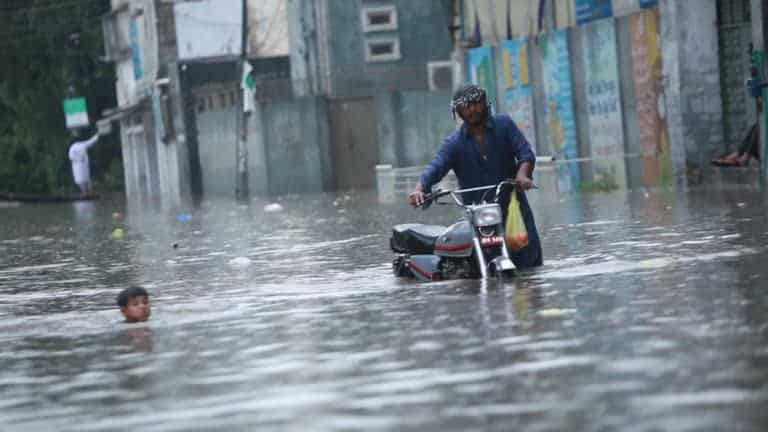
ISLAMABAD – Vast swathes of Pakistan are underwater, in a grim replay of a climate-driven nightmare that the country has scarcely recovered from. For weeks, unrelenting monsoon rains have unleashed catastrophic flooding, killing more than 1,500 people, displacing nearly four million, and laying waste to infrastructure and agriculture in a disaster officials are calling the worst since the devastating 2022 deluge.

From the agricultural heartlands of Punjab to the financial capital of Karachi and the remote valleys of the KPK, the scale of the destruction is staggering. The floods have laid bare the stark vulnerabilities of a nation grappling with political and economic instability while standing on the frontline of the global climate crisis.

A Nation Submerged, A Crisis Unfolding

The crisis began in earnest in mid-August, as what meteorologists termed a “monsoon on steroids” parked itself over Pakistan. The Pakistan Meteorological Department (PMD) reported rainfall nearly 40% above the 30-year average, overwhelming river systems and bursting embankments.

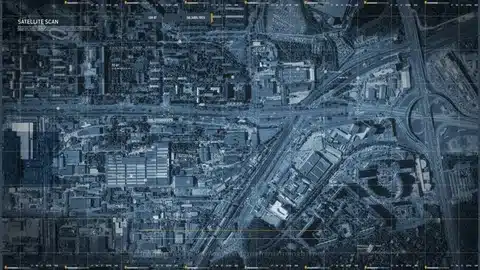
Satellite imagery shows a country drowning; the Indus River system has swollen into a miles-wide inland sea, swallowing villages and farmland whole. The National Disaster Management Authority (NDMA) reports that critical bridges, roads, and nearly 2,000 health facilities have been damaged or destroyed, severely hampering rescue efforts.

“We are racing against time,” a weary NDMA spokesman told reporters. “The immediate priority is rescuing those still stranded and getting life-saving aid to the displaced. But the water is everywhere. Access is our biggest challenge.”

In the aftermath, a second disaster is brewing. Health officials in Sindh province report a rapid rise in water-borne diseases like cholera, acute diarrhea, and mosquito-borne dengue and malaria, as millions are forced to drink contaminated water and live in crowded, unsanitary relief camps.

The Provinces: A Tapestry of Devastation

Each region tells a different story of the same catastrophe.

In Punjab, the nation’s agricultural engine, the Chenab, Ravi, and Sutlej rivers breached their banks, inundating key districts. Farmers stood helplessly as torrents washed away entire fields of cotton and sugarcane—crops vital to both their livelihoods and Pakistan’s fragile economy. The UN’s Food and Agriculture Organization (FAO) warns of a “catastrophic” impact on food security, with losses estimated in the billions of dollars.

In Sindh, the situation is dire. The southern province, still recovering from previous floods, has been hit with particular ferocity. In the megacity of Karachi, a malfunctioning drainage system collapsed under the biblical downpour, turning streets into rivers and stranding thousands. Further north, in rural Sindh, communities were washed away as the Indus overflowed, their mud-brick homes dissolving into the muddy water.

“The water took everything: my home, my animals, my wheat stores,” said Ghulam Sarwar, a farmer sitting on a raised highway in Dadu, now an island in a sea of floodwater. “We have nothing but the clothes we fled in.”

The mountainous terrain of Khyber Pakhtunkhwa (KP) saw a different kind of destruction. Here, the rains triggered violent flash floods and landslides that ripped through villages. The Swat Valley, a scenic tourist destination, now bears the scars of eroded riverbanks and collapsed roads. Residents speak of a wall of water arriving in the dead of night with little warning.

Balochistan, Pakistan’s largest and most impoverished province, has been effectively cut off. Flash floods severed road links, isolating entire communities. For the pastoralist communities who have lost their herds, the economic devastation is total and potentially irreversible.

Response and Recrimination

The government of Prime Minister Shehbaz Sharif has declared a national emergency and deployed the military, its primary disaster-response force, to lead rescue operations. Mr. Sharif has embarked on tours of the affected areas and issued urgent appeals for international assistance.

“The Pakistani people are facing a monsoon of suffering,” he stated in a televised address. “We are doing all we can, but the magnitude of this calamity is greater than any one country can handle.”

The international community has begun to respond. Aid flights from China, Turkey, and the UAE have landed in Islamabad carrying tents, food, and medicines. The United Nations is launching a formal flash appeal for funds.

Yet, on the ground, there is a palpable sense of anger and frustration. Survivors and local officials accuse the central government of a slow and disorganized response, alleging that aid is being distributed along political lines. Many question why lessons from the 2022 floods, which killed over 1,700 people, were not better applied.

“Where is the investment in early warning systems? Where are the dams? Where are the strengthened embankments?” asked Mariam Solangi, a climate activist in Hyderabad. “We mourn the lives lost, but we must also call this what it is: a failure of governance and foresight.”

The Unavoidable Truth: A Climate Crucible

Beyond the immediate crisis lies an inescapable and deeply unfair truth: Pakistan is paying a deadly price for a climate crisis it did little to create.

The country contributes less than 1% to global greenhouse gas emissions, yet consistently ranks among the world’s most climate-vulnerable nations. Scientists from the World Weather Attribution group, who analyzed the 2022 floods, found that climate change likely made the extreme rainfall more intense and more probable.

“This is not just a natural disaster; it is a man-made climate catastrophe,” explains Dr. Ayesha Qureshi, a climate policy expert at Islamabad’s Quaid-i-Azam University. “The warming Indian Ocean is fueling more intense monsoon systems, and our glaciers in the north are melting at an alarming rate. We are living the predictions of climate models today.”

The question now is what comes next. As the waters eventually recede, they will leave behind a country facing a reconstruction bill estimated at over $10 billion—a sum Pakistan’s debt-ridden economy can ill afford. The world’s attention, fleeting as it is, will move on.

But for the millions of Pakistanis starting from zero, and for a government trapped between recovery and resilience, the 2025 floods are a searing indictment of global inaction on climate change and a stark warning that for some nations, the future is already here.

Kashmir Floods 2025: Thousands Displaced, Hundreds Dead as Monsoon Devastates J&K, AJK, GB and Ladakh

0

MUZAFFARABAD – The first sound was the rocks, a deep, grinding roar from the mountains above. Then came the water, a churning, coffee-brown torrent that swallowed the wooden bridge in an instant. For Shakeela Bibi, huddled on her rooftop in Chattar Kalas with her children clutched tightly to her chest, the world narrowed to the relentless climb of the floodwater up her walls.

“I kept telling my children, ‘We will survive, we will survive,’” she recalled, her voice breaking as she pointed to the void where the bridge once stood. “But when the water took away my brother’s house, I realised we were all at Allah’s mercy.”

Her family was rescued hours later by local volunteers in a small, precarious fishing boat. Others in her neighbourhood were not so fortunate.

Shakeela’s story is one thread in a vast tapestry of loss and despair woven across the Himalayan region of Jammu and Kashmir throughout August and into September 2025. From the pilgrim trails of Jammu to the remote valleys of Gilgit-Baltistan, from the high-altitude desert of Ladakh to the communities of Azad Kashmir, torrential monsoon rains and catastrophic cloudbursts have unleashed a wave of destruction that has ignored political boundaries and united a divided land in a shared catastrophe.

A Region Submerged: No Land Untouched

The scale of the disaster is staggering in its geography and its severity. The floods have carved a path of indiscriminate ruin through territories administered by both India and Pakistan, exposing a common vulnerability to an escalating climate crisis.

In the Indian-administered Jammu division, a sudden cloudburst on August 14th turned the revered Machail Mata pilgrimage route into a death trap. Tons of mud and rock slid down mountainsides, swallowing entire groups of devotees. Official figures confirm at least 65 dead, with hundreds more missing, their fate likely sealed beneath the debris. Survivors spoke of devotional songs turning to screams, echoed in valleys suddenly cut off from the world.

Just days later, on August 26th, a massive landslide in Reasi buried homes and vehicles, claiming 38 lives. Among the dead were children visiting the Vaishno Devi shrine. One rescue worker, his hands raw and bleeding, described a grim scene: “We dug with bare hands because machines couldn’t reach. The mountain just came down on them.” By the end of August, the death toll in Jammu alone had surpassed 120, with infrastructure—bridges, highways, entire villages—washed away or isolated.

Further north, in the breathtaking but fragile terrain of Gilgit-Baltistan, a lethal combination of glacial melt and cloudbursts triggered devastating mudslides and flash floods. The human cost is profound: at least 45 lives lost, 993 houses completely destroyed, and 87 bridges collapsed, severing vital connections between communities. In a tragedy that struck at the heart of local resilience, seven young volunteers in Danyor lost their lives while courageously attempting to repair a drainage channel to save their town.

In Azad Kashmir, towns like Muzaffarabad, Bagh, and Bhimber were hammered by cloudbursts. In one heartbreaking incident, six members of a single family were buried alive as their home collapsed. The education system ground to a halt as schools were shuttered for days, their access routes blocked by landslides.

Even Ladakh, a high-altitude desert known for its stark beauty, was not spared. Swollen, furious rivers tore through centuries-old farmlands, destroying the traditional irrigation systems, or zings, that are the lifeline for agriculture. Communities were left with the cruel paradox of their homes being flooded while their future water security was washed away.

The Human Toll: Beyond the Numbers

The statistics are numbing, but they fail to capture the intimate texture of the loss.

  • ~122 deaths reported in Indian-administered Jammu & Kashmir and Ladakh in August.

  • ~45 deaths and nearly 1,000 homes destroyed in Gilgit-Baltistan, with 70% of the population in the Ghizer district affected.

  • An estimated 10-20 deaths in Azad Kashmir, with dozens more missing.

  • A national toll in Pakistan exceeding 800 dead and 150,000 displaced, with Azad Kashmir and Gilgit-Baltistan bearing a significant portion of the devastation.

Behind each number is a life upended. Farmers stand in silent shock where their annual crop once grew, now a wasteland of silt and rock. Children sift through the mud-filled ruins of their classrooms, searching for salvageable books. Families mourn not just loved ones, but the obliteration of generations of memory and livelihood—photographs, heirlooms, and carefully assembled dowries, all swept downriver.

Response and Resilience: Official Action and Community Gaps

Governments on both sides of the Line of Control (LoC) have scrambled to respond, announcing relief measures and deploying resources.

In Indian-administered Jammu and Kashmir, the administration pledged approximately ₹6 lakh (roughly $7,200) in compensation for each victim’s family. The Indian Army has been at the forefront, constructing temporary Bailey bridges to reconnect devastated districts like Ramban and Doda.

In Islamabad, the federal government approved $10.8 million in immediate relief aid for Gilgit-Baltistan. Across the territory, officials distributed tents, food packages, and established emergency shelters. In Azad Kashmir, Prime Minister Shehbaz Sharif directly handed out compensation cheques as part of a larger Rs 4 billion ($14.3 million) relief package, while local administrations ordered pre-emptive school closures for safety.

Yet, for many in the most remote and severely impacted areas, official help has been slow, insufficient, or entirely absent.

“We have not seen a single government official,” said Muhammad Ashfaq, a farmer from Ghizer whose home and fields were obliterated. “Our only help came from the youth of our own village.”

This gap has been filled by remarkable displays of community solidarity and established civil society organisations. Groups like the Aga Khan Development Network (AKDN) and local volunteer rescue teams have emerged as lifelines, evacuating thousands of stranded people, distributing essential supplies, and providing critical medical aid where state machinery has failed to reach.

The Unignorable Climate Catalyst

Scientists and researchers point to a clear and alarming pattern: the Kashmir Himalayas are on the front lines of the global climate crisis. The region experienced rainfall 726% above normal in August, a historic deviation not seen since record-keeping began in 1950. Rising global temperatures are accelerating glacial melt, adding immense volumes of water to already saturated watersheds and making such extreme weather events more frequent and more deadly.

“The data is unequivocal. Every year, the mountains are crumbling faster,” said Dr. Seema Qureshi, a climate researcher based in Srinagar. “What used to be once-in-a-generation floods are now happening every few years. The climate crisis is no longer a future threat; it is our present reality. Without serious, coordinated investment in adaptation, we will see these tragedies repeat and worsen.”

Voices from the Rubble

Amid the mud and ruins, individual stories of resilience and heartbreak paint the truest picture of the disaster.

In Muzaffarabad, 16-year-old Hina sifted through the rubble of her collapsed home, not for valuables, but for her schoolbooks and uniform. “I don’t know if I can return to school this year,” she whispered, her future as uncertain as the ground beneath her feet.

In Skardu, a shopkeeper watched, motionless, as volunteers dug through two feet of mud that had once been his livelihood. “It took me 20 years to build this,” he said, his voice hollow. “The river destroyed it in 20 minutes.”

And in Reasi, the echoes of the landslide were replaced by the sounds of desperate digging. As one rescuer recounted, the silence was the worst part. “We could hear them crying at first, but then the mountain had buried them alive.”

A Shared Future Forged in Crisis

The floods of 2025 have delivered a brutal lesson: rivers and storms do not recognise flags, borders, or lines of control. The water that rages through Muzaffarabad finds its source in the same mountains that overlook Srinagar; the clouds that burst over Gilgit affect the rivers that flow into Ladakh. The people of this region, regardless of administration, face the same existential threats from a changing climate.

Yet, the response remains fractured, tied to competing political priorities, bureaucratic hurdles, and short-term relief cycles. The path to long-term resilience requires a paradigm shift: transcending political divisions to share data and early warnings, investing in climate-resilient infrastructure and sustainable development, and, most importantly, heeding the voices of the communities who live with these escalating risks.

As the waters finally recede, the people of Kashmir, as they always have, begin the agonising work of rebuilding their lives from whatever scraps they can salvage. But the questions hanging in the rain-cleansed air are ones that demand an answer from governments and the international community alike: How many more Augusts like this can Kashmir endure? And when the next flood inevitably comes, who will truly stand with its people?

Additional reporting from contributors in Srinagar, Gilgit, and Leh. The Azadi Times maintains editorial independence and supports the right to self-determination for the people of Kashmir.

Allegations of Nepotism Rock Key TEVTA Appointments in Pakistan-Administered Kashmir

0

Muzaffarabad, Pakistan-administered Jammu and Kashmir – Allegations of widespread irregularities have emerged in the recent recruitment process at the Technical Education and Vocational Training Authority (TEVTA), the region’s only vocational training body, raising concerns over transparency, merit, and political favoritism.

TEVTA falls under the portfolio of Assembly Member Amir Altaf, elected from constituency LA-2 Hajira, Tararkhel. After a nine-month-long process, appointments were finalized earlier this year for six senior posts: four lecturers, one assistant director, and one accountant.

However, critics and whistleblowers allege that the entire recruitment drive was manipulated to favor the minister’s close associates and relatives of political allies—many of whom reportedly failed to meet basic merit criteria in standardized testing.

Court orders ignored, candidates allege bias

Opposition figures and candidates claim that judicial stay orders were disregarded during the process. Interview call letters were allegedly issued selectively, bypassing higher-scoring candidates. Even as legal challenges proceeded, merit lists were finalized and displayed, leading to accusations of deliberate bias.

For example, the candidate who topped the merit list for the accountant post had reportedly ranked 135th out of 135 in the National Testing Service (NTS) exam, raising questions about the credibility of the results.

Similarly, both top candidates for the lecturer (Mathematics) posts were close to the ruling elite: one is reportedly the wife of the minister’s legal officer, and the other the spouse of a politician who withdrew his candidacy in favor of Amir Altaf. Reports suggest one had scored only 58 marks in NTS, while the other had failed entirely.

Comparable allegations surround the appointments of the lecturer (Chemistry) and assistant director, both said to have direct links to the minister and his party network. Critics argue that despite hundreds of applicants from across the division, all six positions went to individuals from the minister’s constituency and political circle.

“Merit remains in the pockets of the powerful”

Analysts and rights groups argue the scandal underscores a systemic issue: the erosion of meritocracy in public service recruitment. They say citizens are often made to believe in transparent procedures, only to see the final outcome shaped by political patronage.

“Merit, in reality, exists only in the pockets of the powerful,” one education rights activist in Muzaffarabad told The Azadi Times. “This isn’t about individual jobs—it’s about keeping citizens dependent on political elites for survival.”

A wider pattern of governance failure

The controversy, critics say, reflects a colonial-style governance structure in the region, where public resources and opportunities are monopolized by ruling elites. Citizens are pressured to pledge loyalty to political patrons in order to secure employment, further entrenching dependence and stifling independent civic voices.

Observers warn that such practices not only erode public trust but also undermine the region’s long-term development by sidelining competent candidates in favor of political loyalists.

Calls for reform and accountability

Civil society groups are calling for a transparent, independent review of the TEVTA appointments and reforms in the recruitment system to ensure equal opportunity. Advocates stress the need for universal access to modern, scientific education, equitable job distribution, and fair resource allocation as the only path toward building a truly representative and progressive society in the region.

Until then, critics argue, the system will continue to produce “compliant dependents of the ruling class, rather than empowered citizens capable of shaping their collective future.”

Dozens Arrested in Kashmir After Pro-Independent Kashmir Slogans at Rawalakot Volleyball Match

0

Rawalakot, Azad Jammu and Kashmir (AJK) – Authorities in Pakistan-administered Jammu and Kashmir have registered two cases against young men accused of chanting slogans in favor of an independent Kashmir during a volleyball match and local festival at Rawalakot Stadium.

According to police records, 23 named individuals and more than 200 unidentified persons have been booked under a range of serious charges, including sedition, treason, terrorism, and interference in state affairs.

So far, more than 35 people have been arrested, with six of them remanded into police custody for 90 days under anti-terrorism provisions. Among those detained, rights groups say, is at least one minor. While two youths were released on Friday evening, police raids continue in search of other suspects.

Charges of sedition and anti-state slogans

The FIRs allege that the young men raised anti-Pakistan and anti-accession slogans, tore Pakistani flags, disrupted Independence Day celebrations, damaged police vehicles, and carried Kashmiri flags. Specific sections applied in the cases include 123-A, 123-B, 124-A, 121-A, and 6 of the Anti-Terrorism Act, often associated with treason, rebellion, and terrorism-related offenses.

Critics argue that such cases highlight the criminalization of political dissent in the region, where advocating self-determination or opposing Pakistan’s constitutional narrative on Kashmir is frequently met with state repression.

Freedom leaders demand unconditional release

In response, pro-independence organizations held an emergency meeting in Rawalakot, attended by leaders such as Jammu Kashmir Liberation Front (JKLF) chairman Sardar Muhammad Saghir Khan and former president of the National Awami Party (NAP) Sardar Liaqat Hayat.

The leaders condemned the FIRs, demanded the immediate release of all detained youths, and called for an end to police raids. They also announced a protest rally on Saturday afternoon at College Ground, warning that if their demands were not met by 1 p.m., the responsibility for any escalation would lie with the authorities.

A broader context of dissent

This is not the first time dissent has been met with sedition and terrorism charges in AJK. Analysts note that despite the region’s unique founding documents, which envisioned self-determination and political autonomy, successive governments in Islamabad have pursued policies that leave little space for dissenting voices.

The events in Rawalakot come amid heightened political sensitivities in the region, where Independence Day celebrations are often contested by sections of the population demanding either complete independence or recognition of Kashmir’s right to self-determination.

As the protest call gathers momentum, the situation in Rawalakot remains tense, with many fearing further arrests or clashes between demonstrators and law enforcement.

Founding Document vs. Recent Crackdowns: Questioning Democracy and Self-Determination in Kashmir

0

Muzaffarabad, Pakistan administered Kashmir — On August 13, more than 200 young people and students in Pakistan-administered Jammu and Kashmir (PAJK) were charged under allegations of raising slogans against Pakistan’s accession, desecrating the Pakistani flag, and committing “terrorism.” Over 35 have been arrested, with some placed on 90-day remand. In response, protest demonstrations have been called for this Saturday, where activists say they will announce their next course of action.

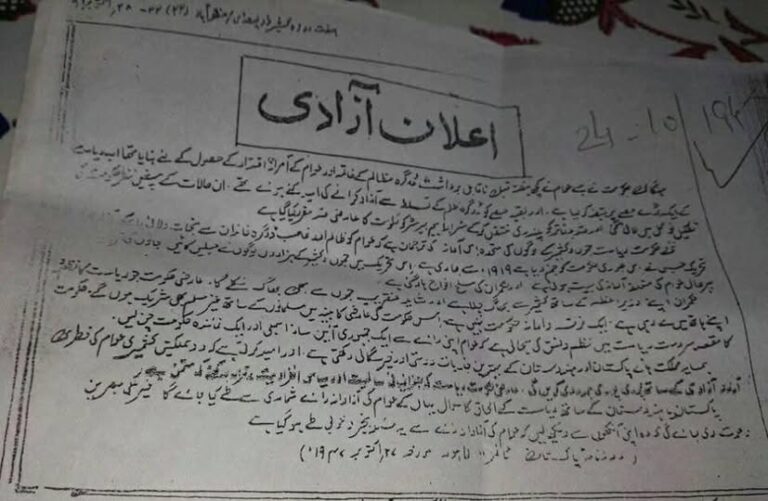
This development has reignited debate around the foundational document of the AJK government, the Declaration of Independence (1947). Many question whether the recent cases, arrests, and charges of treason are compatible with the spirit of that founding document — or whether, in fact, they represent its complete betrayal.

The founding declaration, drafted at the time of liberation from the Dogra regime, defined the new government as a temporary authority — tasked only with maintaining law and order until the people of Jammu and Kashmir could freely elect a democratic and representative constitutional assembly. It also envisioned a secular government inclusive of all communities, explicitly emphasizing Kashmir’s distinct political identity and territorial integrity, separate from both India and Pakistan.

Crucially, the document stipulated that any decision regarding accession to India or Pakistan could only be taken through a free and impartial plebiscite, monitored by international observers. Until then, the government’s role was to safeguard self-rule, ensure sovereignty, and prepare the ground for an elected body chosen by the people themselves.

By contrast, today’s political reality in PAJK is starkly different. Following the Karachi Agreement, Islamabad assumed control of key areas including Gilgit-Baltistan, finances, resources, refugee rehabilitation, and oversight of the freedom movement. Later, the 1974 Interim Constitution (Act 74) further institutionalized Pakistan’s dominance: any political activity challenging Pakistan’s accession, questioning its integrity, or advocating for independence was criminalized. Under this act, even candidates for the lowest public office — from peons to prime ministers — are required to sign a declaration of faith in Pakistan’s accession.

This legal framework has effectively outlawed the very principles enshrined in the 1947 Declaration. Talking about independence, autonomy, or self-determination is criminalized, while political parties, associations, and civil groups cannot legally exist if they refuse to endorse accession to Pakistan.

The recent arrests of students and activists in Muzaffarabad are seen by critics as a continuation of this colonial-style arrangement, where the sacrifices of Kashmiris are overshadowed by policies imposed in the name of Pakistan’s national interest. Dissenters argue that treating slogans — whether pro-accession or anti-accession — as treason undermines not just democratic rights but the very foundation upon which the provisional government was created.

The question many now ask is simple: Why has the original spirit of the Declaration of Independence been sidelined for over seven decades? The answer, historians argue, lies in the Pakistani state’s early intervention in 1947, when tribal militias shifted the seat of government to Muzaffarabad under Islamabad’s control. Since then, constitutional documents, from the Karachi Agreement to Act 74, have turned AJK into a de facto dependency rather than the independent, representative government envisioned in 1947.

The way forward, critics contend, still lies in returning to the principles of the founding document: establishing a genuine constituent assembly, enabling free choice through democratic means, ending the rule of colonial-style officers, and allowing the people of Jammu and Kashmir to determine both their internal governance and external relations.

Anything less, they argue, is not only a violation of democratic rights but also a betrayal of the sacrifices made in 1947 for freedom and dignity.

Google Maps in Kashmir: Tool of Convenience or a New Front in the Propaganda Battle?

0

Muzaffarabad, Pakistan-administered Kashmir — Authorities in Pakistani-administered Kashmir, Azad Jammu and Kashmir (AJK) have arrested a young man from Rawalakot’s Khai Galla area on charges of spying for India’s intelligence agency, the Research and Analysis Wing (RAW), allegedly in exchange for money.

According to a First Information Report (FIR) registered at Thana Panjgran in Muzaffarabad on July 23, the accused — identified as Muhammad Ubaid Jahangir, son of Muhammad Jahangir Shahid and resident of Khoiyan, Khai Galla (Rawalakot) — is accused of sending GPS coordinates and details of Bilal Mosque and Nala Shoai in Muzaffarabad to Indian handlers via WhatsApp. The FIR also claims he received financial compensation in return for the information.

Officials allege that Jahangir continued to share “sensitive data and details of key installations” with Indian intelligence. A case has been registered under the Official Secrets Act, and he remains in custody in Muzaffarabad.

Local residents of Khai Galla told reporters that the accused maintained links with the proscribed militant group Lashkar-e-Taiba (Jamaat-ud-Dawa). They alleged that his uncle, Shaukat (son of Samandar), is a known figure in the banned outfit and serves as a caretaker of a Jamaat-ud-Dawa mosque. Community members also noted that the family originally migrated from Indian-administered Jammu and Kashmir before settling in Khai Galla.

This is not the first such case. In March this year, another man, Saqib Ghani, said to be associated with Jamaat-ud-Dawa, was detained on accusations of having ties with the banned Tehreek-e-Taliban Pakistan (TTP). At the time, Pakistani authorities claimed that Indian agencies were backing such networks to destabilize the region.

The latest arrest has reignited debate in AJK about cross-border intelligence operations, the role of banned outfits, and the continuing security challenges in the territory.

Meanwhile, a separate controversy has emerged after an AJK minister, just days before renewed tensions between India and Pakistan, gave an interview near a mosque in which he reportedly pointed out a specific Google Maps location. While some critics claim the minister disclosed sensitive information, others argue that such data is already publicly accessible, raising questions about the motive behind the statement.

Social media users have accused the minister of carelessness, warning that highlighting such locations could be misused as a political tool against the people of Kashmir amid growing regional hostilities.

JK Joint Awami Action Committee, the 12 Migrant Seats, UN Resolutions, AJK Politics and Constitutional Questions

0

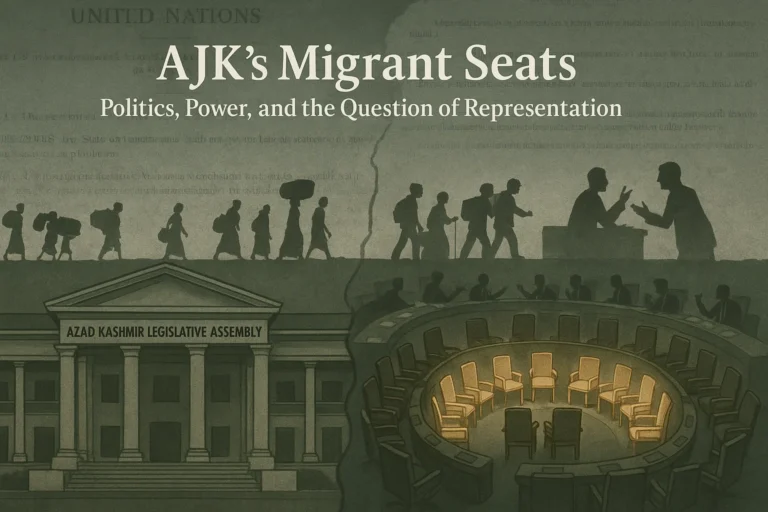
Muzaffarabad, AJK, August 6, 2025 — The Azadi Investigation Desk: In Pakistan-administered Azad Jammu and Kashmir (AJK), the political landscape has shifted dramatically following the Jammu Kashmir Joint Awami Action Committee’s (JKJAAC) call for abolishing 12 reserved seats for Kashmiri migrants in the Legislative Assembly. From the Prime Minister’s tours to Assembly debates, government figures have lined up to defend these seats while criticising the JKJAAC.

But at the heart of the storm lies a fundamental question:

Where did these 12 seats for migrants from Indian-administered Jammu and Kashmir originate? And do United Nations resolutions on Kashmir make any reference to them?

The answer touches not only constitutional law but also Kashmir’s political identity. Yet, strikingly, nearly three-quarters of AJK’s 4.5 million residents admit they do not even know what the UN resolutions actually say. This investigation traces the origins of the migrant seats, their legal framework, and the controversies surrounding them.

UN Resolutions on Kashmir (1947–1950)

Kashmir has long been debated at the United Nations. But the earliest resolutions, from 1947 to 1950, remain foundational. AJK politicians frequently cite them, especially now when almost every Assembly member links the migrant seats to the “freedom struggle.” But do the resolutions really mention them?

Resolution 38 (January 17, 1948): Called on India and Pakistan to reduce tensions and avoid steps that would worsen the conflict.

Resolution 39 (January 20, 1948): Established the UN Commission for India and Pakistan (UNCIP) to investigate and mediate.

Resolution 47 (April 21, 1948): Demanded Pakistan withdraw tribesmen and troops; urged India to reduce its forces. Called for a UN-supervised plebiscite to determine Kashmir’s future and recommended an interim administration with representation from all parties.

Resolution S/1196/Rev.1 (August 13, 1948): Proposed a complete ceasefire, Pakistani withdrawal, Indian troop reduction, and UN-supervised plebiscite.

Resolution S/1430/Rev.2 (January 5, 1949): Accepted by both India and Pakistan, affirming that the future of Jammu and Kashmir would be determined by “the will of the people.”

Resolution 80 / S/1469 (March 14, 1950): Reaffirmed earlier pledges, appointed Sir Owen Dixon as mediator, and once again stressed a plebiscite.

Across all these documents, there is no mention of reserved legislative seats for migrants. Migrants are only indirectly included as part of “the people” whose will must be determined through a plebiscite.

Constitutional Origins: From Interim Rules to 1974

For more than two decades after 1947, Azad Jammu and Kashmir (AJK) functioned without a formal constitution. Governance ran through executive councils and ad hoc arrangements, reflecting the uncertainty of Kashmir’s unresolved status.

In 1970, the AJK Interim Constitution Act introduced a basic structure, and by 1974, the Interim Constitution was formally enacted. It was here that 12 reserved seats for Kashmiri migrants were written into law.

The seats were divided equally:

  • 6 for Jammu migrants, settled mainly in Punjab and other parts of Pakistan.

  • 6 for Kashmir Valley migrants, residing in Khyber Pakhtunkhwa and nearby regions.

The intent was to give a political voice to those displaced during the 1947–48 war. On paper, it looked like a gesture of inclusion. In practice, however, these seats soon became decisive in AJK politics — often determining the survival or fall of governments.

What began as representation for refugees gradually turned into a power lever, shaping political dynamics in ways far beyond their original purpose.

Before the Migrant Seats

Between 1947 and 1970, Azad Jammu and Kashmir (AJK) was governed through a State Council, composed exclusively of representatives from areas physically under AJK’s control. During this period, migrants from Indian‑administered Jammu and Kashmir had no reserved political representation.

That changed with the constitutional reforms of the early 1970s. The introduction of 12 reserved migrant seats in 1970 — and their formal entrenchment in the 1974 Interim Constitutionpermanently altered AJK’s political landscape.

From that point onward, migrants were no longer outside the system. Their votes and representatives became pivotal players, shifting the balance of power in ways that continue to shape AJK politics today.

The UN and Representation

Do the UN resolutions permit or require migrant seats?

The clear answer is no. The UN never prescribed a political structure for AJK. It simply demanded that the “will of the people of Jammu and Kashmir from all parts of the state” be ascertained.

Resolutions such as S/1196 and S/1430 mention this principle, but they do not explain whether it should be through assemblies, constituencies, or direct plebiscite.

Thus, the 12 migrant seats are a purely local constitutional invention — not an international requirement.

Political Controversy

Over the decades, the 12 migrant seats have become a lightning rod for political debate in Azad Jammu and Kashmir.

Electoral imbalance: Migrant constituencies often contain far larger pools of voters than many AJK constituencies, producing serious questions about whether the system respects the principle of “one person, one vote.”

State Subject Rule: The criteria for who qualifies as a “state subject” — and thus eligible to vote on these seats — has been applied inconsistently, fueling accusations of manipulation.

Power politics: In practice, the 12 seats frequently serve as kingmakers. With AJK’s slim parliamentary margins, migrant representatives have often determined whether governments stand or fall.

Beyond technical concerns, the debate is also deeply political. Several AJK-based parties and activists refuse to even recognise these representatives as “genuine migrants.” They argue that many families have long since settled into permanent lives in Pakistan, far from refugee conditions. As a result, the seats, they claim, function less as a voice for displaced Kashmiris and more as instruments of electoral engineering — detached from the lived struggles of actual displacement.

Local Mechanism, Not Freedom Struggle

If examined neutrally, the migrant seats have no direct link to the freedom struggle or UN resolutions. They are a domestic political arrangement born of the 1970 and 1974 laws.

They were designed to represent displaced populations but have since become entangled in local power struggles. Until a UN-supervised plebiscite resolves the status of Jammu and Kashmir, these seats remain a temporary political device. Their future — abolition, reform, or continuation — depends on political consensus or judicial interpretation within AJK.

The 12 migrant seats in AJK’s Assembly are not grounded in UN resolutions, nor in international law. They are a local constitutional arrangement, introduced decades after partition to accommodate refugees but later co-opted into the power politics of Muzaffarabad.

As the Joint Awami Action Committee revives debate around their legitimacy, the migrant seats are once again at the centre of controversy. But the evidence is clear: they are not a pillar of the freedom struggle, but rather a domestic political mechanism whose relevance is being increasingly questioned.

Six Years After Article 370: Kashmir’s Unfinished Struggle for Self‑Determination

0

On August 5, 2019, the Government of India revoked Article 370 and 35A of its constitution, dissolving Jammu and Kashmir’s semi‑autonomous status and splitting the region into two federally governed union territories. The move was presented by New Delhi as an act of national integration.

For many Kashmiris, however, it was experienced as a rupture a unilateral decision that erased political identity and deepened a decades‑long conflict already shaped by wars, militarisation, and broken promises.

Six years on, August 5 remains one of the most contested dates in South Asia’s political calendar. While India celebrates it as a “new dawn,” Pakistan observes it as “Youm‑e‑Istehsal” — the “Day of Exploitation.” In between, ordinary Kashmiris remain caught in competing narratives, still waiting for the fulfilment of a promise made to them by the international community: the right to self‑determination under United Nations resolutions.

What Was Article 370 and 35A, and Why Did It Matter?

To understand the resonance of August 5, it is important to grasp what Article 370 and Article 35A represented.

Article 370 was written into the Indian constitution in 1949. It granted Jammu and Kashmir its own constitution, separate flag, and autonomy over all matters except defence, foreign affairs, finance, and communications. In practical terms, it meant that laws passed by the Indian parliament did not automatically apply to the region unless approved by the state legislature. The provision formalised the terms of Kashmir’s accession to India in 1947, which was described as temporary and conditional until a final settlement of the dispute.

Article 35A, introduced in 1954 through a presidential order, gave the J&K legislature the power to define who qualified as a “permanent resident.” This definition carried significant implications: only permanent residents could own property, secure government employment, or access certain scholarships and welfare benefits.

For many Kashmiris, these provisions were more than legal arrangements — they were seen as a fragile shield protecting the region’s demography, land ownership, and cultural identity from outside influence. Supporters viewed them as the minimum guarantee of political and social security within the Indian Union.

Critics in India, however, described them as outdated privileges that encouraged separatism, blocked investment, and hindered full integration. The ruling Bharatiya Janata Party (BJP) had long campaigned for their abrogation, calling Article 370 a “temporary” provision that needed to go.

On August 5, 2019, India’s parliament passed a resolution and presidential order that revoked both Article 370 and 35A. Jammu and Kashmir was reorganised into two federally governed union territories: Jammu & Kashmir, and Ladakh.

But for many Kashmiris, the decision carried consequences far beyond constitutional changes. Critics argue that the abrogation was not only a blow to autonomy, but also a deliberate tactic to divert attention from the real and unresolved issue: the right to self‑determination under United Nations resolutions.

Scholars and activists warn that by focusing the debate on special status, both India and Pakistan have managed to sideline the central question of Kashmir’s political future. As one Kashmiri historian put it: “Article 370 gave us autonomy, but it never gave us freedom. Its removal may have hurt us, but the larger denial remains the same — the denial of our right to decide.”

Political Reactions: Black Day vs. Celebration

The anniversary of August 5 continues to expose the stark political divide over Kashmir.

In Indian‑administered Kashmir, mainstream opposition parties such as the National Conference (NC), the Peoples Democratic Party (PDP), and the Communist Party of India (Marxist) observe the day as a “Black Day.” Their leaders argue that the 2019 decision to revoke Article 370 was carried out unconstitutionally and without the consent of the people of Jammu and Kashmir. They describe it as a “betrayal of trust” that violated the terms of accession agreed upon in 1947.

NC leader Omar Abdullah has repeatedly insisted that the abrogation stripped Kashmiris of dignity, while PDP’s Mehbooba Mufti has warned that the move has pushed the region into deeper political alienation. Smaller regional groups echo these concerns, calling the anniversary a painful reminder of broken promises.

Across the Line of Control, in Pakistan‑administered Kashmir and throughout Pakistan, the day is commemorated as “Youm‑e‑Istehsal” (Day of Exploitation). The government and civil society hold rallies, speeches, and seminars condemning India’s actions, with officials calling for international pressure on New Delhi to reverse its decision. Politicians in Islamabad describe August 5 as the day when “Kashmir was robbed of its identity,” and resolutions are passed in Pakistan’s parliament to reaffirm support for Kashmiri self‑determination.

Meanwhile, the Bharatiya Janata Party (BJP) government in New Delhi frames August 5 in starkly different terms. For the ruling party, the day marks the beginning of a “new Jammu and Kashmir” — one that is fully integrated into the Indian Union. The government highlights infrastructure projects, new business investments, and a boom in tourism as proof that abrogation has brought peace and development. Senior BJP leaders argue that removing Article 370 has ended a “temporary” provision that only fostered separatism.

But beneath these opposing commemorations lies a shared criticism from many ordinary Kashmiris: both narratives bypass their real aspirations. For them, August 5 is not simply about statehood or integration. It is about the absence of their own voice in decisions that shape their future.

The Silence on Self‑Determination

Since 1948, the United Nations Security Council has passed multiple resolutions affirming the right of the people of Jammu and Kashmir to decide their future through a plebiscite.

Seventy‑five years later, that vote has never been held.

Instead, the issue has been reframed through the lens of constitutional provisions like Article 370, bilateral agreements, or statehood debates. Yet, for many Kashmiris, these are side issues.

“Restoring Article 370 may bring autonomy,” explains a Kashmiri academic, “but it will not bring freedom of choice. The real issue is the right to self‑determination.

Pakistan’s Own Contradictions

While Pakistan positions itself internationally as a defender of Kashmiri rights, pro‑self‑determination groups inside Kashmir argue that Islamabad’s own record is far from clean.

On March 2, 1949, Pakistan separated Gilgit‑Baltistan from the wider state of Jammu and Kashmir, placing it under a federal‑appointed administration. Over time, Gilgit‑Baltistan was treated as a de facto semi‑province, despite being part of the territory recognised under UN resolutions.

For critics, this mirrors the unilateralism Pakistan condemns in India. Both states, they argue, have altered the map of Kashmir without the consent of its people.

This is why independent Kashmiri voices stress: the conflict is not simply India versus Pakistan — it is Kashmir versus the denial of its people’s right to decide their own destiny.

Atmosphere on Both Sides of the Ceasefire Line

Every year on August 5, the contrast is visible across the ceasefire line.

In Srinagar, heavy security deployment blankets the city. Political leaders are often placed under house arrest, rallies are restricted, and commemorations take place indoors with black flags and press statements.

In Muzaffarabad, the capital of Pakistan‑administered Kashmir, thousands pour into the streets waving Kashmiri flags, chanting slogans, and calling for UN intervention.

Media coverage mirrors the divide. Indian media emphasises development projects, rising tourism numbers, and investment opportunities. Pakistani media highlights human rights concerns, militarisation, and demographic engineering.

For many ordinary Kashmiris, these narratives feel distant from daily realities of unemployment, restricted freedoms, and uncertainty about the future.

Will Restoring Article 370 Solve the Issue?

This question continues to dominate political debate inside Indian‑administered Kashmir. For mainstream opposition parties, including the National Conference and the PDP, the restoration of Article 370 and 35A has become the central demand. They argue that the 2019 move was unconstitutional, carried out without consultation, and represented the erosion of a political compact that existed between New Delhi and Srinagar since 1947. For them, bringing Article 370 back is the first step toward rebuilding trust and dignity.

But analysts caution that even if these provisions were reinstated, the larger dispute would remain unresolved. Autonomy within India does not address the central question that has haunted the region for more than seven decades: Do the people of Jammu and Kashmir get to decide their own political future?

Article 370 is a constitutional issue, not a political solution,” says a Srinagar‑based lawyer. “The conflict is about whether Kashmiris get to decide their political future. Until that question is answered, constitutional fixes will only scratch the surface.”

Many young Kashmiris also share this view. For them, debates about 370 and 35A feel like distractions from the bigger picture — the right to self‑determination promised under United Nations resolutions. Restoring autonomy might restore limited protections, but it does not equate to freedom of choice.

As one university student in Muzaffarabad put it during a rally: “Whether it is Article 370, 35A, or even statehood, these are administrative matters. They do not answer our real question: who decides the future of Kashmir — India, Pakistan, or the Kashmiri people themselves?”

International Law and the Forgotten Plebiscite

The call for self‑determination in Kashmir is not just rhetoric — it is rooted in United Nations resolutions.

In 1948, the UN Security Council’s Resolution 47 called for a plebiscite after troop withdrawals, allowing Kashmiris to decide between India and Pakistan. Subsequent resolutions reaffirmed this, but disagreements over demilitarisation stalled implementation.

Over time, the issue slipped off the global agenda. Today, the international community largely frames Kashmir through bilateral talks, development, or counter‑terrorism, rarely mentioning the promised plebiscite.

For Kashmiris who still believe in that pledge, this silence feels like betrayal. As one activist put it: “The world remembers Kashmir when there is conflict, but forgets us when it comes to our rights.”

Kashmir’s Generational Shift

Perhaps the most significant change since August 5, 2019, is among Kashmir’s younger generation.

Many young Kashmiris, both in Srinagar and Muzaffarabad, express frustration at being caught in a conflict where their voices are peripheral. They argue that both India and Pakistan claim to speak for them, but neither allows genuine space for their aspirations.

Social media has amplified these voices. Campaigns emphasising “Kashmir belongs to Kashmiris” are gaining traction among students, activists, and diaspora groups worldwide.

This generational shift is redefining the conflict: less about integration with India or Pakistan, and more about independence of choice.

The Role of Gilgit‑Baltistan

Gilgit‑Baltistan’s story remains crucial to understanding Kashmir’s complexity. Its formal separation from the rest of Jammu and Kashmir in 1949 set a precedent for unilateral decisions about the region’s political future. Today, Gilgit‑Baltistan residents face their own struggles for constitutional rights and representation, even as their status remains undefined under international law.

For Kashmiri activists, GB stands as proof that both India and Pakistan have altered the region’s map without Kashmiri consent. Yet despite the absence of a clear constitutional or administrative link between Azad Jammu and Kashmir (AJK) and GB, an unusual relationship persists.

Over the past decade, parallel trends have emerged on both sides. In AJK and GB, grassroots groups such as Awami Action Committees have risen in response to local grievances, reflecting similar public anger over electricity shortages, taxation, and resource control. Political figures from GB have also engaged with Kashmiri leaders, reinforcing these cross‑border connections. Just last month, former AJK Prime Minister Sardar Attique Ahmed Khan visited Gilgit and paid respects at the grave of Amna Ullah Khan, founder of the Jammu Kashmir Liberation Front (JKLF) — a symbolic act highlighting shared histories of struggle.

Social media has further amplified these links. Platforms have allowed activists, students, and journalists from AJK and GB to exchange ideas, campaign together, and highlight each other’s movements in real time.

Even at the organisational level, cooperation is increasing. The Joint Awami Action Committee of Jammu and Kashmir recently added the demand for the construction of the Shoonter Tunnel — a vital project that would physically connect AJK and GB — to its charter. Calls are also growing for opening natural routes between the two regions, emphasising that any serious discussion of Kashmir’s future cannot exclude Gilgit‑Baltistan.

For many activists, this evolving relationship is a reminder that despite political boundaries imposed by states, the lived experiences of Kashmiris and Gilgit‑Baltistanis remain intertwined

What Lies Ahead?

The Supreme Court of India upheld the abrogation of Article 370 in 2023 but directed the government to restore statehood and conduct elections. As of August 2025, elections remain pending, and a new petition is set to be heard this week.

In Pakistan, political instability and economic crisis have limited space for meaningful engagement with Kashmir, leaving the issue primarily symbolic.

Internationally, Kashmir rarely dominates headlines, surfacing only during border skirmishes or human rights reports.

For Kashmiris, this neglect reinforces a sense of abandonment.

Conclusion:

The Unfinished Question

Six years after August 5, 2019, Kashmir continues to stand at a crossroads.

For India, the abrogation of Article 370 is framed as the moment of “final integration” — a decisive step to bind Jammu and Kashmir irreversibly to the Indian Union. For Pakistan, the same date is remembered as a day of “exploitation”, used to mobilise rallies, resolutions, and diplomatic appeals.

But for many Kashmiris, August 5 is neither integration nor exploitation. It is a reminder of promises unkept, voices unheard, and futures denied.

The demand is not simply about the restoration of Article 370 or 35A, nor about rhetorical solidarity offered from distant capitals. At its core, it is about the recognition of a fundamental and universal right: the right to self‑determination.

That right has been pledged in international law, repeated in UN resolutions, and echoed across generations — yet it remains unrealised. For young Kashmiris who have grown up in an environment of militarisation, censorship, and uncertainty, August 5 has come to symbolise not progress but paralysis.

Until the question of self‑determination is addressed — honestly, internationally, and with Kashmiris themselves at the centre of the conversation — the anniversary will remain less a celebration or a day of mourning than a stark symbol of unfinished history.

Gilgit-Baltistan: Floods Expose a Region Left to Struggle Alone

0

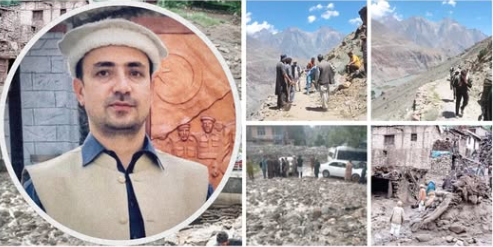
Gilgit Baltistan, (PaJK): High in the Himalayas, Gilgit-Baltistan part of the wider Kashmir region, is facing one of its worst environmental disasters in recent memory. Unprecedented glacier melt, heavy monsoon rains, landslides and glacial lake outburst floods have left behind a trail of destruction: homes washed away, roads cut off, bridges collapsed, and families displaced.

For residents, however, the devastation is compounded by something even more painful the absence of state support.

In Ghizer’s Khaltikhutum valley, a key section of the main highway was swallowed by floods and landslides. No government agency arrived. Instead, villagers — more than 500 of them — began clearing debris and building an alternative path with their own hands.

Such scenes have become common across Gilgit-Baltistan: ordinary people stepping in where authorities failed.

Scale of the Crisis

  • 500+ homes destroyed or damaged

  • 27+ bridges, roads, irrigation channels swept away

  • Dozens dead, many missing

  • Shortages of food, drinking water and medicines

  • Thousands forced into makeshift shelters

Districts across Gilgit, Ghizer, Diamer, Skardu, Shigar, Kharmang, Ghanche and Nagar have reported severe losses. Entire villages remain cut off, awaiting assistance that has yet to arrive.

Local voices are increasingly critical of what they describe as a “puppet administration” in Gilgit-Baltistan. Despite repeated warnings from climate scientists about the risks of glacier melt and flash floods, residents say there was no preparedness plan, no effective disaster response unit, and no early warning systems.

One community elder told Azadi Times:
“People here are burying their dead, rebuilding roads, and feeding each other. Officials appear only in photographs and press releases.”

Gilgit-Baltistan, often treated as a peripheral zone despite its strategic significance, is once again caught between geography and politics. The region is part of disputed Kashmir, yet in moments of crisis it finds itself on the margins of both governance and policy.

Analysts caution that neglecting Gilgit-Baltistan not only deepens humanitarian suffering but also fuels feelings of political abandonment in a population already sidelined.

Experts and activists have called for:

  • Transparent and immediate relief operations

  • Independent audits of disaster funds

  • Permanent disaster response units in each district

  • Restoration of communication networks

  • Active presence of public representatives on the ground

Gilgit-Baltistan’s people have once again shown resilience. But their question is simple: When disaster strikes, why must the region always be left to fend for itself?

Until that question is answered, the floods will remain not just a story of climate crisis — but a stark reminder of political failure in Kashmir’s northernmost region.

Khuiratta in Shock: Community Rises After 6‑Year‑Old Tasmiya Found Dead

0

Khuiratta, (PaJK) | The Azadi Times: The quiet town of Khuiratta in Azad Kashmir was shaken after the body of six‑year‑old Tasmiya Suhail, missing for three days, was found in agricultural fields late Saturday night. According to family sources, the area had already been searched “dozens of times,” raising suspicions that the child’s body was placed there deliberately after her death.

Tasmiya’s body was later transferred to THQ Khuiratta Hospital for post‑mortem examination.

The killing triggered one of the largest protests in recent memory in Banah Valley. Thousands of residents poured into the streets, blocking major chowks and demanding justice. Markets in Khuiratta remained completely shut as a mark of protest.

Community leaders declared: “We want justice for Tasmiya. The culprits must be hanged in the very chowk where this crime shocked us all.”

Demonstrators described the protest as a “historic moment” for the people of Banah, portraying it as proof that the valley’s residents are conscious, united, and unwilling to remain silent in the face of injustice.

Local administration faced intense criticism during the demonstrations. Protesters accused authorities of failing to ensure safety for children and demanded an impartial investigation into the case.

Several residents alleged that the discovery of Tasmiya’s body in an already searched field suggests a cover‑up or negligence. “This was not just an accident. Someone placed her body there later,” a family member told Kashmir Digital on condition of anonymity, citing safety concerns.

The tragedy has deeply shaken KhoiRatta, where residents describe Tasmiya as a lively child from Syedpur Peelan village. Her disappearance three days ago had already created anxiety, but the discovery of her body transformed sorrow into anger.

In Hajira and other nearby towns, solidarity protests erupted, with crowds blocking Siraari Chowk for hours before police attempted to disperse them.

Activists and locals are demanding swift action to bring the perpetrators to justice. Many argue that political instability in Pakistan has spilled over into Kashmir, leaving institutions weak and unable to provide security to vulnerable groups, particularly women and children.

“This is not just about one child. It is about the safety of every Kashmiri girl,” one rights activist said. “If justice is not delivered quickly, public anger will only grow.”

The case has highlighted not only the fragility of law and order in Azad Kashmir but also the deepening public distrust of state institutions. The scale of the protests indicates that the community sees this as more than an isolated tragedy — it is viewed as a test of whether justice and accountability can prevail in Kashmir without external political interference.