Monday, March 30, 2026
12.4 C
Srinagar
Home Blog Page 62

Everything You Need to Know About Kashmiri Dress for Men, Women, Girls, Where to Buy & Expert Tips

Kashmir, often called the “Paradise on Earth,” is famous not only for its breathtaking valleys and mountains but also for its rich cultural heritage. One of the most vivid expressions of Kashmiri culture is its traditional clothing, which blends centuries-old artistry, comfort, and symbolism. For locals and admirers worldwide, Kashmiri dress represents more than just fabric — it tells a story of the region’s history, identity, and craftsmanship.

What Makes Kashmiri Dress Unique?
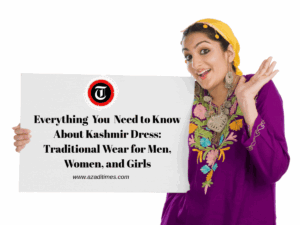
How to Choose, Where to Buy & Style Tips

At the heart of Kashmiri dress lies the famous pheran, a loose-fitting, woolen cloak that serves as both an everyday garment and a cultural symbol. Its design is perfectly suited to Kashmir’s cold climate, offering warmth without compromising elegance. Men and women alike wear the pheran, but the styles and embellishments differ significantly.

Read Also: Tech, Crafts, and Saffron: 15 Homegrown Business Ideas for Kashmiri Women

The Pheran: Kashmir’s Iconic Garment

  • Material: Traditionally made from wool or pashmina, the pheran is designed to keep the wearer warm during the harsh winter months. Modern variations may include silk or cotton blends for lighter wear.

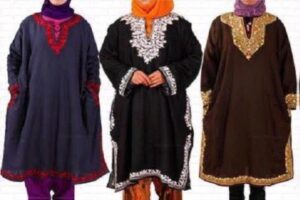
  • Design: Women’s pherans often feature intricate Kashida embroidery around the neckline, sleeves, and hemline. Men’s pherans are usually plainer but can also be decorated for special occasions.

  • Length and Style: While the men’s pheran typically reaches the knees, women’s pherans may be longer and are often paired with embroidered scarves or shawls.

Kashmiri Traditional Dress: A Closer Look

The essence of Kashmiri traditional dress lies not only in the garments themselves but in the intricate handcrafted details and symbolic patterns that adorn them. These dresses are more than just clothing—they are a vibrant expression of Kashmir’s rich cultural heritage and natural beauty. At the heart of this tradition is the exquisite art of Kashida embroidery, a craft passed down through generations of skilled artisans.
Kashida embroidery is renowned for its fine, detailed needlework, where artisans use silk or woolen threads to create stunning motifs that tell stories of the region’s flora and fauna. The embroidery designs are deeply inspired by Kashmir’s lush environment, featuring elements such as tulips, chinar leaves, vines, and other botanical forms. These motifs are not randomly chosen but hold symbolic significance—each representing aspects of nature, life, and spirituality in Kashmiri culture.

Read Also: Kashmiri Mehndi Designs: Timeless Henna Art for Hands & Feet Now Trending Globally

Creating a piece with Kashida embroidery is a labor-intensive process that demands immense patience and precision. Artisans often spend weeks, sometimes even months, meticulously stitching each design by hand. This slow and careful approach ensures that every thread is perfectly placed, resulting in a rich texture and depth that machine embroidery cannot replicate. The colorful threads contrast beautifully against the fine wool or silk fabric, making each garment a unique masterpiece.

Pashmina and Woolen Shawls

Pashmina, the world-renowned wool harvested from Himalayan goats, is a staple of Kashmiri clothing. The shawls made from this wool are soft, lightweight, and warm — perfect companions to the pheran. For centuries, these shawls have been a symbol of status and craftsmanship, often embellished with delicate embroidery or patterns.

Kashmiri Dress for Ladies: Elegance and Grace

The Kashmiri dress for ladies is a perfect blend of tradition and modern style. Women’s clothing typically combines the traditional pheran with contemporary fabrics and cuts, making it versatile for both everyday wear and special occasions.
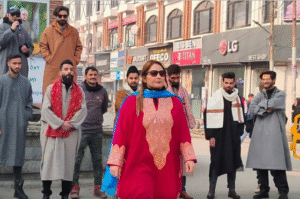
A woman at Srinagar’s Lal Chowk wearing a deep red traditional Kashmiri pheran with intricate Kashida embroidery during the International Pheran Day show.

Features of Women’s Kashmiri Dress

  • Embroidered Pherans: Women’s pherans are richly embroidered with Kashida work, featuring bright colors and intricate designs that enhance the garment’s elegance.

  • Pairings: These dresses are often worn with churidars or straight pants and complemented by colorful scarves.

  • Jewelry: Traditional silver and gold jewelry such as the Tujhoor necklace, bangles, and earrings add to the regal look.

  • Occasions: From weddings to religious festivals like Eid and Navroz, the Kashmiri dress for ladies is designed to shine in cultural celebrations.

Kashmiri Dress for Girls: Preserving Tradition Young and Bright
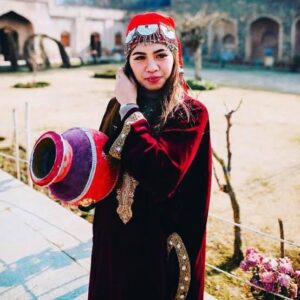
A young Kashmiri girl stands wearing traditional Kashmiri dress.


For the younger generation, the Kashmiri dress for girls is a charming adaptation of adult styles, maintaining cultural roots while allowing comfort and playfulness.
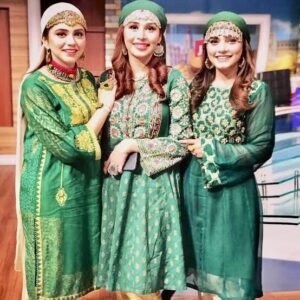
Nowadays, some Kashmiri pherans and dresses are sold in markets with altered basic colors like green, but the traditional and authentic color of the Kashmiri pheran is red.

Key Elements

  • Miniature pherans crafted from lighter wool or cotton.

  • Bright, floral embroidery reflecting Kashmir’s natural motifs.

  • Coordinated scarves and caps.

  • Light accessories suitable for children.

Parents often dress their daughters in these traditional outfits during family gatherings and religious festivals, nurturing a deep appreciation for their heritage.

Kashmiri Dress for Men: Tradition and Elegance

The traditional dress for Kashmiri men is deeply rooted in the region’s culture and climate, combining practicality with refined craftsmanship. The most iconic garment worn by men in Kashmir is the pheran—a loose, long cloak made from wool or other warm fabrics, designed to protect against the chilly mountain weather. Unlike the women’s pheran, which often features elaborate embroidery, the men’s version is usually simpler but no less dignified, symbolizing modesty and resilience.
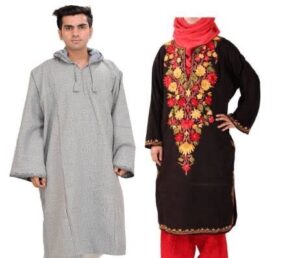
A Kashmiri boy and girl together wearing traditional Kashmiri dresses.

Underneath the pheran, men traditionally wear shalwar kameez, a comfortable and versatile outfit consisting of a long tunic (kameez) and loose trousers (shalwar). This combination allows ease of movement, suitable for both daily chores and formal occasions.

Read Also: Panzath’s Traditional Fishing Festival Blends Culture, Conservation, and Community Spirit

A key accessory in men’s traditional attire is the karakul cap, made from the wool of the Karakul sheep. This hat is a symbol of Kashmiri identity and pride, often worn during special events and gatherings. In colder months, men also use woolen shawls or pashmina wraps draped over their shoulders, providing extra warmth and an added layer of elegance.

Contemporary Trends and The Revival of Kashmiri Dress

Kashmiri designers—both local artisans and those working internationally—are at the forefront of this movement, reimagining traditional attire through innovative designs and fresh perspectives. One prominent trend is fusion wear, where classic pieces like the iconic pheran (a loose, flowing gown traditionally worn in Kashmir) are redesigned with sleek, tailored cuts and paired with casual Western staples such as jeans or trousers. This creates a harmonious balance between comfort, tradition, and urban style.

The intricate Kashida embroidery has also found new life beyond conventional garments. Its elegant floral and paisley motifs now embellish a variety of Western-style clothing—dresses, shirts, jackets—and even extend to accessories like handbags and scarves. This fusion not only highlights Kashmiri artistry but also makes it accessible to a diverse, fashion-forward crowd.

Sustainability has become a crucial aspect of modern fashion, and Kashmiri textiles fit perfectly into this narrative. The renewed focus on handwoven, natural fabrics such as pashmina, silk, and wool reflects a growing eco-conscious mindset among consumers. These materials are prized for their quality, durability, and minimal environmental impact, making Kashmiri fashion a symbol of both cultural pride and responsible consumption.

This ongoing revival is more than a trend; it is a powerful movement that supports local artisans, sustains traditional crafts, and introduces the timeless beauty of Kashmiri craftsmanship to the global stage.

Where to Buy Authentic Kashmiri Dress Internationally: Top Countries and Trusted Online Stores

The beauty and craftsmanship of Kashmiri dress are no longer limited to Kashmir or South Asia. Fashion enthusiasts and cultural lovers around the world can now easily purchase authentic Kashmiri traditional dresses online. Whether you live in India, Pakistan, the United States, China, the United Kingdom, Canada, or other countries, there are several trusted brands and online platforms that offer genuine, high-quality Kashmiri attire.

Popular Countries Where Kashmiri Dress is in High Demand

  • India — Besides Kashmir itself, major cities like Delhi, Mumbai, and Bangalore have seen growing demand for Kashmiri dress, especially among lovers of ethnic and traditional wear.

  • Pakistan — Kashmiri pherans and pashmina shawls are very popular, particularly in Azad Kashmir and Punjab.

  • United States (US) — The Kashmiri diaspora and fashion lovers in the US can find many online stores offering international shipping for authentic Kashmiri garments.

  • China — Appreciation for Kashmiri wool and embroidery has grown, with online platforms facilitating access to these traditional clothes.

  • United Kingdom (UK) — The South Asian community in the UK highly values Kashmiri traditional dress, available through several boutique stores and online shops.

  • Canada — Kashmiri dresses, especially woolen pherans and shawls, are in demand during cold months, with multiple online options providing international delivery.

Trusted Online Stores and Top Brands to Purchase Kashmiri Dress

  • Amazon (Global) — Amazon features a wide selection of Kashmiri pherans, pashmina shawls, and embroidered dresses with verified sellers offering worldwide shipping.

  • Etsy (Global) — Etsy is popular for handmade and traditional crafts; many Kashmiri artisans sell their authentic products directly here.

  • KashmiriShawl.com — A specialized online store delivering genuine Kashmiri pashmina shawls and pherans internationally.

  • Craftsvilla (India) — A leading ethnic wear platform in India offering a wide range of Kashmiri traditional dresses and accessories.

  • Daraz.pk (Pakistan) — Pakistan’s largest online marketplace, featuring an extensive collection of Kashmiri pherans and woolen garments.

  • PashminaHouse.com — Trusted for premium Kashmiri pashmina shawls and dresses, shipping to the US, UK, and Canada.

  • Fabindia (India, International Shipping Available) — Known for handwoven ethnic collections, Fabindia also offers Kashmiri-inspired designs.

  • Kashmir Box — A subscription box service delivering authentic Kashmiri crafts, including traditional dresses, shawls, and accessories worldwide.

Tips and Recommendations for Buying Kashmiri Dress

If you’re inspired to add Kashmiri attire to your wardrobe, authenticity and quality are key. Here are some tips:

  • Look for Handcrafted Embroidery: Machine-made embroidery lacks the depth and finesse of Kashida work.
  • Check Fabric Quality: Genuine pashmina is soft and lightweight, unlike cheap wool blends.
  • Check Shipping Policies: Different stores have varying shipping options, so verify that they deliver to your country before ordering.

  • Verify Authenticity: Always check seller ratings and customer reviews to ensure you receive genuine Kashmiri products.

  • Customs and Import Duties: Be aware that international purchases might be subject to customs fees or import taxes in your country.

Final Thoughts

The Kashmiri dress is more than just clothing; it is a living tradition, woven with history, art, and pride. From the iconic pheran to the delicate Kashida embroidery, every element tells a story of Kashmir’s vibrant culture. Whether it’s the elegant Kashmiri dress for ladies, the playful styles for girls, or the timeless traditional wear, these garments continue to captivate hearts worldwide.

For Kashmiris and admirers of global fashion, embracing Kashmiri dress means celebrating resilience, craftsmanship, and beauty — a true cultural treasure from the heart of the Himalayas.

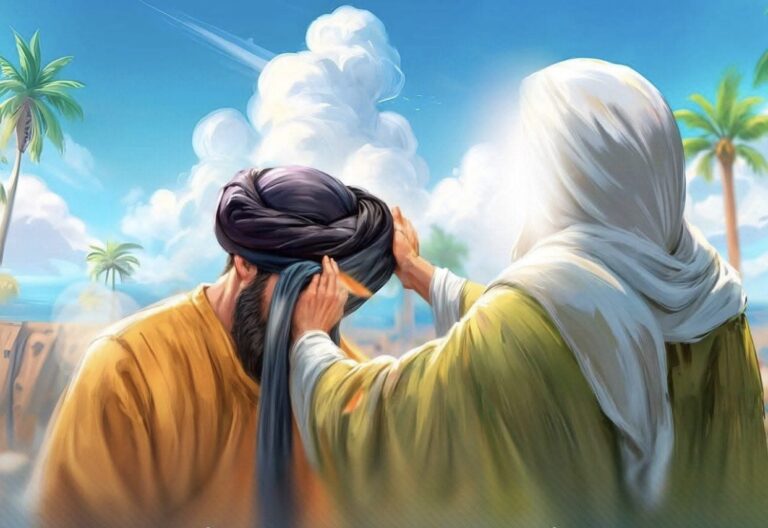
Eid e Ghadeer Poetry & Greetings | Eid Ghadeer Mubarak Celebration 2025

Eid e Ghadeer is among the most significant and spiritually powerful occasions in the Islamic calendar, especially for Shia Muslims around the world. Celebrated on the 18th of Dhu al-Hijjah, it commemorates the historic event at Ghadir Khumm, where Prophet Muhammad (PBUH) declared Hazrat Ali (A.S.) as his successor. The day is not only a political declaration of leadership but also a spiritual affirmation of divine will.

For many believers, “Eid e Ghadeer Mubarak” is more than just a greeting. It is a declaration of loyalty, a remembrance of divine guidance, and a poetic celebration of truth and justice.

The Poetic Spirit of Eid e Ghadeer

Poetry has always played a vital role in Islamic tradition, especially during religious festivals. On Eid e Ghadeer, poetry becomes a voice of allegiance, love, and remembrance of Wilayah (guardianship). Whether recited in majlis gatherings, printed in newspapers, or posted on social media, Eid Ghadeer poetry brings out the emotional and intellectual depth of this historic occasion.

Example of Traditional Eid e Ghadeer Poetry:

“Ghadeer ke mehdan mein, uthi jab Muhammad ki aawaz,
Ali hai mere baad, har Wali par ye hai Farmaan-e-Raaz.”

This couplet, like many others, echoes the divine appointment of Imam Ali (A.S.) and is recited by believers across the world to honor the day.

Why Poetry Matters on Eid Ghadeer

1. Expression of Devotion

Poetry on Eid Ghadeer allows believers to express their love for Imam Ali (A.S.) in words that are both emotionally rich and spiritually deep. These verses are often passed down generations, becoming part of the cultural memory of Shia communities from Kashmir to Karbala.

2. Cultural Preservation

In regions like Kashmir, Iran, Pakistan, and Iraq, poets write ghazals, qasidas, and manqabats to celebrate Eid e Ghadeer. These poetic traditions help preserve religious identity and serve as a form of cultural resistance in the face of oppression.

3. Medium of Education

Through rhyme and rhythm, Eid Ghadeer poetry teaches history, theology, and values of justice, courage, and loyalty. Especially for children and youth, it becomes an accessible way to learn about the Wilayah of Ali (A.S.).

Read Also: What is Eid al-Ghadeer? Significance, History, and Global Observance — A Kashmiri Perspective

Top 20 Eid e Ghadeer Poetry in Urdu

  1. Man kunto Maula, fa haza Ali-un Maula,
    Nabi ne kaha, Ali har ek ka Maula.

  2. Ghadeer ka paighaam hai roshni ka safar,
    Nabi ka farmaan, Ali hai Rahbar.

  3. Jahan Ali ka zikr ho, wahan Noor hi Noor,
    Ghadeer ke jashn mein hai har dil pur-suroor.

  4. Ghadeer Khumm mein uthi jo awaaz thi,
    Woh Rehmat-e-Rab ki misaal thi.

  5. Ali hai Wali, Ali hai Imam,
    Ghadeer ka hai yeh asal paighaam.

  6. Jashn-e-Ghadeer hai jashn-e-Wilayat,
    Yeh Eid hai sirf haq ki shanaakht.

  7. Ali se mohabbat hai imaan ki nishani,
    Ghadeer ka jashn hai sab se suhani.

  8. Ghadeer ki yaadon se roshan hai zameen,
    Har momin ke dil mein Ali ka noor hai hameen.

  9. Jis ne maana Ali ko Maula,
    Us ne paaya raah-e-huda ka taaj-o-tola.

  10. Ali ka zikr hai barkat ka sabab,
    Ghadeer ki khushi mein hai har dil khush tab.

  11. Ghadeer ka jashn hai rehmat ka nizaam,
    Ali ka naam hai har haq ka payaam.

  12. Ali ke bina adhoora hai deen,
    Ghadeer ne poora kiya Rasool ka yeh seen.

  13. Zameen bhi jhoom uthi, aasman bhi muskaraaya,
    Jab Nabi ne kaha: “Ali hai mera jaaya.”

  14. Ghadeer ka jashn hai Allah ka waada,
    Ali ka maqam hai sab se zyada.

  15. Ali ka zikr ho to milta hai sukoon,
    Ghadeer mein har lab pe hota hai junoon.

  16. Jashn-e-Ghadeer mein hai roshan har chiraagh,
    Ali ke naam se hai har saaz-o-raagh.

  17. Ali ke doston ko ho Eid e Ghadeer Mubarak,
    Mohabbat se bhar jaaye har ek dastarkhwan aur darakht.

  18. Ghadeer hai manzil bhi, raah bhi Ali,
    Nabi ka farmaan hai gawahi bhi Ali.

  19. Ali Ali har dil se nikle sada,
    Ghadeer ka paighaam hai sab se bada.

  20. Imamat ka jashn hai, Wilayat ka noor,
    Ghadeer mein hai har dil maghroor.

Trending Eid e Ghadeer Poetry

  1. Ghadeer ka jashn hai rehmaton ka silsila,
    Ali ka zikr hai har gham ka ilaaj-e-khila.

  2. Na ho ghamzada, agar tu Ali ka hai,
    Ghadeer ke jashn mein har zarra muskara raha hai.

  3. Nabi ne kaha, jise chaha maine,
    Ali usi ka Maula hai, har zamane ke liye.

  4. Jashn-e-Ghadeer aaya hai, roshan har dar ho gaya,
    Ali ka naam sunte hi, dil bhi sukoonwar ho gaya.

  5. Wilayat ka ye taaj hai, jise sir pe Nabi ne rakha,
    Ghadeer mein har mo’min ne Ali ka dast tha pakda.

  6. Eid e Ghadeer sirf Eid nahi, ye imaan ki pehchaan hai,
    Jo Ali se juda, wo haq se anjaan hai.

  7. Jashn hai us paighaam ka jo aasman se aaya,
    Nabi ne jise sunaaya, har mo’min ne wo paaya.

  8. Ghadeer mein na tha sirf ek elaan,
    Woh tha deen ka tamaam imtehaan.

  9. Ali ka zikr hai rehmat ki misaal,
    Ghadeer ka jashn hai mohabbat ka jaam-e-laal.

  10. Nabi ne uthaya haath, Ali ka kiya izhaar,
    Banaya Maula, diya Wilayat ka ikraar.

  11. Man kunto Maula ki goonj ab bhi hai zinda,
    Har mo’min ke dil mein Ali ka hai jhanda.

  12. Na ho udaas, Ali tera Maula hai,
    Ghadeer ka jashn tere liye toola hai.

  13. Jahan Ali ka naam ho, wahan noor hi noor hai,
    Ghadeer ki raat mein har dil mashkoor hai.

  14. Ali se jud kar mila hai raasta-e-hidayat,
    Ghadeer ka paighaam hai sirf haq ki riwayat.

  15. Ali ka zikr sirf manzil nahi, raasta bhi hai,
    Ghadeer ka paighaam har dil ka waasta bhi hai.

  16. Ali ke bina Deen adhoora rehta,
    Ghadeer ka jashn poori duniya ke liye rehta.

  17. Mubarak ho tumhein yeh Eid-e-Ghadeer,
    Har dua mein ho Ali ka zikr, har zikar mein ho taqdeer.

  18. Ali ka jashn manaayein, mohabbat ka geet gayein,
    Ghadeer ke roshan raaste par sab ko le aayein.

  19. Ali ke naam ka parcham har dil pe lehraye,
    Ghadeer ki raat har saans mein samaaye.

  20. Eid e Ghadeer ka paighaam hai sab se azeem,
    Nabi ka waris hai Ali, deen ka hai yeh naseem.

Modern Trends: Eid e Ghadeer Mubarak Poems Online

With the rise of social media, poetic greetings such as “Eid e Ghadeer Mubarak” are now shared widely online through:

  • Instagram reels featuring Eid Ghadeer couplets

  • Facebook posts with Urdu and Persian manqabats

  • YouTube videos of poetry recitations

  • Whatsapp status updates with poetic cards

This digital transformation has allowed Ghadeer poetry to reach global audiences, helping younger generations connect with their heritage in fresh and inspiring ways.

Sample Eid e Ghadeer Poetry in English

“On the day of Ghadir, the truth was made clear,
With the Prophet’s voice, we learned to revere.
‘Ali is your leader,’ the Messenger declared,
A moment divine, so eternally shared.”

This kind of English poetry has become increasingly popular among diaspora Muslims in the West, offering a bridge between heritage and modern expression.

Regional Flavor: Eid Ghadeer Poetry in Kashmir

In Kashmir, Eid e Ghadeer is marked by majlis, nasheed sessions, and poetry contests. Local poets write verses that merge classical Arabic influences with the cultural rhythms of the valley.

A Kashmiri couplet might sound like:

“Ghadeer ki yaadon mein hai roshan har ek chiraagh,
Ali ke naam par hai Kashmir ka har saaz-o-raag.”

From Srinagar to Muzaffarabad, believers chant “Eid e Ghadeer Mubarak” while attending events where poets read powerful lines in Urdu, Kashmiri, and Persian.

How to Say “Eid e Ghadeer Mubarak” Creatively

While the traditional “Eid e Ghadeer Mubarak” is beautiful in its simplicity, expressing this sacred greeting with heartfelt poetry and eloquent phrasing brings the spirit of Wilayat to life in a way that resonates deeply with every believer. Across Kashmir, the Muslim world, and in Shia communities worldwide, creative greetings are often used in calligraphy art, posters, social media captions, and Eid cards, carrying both reverence and rhythm.

Here are some inspired, poetic, and soul-stirring variations of saying “Eid e Ghadeer Mubarak”:

Poetic & Meaningful Greetings for Eid e Ghadeer

🔹 “Wasi-e-Rasool ko salaam ho, Eid Ghadeer Mubarak!”
Translation: “Salutations upon the successor of the Prophet — Blessed be this Eid of Ghadeer!”

🔹 “Jashn-e-Wilayah mubarak ho, har mo’min ko Ghadeer Mubarak!”
Translation: “May the celebration of Wilayah bless every believer — Eid Ghadeer Mubarak to all!”

🔹 “Ali ke naam ka parcham buland ho, Eid e Ghadeer Mubarak!”
Translation: “May the banner of Ali’s name fly high — Wishing you a blessed Eid e Ghadeer!”

🔹 “Man kunto Maula fa haza Ali-un Maula — Mubarak ho Ghadeer ka paighaam!”
Translation: “He of whom I am the master, Ali is his master — Blessed be the message of Ghadeer!”

🔹 “Wilayat ka taaj jisko mila, us Ali (A.S.) ko salaam — Eid e Ghadeer Mubarak ho!”
Translation: “Peace be upon the one who was crowned with Wilayah — Eid e Ghadeer Mubarak!”

🔹 “Ghadeer ka noor har dil mein chamke, Wilayat ka parcham sada lehraye — Mubarak ho yeh Eid sab ko!”
Translation: “May the light of Ghadeer shine in every heart, and the flag of Wilayah always wave — Blessed Eid to all!”

🔹 “Ali se mohabbat hai imaan ki shanakht — Eid e Ghadeer Mubarak ho, har haqparast ko!”
Translation: “Loving Ali is the mark of true faith — Eid Ghadeer Mubarak to every follower of truth!”

🔹 “Jahan Ali ka zikr ho, wahan rehmaat barsi ho — Eid Ghadeer Mubarak ho har us shakhs ko jo Wilayat ka raahi hai!”
Translation: “Where Ali is remembered, there mercy descends — Eid Ghadeer Mubarak to every soul on the path of Wilayah!”

🔹 “Ali Ali har dil ki sada ban jaye — Jashn-e-Ghadeer mubarak ho, doston!”
Translation: “May every heart echo with the name of Ali — Happy Ghadeer Mubarak, friends!”

Why Creative Greetings Matter

These poetic expressions do more than just convey good wishes — they celebrate a historic moment of spiritual succession. Eid e Ghadeer is not just a celebration, but a reaffirmation of allegiance to truth, justice, and divine leadership. In Kashmir and globally, such creative phrases are widely shared in:

  • Instagram reels and captions

  • YouTube manqabat and nasheed intros

  • Calligraphy artworks and posters

  • WhatsApp and Telegram greeting cards

  • Public banners in majalis and juloos

By using creative greetings, we add beauty, reverence, and identity to the message of Ghadeer — and keep the flame of Wilayat alive in every generation.

Key Themes in Eid Ghadeer Poetry

  1. Wilayah (Guardianship):
    Poetry focuses on the divine appointment of Imam Ali (A.S.) and his unmatched virtues.

  2. Unity & Justice:
    Many poems emphasize how Ghadeer symbolizes the triumph of truth and justice in Islam.

  3. Prophet Muhammad’s Sermon:
    Verses often cite the Prophet’s words, such as: “Man kuntu Mawla, fa haza Ali-un Mawla.”

  4. Love for Ahlul Bayt:
    Deep devotion to the family of the Prophet is a central pillar of Ghadeer poetry.

Popular Poets Who Wrote on Eid e Ghadeer

  • Allama Iqbal (indirect references)

  • Mir Anis & Dabeer (classical marsiya style)

  • Modern Urdu poets from Lucknow, Lahore, and Kashmir

  • Ayatollah Khamenei and other Iranian poets have also written lines to honor Ghadeer

Conclusion: The Eternal Light of Ghadeer Lives Through Poetry

Eid e Ghadeer is not just a date in history. It is a living event, commemorated in verses, echoing in hearts, and chanted in gatherings across the globe. Through Eid e Ghadeer poetry, generations are reminded of the trust placed in Imam Ali (A.S.), and the unbreakable chain of truth that began at Ghadir Khumm.

As believers greet each other with “Eid Ghadeer Mubarak”, they not only share joy but also revive a legacy of leadership, love, and unwavering faith.

What is Eid al-Ghadeer? Significance, History, and Global Observance — A Kashmiri Perspective

Eid al Ghadeer, known by various names such as Eid e Ghadeer, Eid ul Ghadeer, and Eid al Ghadeer, is one of the most important festivals in the Islamic calendar for millions of Shia Muslims worldwide. This commemorative event is celebrated in honor of the historic event at Ghadeer Khumm, where Prophet Muhammad is believed to have appointed his cousin and son-in-law, Ali ibn Abi Talib, as his successor.

While the occasion is steeped in rich tradition, spiritual symbolism, and theological debate, its multifaceted dimensions—spanning historical context, religious interpretations, and even political undertones—continue to prompt vibrant discussions among scholars, believers, and communities.

For the people of Kashmir—a region that has seen cultural intermixing and religious diversity for centuries—the celebration of Eid al Ghadeer holds a unique place in the collective memory.

What is Eid al-Ghadeer?

Eid al-Ghadeer marks the anniversary of the event of Ghadir Khumm, which took place on the 18th of Dhul-Hijjah in 10 AH (March 632 CE). According to Shia tradition, during his final pilgrimage (Hajj), Prophet Muhammad (PBUH), while returning to Medina, stopped at a place called Ghadir Khumm and made a profound announcement:

“Man kuntu mawlahu fa-hadha Aliyyun mawlahu”
“Whomsoever I am his master, Ali is also his master.”

This declaration is seen by the Shia community as a divine appointment of Hazrat Ali ibn Abi Talib (AS) as the Wali (guardian) and immediate successor to the Prophet.

Eid e Ghadeer in the Holy Qur’an and Hadith

Many Islamic scholars argue that this event is alluded to in the Holy Qur’an in the following verse:

“O Messenger, proclaim what has been sent down to you from your Lord. And if you do not, then you have not conveyed His message…”
(Surah Al-Ma’idah, 5:67)

Shia interpretations see this verse as a command to the Prophet to announce the leadership of Ali (AS), suggesting the immense gravity of the message. Numerous Hadiths from both Sunni and Shia sources also reference the event at Ghadir Khumm, although the interpretation and its implications differ.

Read Also: Top Shia Cleric Warns Against Exploitation of Gilgit-Baltistan’s Natural Resources

Historical Context of Eid al Ghadeer

The roots of Eid al Ghadeer can be traced back to the events of the 7th century, a time that witnessed the rapid spread of Islam and the mobilization of religious fervor across the Arab world. At the heart of this historical episode lies the event of Ghadeer Khumm—an oasis in the Arabian Peninsula where the Prophet Muhammad is said to have delivered a momentous sermon shortly after his Farewell Pilgrimage.

The Event at Ghadeer Khumm

According to Shia tradition, it was during this gathering that Prophet Muhammad, addressing a large assembly of his followers, declared Ali ibn Abi Talib as the “Mawla” or guardian and successor. For many Shia Muslims, this declaration was not merely a symbolic gesture but a clear designation of political and spiritual authority. The wording and context of the announcement have been the subject of intense scrutiny by historians and theologians alike. Whereas Sunni narratives emphasize the broader aspects of communal responsibility and leadership through consensus, Shia interpretations underscore the divinely sanctioned appointment of Ali—a cornerstone that defines their theological perspective.

How is Eid e Ghadeer Celebrated?

Global Observance

From Iran and Iraq to Lebanon, Pakistan, India, Bahrain, and Nigeria — Shia communities across the globe celebrate this day with great reverence:

  • Special Prayers & Supplications: Known as Dua Nudba and Ziyarat Ameenullah, these are recited to express allegiance to Imam Ali (AS).

  • Majalis (Religious Gatherings): Speeches, sermons, and poetry (manqabat/nauha) sessions commemorate the event.

  • Feeding the Poor: Acts of charity and food distribution are considered meritorious on this day.

  • Processions and Public Celebrations: Especially in cities like Najaf and Qom, large gatherings are held with banners and lights.

  • Renewal of Allegiance: Believers renew their commitment to the principles of Imamate and justice.

Differences in Historical Narratives

The divergent interpretations of what occurred at Ghadeer Khumm have contributed fundamentally to the Sunni-Shia divide in Islam. While Sunni scholars regard the event as an expression of fraternity and a reinforcement of social bonds among Muslims, Shia sub-traditions prioritize the concept of Imamate—a divine institution that sets their understanding of leadership apart. These contrasting worldviews have continued to fuel debate through centuries of Islamic scholarship, influencing not just religious beliefs but also political allegiances in various regions, including the volatile and diverse landscape of Kashmir.

Common Misconceptions About Eid e Ghadeer

Many Sunnis and even some Muslims unfamiliar with Shia theology confuse Eid al-Ghadeer with regular Islamic events. Here’s a quick clarification:

  • Not a Bid’ah: Eid Ghadeer is not an innovation but is based on a well-documented event, accepted even by Sunni historians.

  • Not Anti-Sunni: Commemorating Eid Ghadeer is not about sectarianism but about honoring a profound event of Islamic unity.

  • More than Political: It’s not just a political declaration but a spiritual covenant.

The Spiritual and Religious Dimensions

Eid al Ghadeer is much more than a historical commemoration; it embodies a profound sense of spiritual heritage and religious identity for Shia Muslims across the globe.

Theological Importance

For believers, the event of Ghadeer Khumm symbolizes a moment of divine clarity—a moment when the human and the divine converged to shape the destiny of the Muslim Ummah. By choosing Ali ibn Abi Talil as his successor, the Prophet Muhammad provided guidance on establishing an equitable society rooted in justice, knowledge, and the spirit of sacrifice. The celebration of Eid al Ghadeer hence becomes an annual reminder of these attributes, inspiring millions to reflect on the virtues of loyalty, humility, and service to humanity.

Rituals and Celebrations

The observance of Eid al Ghadeer is marked by elaborate ceremonies that combine elements of religious reflection, community bonding, and public discourse. Mosques around the world host gatherings where scholars recite historical texts, poetry, and sermons that recount the events of Ghadeer Khumm.

In numerous communities, processions are organized, and public speeches highlight the continuing relevance of the Prophet’s declaration, especially in turbulent times. Particular rituals vary from region to region, ensuring a rich diversity in the way this sacred event is observed. In Kashmir, traditional practices blend local cultural elements with broader Islamic observances, thus reinforcing a unique, locally adapted narrative around the festival.

Sermons and Literary Reflections

Scholars and theologians use the occasion as a platform to expound on key Islamic values—emphasizing the importance of justice, ethical leadership, and community solidarity. These sermons are not merely religious discourses; they serve as unifying forces that help bridge various sects and ethnic groups in the broader Muslim community. The philosophical and legal discourses woven around the event have often provided the intellectual groundwork for movements aimed at social justice and political reforms in several Muslim-majority regions.

Eid al Ghadeer in the Kashmiri Context

Kashmir, a region renowned for its breathtaking landscapes and storied history of cultural synthesis, offers an intriguing context for the celebration of Eid al Ghadeer. The convergence of diverse religious traditions in the valley has historically made it a microcosm of larger sociopolitical narratives influencing the broader South Asian subcontinent.

Eid Ghadeer in Kashmir

In Azad Kashmir and Indian-administered Jammu & Kashmir, where a significant number of Shia Muslims reside, Eid al-Ghadeer is observed with traditional zeal:

  • Religious Gatherings in Imambargahs: Towns like Muzaffarabad, Gilgit, Baltistan, Kargil, and Srinagar see large-scale gatherings.

  • Youth Participation: Speeches by scholars and youth activists emphasize unity, leadership, and Islamic values.

  • Cultural Events: Qasidas and local languages’ poetry pay homage to Hazrat Ali (AS).

  • Security Measures: Due to the volatile situation in the region, Eid Ghadeer processions are often conducted under strict security arrangements.

Religious Heritage and Diversity

In Kashmir, where Sufi traditions have long flourished alongside orthodox Islamic practices, Eid al Ghadeer assumes a particularly inclusive character. The festival provides an opportunity for different communities to engage in dialogues about leadership, spirituality, and cultural identity.

Kashmiri poets and intellectuals often draw upon the themes of Ghadeer Khumm to articulate a vision of a pluralistic society—one that honors its past yet strives for contemporary democratic ideals. For many in Kashmir, celebrating Eid al Ghadeer is both a religious duty and an assertion of cultural pride in an era marked by political upheaval and territorial conflicts.

Quotes from Scholars about Eid al-Ghadeer

Allama Tabatabai (Tafsir al-Mizan):
“The event of Ghadir Khumm is one of the most authentic traditions recorded by both Sunni and Shia scholars.”

Imam Khomeini:
“Eid Ghadeer is the day of allegiance, the day of brotherhood, and the day of Islam’s continuation.”

Dr. Ali Shariati:
“Ghadir was not merely about succession; it was the climax of Islamic idealism.”

Political Nuances and Social Movements

The political implications of Eid al Ghadeer are significant, especially in regions where history and ideology intersect. In Kashmir, the discourse surrounding the festival frequently intersects with broader narratives of self-governance, regional autonomy, and resistance to external pressures. Many Kashmiri leaders and activists have invoked the legacy of Ghadeer Khumm in their arguments for more accountable and representative forms of governance. The festival thus evolves into a symbol of empowerment—a reminder that true leadership entails a commitment to justice and the equitable treatment of all citizens.

The Global Impact of Eid al Ghadeer

While Eid al Ghadeer holds deep personal and communal significance for Shia Muslims, its impact transcends the boundaries of religious celebration. The festival has inspired artistic, literary, and political endeavors across the globe, playing an influential role in shaping global Islamic discourse.

Interfaith Dialogue and Community Building

Eid al Ghadeer serves as a catalyst for interfaith dialogue, inviting scholars, leaders, and laypersons from various religious traditions to engage in discussions about leadership and morality. By focusing on universal themes such as justice, integrity, and compassion, the festival fosters a spirit of inclusivity and collective responsibility.

International conferences, cultural festivals, and academic symposiums often feature panels on the legacy of Ghadeer Khumm, underscoring research that bridges historical narratives with contemporary challenges. These platforms not only deepen the understanding of Islamic heritage but also contribute to global efforts aimed at reconciling diverse cultural identities.

Political Symbolism in the Modern Era

In recent decades, the legacy of Eid al Ghadeer has been invoked by various political movements seeking reform and social justice. For many activists around the world—whether in the Middle East, South Asia, or beyond—the historical event serves as a powerful reminder that transformative change is possible when moral and ethical leadership is embraced. In regions where political narratives are often polarized, the story of Ghadeer Khumm has sometimes been deployed as a call to reject autocracy and to champion progressive, inclusive governance. This political symbolism has contributed to the continuing relevance of the festival in modern urban centers and border regions alike.

Contemporary Challenges and Future Perspectives

As the world becomes increasingly interconnected, the celebration of religious events such as Eid al Ghadeer continues to evolve. The interface between global media narratives, political activism, and digital storytelling has transformed how traditional festivals are perceived and celebrated.

Bridging Tradition and Modernity

One of the greatest challenges facing religious festivals today is balancing tradition with modernity. While the historical narratives and rituals associated with Eid al Ghadeer remain unaltered, emerging practices—driven by digital media and global discourse—offer new dimensions to how the festival is celebrated. In communities like Kashmir, where cultural history is deeply interwoven with political conflicts and emerging democracies, these evolving practices can either lead to a renaissance of cultural identity or spark further debate and division.

Interpreting Historical Narratives in a Global Context

Studying Eid al Ghadeer can significantly enhance one’s understanding of how religious traditions inform modern political ideologies. Whether it is by exploring the detailed historical accounts of Ghadeer Khumm or understanding the resulting theological debates, international scholars and curious readers can learn valuable lessons in leadership, ethical governance, and the importance of community solidarity.

FAQs About Eid e Ghadeer

Q1: Is Eid al-Ghadeer celebrated by all Muslims?
A: Primarily by Shia Muslims, though the event of Ghadir Khumm is acknowledged by Sunni traditions as well.

Q2: When is Eid al-Ghadeer in 2025?
A: In 2025, Eid al-Ghadeer is expected to fall on Tuesday, June 17, depending on the lunar calendar.

Q3: What is the best greeting for Eid e Ghadeer?
A: “Eid al-Ghadeer Mubarak!” or “Congratulations on the Day of Wilayah!”

Q4: How can I participate in Eid Ghadeer online?
A: Join livestreamed majalis, share educational content, or read Ziyarat Ameenullah online.

Final Thoughts

Eid al Ghadeer remains one of the most significant and multifaceted events in Islamic history. It encapsulates a broad spectrum of historical narratives, theological debates, and socio-political challenges that resonate with millions of Shia Muslims around the world. For the people of Kashmir, the festival takes on additional local relevance—serving as a beacon of cultural pride amidst an ever-changing regional landscape defined by conflict, resilience, and hope.

As the discourse around religious leadership and community solidarity continues to evolve, Eid al Ghadeer stands as a reminder that history, spirituality, and the quest for justice cannot be relegated to the annals of the past. Instead, they remain integral to our understanding of present-day challenges and the aspirations for a more inclusive, equitable future. In an increasingly polarized digital age, robust investigative journalism and balanced reporting on events like Eid al Ghadeer will remain crucial in bridging divides, fostering understanding, and ultimately empowering communities worldwide.

In conclusion, the narrative of Eid al Ghadeer is both a historical touchstone and a dynamic call for modern reform. For Kashmir—as well as for the global community—this celebration is an opportunity to honor a legacy that has shaped the course of Islamic civilization while inspiring future generations to strive for a more just and harmonious world.

Israel Intercepts Gaza-Bound Aid Ship Carrying Greta Thunberg and Prominent Activists, Detains Passengers Amid Ongoing Blockade

0

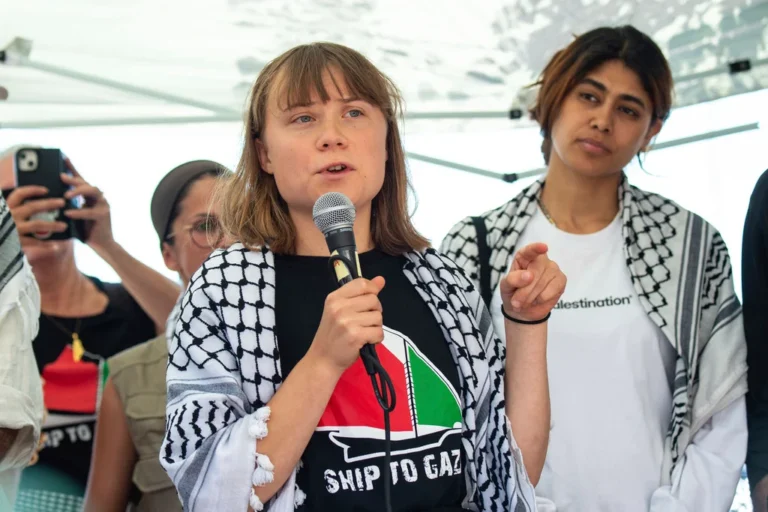
Muzaffarabad, June 9, 2025 — In a dramatic and controversial move, Israeli forces intercepted a Gaza-bound aid ship named “Madleen”, which was carrying climate activist Greta Thunberg and several other high-profile international activists. The vessel was detained in international waters and forcibly taken to Israel, where all passengers were held for questioning.

The Freedom Flotilla Coalition (FFC), the group organizing the mission, denounced Israel’s action as an unlawful attack and a blatant violation of international law. The “Madleen” was attempting to deliver essential humanitarian aid — including baby formula, food supplies, and medical equipment — to the Gaza Strip, which has been subjected to a stringent Israeli blockade for over 11 weeks. This blockade, amid more than 600 days of ongoing conflict, has worsened Gaza’s already dire humanitarian crisis, pushing its 2.1 million residents deeper into hunger and deprivation.

Details of the Interception and Detainment

Israel’s Foreign Ministry released statements early Monday, confirming that the “Madleen” was intercepted at sea and escorted to the shores of Israel. The ministry shared videos showing activists, including Greta Thunberg, sitting together in orange life jackets while being offered water and food by Israeli soldiers. Despite Israel’s assurances of humane treatment, the Freedom Flotilla Coalition labeled the incident a hostile boarding and kidnapping, describing how their vessel was subjected to aggressive tactics.

Read Also: Tensions Escalate in Los Angeles: Day Two of Violent Clashes Between Protesters and Federal Agents Amid Immigration Raids

The FFC reported via Telegram that Israeli forces used quadcopters around the ship that sprayed a white paint-like substance on the deck, which reportedly caused eye irritation among crew members. Communications with the ship were jammed, and disturbing noises were broadcast over the radio. A video posted by the Israeli Foreign Ministry showed a naval staffer warning the crew that the maritime zone off Gaza’s coast was closed. This, however, was contested by the FFC and human rights advocates as illegal interference in international waters.

Voices from Onboard: Greta Thunberg and Activists Respond

In pre-recorded videos released after communication was lost, Greta Thunberg said, “If you see this video, we have been intercepted and kidnapped in international waters by the Israeli occupational forces, or forces that support Israel.” Other activists echoed these sentiments, asserting that the mission was purely humanitarian and nonviolent.

Activist Yasmin Acar livestreamed footage from the ship showing the mysterious white substance on the deck and described the adverse effects it had on her eyes. The activists were eventually detained upon arrival at Ashdod port, Israel, where they were subjected to screenings and video presentations of Hamas attacks on Israel from October 7, 2023, as per Israeli Defense Minister Israel Katz’s instructions.

Human Rights Concerns and International Law

Human rights lawyer and Freedom Flotilla organizer Huwaida Arraf condemned the seizure of the “Madleen,” stating that Israel lacked any legal authority to detain international volunteers. She said the interception violated binding rulings from the International Court of Justice (ICJ) mandating unrestricted humanitarian access to Gaza.

The Israeli government, meanwhile, dismissed the flotilla as a “selfie yacht” carrying celebrities seeking media attention. Israel’s Foreign Ministry accused the activists of attempting to stage a media provocation and insisted that aid can be delivered through authorized humanitarian channels, rather than “Instagram selfies.”

Gaza’s Humanitarian Crisis: A Context to the Aid Mission

Since March 2, 2025, Israel has maintained a full humanitarian blockade on Gaza, cutting off food, medical supplies, and other essential goods. This has led to a rapidly deteriorating humanitarian situation for Gaza’s population of over 2 million. The United Nations has repeatedly warned that Gaza is facing a looming famine, with one in five residents at risk of starvation.

Although Israel began allowing a limited flow of aid into Gaza in late May, humanitarian organizations argue that the volume remains far below pre-conflict levels. New aid distribution mechanisms, including a US-backed group named the Gaza Humanitarian Foundation (GHF), have struggled to meet the enormous need and have faced deadly violence during attempts to distribute supplies.

The Freedom Flotilla’s mission to break the blockade by sea is part of ongoing efforts to challenge Israel’s restrictions and highlight the humanitarian crisis.

Reactions and Protests in Israel and Beyond

After the detention of the activists, approximately 15 demonstrators protested in Ashdod city, Israel, demanding the immediate release of the “Madleen” passengers. Protest signs read “Resist Genocide,” “Release the Madleen Activists Now,” and “Stop State Terror.” Such public protests are rare in Israel since the war’s escalation in 2023.

However, the protest was met with hostility by some Israelis. A passerby shouted in Hebrew accusing protesters of being “bullies” and “hooligans,” reflecting the deep divisions within Israeli society regarding the Gaza conflict.

The Freedom Flotilla Coalition: History of Defiance

The “Madleen” is the latest in a series of vessels organized by the Freedom Flotilla Coalition aimed at breaking the Israeli blockade of Gaza by delivering humanitarian aid via the sea. Last month, another flotilla ship called the “Conscience” was reportedly targeted by a drone attack off Malta in international waters — an incident claimed by organizers but not confirmed by Israeli authorities.

The “Madleen” set sail from Sicily last Friday, with activists publicly sharing the ship’s location through an online tracker until the moment communications were lost.

The Bigger Picture: War and Blockade in Gaza

The conflict that began over 600 days ago continues to take a heavy toll on Gaza’s civilians. Israel’s blockade and the ongoing war have left millions trapped without adequate access to food, medicine, and basic services. The international community has raised urgent calls for humanitarian access, yet the blockade persists.

Israel’s official stance is that the blockade and restrictions are necessary for its security, especially to prevent weapons smuggling to Hamas and other militant groups.

The interception of the “Madleen” and detention of Greta Thunberg and other activists has once again thrust the Gaza blockade and humanitarian crisis into the global spotlight. While Israel maintains it is enforcing security measures and legal protocols, activists and human rights groups decry the action as unlawful and inhumane.

As Gaza’s humanitarian situation worsens, missions like the Freedom Flotilla Coalition’s efforts symbolize ongoing international frustration with the blockade and the desperate call for urgent aid to reach those in need.

Muzaffarabad, Kashmir: The Historical Crossroads of Trade and Culture in the Heart of the Himalayas

Muzaffarabad, the capital of Azad Jammu and Kashmir (PaJK), has long stood at the intersection of Kashmir’s ancient trade routes and strategic travel corridors. While today it is known for its scenic beauty and political importance, its historic role as a key trade hub and river crossing point often goes unnoticed.

From ancient times to the British colonial period, Muzaffarabad’s geography and proximity to the Jhelum River made it a critical gateway between the subcontinent and Kashmir Valley. his city was once a bustling corridor where caravans, merchants, and armies passed through, carrying goods, cultures, and ideas across natural and political frontiers.

Ancient Trade Routes Through Muzaffarabad and Their Importance in Kashmir History

The network of trade routes passing through Muzaffarabad included paths such as Pakhli–Dhamtor–Pattan–Rarah–Chikar–Uri–Srinagar, linking the western Himalayan belt to Kashmir’s heartland. These routes served as economic lifelines for communities in and around Muzaffarabad, facilitating trade, cultural exchange, and military movements.

Read Also: Temples of Jammu and Kashmir: A Journey Through Sacred History & Hidden Heritage

One of the most challenging aspects of these trade routes was crossing the Jhelum River at Pattan Ghat near Muzaffarabad. Local communities used traditional methods like inflated animal-skin rafts to ferry goods and people safely across the river, demonstrating the ingenuity and resilience of Kashmir’s inhabitants.

The Jhelum River: Muzaffarabad’s Lifeline and Natural Barrier

The Jhelum River has always played a dual role in the geography and economy of Muzaffarabad and greater Kashmir. While it provided fertile lands and routes for trade, it also posed a significant barrier. Early crossings were fraught with danger due to the river’s swift current and deep waters. However, the arrival of British colonial administration marked a turning point in infrastructure development along the river and the surrounding areas.

British-Era Road Construction and Its Impact on Muzaffarabad’s History

By 1859, the British government prioritized linking the plains of Punjab to the Kashmir Valley to improve trade and military logistics. The construction of the Rawalpindi–Srinagar road, passing through Muzaffarabad, began in earnest. Between 1860 and 1870, roads connecting Rawalpindi to Murree and onwards to Kohala—near Muzaffarabad—were built, culminating in the completion of the iconic Kohala Bridge in 1871.

This bridge was a landmark engineering achievement, vastly improving the safety and speed of travel across the Jhelum River. It not only facilitated commerce but also enhanced military mobility, underscoring Muzaffarabad’s growing strategic importance.

Road Expansion: Connecting Kohala, Domel, and Srinagar

The British extended the road from Kohala to Domel and onward to Srinagar, covering a distance of approximately 126 kilometers. A British construction firm was contracted to complete this ambitious project in just two years—a feat that transformed the regional economy and infrastructure.

Read Also: Kashmiri Calendar: History, Evolution, and Cultural Significance

This expanded road network enabled the regular passage of carts, pack animals, travelers, and military convoys, increasing connectivity for Muzaffarabad and Kashmir as a whole. The enhanced accessibility helped Muzaffarabad evolve from a mere transit point to an essential hub of trade and communication.

Customs House in Muzaffarabad: A Historical Trade Regulation Center

Another key aspect of Muzaffarabad’s historical role in Kashmir’s trade was the establishment of a customs house by the princely state of Jammu and Kashmir. This customs checkpoint served to regulate goods entering and leaving the valley.

All commercial goods passing through Muzaffarabad were required to stop at this customs house for inspection, weighing, and taxation. Traders were issued a transit receipt upon payment of duties, allowing their merchandise to legally move onward. This system helped the state maintain revenue and control over the flow of commerce in and out of Kashmir.

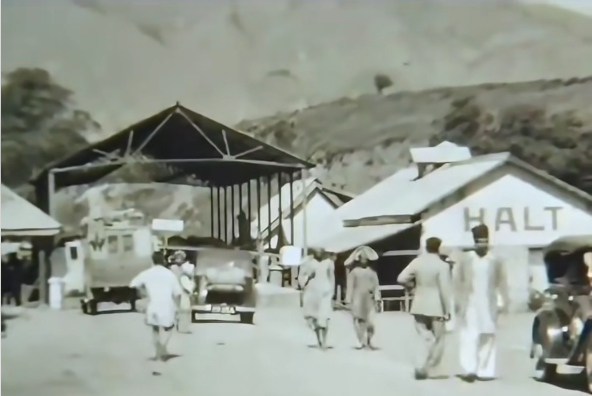
A Rare 1937 Photograph: Visualizing Muzaffarabad’s Historic Trade Scene

A rare historical photograph dating back to 1937 vividly captures the operations at Muzaffarabad’s customs checkpoint and weighing station, locally known as the Kanta House. This image provides a unique glimpse into the bustling trade activities and the regulatory mechanisms in place before the partition of India.

Historic 1937 photo of Muzaffarabad customs checkpoint on ancient Kashmir trade route.

The photograph is an invaluable record of Kashmir’s pre-modern economic landscape, highlighting Muzaffarabad’s pivotal role as a trade gateway and a node within larger commercial networks.

Legacy and Continued Relevance of Muzaffarabad’s Historical Trade Routes

Today, despite political changes and evolving economic conditions, the legacy of Muzaffarabad’s historic trade routes and infrastructure remains visible. The Rawalpindi–Srinagar road, Kohala Bridge, and remnants of the customs infrastructure continue to symbolize the city’s important position in Kashmir’s history.

These sites not only serve as reminders of Muzaffarabad’s past but also offer potential for heritage tourism and educational projects. Understanding this rich history helps frame the region’s contemporary cultural identity and economic prospects.

Written & Researched by:
Jawad Khurshid Kayani
Sheher Khas, District Muzaffarabad – Azad Jammu & Kashmir

Jammu Kashmir Joint Awami Action Committee Issues Ultimatum as Government Misses Charter Deadlines

    0

    Muzaffarabad, Azad Jammu & Kashmir (PaJK) – The Jammu Kashmir Joint Awami Action Committee (JKJAAC) has announced a renewed phase of action following the government’s failure to implement the remaining points of the agreed Charter of Demand. Despite granting a six-month extension after the final round of negotiations on December 7, 2024, the committee says no meaningful progress was made by the deadline on June 7, 2025.

    In a statement issued by Core Committee member Shaukat Nawaz Mir, the committee emphasized that repeated delays and broken promises have forced them to escalate demands. As of June 8, 2025, the committee has formally added five new demands to the original charter following a Core Committee meeting in Dheerkot on May 21, widely endorsed during a mass public event on May 24 – the Martyrs’ Day of JKJPAC.

    Newly Added Demands:

    1. Free and universal healthcare

    2. Equal and free education for all citizens

    3. Construction of an international airport in AJK

    4. A central Kashmir highway (motorway/expressway) from Neelum Valley to Bhimber

    5. Abolition of the 12 refugee seats and quota in the AJK Legislative Assembly

    JKJPAC now insists that any further negotiations with the state or federal institutions must strictly include these additional demands as non-negotiable conditions for dialogue.

    Read Also: Gilgit-Baltistan Police Arrest Awami Action Committee Gilgit Baltistan Leaders; Civil Society Condemns Political Tactics

    This move reflects growing frustration among citizens across the region, who have consistently supported the committee’s non-violent efforts over the past year. Observers warn that failure to act could deepen political unrest and widen the gap between state authorities and civil society.

    Tensions Escalate in Los Angeles: Day Two of Violent Clashes Between Protesters and Federal Agents Amid Immigration Raids

    LOS ANGELES, CALIFORNIA — Clashes between federal agents and protesters escalated for a second day on Saturday, February 16, in the southeastern neighborhoods of Los Angeles, particularly in Paramount, after a wave of controversial immigration raids executed by U.S. Immigration and Customs Enforcement (ICE) agents. The confrontations, marked by street fires, rubber bullets, and tear gas, have drawn national attention as tensions flare over President Donald Trump’s immigration enforcement policies and his administration’s pledge to tighten control over the U.S.-Mexico border.

    Immigration Raids Trigger Mass Protests

    The protests began late Friday evening, following an intensive round of immigration enforcement operations that resulted in the arrest of 44 individuals in Los Angeles for alleged immigration violations. ICE’s large-scale raids are part of the Trump administration’s controversial strategy to bolster border security, with President Trump recently setting a target of arresting 3,000 migrants per day at the U.S.-Mexico border.

    These raids have sparked fierce backlash from both local residents and immigrant rights activists, particularly in communities with significant Latino populations. In Paramount, demonstrators gathered in protest, rallying against the U.S. government’s aggressive tactics toward undocumented immigrants.

    Read Also: Public Rights Movement Demands Kashmiri Self-Determination and Justice

    Protesters, including several community organizations, have condemned the raids as inhumane, particularly as they have led to the mass separation of families and led to widespread fear in immigrant communities.

    Growing Tensions: Federal Agents Respond

    On Saturday, federal law enforcement agencies, including ICE and the Department of Homeland Security (DHS), intensified their presence in the area. The situation quickly became volatile, as officers responded to the protesters with tear gas, rubber bullets, and other crowd control methods.

    In response to the growing unrest, Christy Nome, the head of the DHS, issued a statement on social media, condemning the protests, stating: “You will not stop us. You will not slow us down.” In another statement, Tom Homan, the U.S. Border Czar appointed by President Trump, declared that the National Guard would be deployed to Los Angeles Saturday evening, to quell the violence and ensure the safety of federal officers.

    As of 5:00 p.m. local time, the National Guard’s deployment was expected to coincide with increasing unrest across the city. Eyewitness reports from the scene indicated that protesters were becoming more organized, with barricades being set up on streets and several police vehicles being set on fire in the chaos.

    On-the-Ground Images: A City in Turmoil

    Live images from Los Angeles showed riot police advancing through the streets, using their vehicles to shield themselves from angry demonstrators. There were reports of burning cars and shopping carts strewn across the road as barricades, creating a volatile and unpredictable environment.

    At one point, riot officers were seen in intense standoffs with the protesters. Though the crowds appeared to be dispersing toward the late afternoon, there were still pockets of protesters, with a few individual demonstrators clashing with federal officers.

    Read Also: Trump Meets Gaza Hostages at White House, Issues Final Warning to Hamas

    Local media outlets reported that a number of law enforcement officers had been injured in the confrontations, although no fatalities had been confirmed at the time of publication.

    Protestors shouted demands for the abolition of ICE and an end to the harsh deportation policies, while others voiced support for immigrant families affected by the raids. The demonstration’s slogans included “Trump Must Go Now” and “Justice for Immigrants.”

    Department of Homeland Security’s Reaction

    In the midst of the unrest, the Department of Homeland Security issued a statement accusing the demonstrators of engaging in violent and unlawful activities. The department claimed that over 1,000 protesters surrounded a federal law enforcement building, assaulting officers, slashing the tires of police vehicles, defacing government property, and causing damage to taxpayer-funded assets. The DHS vowed to continue its crackdown and stated that such violence would not deter its operations.

    Community’s Resentment of Federal Immigration Policy

    The protests are a response to the Trump administration’s immigration enforcement strategy, which has faced widespread criticism both domestically and internationally. Advocates argue that the policy disproportionately targets Latino and undocumented immigrant communities, especially in states with high immigrant populations like California, Texas, and Arizona.

    “These people are just trying to survive. We are doing our best to get by, and yet we face this treatment every day,” said Maria Lopez, a protester from the predominantly Latino neighborhood of Paramount, during an interview with Al Jazeera. “We need to stand up for our families, our neighbors, and our friends who are being torn apart by these raids.”

    Since Trump’s inauguration in 2017, the U.S. has experienced a marked increase in deportations, and the White House has been vocal in its support for ICE and other immigration enforcement agencies. Critics argue that these policies exacerbate racial tensions, particularly within immigrant communities.

    National Guard Deployed: Escalating the Crisis

    As the situation continues to develop in Los Angeles, many residents fear that the deployment of the National Guard will only escalate the crisis further. Though the White House has argued that the presence of the National Guard will help restore order, experts warn that the increased military presence in the streets could spark more violent confrontations.

    For immigrant rights groups, the involvement of the National Guard represents a dangerous precedent, with fears that the state will resort to military intervention to quash political dissent.

    “We are already dealing with a system that criminalizes immigrants and now they’re sending military personnel to intimidate us,” said Carlos Hernandez, an activist and spokesperson for the advocacy group Movimiento Cosecha. “It’s clear that this administration’s priority is power, not people.”

    Local and International Responses

    The protests in Los Angeles have garnered support from other immigrant communities across the United States and around the world. International reactions have ranged from condemnation of the U.S. government’s immigration policies to calls for increased solidarity with immigrants and refugees.

    The Mexican government has issued multiple statements denouncing the Trump administration’s aggressive stance at the border, while human rights groups have called for an end to mass deportations and family separations.

    Rep. Alexandria Ocasio-Cortez, one of the leading voices for progressive policy in the U.S. House of Representatives, tweeted: “The violence and racism facing immigrant communities today is unacceptable. We must call for the immediate abolition of ICE and stand against Trump’s militarization of our neighborhoods.”

    Meanwhile, Senator Bernie Sanders also weighed in on the protests, stating, “We are witnessing the cruel and unjust treatment of families who are simply seeking a better life. I stand with the people of Los Angeles and all immigrant communities who are being harmed by this administration’s policies.”

    Looking Ahead: What’s Next for Los Angeles?

    As the National Guard mobilizes in Los Angeles, the future remains uncertain. The deployment of additional federal troops could either pacify the situation or further inflame tensions. Given the explosive mix of immigrant rights activists, immigrant families, and federal agents, it’s possible that the protests could spread to other cities with significant immigrant populations.

    For many, the ongoing protests are not just about immigration policy; they represent a broader battle for justice, fairness, and dignity for those often ignored by the political establishment. As the unrest in Los Angeles continues, it remains clear that the debate over immigration policy in the U.S. is far from over, with no clear resolution in sight.

    The Future of AI Voice Cloning: How Free Tools Are Revolutionizing Content Creation in 2025

    In the rapidly evolving world of digital media, voice cloning technology has emerged as one of the most disruptive innovations of 2025. From creating highly realistic text-to-speech content to replicating voices for entertainment and marketing, AI-driven voice cloning is pushing boundaries and opening up new opportunities. In recent months, a new tool has begun to garner attention, offering an advanced and free way to clone voices with remarkable precision. This development is set to revolutionize industries across the globe, from content creation to digital advertising.

    Voice cloning is not entirely new, with tools like 11 Labs and Play.ht already popular in the market. However, a new platform called Hello AI, using a cutting-edge tool called Minimax.audio, promises even greater quality and accessibility. As AI tools become increasingly sophisticated, it raises significant questions about the ethical implications of voice cloning, its legal framework, and the future of content creation.

    In this article, we’ll explore the newest advancements in AI voice cloning, how they work, and their implications for various industries, including entertainment, digital marketing, and cybersecurity. Furthermore, we’ll examine the pros and cons of these new technologies and highlight the tools that are currently leading the market.

    The Rise of AI Voice Cloning

    Voice cloning technology has evolved dramatically over the past few years. Initially, AI-generated voices sounded robotic and unnatural, making them difficult to incorporate into professional settings. However, recent developments in deep learning and natural language processing have made it possible to replicate voices with stunning accuracy. These advancements have significant ramifications for content creators, brands, and even governments, as voice cloning can now be used for everything from dubbing films in different languages to creating hyper-realistic virtual assistants.

    At the forefront of these advancements is Hello AI, a platform that allows users to clone voices for free, a feature that has created a buzz in the digital content creation community. While several voice cloning platforms already existed, Hello AI’s integration with Minimax.audio promises a level of realism that previously required costly investments in voice talent and recording equipment. What makes this platform particularly appealing is its ability to generate voices with minimal effort and cost, making it accessible to anyone with an internet connection.

    How It Works: The Mechanics of Voice Cloning

    To clone a voice, users must upload an audio sample. This can be any recording featuring the voice they wish to replicate. The AI tool then processes the sample, isolating the unique characteristics of the voice, including tone, pitch, cadence, and accent. Once the AI has analyzed the voice, it can then generate synthetic speech in that voice, using only text input.

    Read Also: How to Safely Get a Free Amazon Gift Card: Tips, Legitimate Offers, and Scam Warnings

    In the case of Minimax.audio, users can upload a variety of voice samples, including celebrity voices such as Salman Khan, Shahrukh Khan, CarryMinati, and Dhruv Rathi. After uploading the sample, users can choose the language and accent they wish to generate, with options now including Hindi, English, and other regional dialects.

    Once the voice is cloned, the platform allows users to generate text-to-speech audio by simply typing in the desired content. The tool even allows for customization, enabling users to adjust the pacing, tone, and pauses between words to mimic natural speech patterns. The result is a hyper-realistic synthetic voice that can be used for a wide range of applications, from content creation to personal projects.

    The Power of Free Voice Cloning: Why It Matters

    The ability to clone voices for free is a game-changer for content creators. Historically, voice talent was a costly and often time-consuming endeavor. Even for small YouTube channels or indie filmmakers, hiring voice actors or narrators was often an expense that stretched budgets thin. With the advent of free voice cloning platforms, creators now have access to professional-quality voiceovers without spending a penny.

    Beyond entertainment, this technology opens up opportunities in fields like digital marketing, advertising, and virtual assistants. Brands can now create personalized ads in a wide array of voices, tailoring the message to specific demographics without the need for multiple voice actors. Additionally, virtual assistants and AI chatbots can be made more interactive and engaging by incorporating human-like voices that users can relate to.

    Moreover, voice cloning technology provides a new avenue for accessibility. For individuals with speech impairments or other disabilities, voice cloning can be used to create synthetic voices that sound just like their own. This could have profound implications for communication, allowing people who have lost the ability to speak to communicate more naturally through AI-generated voices.

    Ethical and Legal Considerations

    While the potential applications of voice cloning are exciting, they also raise important ethical and legal concerns. The ability to replicate a person’s voice opens the door to potential misuse. Deepfake technology, which can generate video and audio content that is nearly indistinguishable from reality, has already been used to create misleading content that can damage reputations or spread misinformation. With voice cloning, the risk of impersonation becomes even greater.

    The legal implications of voice cloning are still in their early stages. Currently, there are no standardized laws governing the use of cloned voices, and the practice of cloning someone’s voice without their consent could lead to legal action in some cases. For instance, if a cloned voice is used to produce misleading content or to impersonate someone for financial gain, it could be considered identity theft or fraud.

    To address these concerns, many AI voice cloning platforms are implementing safeguards, such as requiring users to provide proof of consent for voice samples before they can be uploaded and cloned. However, these safeguards are still in their infancy, and more work needs to be done to ensure that voice cloning technology is used ethically and responsibly.

    The Future of Voice Cloning

    As AI voice cloning technology continues to evolve, the possibilities for its use are virtually limitless. In the future, we can expect to see even more advanced features, such as the ability to replicate voices in real-time and the integration of AI-generated voices into virtual reality and gaming. This could lead to the creation of fully immersive virtual environments where users can interact with characters whose voices are indistinguishable from those of real people.

    In addition to entertainment and marketing, voice cloning has the potential to revolutionize industries such as education, journalism, and customer service. For example, educators could use voice cloning to create personalized lessons in their own voices, and journalists could generate audio versions of their written reports for accessibility purposes. Customer service representatives could use cloned voices to provide more personalized support to customers, further enhancing the user experience.

    Conclusion: A New Era in Content Creation

    The rise of AI-driven voice cloning technology marks the beginning of a new era in digital content creation. With platforms like Hello AI and Minimax.audio, users can now create hyper-realistic voice clones without breaking the bank. While the technology is still in its early stages, its potential to disrupt industries ranging from entertainment to marketing is undeniable. As voice cloning continues to evolve, it is essential that both the public and lawmakers stay informed about the ethical and legal challenges that come with this new technology.

    For content creators, marketers, and anyone interested in exploring the world of AI-generated voices, the future looks bright. Voice cloning is no longer a distant dream; it is a reality that is ready to be harnessed to create more personalized, engaging, and accessible content. The next step is ensuring that these technologies are used responsibly, ethically, and for the greater good.

    How Whop’s New Clipping Feature is Revolutionizing Online Earning Opportunities in 2025

    In 2025, one of the most exciting opportunities is provided by Whop’s content rewards program, which allows users to earn significant amounts by clipping and sharing viral content. What makes this program so appealing is its simplicity – all you need to do is clip moments from popular videos, add captions, and share them on various platforms.

    But as with any opportunity, there’s a catch. While this can be a lucrative path for many, the time-consuming nature of manual clipping and editing limits how much users can earn. That’s where artificial intelligence (AI) tools, such as Opus Clip, are transforming the landscape, enabling content creators and beginners to generate a steady stream of clips in a fraction of the time.

    Whop’s Content Rewards Program: A Game-Changer for Creators

    Whop’s content rewards program was launched to democratize online content creation. The premise is simple: creators post bounties, offering financial rewards to those who can clip moments from their content, enhance them with captions, and post them on various platforms. The amount you earn depends on the number of views your clips generate. The more viral your clip becomes, the more you earn.

    For new users, the process is simple:

    1. Join a Campaign – After signing up for the platform, users can browse available content rewards. These campaigns usually specify the amount paid per 1,000 views, along with the types of content that need to be clipped.
    2. Clip and Share – Once you’ve selected a campaign, you clip parts of the content (e.g., a podcast, video snippet, or live stream), add captions, and post the clips on platforms such as Instagram, TikTok, or YouTube Shorts.
    3. Earn Money – The more viral your clips go, the more money you can earn. The program is ideal for beginners, offering an entry point into digital content creation.

    In the right circumstances, it’s possible to earn substantial sums in a relatively short time, especially if your clips go viral.

    The Painful Catch: Time and Effort Constraints

    However, as any seasoned content creator will tell you, there’s a painful catch. While Whop offers users the chance to earn money from viral clips, the work involved can be extremely time-consuming.

    Read Also: How to Make Money from WhatsApp: Top Best Ways to Generate Income

    Clipping raw footage requires hours of sifting through long videos to find compelling moments. Afterward, creators must edit the clips by adding captions and fine-tuning them for each platform’s unique format. It’s not just about posting content – it’s about ensuring the clips are perfectly optimized for maximum engagement.

    The tedious nature of this process can significantly limit how much a creator can earn daily. A person could spend hours clipping just a handful of videos, and even then, there’s no guarantee the clips will go viral.

    The AI Revolution: Speeding Up the Process

    Frustrated with the manual labor, many content creators, including one prominent user who recently shared his experience online, have turned to AI tools for help. By leveraging advanced AI technologies, creators can vastly improve their productivity and output.

    The AI tool in question, Opus Clip, has become a game-changer in the world of content clipping and editing. Opus Clip automates the process of identifying viral moments within long-form videos, clipping them, and even adding captions automatically.

    How Opus Clip Works: A Step-by-Step Guide

    Here’s a closer look at how this AI tool transforms the clipping process:

    1. Upload Raw Content – First, users upload their raw footage, which could be anything from podcasts to interviews to live streams.
    2. AI Analysis – Opus Clip analyzes the content, automatically identifying the most viral moments based on trending topics, engagement patterns, and viewer sentiment.
    3. Clipping and Editing – Once the viral moments are identified, the AI tool creates short clips under 60 seconds and adds captions in a matter of minutes.
    4. Instant Publication – The clips can then be posted on multiple social media platforms, significantly improving the chances of going viral.

    By automating these tasks, Opus Clip allows users to produce 20-30 clips in the same time it would take to produce just one manually. This efficiency means that users can scale their efforts and maximize their earnings by clipping far more content.

    How Much Can You Really Earn?

    For those who manage to consistently produce viral content, the financial rewards can be substantial. On average, creators can earn anywhere from $2 to $3 per 1,000 views. With AI tools like Opus Clip, it’s possible to generate hundreds of clips per day, and therefore, significantly increase the chances of earning a large sum of money.

    For instance, in one case study, a creator used Opus Clip to produce 50 reels within an hour. One of those clips went viral and generated 50,000 views, which translated to $100 in earnings from just a single clip. By scaling this process, it’s possible to earn thousands of dollars a month, especially if you consistently create high-quality content.

    Choosing the Right Campaigns: Maximizing Your Earnings

    To maximize earnings, it’s essential to select the right campaigns on Whop’s content rewards platform. Here are some strategies for choosing the most profitable opportunities:

    1. Sort by Paid Out Amount – Always sort campaigns by the amount that has already been paid out. This ensures you’re selecting campaigns from creators who have a proven track record of paying their content clipppers.
    2. Avoid Full Budget Campaigns – Avoid campaigns that are near completion (e.g., 90% funded) as they may run out of money before you can generate enough views.
    3. Choose Campaigns Paying $2-$3 per 1,000 Views – This range typically offers a balance between reasonable requirements and decent earnings potential.
    4. Look for Multi-Platform Opportunities – Campaigns that allow you to post on multiple platforms (Instagram, TikTok, YouTube) increase the likelihood of going viral.

    By using these strategies, creators can find the highest-paying campaigns and avoid wasting time on underperforming ones.

    Leveraging AI to Gain a Competitive Edge

    One significant advantage of using AI tools like Opus Clip is that they allow creators to stay ahead of the competition. While most content creators are still manually clipping and editing their footage, AI users are able to work much more efficiently, increasing their chances of creating viral content and, in turn, earning more money.

    If you want to be a successful content creator in 2025, using AI tools to streamline your work is becoming increasingly essential. The traditional method of manually clipping and editing raw footage is no longer competitive – AI tools offer a way to produce far more content in less time, giving you an edge in the content rewards market.

    Final Thoughts: The Future of Online Content Creation

    The rapid rise of AI-powered tools like Opus Clip is reshaping the way people can earn money online. The combination of Whop’s content rewards program and AI-driven clipping technology offers a powerful opportunity for both beginners and experienced content creators to monetize their skills and efforts.

    However, the key to success in this space is efficiency. As the demand for short-form viral content continues to grow, those who can produce high-quality, engaging clips at scale will be the ones who reap the most rewards. With AI tools making the process faster and more efficient, the future of online content creation looks brighter than ever.

    As this trend continues to grow, expect more creators to adopt AI tools, making it the new standard for content creators across the globe. The potential is limitless, and those who get on board early will likely find themselves at the forefront of this digital revolution.

    Burkina Faso’s Revolutionary Transformation: 10 Groundbreaking Projects Reshaping the Nation

    Burkina Faso, a landlocked country in the heart of West Africa, is quietly redefining the narrative of development in the Global South. While many African nations continue to rely heavily on foreign aid, Burkina Faso’s trajectory under the leadership of President Ibrahim Traoré is a testament to the transformative power of sovereignty, strategic investments, and grassroots empowerment. The country’s journey is not just about economic growth; it’s a radical shift toward reclaiming control over its resources, infrastructure, and future. Through a series of innovative projects, Burkina Faso is proving that sustainable development does not require dependence—it requires determination, collaboration, and vision.

    From Tomato Fields to Global Agro-Industries: The Revolution of “Red Gold”

    One of the most groundbreaking projects spearheaded by Traoré’s administration is the $8 million tomato processing plant. For decades, Burkina Faso’s farmers watched helplessly as their bumper tomato harvests rotted by the roadside, often being imported back as expensive processed goods. The government’s solution: Build a state-of-the-art tomato processing plant in an agrozone with high yields, aimed not just at preserving the harvest, but at reshaping the entire agricultural value chain.

    The plant is more than an industrial facility; it is a weapon in the battle for food sovereignty. By processing tomatoes locally, the plant reduces Burkina Faso’s reliance on costly imported tomato paste from Europe and China. The economic ripple effect is substantial: Thousands of jobs are being created, from machine operators to lab technicians, local farmers to packaging producers. Most importantly, the plant promotes local ownership and reinvestment, ensuring that wealth stays within the Burkinabé economy.

    Read Also: Who Is Ibrahim Traoré? Everything We Know About Burkina Faso’s Young Junta Leader

    But this project goes beyond economics—it is a statement of principle: “Produce what you eat, eat what you grow.” The plant is built with state-backed investment, untainted by foreign aid strings, and is designed to serve as the first node in a nationwide network of agro-industrial facilities. Training centers for farmers are being established to equip them with the knowledge to maximize crop yields and diversify their produce. The goal is clear: transform Burkina Faso into the agro-industrial heart of the Sahel.

    Infrastructure as a Path to Independence: The $120 Million Bobo Dulaso-Ivory Coast Motorway

    Burkina Faso is not just building factories; it is also building roads, and the $120 million Bobo Dulaso-Ivory Coast Motorway stands as a symbol of the country’s new infrastructure-driven future. Stretching from Burkina Faso’s second-largest city to the Ivorian border, this highway is more than just a transportation route—it is a vital artery that will facilitate trade and regional integration.

    Historically, Burkina Faso has been a landlocked country, dependent on foreign-controlled transport corridors to access global markets. This new highway will not only streamline the movement of goods—such as locally processed tomato paste—but also reduce transport costs, boost trade with neighboring countries, and weaken the grip of former colonial powers. The Bobo Dulaso-Ivory Coast Motorway is a direct challenge to the legacy of trade dependence, and it is already catalyzing rapid development in the surrounding communities. Logistics hubs, markets, and housing clusters are sprouting along the route, creating jobs and ensuring that the benefits of this infrastructure project reach ordinary Burkinabé citizens.

    A Renewable Energy Revolution: Yelen Solar Power Program

    In a country where energy access has long been a challenge, Burkina Faso is taking bold steps to power its future—without relying on foreign oil or unstable grids. The Yelen Solar Power program, which is connecting over 150 villages to electricity for the first time, is a testament to the nation’s commitment to clean, sustainable energy.

    Read Also: Eid in Kashmir: Jamia Masjid Remains Locked for 7th Consecutive Year Amid Celebrations Across Valley

    The project uses mini-grids and standalone solar systems to bring electricity to schools, health clinics, markets, and households. This is not just about turning on lights; it is about creating economic opportunities. Solar power enables rural health centers to store vaccines, schools to extend hours of study, and local businesses to run refrigeration and lighting systems. With local technicians being trained to install and maintain these solar systems, the project is creating jobs and securing energy independence for Burkina Faso.

    More than just a power project, Yelen is a catalyst for industrialization, education, and digitization. With clean, decentralized power, the country can now industrialize on its own terms, reducing reliance on imported energy and allowing for greater control over its economic development.

    Revolutionizing Healthcare: The Bobo Dulaso Regional University Hospital

    Burkina Faso’s commitment to its citizens’ well-being is evident in the construction of the Bobo Dulaso Regional University Hospital, one of the most advanced medical facilities in the country. For years, the southwestern region of Burkina Faso suffered from inadequate healthcare, with outdated equipment and long travel distances to access proper care. Traoré’s administration is working to change that with a facility designed to provide modern healthcare services while also training the next generation of Burkinabé doctors and nurses.

    The hospital will offer specialized departments, surgical units, and digital health systems powered by the Yelen solar grid, ensuring that it can provide comprehensive care, from maternal health to emergency surgeries. The facility will not operate in isolation; new ambulance routes and data links will connect rural clinics directly to the hospital, ensuring that healthcare reaches even the most remote areas.

    The vision is clear: A strong nation starts by keeping its people alive, healthy, and educated. This is not just about building a hospital—it’s about creating a healthcare ecosystem that works for the entire population.

    Water Sovereignty: The Ziga 2 Dam and National Water Strategy

    Water is life, and Burkina Faso is taking unprecedented steps to ensure that its people have access to clean, sustainable water. The Ziga 2 Dam, located near the capital city of Ouagadougou, is designed to address chronic water shortages in the capital and beyond. The project is more than just a dam—it’s a lifeline for urban and rural communities alike.

    In a country where water scarcity has historically hindered development, the Ziga 2 Dam will provide a stable and clean water supply to hundreds of thousands of residents. Equipped with modern filtration systems, solar-powered pumping stations, and updated distribution pipelines, this project is designed with resilience in mind. It will not only provide water for domestic use but will also support industrial needs, improving sanitation, agriculture, and public health across the country.

    Ziga 2 is part of a broader strategy to ensure that water is available to everyone, everywhere. Through rainwater harvesting, rural water systems, and a focus on protecting aquifers, Burkina Faso is building water sovereignty, ensuring that access to this vital resource is no longer a luxury but a right.

    Building the Future: The Faso Mayo Urban Development Project

    Urbanization is rapidly transforming cities across the African continent, and Burkina Faso is no exception. The Faso Mayo Urban Development Project, aimed at constructing 50,000 affordable and sustainable housing units, is not just about building homes—it is about designing a future where cities grow with dignity, equity, and strength.

    Faso Mayo is a visionary project that integrates housing with essential services such as schools, clinics, markets, and public transport hubs. The development will use locally sourced materials and labor, providing jobs and stimulating the economy. It is a blueprint for urban development that focuses on people rather than profit.

    This project addresses the challenges of overcrowded slums and fragile infrastructure by creating livable, vibrant communities where residents have access to basic services and opportunities for social mobility.

    Burkina Faso’s Sovereign Bank: Empowering Citizens and Communities

    For many years, Burkina Faso’s financial system was dominated by international banks that prioritized foreign trade and urban elites, leaving rural communities and small businesses underserved. To address this gap, the government has launched Burkindam, the country’s first state-owned bank, designed to empower ordinary Burkinabé citizens and communities.

    Burkindam offers basic accounts, low-interest loans, microcredit for women, and mobile banking services in local languages. By providing financial access to rural communities, the bank is helping entrepreneurs secure startup capital, farmers invest in better equipment, and families save money without having to travel to the city. It’s a strategic initiative that is aligned with the government’s broader goals of economic inclusion and empowerment.

    A Digital Future: PAC Digital and the Digital Transformation of Burkina Faso

    In today’s world, digital control is power, and Burkina Faso is taking steps to ensure that its future is digitally sovereign. The PAC Digital project, a $150 million digital transformation initiative, aims to revolutionize the way the government delivers services, governs, and interacts with its citizens.

    At the heart of this transformation are two national data centers, designed to house everything from government records to medical databases. With the support of this digital infrastructure, public services will be digitized, allowing citizens to access important documents, apply for permits, and even enroll their children in school—all from their mobile phones.

    This digital transformation goes beyond government efficiency; it is about bridging the digital divide. By expanding network coverage to underserved areas and providing digital literacy training, Burkina Faso is preparing its citizens to thrive in the digital economy.

    Livestock Revolution: Transforming Burkina Faso’s Rural Economy

    In rural Burkina Faso, livestock is not just a livelihood—it’s a currency, a source of protein, and a symbol of wealth. However, for too long, the sector has been plagued by low yields, disease outbreaks, and informal markets. To address this, the government has launched the Livestock Sector Development Support Project, aimed at modernizing the entire sector.

    From veterinary care to commercial feed production, this initiative is injecting science, infrastructure, and capital into the livestock industry. It is not just about expanding herds—it is about turning livestock into a strategic economic sector, improving food security, and increasing income stability for rural communities.

    Conclusion: Burkina Faso’s Blueprint for True Independence

    Burkina Faso is not waiting for change—it is building it