Monday, March 30, 2026
11.8 C
Srinagar
Home Blog Page 73

Kashmir’s Tourism Industry Faces Devastating Impact After Recent Tensions: Losses in Millions

Srinagar — The recent surge in cross-border tensions, particularly following the Pehalgam attack, has severely disrupted the tourism sector in Jammu and Kashmir. As tensions continue to escalate, the once-bustling tourist activities across the valley have come to a halt, leaving thousands of families reliant on tourism for their livelihood, grappling with economic devastation.

One of the most visibly impacted sectors is the iconic houseboats and shikaras, with their owners lamenting significant losses. Traditionally, Dal Lake and Nigeen Lake have been buzzing with tourists, and the houseboats—floating luxury accommodations—have long been a hallmark of Kashmir’s tourism. But the current situation paints a starkly different picture. These serene waters, which once teemed with vibrant activity, are now eerily quiet.

Widespread Cancellations and Lost Opportunities

According to industry bodies, such as the Kashmir Chamber of Commerce and Industry, the Kashmir Hotel and Restaurant Association, and the Shikara Owners Association, around 90% of tourist bookings for the upcoming season have been canceled in the wake of rising unrest. Travel agencies report that houseboat bookings for May and June have plummeted by up to 80%. This sudden drop in tourist arrivals is largely due to the deteriorating security situation, which has caused travelers to reconsider or cancel their plans to visit the region.

The ripple effect has been felt across the region. Once-bustling spots like the Boulevard Road, Dal Lake, and Nehru Park, which used to host large crowds of tourists, have now fallen silent. A month ago, Nehru Park, which had been a popular tourist destination, was teeming with visitors, but now, it stands desolate.

Economic Fallout: Kashmir’s Tourism in Crisis

The impact of these cancellations on the local economy is profound. The Kashmir tourism industry, which contributes significantly to the region’s economy, is now facing what many are calling its worst crisis in recent memory. Many of the region’s houseboat owners and shikara operators are struggling to make ends meet. For these families, the uncertainty is unbearable. In particular, houseboat owners are reporting a drastic fall in income, with some estimating their losses at over INR 100 crore in just one month.

Former General Secretary of the Houseboat Owners Association, Mohammad Yaqub Don, shared that his business has suffered a loss exceeding INR 50 crore, attributing it to the sudden cancellations after the Pehalgam incident. He explained, “Bookings for May and June, which were traditionally a high season, have been canceled. The administration directed us to refund advance payments, which further exacerbated the financial strain.”

Shikara owners, who typically depend on peak-season revenue to sustain their businesses throughout the year, are also facing unprecedented losses. On average, a shikara operator would earn between INR 2,500 to 3,000 per day during the peak tourist season, but the current quietness has left them struggling to support their families.

A Silent Valley: From Bustling to Abandoned

The picturesque Dal Lake, a world-renowned destination for houseboats and shikaras, has gone from being a hub of vibrant tourism activity to a silent expanse of water. Similarly, Nigeen Lake, once known for its enchanting tranquility and row upon row of houseboats, now reflects the profound impact of the ongoing tensions in the region. The businesses that once flourished on these serene waters now find themselves in disarray.

In Srinagar, the traditionally crowded airport, which once saw long lines of domestic and international tourists, now reflects a stark difference. The reduced number of incoming flights and fewer tourists has caused a noticeable dip in the economy. The airport’s security checks have become quicker due to the reduced passenger volume, underscoring the drastic changes the region is undergoing.

Long-Term Concerns for Kashmir’s Tourism Resilience

While the immediate impact is grave, there are growing concerns within the industry about the long-term implications. Travel experts fear that not only is Kashmir witnessing a sharp drop in tourists now, but the region’s overall image as a tourist destination may also be adversely affected for years to come.

The Kashmir tourism industry, already vulnerable due to the ongoing political and security situation, now faces even more severe challenges. As the violence and instability continue, the region risks losing its status as a popular destination for travelers, especially those from abroad who may see Kashmir as increasingly unsafe.

Local businesses are finding themselves on the brink of collapse. Even small vendors, selling flowers, handicrafts, and local produce around the lakes, have reported steep losses, with thousands of people left without work. Haji Wali Mohammad, president of the Kashmir Taxi and Shikara Association, explained, “Last year, during this time, we couldn’t even take a breath, but this year, the situation is entirely different. Our boats are empty, and families are finding it difficult to survive.”

Government Measures and Response

In response to the mounting crisis, the government has initiated several measures to alleviate the situation. Airline operators and hotels have been urged to show flexibility in handling cancellations and rescheduling, but many stakeholders feel these steps are insufficient. Mohammad Yaqub Don highlighted that, while the government is offering assistance, it cannot replace the lost income that businesses have suffered.

Furthermore, local organizations, including tourism and trade associations, have demanded that the government take stronger steps to restore tourist confidence and secure the region’s reputation as a safe and welcoming destination.

An Urgent Call for Stability and Peace

As Kashmir continues to endure this difficult chapter, the cry for lasting peace and stability grows louder. The valley, which has long been a beacon for nature lovers, culture seekers, and adventure tourists, now faces the daunting task of restoring not just its tourism industry, but also its socio-economic fabric.

There is a palpable sense of urgency in Kashmir’s tourism community. The silence across Dal Lake and the empty houseboats are symbolic of a deeper, ongoing struggle—a struggle for peace, for freedom, and for an end to the turmoil that has long been a part of the region’s history.


Palestine Defeats Pakistan to Claim Historic West Asia Baseball Title

Karaj, Iran: In a thrilling final that went down to the wire, Palestine secured a historic 5-4 victory over defending champions Pakistan to claim the West Asia Baseball Championship title after a tense extra-inning showdown in Karaj.

The underdog Palestinian squad stormed ahead early, building a commanding 4-0 lead and putting Pakistan on the back foot. However, the defending champions mounted a dramatic comeback, clawing their way back into the game before finally leveling the score 4-4 in the ninth inning, sending the match into extras.

With momentum swinging between both sides, Palestine held their nerve, pushing ahead with a decisive run to seal a 5-4 victory and etch their name into the tournament’s history books.

The win marks a landmark achievement for Palestinian baseball, showcasing the team’s resilience and skill against a traditionally dominant opponent. Pakistan, the reigning champions, fought valiantly but fell just short in their bid to retain the title.

Fans celebrated the underdog triumph on social media, with #WestAsiaBaseballChampionship trending as supporters hailed Palestine’s breakthrough performance.

The victory not only cements Palestine’s rising status in regional baseball but also sets the stage for future international competitions. As the team returns home with the championship trophy, the win serves as an inspiring moment for sports in the region.

Two Israeli Embassy Staff Killed Near Jewish Museum in Washington D.C.; Netanyahu Orders Heightened Security Worldwide

Washington D.C. — Late Wednesday night, two employees of the Israeli Embassy were shot dead near the Jewish Museum in Washington D.C., officials confirmed. U.S. Secretary of Homeland Security, Kirstjen Nielsen, announced the killings via a social media post, describing the attack as brutal and expressing that investigations are underway.

“We are actively investigating the incident and will share more information as it becomes available,” Nielsen stated.

According to media reports, the two embassy staff were fatally shot. The Israeli Embassy spokesperson in Washington, Tal Naim, confirmed the deaths of two key personnel and expressed full trust in U.S. security forces to safeguard Israeli diplomats.

The attack has raised alarm internationally. In response, Israeli Prime Minister Benjamin Netanyahu announced an immediate global increase in security measures at Israeli diplomatic missions. “My heart goes out to the families of those who lost their lives in Washington,” Netanyahu said. “We will strengthen security at all Israeli embassies worldwide. This act was carried out by those who hate us, and they will pay the price.”

The incident comes amid heightened global tensions involving Israel and has further underscored the vulnerabilities faced by diplomats abroad. U.S. authorities have launched an intensive probe into the attack, which has sent shockwaves through both the diplomatic community and international observers.

This tragic event highlights the ongoing risks faced by diplomatic staff amid rising geopolitical conflicts and calls for robust international cooperation to ensure their safety.

Israeli Prime Minister Netanyahu Sets Strict Conditions for Ending Gaza Conflict

0

Jerusalem — Israeli Prime Minister Benjamin Netanyahu has outlined stringent conditions for ending the ongoing conflict in the Gaza Strip, demanding the release of all Israeli hostages, demilitarization of the enclave, and the removal of Hamas leadership from the territory.

In a press conference, Netanyahu emphasized his readiness to end the war only on terms that ensure Israel’s security. “All hostages will return home safely, Hamas will lay down its arms, relinquish power, and its leadership will be expelled from Gaza. The territory will be completely demilitarized,” he stated.

Netanyahu also stressed the importance of implementing the peace plan proposed by former U.S. President Donald Trump, describing it as a “precise and revolutionary” framework. “It includes a simple premise: residents of Gaza who wish to leave will be allowed to do so,” he said.

The Prime Minister criticized international calls for ending hostilities on terms he described as favoring Hamas. “Those demanding Israel to cease its operations are, in effect, supporting Hamas’s continued rule in Gaza,” he added.

The announcement comes amid an intensification of Israeli military operations in Gaza, which began last week under the codename “Operation Gideon.” Israeli officials claim the offensive aims to decisively weaken Hamas.

Read Also: Pakistani Architect Yasmeen Lari Rejects Israeli Award Over Gaza Genocide

Parallel to these military efforts, mediation talks are ongoing in Qatar, focusing on a ceasefire agreement and the release of Israeli hostages.

The renewed violence follows Israel’s resumption of attacks on Gaza starting March 18, after Hamas reportedly rejected the U.S.-brokered ceasefire extension, which had expired on March 1. Earlier in March, Israel cut electricity supply to Gaza and blocked humanitarian aid convoys, exacerbating the humanitarian crisis.

Context and Impact

The escalating conflict in Gaza has led to significant civilian suffering and heightened regional tensions. Independent observers and humanitarian organizations have repeatedly called for restraint and urgent humanitarian access to the affected population.

As the situation remains fluid, the international community watches closely, urging dialogue alongside efforts to protect civilian lives and uphold human rights.

Srinagar Registers Third-Highest May Temperature in 133 Years Amid Intense Heatwave

Srinagar, (Indian administered Kashmir) — In a striking indicator of the intensifying climate crisis in the Himalayan region, Srinagar on Thursday recorded its third-highest temperature ever for the month of May, with mercury touching 34.4°C, according to independent meteorological observers.

Faizan Arif Keng, a well-known independent weather forecaster based in Kashmir, confirmed that Thursday’s temperature of 34.4°C marks the highest recorded in the Valley this season, and is only marginally higher than the 34.3°C recorded on May 28, 1971.

“This is the third-highest maximum temperature in May recorded at the Srinagar station in the last 133 years,” Keng said in a statement shared with journalists and posted across social media platforms, where his climate data regularly informs public discourse.

Check Also: Srinagar Weather

The all-time May record in Srinagar remains 35.0°C, set in May 1894. However, the latest data underscores a concerning pattern of rising temperatures in a region historically known for its mild summers.

Heatwave Sweeps Kashmir

Jammu and Kashmir is currently in the grip of a severe heatwave, with cities and rural districts alike facing extreme weather conditions not typically associated with the region at this time of year.

In response, local health departments and disaster management officials have issued advisories, urging the public to avoid direct sun exposure, stay hydrated, and limit outdoor activities during peak hours. Schools in various districts have also adjusted their operating hours due to the oppressive heat.

“This level of heat is uncommon for Kashmir, especially in May,” said Dr. Samina Qadri, a public health official in Srinagar. “We are monitoring vulnerable populations closely, particularly the elderly and children who are more prone to heatstroke.”

Environmental Concerns Grow

Climate scientists and environmental activists in the region have linked the increasing frequency of such heat spikes to broader trends in climate change, deforestation, and unplanned urban development.

“From glacial retreat to erratic rainfall and now record-breaking heat, the signs are all around us. The Himalayas are no longer shielded from the climate crisis,” said Dr. Asif Maqbool, a climate researcher at the University of Kashmir.

Independent observers have raised alarm over the lack of robust infrastructure and policy preparedness to cope with extreme weather events in Kashmir, a region already reeling from ecological and political stressors.

The rising temperatures serve as a wake-up call, say civil society groups. “What we are witnessing is not just a weather anomaly, but a long-term shift. There needs to be stronger governmental response and local adaptation strategies,” said Farhat Shah, director of the Kashmir Environmental Watch, an NGO based in Baramulla.

Farmers in Jammu Appeal for Return of Labourers as Basmati Sowing Begins Amid Fragile Calm

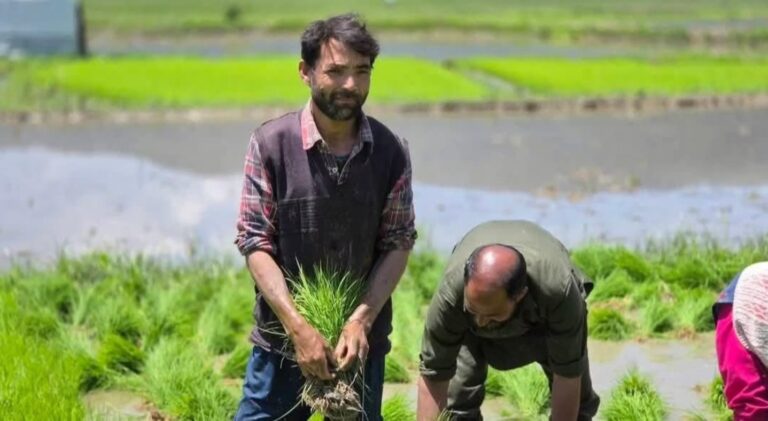
Jammu (Indian-administered Kashmir: With the onset of the Basmati sowing season, farmers residing along the Ceasefire Line in Jammu’s RS Pura and Arnia sectors are facing a severe shortage of agricultural labourers. The shortage follows intense cross-ceasefire hostilities earlier this month that forced hundreds of seasonal workers from across India to flee the region.

According to local estimates, between 1,000 to 1,500 labourers—primarily from Bihar, Uttar Pradesh, Rajasthan, Uttarakhand, and Jharkhand—left the region after heavy drone attacks and artillery shelling that began on May 8, reportedly in response to India’s “Operation Sindoor”, a series of targeted strikes on militant infrastructure across the Line of Control (LoC) and Pakistan-administered Kashmir (PaK).

Read Also: Leepa Valley: A Gem of Natural Beauty and the Home of Red Rice

Although both India and Pakistan agreed to a ceasefire on May 10, and relative calm has since returned, the agricultural fields remain largely deserted.

“We returned home after spending 10 days away. It felt like a warzone here,” said Garmeet Singh, a farmer from Abdulian village, located less than half a kilometre from the ceasefire line. “Now that peace has returned, we’ve resumed work with help from our own families—but we desperately need labourers back.”

In the absence of the usual migrant workforce, farmers have started sowing Basmati rice themselves, braving soaring temperatures that reach up to 45°C. Families were seen ploughing and transplanting in early morning and late evening hours to avoid the extreme heat.

“There’s peace now, and a ceasefire is holding,” said Skinder Kumar, a farmer from Gulabgarh Basti. “We appeal to all our labourers to come back. Without them, it’s impossible to complete the sowing season on time.”

Farmers in RS Pura and Arnia cultivate over 17,700 hectares of premium Basmati rice, much of which contributes to India’s export economy. The region, however, lies within the shelling range of the ceasefire line, making agriculture not only uncertain but sometimes life-threatening.

Dangers Still Linger

Despite the ceasefire, the aftermath of the shelling remains visible—and dangerous. According to local sources, over 100 unexploded mortar and artillery shells were found buried in the farmlands. Army bomb disposal squads and engineers are currently engaged in clearing operations.

“Unexploded shells have taken lives in the past. But this time, the army is actively clearing the fields, which gives us some relief,” Kumar added.

According to official estimates, approximately 125,000 hectares of agricultural land in the districts of Jammu, Samba, and Kathua fall within range of cross-ceasefire fire. Villages such as Treva, Mahashe-de-Kothe, Gharana, Chandu Chak, and Korotana Kalan—located near the de facto boundary—are gradually returning to farming activities amid cautious optimism.

“Agriculture has resumed, and families are back,” said Avatar Singh, another farmer from Abdulian. “But we are still waiting for the return of the workforce to save the season.”

Operation Sindoor and Escalation

The recent escalation began after the Indian military launched Operation Sindoor on May 7, targeting what were described as terror camps across the LoC in response to an attack in Pahalgam. In retaliation, Pakistan reportedly conducted drone, missile, and artillery attacks between May 8 and 10, killing 27 civilians and injuring more than 70, prompting mass evacuations to government relief camps.

The international community, including human rights monitors, expressed concern over the impact of the military confrontation on civilians, particularly those living near the volatile ceasefire zones.

Kashmir’s School Timings Revised Amid Rising Temperatures

    0

    Srinagar (Indian admonistered Kashmir): In light of the rising heatwave in Jammu and Kashmir, the Directorate of School Education Kashmir (DSEK) has officially revised school timings across the Valley.

    According to the new schedule:

    • Schools within the Srinagar Municipal Limits will now function from 8:30 AM to 2:30 PM.

    • Schools located outside Srinagar’s municipal boundaries and in other districts of Kashmir will operate from 9:00 AM to 3:00 PM.

    The decision comes following growing health concerns raised by parents and school stakeholders over students experiencing dizziness and discomfort during early school hours and morning assemblies.

    Read Also: Rising Heat Threatens Jammu and Kashmir’s Fragile Mountain Environment

    Education Minister Sakina Itoo, while speaking to reporters, said:

    “Due to the discomfort students face under the scorching sun during morning assemblies, we have directed all heads of departments to revise the school timings immediately.”

    She added that assemblies should no longer be held under direct sunlight and recommended shaded or indoor venues instead.

    Earlier reports indicated that the School Education Department had been working on this change after consultations with local communities.

    Kashmir: Cyber Police Arrest Former Professor and Journalist in Srinagar Over Social Media Content

    Srinagar, Indian administered Kashmir: May 22, 2025 Cyber Police Srinagar arrested two individuals, including a terminated academic and a journalist, in connection with the alleged dissemination of “objectionable content” on social media platforms.

    The individuals identified as Dr. Abdul Waseem alias Bari, a former professor hailing from Kulgam and currently residing in Natipora, and journalist Asifa Bashir, a resident of Chattabal, were taken into custody earlier today.

    The arrests were made under FIR No. 06/2025, and the case has been registered under multiple provisions, including Sections 67 and 67-A of the Information Technology Act, as well as Sections 75(3), 79, and 356(2) of the newly implemented Bharatiya Nyaya Sanhita (BNS).

    According to official sources, Dr. Waseem has been transferred to Police Station Shergari, whereas Asifa Bashir has been sent to the Women’s Police Station Rambagh for further legal processing and investigation.

    Police officials have not publicly disclosed the nature of the “objectionable content” or whether it pertains to journalistic activities, personal expression, or other forms of online commentary. Media and digital rights organizations have yet to issue formal responses, but the arrests are likely to invite scrutiny from civil liberties and press freedom advocates.

    The arrests come amid increasing concern and ban over freedom of expression and digital surveillance in the region, particularly following the rollout of the Bharatiya Nyaya Sanhita, which has replaced sections of the Indian Penal Code. Legal experts have raised questions about the interpretation and potential misuse of these laws in regulating online speech.

    While the authorities maintain that the arrests are part of routine cybercrime monitoring, press freedom watchdogs are expected to follow the case closely, especially given the involvement of a working journalist.

    Further developments are awaited as the investigation progresses.

    Gilgit-Baltistan Anti-Terrorism Court Extends Custody of Awami Action Committee Leaders

    Gilgit-Baltistan (Pakistan-administered Kashmir) — The Gilgit-Baltistan Anti-Terrorism Court today extended the police custody of three prominent leaders of the Awami Action Committee Gilgit-Baltistan (AACGB), including Youth Chairman Asghar Shah, Media Cell Incharge Waheed Hassan, and BNF President Irfan Abbas Azad, until May 28, 2025.

    The trio was initially presented before the court on charges linked to their political activism and protests. After an initial four-day physical remand, the court granted further custody to law enforcement authorities.

    The decision has sparked strong criticism from human rights activists and civil society groups who view the extended detention as a violation of fundamental human rights and an attempt to suppress peaceful political dissent. Critics say that portraying these leaders as criminals is part of a broader strategy to silence voices demanding justice and political rights in the region.

    Read Also: Gilgit-Baltistan Police Arrest Awami Action Committee Gilgit Baltistan Leaders; Civil Society Condemns “Political Tactics”

    The Awami Action Committee condemned the court’s ruling and called for the immediate release of Asghar Shah, Waheed Hassan, and Irfan Abbas Azad. The committee also demanded that all fabricated charges against them be dropped.

    This case highlights ongoing tensions in Gilgit-Baltistan, where residents continue to raise their voices over issues related to political representation, land rights, and economic opportunities. The detention of these leaders has further ignited calls for respect of political freedoms and an end to state repression.

    The Awami Action Committee emphasized that the struggle of Gilgit-Baltistan’s youth and activists is a fight for justice and democratic rights, and urged the authorities to uphold these principles.

    Revolutionary Communist Party Denmark Condemns Arrests of Gilgit-Baltistan Awami Action Committee Leaders, Affirms Solidarity

    The Revolutionary Communist Party of Denmark has strongly condemned the recent arrests of leaders of the Awami Action Committee Gilgit-Baltistan (AACGB) in Gilgit-Baltistan (Pakistan-administered Kashmir). Expressing full solidarity with these activists, the party acknowledged their peaceful struggle for the rights of the people in the region.

    The party statement highlighted that these arrests once again demonstrate the state’s persistent attempts to silence the voices of working-class people, particularly when they unite to demand their fundamental rights. The ongoing struggle of Gilgit-Baltistan’s population for access to water, land, employment, and cultural identity is not only justified but essential.

    According to the party, the real perpetrators are the ruling elites responsible for pushing the poor into poverty, inflation, and unemployment. The AACGB leaders have been raising their voices against such injustices, and their detention constitutes political repression.

    The Revolutionary Communist Party of Denmark demands:

    • The immediate release of all detained leaders.

    • The recognition and granting of full political, economic, and cultural rights to the people of Gilgit-Baltistan.

    • An end to restrictions on peaceful political activism.

    The party affirmed its unwavering support for all struggles against imperialism, capitalism, and oppression worldwide, underscoring that the people of Gilgit-Baltistan are not alone. Revolutionaries around the globe stand in solidarity with their fight for justice.