
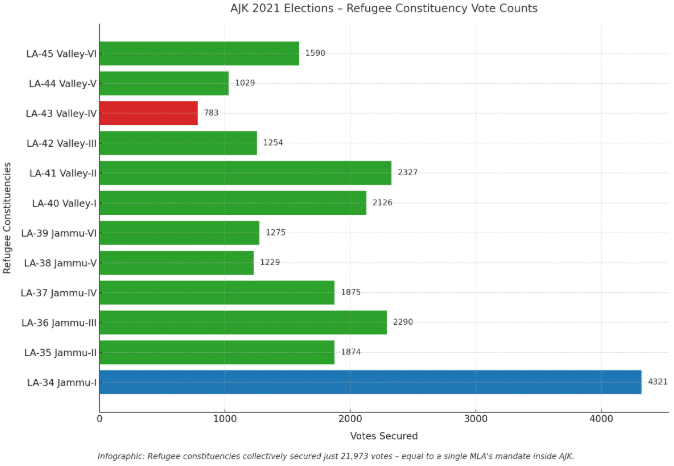

The Azadi Times | News Desk – The 2021 general elections in Azad Jammu and Kashmir (AJK) have reignited debate over the 12 legislative seats reserved for Kashmiri refugees settled across Pakistan. These constituencies, carved out for displaced families from Jammu and the Kashmir Valley, collectively produced winning candidates with significantly fewer votes than most directly elected representatives within AJK itself.
According to official results, the combined vote tally of all 12 successful refugee-seat candidates stood at just 21,973, a figure that barely matches the average number of votes secured by a single MLA from constituencies inside Azad Kashmir. Critics argue this numerical disparity undermines the principle of equal representation and raises serious questions about the electoral structure that governs the region.
Constituency-Wise Results
Jammu Refugee Constituencies (LA-34 to LA-39):
LA-34 Jammu-I: Riaz Ahmed (PTI) – 4,321 votes
LA-35 Jammu-II: Maqbool Ahmed (PTI) – 1,874 votes
LA-36 Jammu-III: Hafiz Hameed Raza (PTI) – 2,290 votes
LA-37 Jammu-IV: Muhammad Akmal Sargala (PTI) – 1,875 votes
LA-38 Jammu-V: Akbar Ibrahim (PTI) – 1,229 votes
LA-39 Jammu-VI: Raja Muhammad Siddiq (PML-N) – 1,275 votes


Kashmir Valley Refugee Constituencies (LA-40 to LA-45):
LA-40 Valley-I: Aamir Altaf (PTI) – 2,126 votes
LA-41 Valley-II: Ghulam Mohi-ud-Din Diwan (PTI) – 2,327 votes
LA-42 Valley-III: Muhammad Asim Sharif (PTI) – 1,254 votes
LA-43 Valley-IV: Javed Butt (PTI) – 783 votes
LA-44 Valley-V: Muhammad Iqbal (PTI) – 1,029 votes
LA-45 Valley-VI: Abdul Majid Khan (PTI) – 1,590 votes
A Question of Representation
The stark imbalance becomes clear when compared to ward-level politics within AJK. Many local ward councillors secure more votes than the refugee-seat MLAs, yet their positions carry far less legislative authority and privilege.
Observers point out that despite the low voter base, refugee-seat MLAs enjoy the same status, salaries, and privileges as their colleagues representing larger constituencies. In addition, the costs of their travel and accommodation during legislative sessions—since many live outside Azad Kashmir—are covered by public funds, adding financial strain to an already limited budget.
“Why should representatives elected by less than 2,000 voters hold the same power as those supported by tens of thousands?” one political analyst told The Azadi Times. “This is not just a numbers game, it is a matter of democratic fairness.”
Political and Social Implications
The refugee seats were originally created to ensure displaced Kashmiri families—residing in Punjab, Sindh, and other parts of Pakistan—remained politically connected to AJK. Yet, as electoral cycles pass, many argue that the system now serves as a tool of political patronage rather than genuine representation.
Civil society voices and rights groups within AJK are increasingly calling for electoral reforms, suggesting either a recalibration of these constituencies to reflect population realities or their integration into broader provincial and national frameworks.
The Bigger Picture
The 2021 AJK elections, held on 25 July 2021, saw Pakistan Tehreek-e-Insaf (PTI) secure a sweeping majority with 32 out of 53 seats. Voter turnout stood at over 61%, with nearly 3.2 million registered voters. While the victory consolidated PTI’s grip on power in the region, the controversy surrounding refugee seats has continued to overshadow discussions on governance and development.
For many Kashmiris, the question is simple: should the political weight of a refugee MLA, elected with fewer than 2,000 votes in some cases, equal that of a representative carrying the mandate of 20,000–30,000 voters?
Until this question is addressed, critics warn, the democratic credibility of AJK’s electoral system will remain under scrutiny.