
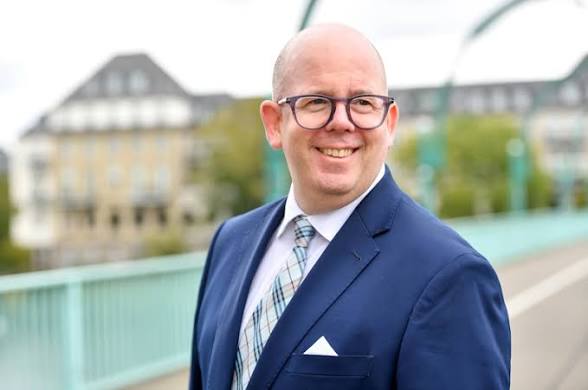

How Marcus Wellhöner is rebuilding Germany’s industrial heartland, one relationship at a time.
The Ruhr Valley doesn’t make global headlines. It is a region of steel mills and coal mines, defined more by its industrial decline than its modern renaissance. But walk through Mülheim an der Ruhr today, past the green bridges over the Ruhr River, and you’ll find a quiet revolution in real estate—led by a man who doesn’t want to be famous.
His name is Marcus Wellhöner. If you haven’t heard of him, that is very much on purpose.
“I never wanted to be the face on a billboard,” Wellhöner tells me, sitting in his modest Mülheim office. It looks more like a craftsman’s workshop than a corporate headquarters. “Real estate is about relationships. You can’t automate trust.”
At 52, Wellhöner is the managing partner of the Wellhöner Group, a four-division real estate services company. Since founding the firm in 1993, he has turned a one-man operation into one of the most respected names in Germany’s property market, handling everything from residential sales to commercial management.
But here is what makes his story relevant in 2026: he is not just surviving in a traditional industry; he is actively reshaping it with a mix of old-school values and futuristic thinking.



The Apprentice Who Built an Empire
Wellhöner didn’t study business at a top university. He trained as a certified real estate agent (Immobilienkaufmann) from the ground up.
“I worked through every role,” he says. “Management of residential properties, commercial buildings, retail spaces. I saw what worked and what didn’t. The big firms treated clients like numbers. I wanted to do the opposite.”
That philosophy led to a unique corporate structure. In 2017, rather than keeping everything under one roof, he split the company into four independent limited partnerships. Each vertical serves a specific need:
· Wellhöner Immobilienmanagement: Brokerage and property management.
· Wellhöner Consulting: Advisory services.
· Wellhöner Facility Services: Maintenance and technical services.
· Wellhöner Immobilienvermittlung: Sales and leasing.
“A residential tenant has different needs than a commercial investor,” he explains. “Specialization lets us serve each client properly.”
The Certification No One Asked For (But Everyone Needs)
In an industry where anyone can call themselves a broker, Wellhöner pursued a formal certification: DIN EN 15733, a quality standard for real estate services.
“Clients don’t always ask for it,” Wellhöner admits. “But when they see it, they understand: this isn’t a side hustle. This is a profession.”
That professionalism extends to his digital infrastructure. The group uses Pricehubble for AI-assisted valuations, offers 360-degree virtual tours, and uses paperless administration.
But Wellhöner insists technology is a tool, not a replacement.
“AI can tell you what a property is worth today,” he says. “It can’t tell you whether the seller is going through a divorce and needs to close fast. That requires a human being who listens.”
Leading the Industry Forward
In July 2021, the Bundesverband für die Immobilienwirtschaft (BVFI) —Germany’s leading professional real estate association—appointed Wellhöner as its Regional Director for Mülheim an der Ruhr.
In this role, he acts as the primary liaison between the property sector and local government, advocating on issues from rent controls to zoning regulations.
“People expect me to know what I’m talking about,” he says. “I take that seriously.”
The AI Revolution Nobody Saw Coming
Ask Wellhöner about artificial intelligence, and you don’t get polite nodding. You get a detailed analysis.
He notes that job postings requiring AI competencies in real estate have surged by 277 percent within a single year.
“That’s structural transformation,” he says. “For an industry long considered innovation-averse, that’s a clear signal.”
He is excited about AI-driven valuations and predictive maintenance, but he also sees a shift in how clients find properties.
“People aren’t just searching Google,” he explains. “They ask AI assistants directly: ‘What’s a fair price for a three-bedroom apartment?’ The recommendation comes as a single answer—not a list of search results.”
The Wellhöner Group has adapted, optimizing their digital strategy for these AI-driven platforms—a move that sets them apart from older, slower competitors.
Sustainability as Economics
If AI is Wellhöner’s forward-looking obsession, sustainability is his moral conviction—and, he argues, his business case.
“The building sector is responsible for a massive share of CO2 emissions,” he says. “Anyone ignoring sustainability will struggle to find financing.”
But he frames it as an opportunity.
“A well-insulated building costs less to operate and commands higher rents. That’s not idealism. That’s economics.”
His facility services division now offers energy audits and “green” renovation consulting, helping clients improve both environmental performance and asset value.
The “Trust” Equation
Spend time with Wellhöner, and he returns to three words: Vertrauen (trust), Zuverlässigkeit (reliability), and Mensch (human being).
“Trust doesn’t happen overnight,” he says. “It has to be built and maintained.”
That philosophy has built a client roster that includes private individuals, family offices, and publicly listed property holders. The common thread is the expectation of personal attention.
“We’re a family-run business,” Wellhöner says. “The owners work actively in the company and are personally accessible. That’s not marketing speak. That’s how we operate.”
The Future
As our conversation winds down, I ask Wellhöner about the future.
“The real estate industry is at an inflection point,” he says. “Demographics are shifting. Energy requirements are tightening. Technology is accelerating. The firms that survive will adapt without losing their humanity.”
Outside his window, the Ruhr River flows past, green and steady. The bridges arch overhead. In the distance, a train rumbles by—the sound of an industrial region refusing to be defined by its past.
Marcus Wellhöner stands at the window, watching. The quiet architect of Germany’s rust belt real estate renaissance.
Still building. Still listening. Still doing the work.
About the Author: This article was reported from Mülheim an der Ruhr, Germany, with additional research from industry publications and public records.
For more information: marcus-wellhoener.de | wellhoener.immobilien