
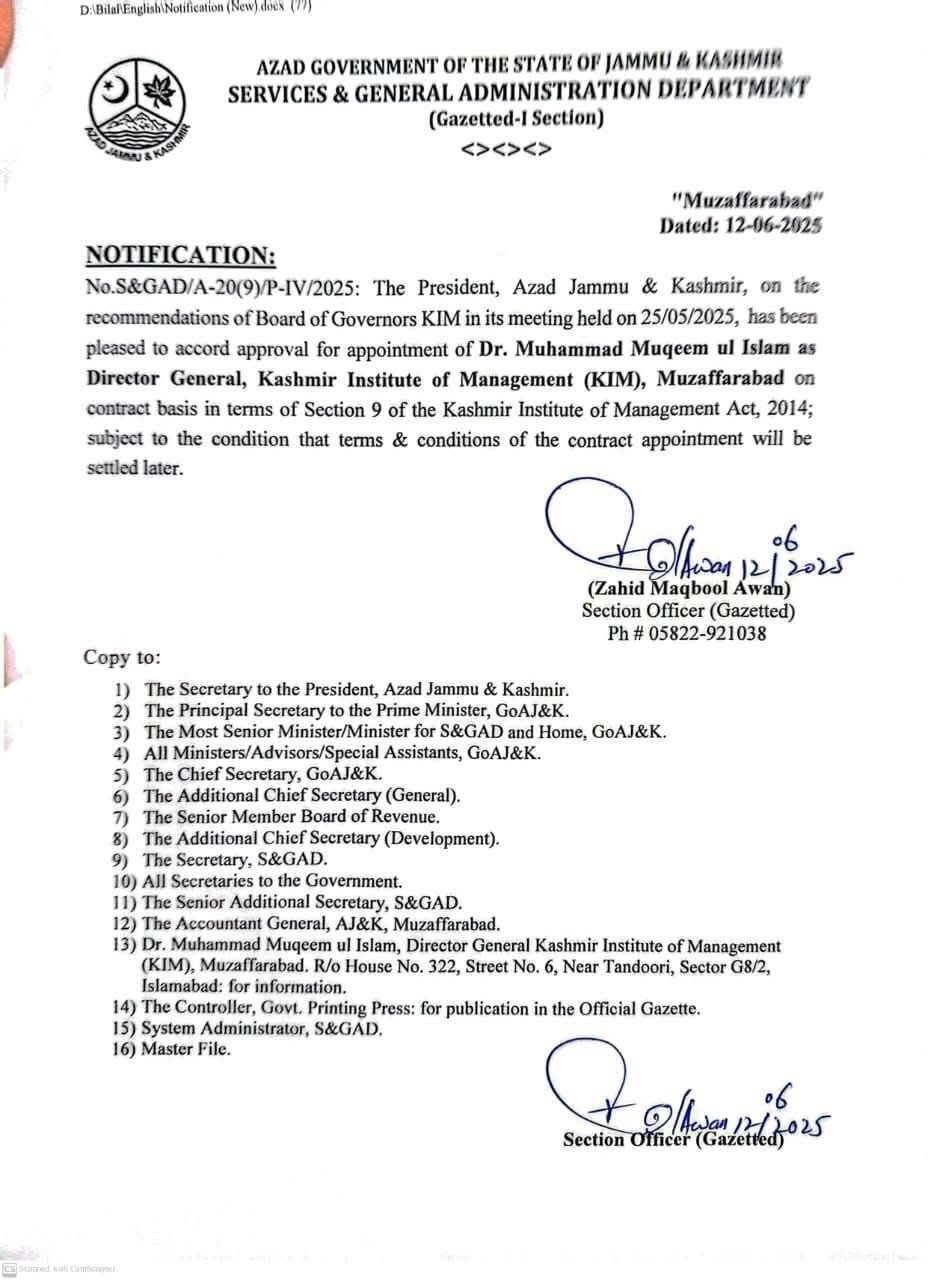

Muzaffarabad, AJK – Pakistan administered Kashmir: The recent appointment of Dr. Muqeem-ul-Islam, a civil servant from Khyber Pakhtunkhwa, as Director General of the Kashmir Institute of Management (KIM) has sparked significant controversy in Azad Jammu and Kashmir (AJK), raising serious concerns about the credibility of the local bureaucracy and the autonomy of AJK’s institutions.
According to the local journalist Siddque Ansar the position of Director General at KIM remained vacant for nearly a year and a half. During this period, a formal advertisement was issued outlining the required qualifications for the role in accordance with the AJK Government’s approved recruitment rules (2017). Several officers from within AJK applied under those conditions.
However, in a move that has alarmed many observers, the Board of Governors of the Institute reportedly amended the eligibility criteria after the application process, raising suspicions that the changes were made deliberately to exclude local candidates. Sources indicate that even the current Additional Chief Secretary (General) of AJK had qualified for the position under the original criteria, but was ultimately overlooked.

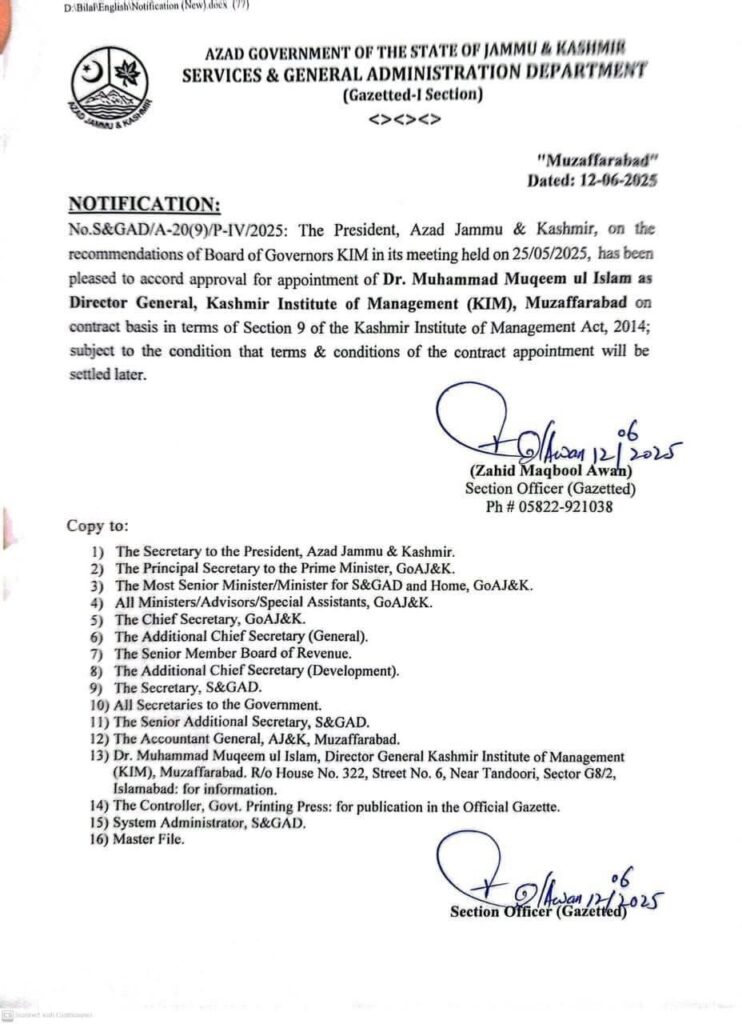
Instead, Dr. Muqeem-ul-Islam, a Grade-20 officer currently serving as Chief Instructor at the National Institute of Public Administration (NEPA) in Peshawar, was appointed to the post. It remains unclear whether he has taken official leave or is serving on deputation. The appointment letter reportedly lacks clear terms of reference (TORs), leaving many key questions unanswered and raising concerns about transparency.
The Kashmir Institute of Management was established as a state institution modeled after Pakistan’s National School of Public Policy, with recruitment rules explicitly requiring adherence to local regulations, including the enforcement of the State Subject Rule—a legal framework that protects the rights of AJK residents. This makes the appointment of a non-resident all the more controversial.
Critics argue that the appointment represents not just a breach of protocol but a broader erosion of trust in AJK’s governance structure. The AJK government, including its cabinet, has remained conspicuously silent on the issue, signaling what many see as a troubling culture of compliance rather than accountability.



The controversy comes on the heels of another recent scandal involving Government Minister Asim Sharif Butt, who was found to have submitted a forged State Subject certificate. Despite the gravity of the matter, the issue was reportedly brought to cabinet without appropriate legal action, further calling into question the integrity of AJK’s political and administrative systems.
Analysts say the developments indicate a growing disconnect between Islamabad and Muzaffarabad, with AJK’s institutions increasingly sidelined. Prime Minister Anwar-ul-Haq has himself publicly expressed dissatisfaction with the current administrative framework—an indication that major structural changes may be on the horizon.
As questions of constitutional authority, autonomy, and administrative credibility swirl, the people of Azad Jammu and Kashmir are left wondering whether their institutions are truly their own—or merely extensions of external power centers.

