
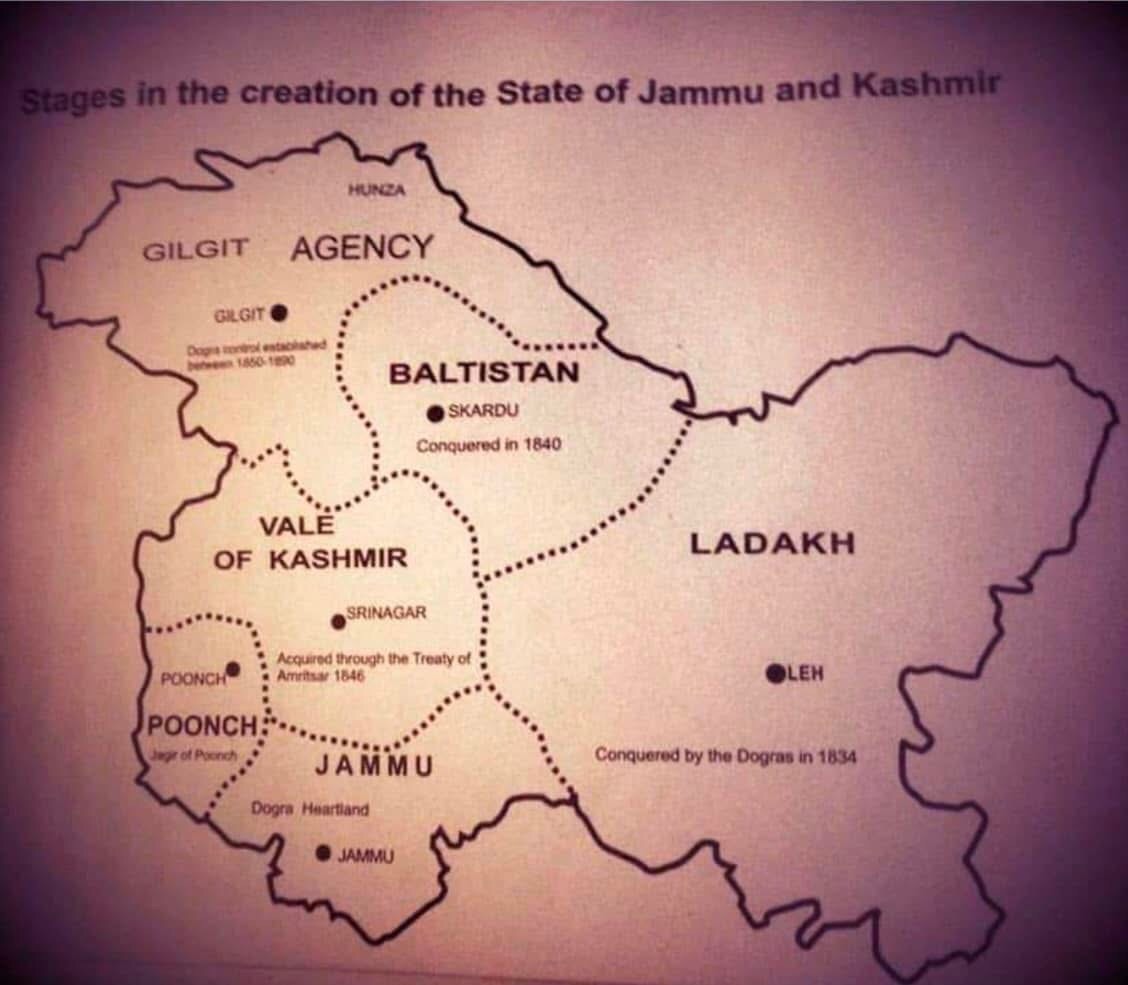

March 16, 2024: Today marks the commemoration of Jammu Kashmir Foundation Day, recalling the historic establishment of the princely state of Jammu and Kashmir on March 16, 1846. The day holds profound significance for residents of the region, as well as the global Kashmiri diaspora, who reflect on its complex history, cultural heritage, and ongoing political discourse.
Historical Context
On this day in 1846, the Treaty of Amritsar was signed between the British East India Company and Maharaja Gulab Singh of Jammu, formalizing the transfer of Kashmir Valley and surrounding territories to the Dogra dynasty for 7.5 million Nanakshahee rupees. This treaty laid the foundation for the princely state of Jammu and Kashmir, a geopolitical entity that would shape the region’s identity for centuries. While some view the day as a marker of administrative unity, others associate it with the colonial-era power dynamics that continue to influence Kashmir’s contested status.
Celebrations and Contested Narratives
Across Jammu and Kashmir, residents marked the day with mixed emotions. Many took to social media platforms like Facebook and Twitter to share nostalgic posts, historical photos, and messages celebrating the region’s cultural legacy. Local events, including seminars, cultural exhibitions, and traditional music performances, highlighted Kashmir’s rich heritage.

However, the occasion also reignited debates about identity and self-determination, with some groups framing it as a reminder of historical grievances and unresolved political aspirations.
In Srinagar and Jammu, government-led functions emphasized the region’s integration with India, while civil society organizations hosted discussions on Kashmir’s historical autonomy. Meanwhile, the Kashmiri diaspora in countries like the UK, US, and Canada organized virtual gatherings, underscoring the global connection to this pivotal date.
Voices from the Ground
“Today is a day to remember our shared history, but also to reflect on the struggles that persist. For some, it’s a celebration; for others, a call to reclaim agency,” said Ayesha Khan, a Srinagar-based academic. On social media, user @Arifurfi shared archival images of 19th-century Kashmir with the caption: “1846 – A turning point that still defines us.”



Political Dimensions
The commemoration comes amid heightened sensitivities following the Indian government’s 2019 decision to revoke Jammu and Kashmir’s special constitutional status and bifurcate the state into two union territories.
Proponents of the move argue it integrates the region more closely with India, while critics label it an erosion of Kashmiri identity. International observers, including human rights groups, continue to monitor developments in the region, urging dialogue to address longstanding disputes.
Global Kashmiri Response
For the international Kashmiri community, Foundation Day serves as a moment to reaffirm cultural pride and advocate for peaceful resolutions. “Our history is not just about borders—it’s about people, art, and resilience,” remarked London-based activist Zubair Mir.


As Jammu and Kashmir observes Foundation Day, the occasion underscores the interplay of history, identity, and politics. While celebrations highlight unity and cultural vibrancy, they also reveal the layered narratives of a region seeking to reconcile its past with aspirations for the future. For now, the day remains a poignant reminder of Kashmir’s enduring quest for peace, dignity, and self-expression.