
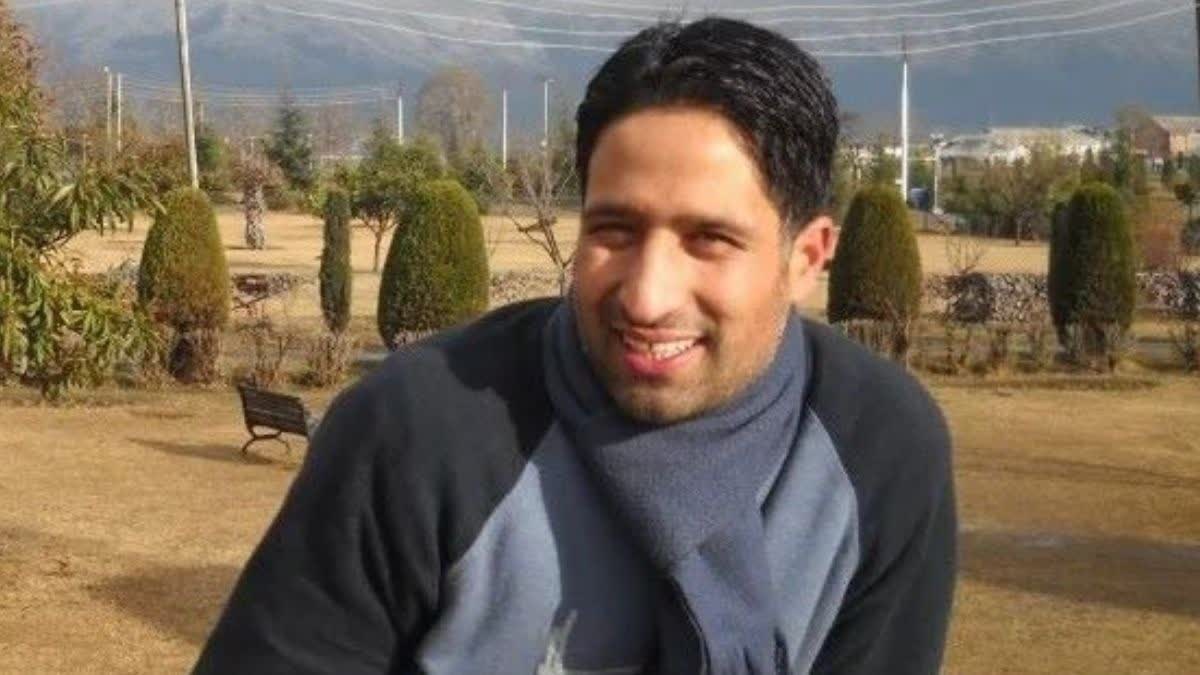

Srinagar: In a significant legal development, a Jammu court has granted bail to PhD scholar Aala Fazili, who was arrested nearly three years ago under the Indian law Unlawful Activities (Prevention) Act (UAPA). His 2011 article, “Chains of Slavery Will Break,” published in The Kashmir Walla, was deemed controversial by the Indian authorities, leading to his prolonged detention. However, the court ruled that there is no evidence linking Fazili’s writings to any act of terrorism, making his imprisonment unjustified.
Delivering the judgment, Third Additional Sessions Judge Madan Lal stated:
“The author neither called for armed resistance, nor incited rebellion against the state, nor advocated for violence. There is no attempt to weaken state authority through terrorism or acts of violence.”
Criminalizing Journalism and Intellectual Discourse in Kashmir
The Jammu and Kashmir State Investigation Agency (SIA) alleged that Fazili’s article was “highly provocative and seditious, aimed at creating unrest in the region.” Based on this claim, he was arrested in April 2022. However, the court pointed out that the government itself ignored the article for more than a decade, proving that it neither posed an immediate threat nor had any long-term impact on public order.
“From November 6, 2011, to April 4, 2022, the government took no action against the article, indicating that it neither incited unrest nor contributed to an increase in militancy-related incidents,” the court observed.
The Jammu and Kashmir High Court had also noted earlier that there was no evidence to suggest that the article incited violence.
“There is no proof on record that the article led anyone to resort to violence. The entire charge sheet is silent on any direct consequence of the article in terms of public disturbance or militancy. The accusations against Fazili are baseless and built on assumptions,” the judgment stated.
Weaponizing the Law to Silence Kashmiri Voices
Fazili’s case is not an isolated incident but part of a systematic crackdown on intellectuals, journalists, and dissenting voices in Kashmir. The Kashmiri people continue to live under an occupation that criminalizes free speech, where academics and journalists face arbitrary arrests for their work.
The prosecution’s case relied heavily on the testimony of The Kashmir Walla’s employee, Yash Raj Sharma, who was hired seven years after the article was published. The claim that Fazili was the article’s author was made despite the magazine’s editorial process, which requires author verification before publication. This raises serious concerns about the credibility of evidence used to justify Fazili’s three-year-long detention.
Kashmir: A Land in Chains
For decades, Kashmir has been subjected to systematic oppression, enforced disappearances, media censorship, and suppression of political dissent. The use of draconian laws like UAPA and Public Safety Act (PSA) has turned the region into one of the most militarized zones in the world, where intellectual and journalistic freedom is curtailed at every step.
Fazili’s arrest reflects India’s broader policy of silencing Kashmiri voices—anyone who speaks of freedom, human rights, or political self-determination is branded a “threat” and imprisoned without trial.
At its core, this case highlights the ongoing colonial treatment of Kashmir, where even an academic article can be used as a pretext for incarceration. Fazili’s bail may be a relief, but the larger battle for Kashmir’s freedom continues. The world must recognize the plight of Kashmiri scholars, journalists, and civilians who are systematically targeted simply for expressing their truth.