
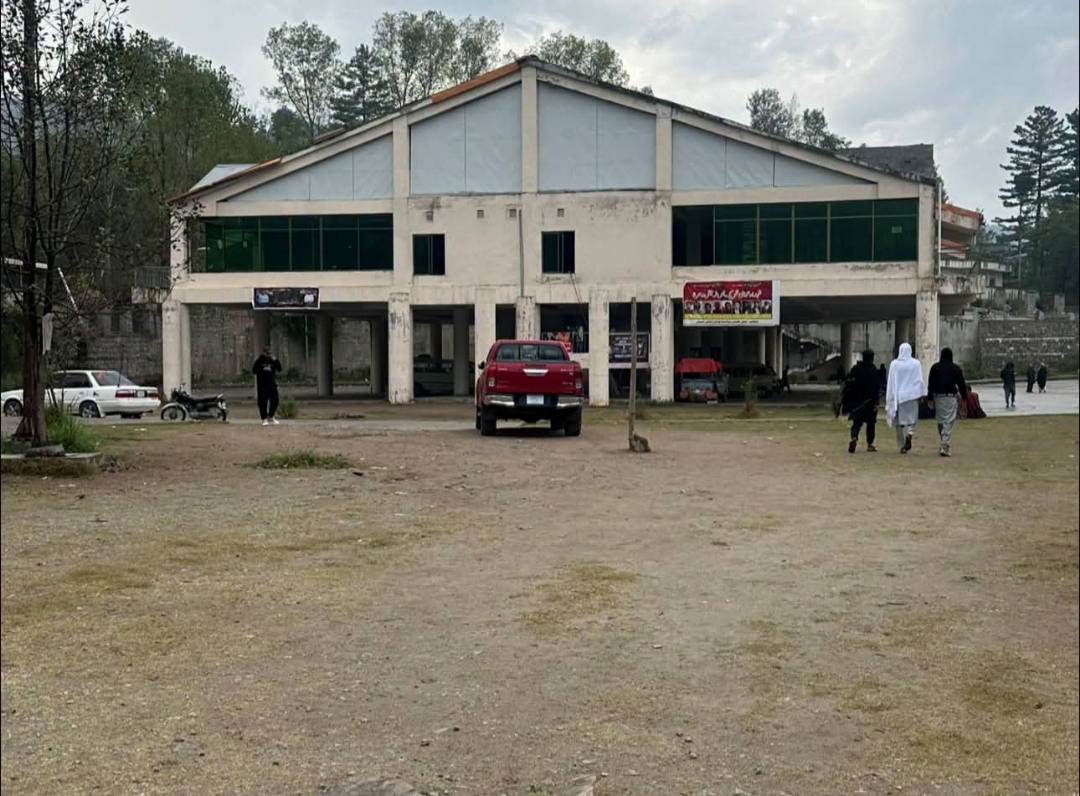
RAWALAKOT, Azad Jammu and Kashmir (PaJK), 5 November 2026 — Pakistani security forces reportedly took control of Rawalakot’s central bus terminal on Thursday morning, bringing a dramatic escalation to a months-long public sit-in organised by the Jammu Kashmir Joint Awami Action Committee (JKJAAC), according to photographs, videos and eyewitness accounts circulated by local Kashmiri social media users.
Posts shared on Facebook and Instagram showed security personnel outside the two-storey bus terminal building, where protesters had maintained a prolonged demonstration demanding the implementation of 38 public demands, including relief on electricity costs, employment opportunities and fundamental rights.
The reported operation has raised fresh concerns about the safety of civilians in Rawalakot, as local accounts described heavy gunfire, the movement of armoured vehicles and attempts by security personnel to clear the protest site.
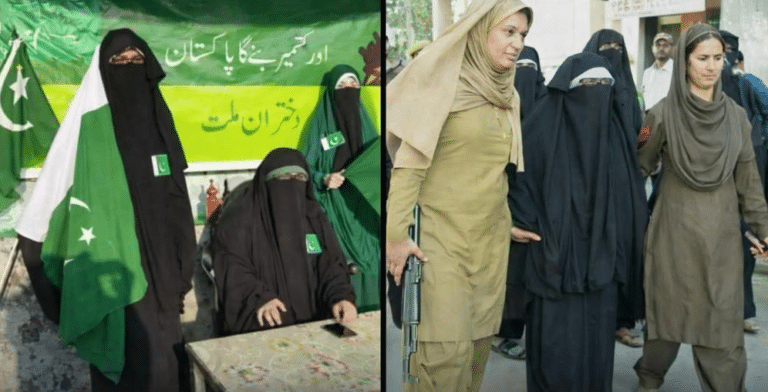
The Azadi Times had earlier confirmed three deaths in connection with the escalating situation in Rawalakot.
https://www.facebook.com/share/v/1C8PRa4GXD
Additional claims of casualties and injuries circulated on Thursday, although the full extent of the reported casualties and the circumstances surrounding them remain independently unverified.


Security forces reportedly occupy the protest site
Several Kashmiri social media accounts shared photographs of the Rawalakot bus terminal on Thursday morning, describing the development as a takeover of the protest site by security forces.
A post attributed to Threads accounts Basharat4230 and @zamikashmiri, shared at approximately 8:27 am, carried the caption: “Rawalakot: Forces’ occupation at the bus terminal, November 5, 2026.”
Similar photographs were subsequently circulated by other local accounts, including Kasher Media Official and Zahid Akhtar Khan.
The images showed the same two-storey concrete structure, an open ground in front of the building and vehicles parked nearby. The photographs were accompanied by Urdu and English captions describing the reported deployment of security personnel and the loss of protesters’ control over the location.
An Instagram graphic shared by account shahidraja3732 also reported that an operation had begun in Rawalakot and that the bus terminal had been evacuated.
Taken together, the posts indicate that security personnel had established a presence at the terminal and that protesters were no longer occupying the site in the same manner as before.
However, the precise circumstances of the reported takeover, including whether all protesters were removed and whether force was used inside the terminal, could not be independently established from the available material.
Local accounts report heavy gunfire and armoured vehicles
Separate Facebook posts attributed to Sardar Hamza Naseer, Tahir Mushtaq Kashmiri, Sehansa Azad Kashmir and other Kashmiri accounts described an operation involving armoured vehicles and heavy machine guns.
One circulating post claimed that security forces were attempting to take control of the bus terminal in the Matialmrah area of Rawalakot, with intense firing reported.
An Instagram account identified as Startup Kashmir Records shared footage filmed from a nearby wooded hillside. The accompanying text described security forces dispersing the Rawalakot bus terminal sit-in and reported multiple injuries. Sounds resembling gunfire could be heard in the footage, although their source and the precise circumstances in which the recording was made could not be independently verified.
Other social media accounts claimed that security personnel were advancing towards the protest area from three directions, identified as Naseem Town, Farhan Chowk and Chandni Chowk.
These accounts also described resistance by local residents and protesters.
Initial reports circulating among Kashmiri social media users referred to at least two injured protesters. The number of injured people, however, remains unconfirmed.
The Azadi Times has not independently verified the reported use of heavy weapons, the direction of the alleged advances or the complete sequence of events during the operation.
A prolonged protest over 38 public demands
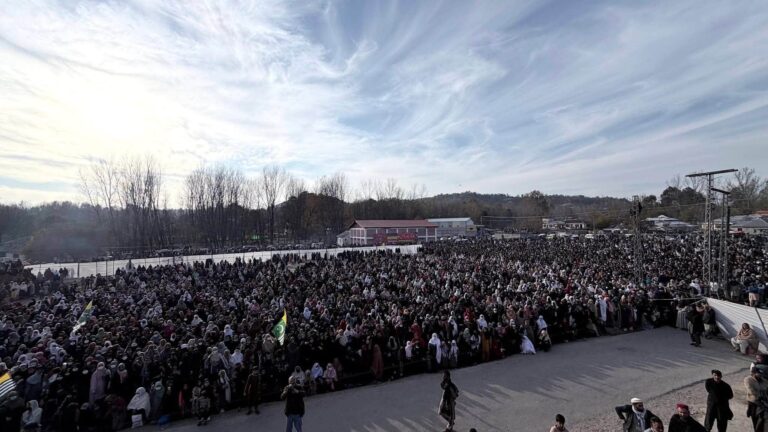
The sit-in at Rawalakot bus terminal was organised under the banner of the Jammu Kashmir Joint Awami Action Committee, a coalition that has mobilised public support around economic relief, electricity pricing, employment and wider civic demands in Azad Jammu and Kashmir.
The protest had continued for several months, attracting residents from different parts of the region.
Participants included men, women, young people and elderly residents, according to photographs and videos shared during the demonstration.
The protesters’ demands centred on issues affecting everyday life, particularly the cost of electricity, access to employment and what the committee describes as the denial of fundamental public rights.
Social media accounts have given differing dates and day counts for the beginning and duration of the sit-in. Some posts identify 6 June as its starting date, while others refer to 9 June. Reports circulated in recent days have variously described the demonstration as having continued for approximately 145 to 151 days.
Regardless of the precise count, the protest represented a sustained period of public mobilisation in Rawalakot.
Its reported removal through a security operation marks a significant development in a dispute that had continued for months without a publicly established resolution of the committee’s demands.
Conflicting accounts and the official response
The developments have also highlighted a significant difference between accounts circulating among local residents and the official position.
A spokesperson for the Inspector General of Police in Azad Jammu and Kashmir rejected social media claims of a police operation, shelling and firing at the protest site.
According to the spokesperson, no action had been conducted by police or other law enforcement agencies at the sit-in location at Darik Eidgah. The spokesperson described the circulating allegations as baseless and misleading propaganda.
The statement, however, did not independently resolve the questions raised by photographs and videos showing security personnel at the central bus terminal.
The bus terminal and Darik Eidgah have been identified separately in the circulating accounts, making precise identification of the location and timeline particularly important.
The available material does not establish whether the official statement was referring to the same location and period described in the social media reports.
The Azadi Times has not independently obtained a detailed operational account from the relevant authorities or a complete explanation of the reported security deployment.
Social media becomes a crucial source of information
With reports of disrupted communications and difficulties accessing information from parts of the region, Facebook and Instagram have become important channels through which residents are sharing photographs, videos and updates.
Several local accounts published images of the same bus terminal building, while others circulated footage and written descriptions of the reported operation.
The similarity of the photographs provides a basis for identifying the location depicted, although it does not independently establish when every image was recorded or verify all the claims attached to it.
The circulation of casualty claims has also increased public anxiety.
The Azadi Times had previously confirmed three deaths in its reporting on the Rawalakot escalation. Further casualty figures circulating on social media should be treated separately until the identities, circumstances and number of additional casualties can be independently established.
The situation also raises concerns about the ability of families to obtain information about missing, injured or detained relatives.
Reliable communication and access to medical assistance are particularly important during periods of heightened tension.
A critical moment for civil rights and public accountability
The developments at Rawalakot bus terminal have placed the authorities and the Joint Awami Action Committee at a critical point in their prolonged confrontation.
For protesters, the sit-in was an expression of demands concerning economic security, public representation and fundamental rights. Its reported removal does not, by itself, resolve the underlying grievances that brought people to the streets.
The central question now extends beyond control of the bus terminal: whether the outstanding public demands will be addressed through meaningful dialogue, and whether the circumstances surrounding the reported operation will be transparently investigated.
The safety of civilians, access to medical assistance, freedom of peaceful assembly and the right to express public grievances remain central concerns.
The Azadi Times will continue to monitor developments in Rawalakot, verify emerging casualty information and seek further accounts from residents, protest representatives and relevant authorities.
This is a developing story. Information will be updated as further independently verifiable details become available.
Editorial Note
This report is based on photographs, videos and written accounts circulated by Kashmiri social media users on 5 November 2026. Claims concerning the use of heavy weapons, casualties, injuries and the circumstances of the reported operation have been attributed where possible and have not been presented as independently established facts. The official police response has also been included for completeness.