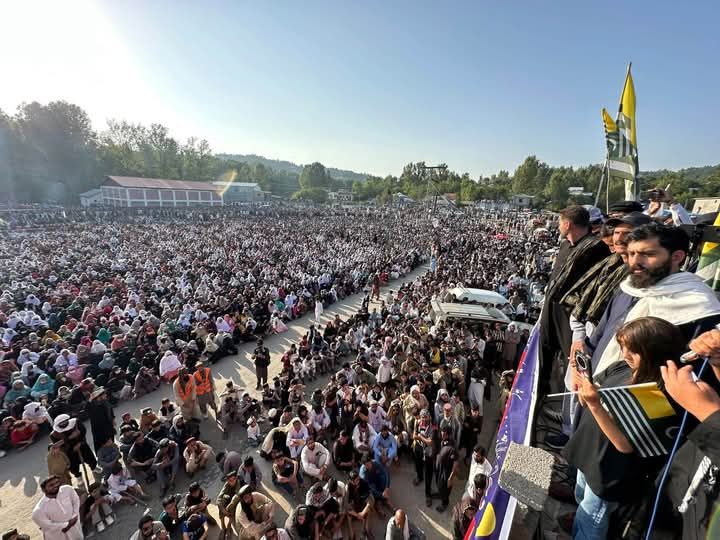

Three years ago this month, the Jammu Kashmir Joint Awami Action Committee (JKJAAC) did not exist. There was no central platform, no shared charter, no single leadership. There were only scattered action committees in different districts, traders unhappy about the price of flour, students, civil society groups, and nationalist and progressive political workers who had been mobilising separately around the same set of grievances.
Today, the JKJAAC is the most recognisable protest platform in Pakistan-administered Kashmir. Its three-year journey is not the story of a single organisation being founded on a single day. It is the story of how a region’s separate frustrations found a common voice — and of what happens to that voice once it has won something.
August 2022: the beginning that was not yet a movement
The story starts in August 2022, when nationalist leaders in Rawalakot held a press conference and announced the launch of a movement for public rights. Leaders associated with the Jammu Kashmir Liberation Front, the Peoples Revolutionary Front, the Jammu Kashmir National Students Federation and the Jammu Kashmir National Awami Party were part of that early activity.
At that stage, there was no central joint action committee. The movement advanced through local action committees, student organisations, traders, civil society and political workers — each operating in its own area, with its own demands and its own pressure tactics. What they shared was a direction, not a structure.
May 2023: the spark from flour prices

On 9 May 2023, during the Pakistan Tehreek-e-Insaf government, a notification raised the price of flour in the region by 600 rupees per maund. Flour depots were shut in different areas, and existing stock was refused at the old rates.
Citizens and traders in Rawalakot protested. Their demand was simple: supply flour at the previous rate. When the district administration and the food department did not accept the demand, a sit-in began.
That same day, a six-member committee was formed, and it was decided to continue the sit-in in front of the Supply Bazaar flour depot.

Within weeks, the protest spread beyond Rawalakot to other districts of the Poonch division and to Kotli. On 27 May, large demonstrations were held in Rawalakot, Khai Gala and other locations. On 31 May, a shutter-down strike was announced across all four districts of the Poonch division and at tehsil level.
There was still no central committee. But the action committees forming in different places were beginning to connect with one another.
August 2023: electricity bills and civil disobedience
In August 2023, the protest widened further. An increase in electricity prices in the region, and the issuance of an ordinance aimed at keeping government employees away from protests, deepened public anger.
On 23 August 2023, the movement crossed a threshold. Thousands of electricity bills were burned in Poonch, Sudhnoti, Bagh and Kotli. Later, bills were collected in Mirpur as well, and an announcement was made that payments would not be made.
By the end of August, the protest had reached the Muzaffarabad division. On 31 August, wheel-jam and shutter-down strikes were called in Muzaffarabad, Neelum and Jhelum Valley, and in early September strikes were held in the Poonch and Mirpur divisions as well.
The movement was no longer only about the price of flour. Electricity, taxes, the privileges of the ruling elite, a local share of revenue from hydropower projects and other basic rights had all become part of it.
The meeting that gave the currents a single platform
On 16 September 2023, a key meeting was held in Muzaffarabad.
Representatives of the Anjuman-e-Tajran, nationalist parties, local action committees and people from different schools of thought attended.
After consultations that ran late into the night, it was decided to take the region’s public rights movement forward jointly.
Then, at about three in the morning on 17 September 2023, a 30-member core committee of the Jammu Kashmir Joint Awami Action Committee was established.
That was the moment scattered resistance across different areas took the shape of a central platform.
The meeting was hosted by Muzaffarabad traders’ leader Shaukat Nawaz, while figures such as Umar Nazir Kashmiri from Poonch and Advocate Khawaja Mehrhan from Mirpur emerged prominently from different regions.
The charter of demands
After its formation, the JKJAAC prepared a charter of demands.
It included subsidies on flour and other food items, an end to alleged corruption in the food department, declaring the region a load-shedding-free zone, supplying electricity at Mangla Dam’s cost, ending the privileges of the ruling elite and bureaucracy, and giving the region a share of revenue from hydropower projects.
The charter also demanded that the region be declared tax- and duty-free, implementation of the court decision on the Neelum-Jhelum project, fulfilment of past promises regarding Mangla Dam, construction of the Rathoa Hariyam bridge, restoration of the students’ union, powers and funds for local government representatives, rehabilitation of people affected by natural disasters, better mobile and internet facilities near the Line of Control, and the removal of restrictions on foreign tourists.
The demands were not limited to day-to-day inflation. They extended to economic, political and administrative rights.
28 September: a sea of electricity bills
On 28 September 2023, the campaign to boycott and burn electricity bills gave the movement an extraordinary form.
According to the electricity department, about 22 per cent of bills were paid during this period, while 78 per cent of consumers did not pay.
In Muzaffarabad, Neelum, Hattian and Tatta Pani, boats were made from bills and floated down rivers. In Poonch, Kotli, Mirpur, Bagh, Sudhnoti and other areas, thousands — indeed hundreds of thousands — of bills were burned.
In some places, garlands were made of bills and worn around the neck. In others, bills were placed in coffins and set alight. At some locations, people danced to the beat of drums as they burned them.
The protest carried a symbolic message: electricity bills were no longer just pieces of paper. They had become a symbol of public anger and resistance.
State response and women entering the field
State institutions began trying to clear the sit-ins and started registering cases and making arrests against protesters.
The sit-ins were re-established again and again.
Meanwhile, for the first time, women joined the protest in large numbers.
On 10 October 2023, women held protest demonstrations in different districts, tehsils, bazaars and villages. A large women’s rally was held in Rawalakot.
On 17 October, despite heavy rain, students came out onto the streets as well.
The movement had mobilised sections of society that usually appear less visible in political protest.
Promises, negotiations and repeatedly postponed protests
The government chose the path of negotiations to end the protest.
A negotiating committee was formed under Minister Faisal Mumtaz Rathore. At various times, agreements and assurances between the government and the action committee came to the surface.
In December 2023, the government assured that demands would be resolved by 4 January, and the protest was postponed.
But with demands not implemented, public unease continued.
From here, another problem inside the movement began to surface: complaints that decision-making had narrowed from the broad core committee to a few individuals.
February 2024: divisions within the movement
On 5 February 2024, a call was given for protest, shutter-down and wheel-jam.
But after negotiations and a government notification, an announcement was made to withdraw the protest. After public reaction, it was announced that the day would be observed as “Youm-e-Azm.”
In Rawalakot and other places, criticism of the decisions of the government and the action committee was heard.
On 13 February, at a meeting of the action committee, a demand was made to withdraw the decision on targeted cash subsidies and to insist on supplying flour at Gilgit-Baltistan rates.
This stage showed that a distance had begun to develop between the movement’s leadership and the public over decisions.
The 11 May long march
On 15 April 2024, it was announced that a long march would be taken from Bhimber towards Muzaffarabad on 11 May.
The announcement took tensions between the government and the movement to a new level.
The government sought additional force. The deployment of 600 personnel of the Punjab Constabulary was approved, while other personnel, including the FC, were also deployed.
The action committee announced that the long march would continue until the demands were accepted.
On 1 May, at Dadyal on the banks of Mangla Dam, members of the action committee took an oath to continue the struggle until the demands were accepted.
From arrests to clashes
Two days before the long march, on 9 May, a series of arrests of several leaders from the Mirpur division began.
Protests against the arrests were held in Dadyal, Nakeyal, Tatta Pani, Sarsawa and other areas.
In Dadyal, police and protesters clashed. Incidents of tear gas shelling and baton charges were reported.
The government imposed Section 144 and made emergency arrangements for two days.
The action committee postponed the long march and announced a region-wide shutter-down and wheel-jam strike from 10 May.
But under public pressure, the 11 May long march went ahead.
A sea of people on the roads
On 11 May, the long march began from Bhimber.
Convoys moved forward from Mirpur, Kotli and other areas. At various points, attempts were made to stop them, and in several places there were severe clashes between police and protesters.
In Islamgarh, a police officer was killed, while several protesters were also injured.
Despite this, the convoys kept moving forward, crossing barriers.
On 12 May, negotiations were held in Rawalakot but no final progress could be made. The convoys set off towards Dheerkot, and negotiations began there as well.
But the convoys were not prepared to turn back without a clear notification accepting the demands.
The 23 billion rupee package and acceptance of demands
As the long march moved towards Muzaffarabad, Pakistan’s Prime Minister Shehbaz Sharif announced a special package of 23 billion rupees.
Alongside it, notifications relating to the demands began to be issued.
The electricity tariff was reduced significantly. Rates were lowered for domestic consumers across different slabs, while new rates were also set for commercial consumers.
The price of flour was also reduced, with a 40-kilogram bag fixed at 2,000 rupees.
A notification was also issued for the formation of a judicial commission to review the privileges of the ruling elite, although delays in actually constituting the commission emerged later.
Thus, a movement that had run for a year reached the acceptance of some of its most important core demands.
Muzaffarabad: reception, resistance and blood
During the long march, scenes of public reception were also seen along the route.
Children, women and men stood on rooftops, hillsides and in bazaars to welcome the convoys.
In some places, water and sherbet were distributed; in others, food was arranged; and in still others, the doors of homes and hotels were opened to participants in the march.
But near Muzaffarabad, the situation became tense once again.
When Rangers convoys moved towards Muzaffarabad, citizens tried to stop them at Bararkot. During firing incidents, young men were killed.
An internet shutdown made the situation more complicated. With information limited, some residents of Muzaffarabad could not know that long march participants had been allowed to enter the city. Some young people therefore came out onto the roads to stop the Rangers convoys.
That incident became the most tragic chapter in the movement’s history.
New questions after success
The JKJAAC movement proved that local economic and civic issues can also generate large-scale public resistance.
Traders, students, women, political workers, labourers and ordinary citizens took part in the movement at different stages.
But with the movement’s success came new questions.
Will the movement remain limited to electricity and flour prices?
Will the political, economic and administrative demands included in the charter of demands also be carried forward with the same force?
And the most important question: in which political direction will the Joint Awami Action Committee go in the future?
The question of nationalist and progressive leadership
In the movement’s early stages, the role of nationalist and progressive political workers was prominent. From the formation of local action committees, to protest activities, to the later establishment of the central Joint Awami Action Committee, various nationalist and progressive circles remained active.
But over time, differences emerged within the committee over leadership, decision-making and the direction of the movement.
Critics argue that instead of the movement’s early broad consultative structure, decisions came to be limited to a few individuals.
On the other hand, the position also surfaced repeatedly that remaining above political affiliations is necessary to keep groups with different political ideologies together on a common public platform.
This contradiction has now become a key question for the JKJAAC’s future.
State concerns and the younger generation
An important aspect of this movement is the large participation of young people.
Young people between the ages of 18 and 35 played a prominent role in protest activities, sit-ins and the long march.
For state institutions, this situation matters also because a movement that began with economic demands over time gave rise to a debate about political consciousness and questioning state policies.
From here, two paths lie before the movement.
One is to keep it limited to the struggle for basic civic and economic rights.
The other is for the movement to make broader political and national questions part of its struggle as well.
Maintaining a balance between these two paths may be the biggest challenge for the Joint Awami Action Committee.
Where does the JAAC stand after three years?
The journey of the Jammu Kashmir Joint Awami Action Committee has not been a straight line.
Sometimes protest, sometimes negotiation.
Sometimes agreements, sometimes allegations of broken promises.
Sometimes the leadership and the public appeared on the same page, and sometimes the leadership had to change its decisions under public pressure.
But the biggest aspect of this entire journey is that a struggle that began with a sit-in in Rawalakot against a rise in the price of flour ended up gripping the entire region.
From local action committees to the central Joint Awami Action Committee, from the boycott of electricity bills to protests by women and students, and then from Bhimber to Muzaffarabad, the long march — these are all different stages of a public movement that influenced politics in Pakistan-administered Kashmir.
After three years, the real question is not only what the JAAC achieved.
The real question is what shape the political and social consciousness the movement created among the people will take in the future.
Will the JAAC maintain its role as a permanent platform for public rights?
Will agreement hold among the groups within it that hold different political ideologies?
And will decision-making in any future movement return to broad public consultation?
The answers will emerge in the coming years.
For now, this three-year journey is testimony to the fact that a voice that began with a single flour sit-in in Rawalakot, when it reached different cities, bazaars, villages, educational institutions and homes, turned into a collective force that compelled the government not only to come to the negotiating table but also to accept several core demands.
And perhaps that is why the three-year history of the Jammu Kashmir Joint Awami Action Committee is not just the story of an organisation’s founding, but also the story of how public resistance in a region has changed its form.