
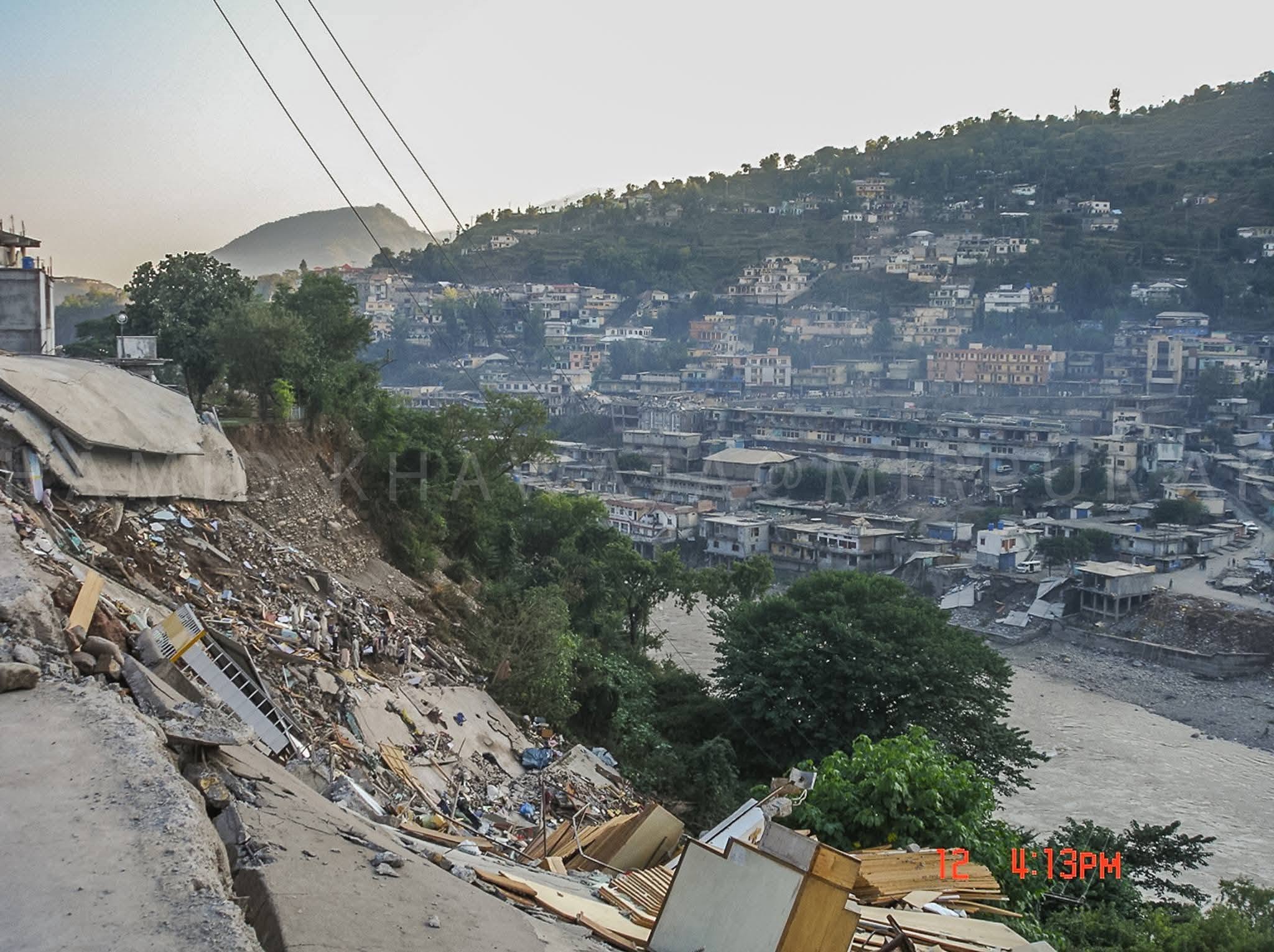

On the morning of 8 October 2005, a powerful earthquake struck Pakistan-administered Kashmir and Khyber Pakhtunkhwa. In seconds, thousands of families lost their loved ones, their homes and a lifetime of savings. In Pakistan-administered Kashmir alone, nearly 46,000 people were killed and more than 300,000 houses were destroyed.
The quake did not only damage homes. Health, education, water supply, communications and other basic services were severely affected across roughly 53 per cent of the region’s area.
It ranks among the largest disasters in human history, and it triggered one of the largest relief and reconstruction operations the region has seen. Twenty-one years on, that operation is still not complete.
From rescue to reconstruction
Immediately after the earthquake, the Government of Pakistan, the government of Pakistan-administered Kashmir, local departments and international agencies began joint rescue and relief activities.
In the initial phase, the focus was on pulling survivors from the rubble, providing medical aid to the injured, supplying food and tents, and moving affected populations to safer locations.

Later, a major reconstruction programme was launched. Its aim was not only to rebuild destroyed buildings but also to promote earthquake-resistant construction to reduce the impact of future quakes.
For that purpose, institutions including ERRA and SERRA trained people involved in construction in earthquake-resistant design and building methods.
The recovery and reconstruction work drew international recognition. According to records provided by ERRA and SERRA, ERRA received the United Nations Sasakawa Award in 2011.

Rs125 billion in losses, nearly Rs198 billion in projects
According to official records, the financial loss in the earthquake-affected districts of Pakistan-administered Kashmir was estimated at about Rs125 billion.
Against that, reconstruction projects worth about Rs198 billion have so far been completed, on which roughly Rs168 billion has been spent.
That figure also includes direct expenditure by various donors and sponsors.
But the reconstruction journey is not over.
7,608 projects, hundreds still pending
According to ERRA and SERRA records, a total of 7,608 recovery and reconstruction projects were undertaken across the seven earthquake-affected districts of Pakistan-administered Kashmir: Muzaffarabad, Hattian, Neelum, Bagh, Haveli, Poonch and Sudhnoti.
Of these:
5,878 projects, or about 77 per cent, have been completed.
919 projects, or about 12 per cent, are still under way.
811 projects, or about 11 per cent, could not be started because of financial difficulties.
So 21 years later, hundreds of projects in the reconstruction programme are still waiting to begin.
Money kept falling short, projects kept stalling
The reconstruction programme has faced financial difficulties for several years.
According to SERRA records, in various financial years, only a limited portion of the funds sought for reconstruction was actually provided.
In the 2010-11 financial year, about Rs2.7 billion was demanded, and Rs750 million was provided.
In 2011-12, about Rs3.332 billion was sought, but only Rs538 million was released.
In 2012-13, against a demand of Rs1.62 billion, Rs356.4 million was received.
In 2013-14, against a demand of Rs1.4 billion, Rs151.2 million was released.
The pattern continued after that.
In 2014-15, against a demand of Rs1 billion, about Rs75.6 million was released, while in 2015-16, against a demand of about Rs696 million, Rs104.8 million was provided.
In 2016-17, against a demand of Rs800 million, about Rs95.3 million was released.
In 2017-18, SERRA sought about Rs1.69 billion, but about Rs102.6 million was provided.
In 2018-19, against a demand of Rs950.4 million, about Rs99.6 million was released.
In 2019-20, against a demand of Rs1.981 billion, only Rs73.1 million was released.
And in 2020-21, against a demand of about Rs960.4 million, just Rs37.3 million was provided.
Rs555.9 million in seven years
Looking at the figures, SERRA received a total of about Rs5.559 billion over the past seven years.
That amount is less than some of SERRA’s single-year demands.
According to SERRA, despite these financial difficulties, about 463 projects in education and health in particular were completed over the past seven years.
These projects include the restoration of schools, hospitals and other basic facilities, which were considered important for bringing life back to normal for the affected population after the earthquake.
Rs30 billion still needed
But the end of this reconstruction journey is still some way off.
According to SERRA, a total of about Rs30.107 billion is needed to complete the remaining projects in the reconstruction programme.
Of this, Rs2.429 billion is needed for liabilities related to completed projects, Rs12.615 billion for the completion of ongoing projects, and about Rs15.061 billion for projects that are still pending.
Because of this situation, there is a risk of further delays in completing the remaining projects in the reconstruction programme.
21 years later, the same question
It has now been 21 years since the earthquake of 8 October 2005.
In that time, thousands of buildings have been rebuilt, schools and hospitals have reopened, roads have been restored, and life in the affected areas has largely returned to normal.
But the scale of the destruction was so large that, even after two decades, not all reconstruction targets have been met.
On one side, reconstruction work was carried out on a large scale compared with the damage caused by the earthquake. On the other, a shortage of financial resources has affected the pace of the remaining projects.
Twenty-one years on, the memory of the earthquake is not confined to the families who lost their loved ones. It also lives in the projects that remain unfinished.