

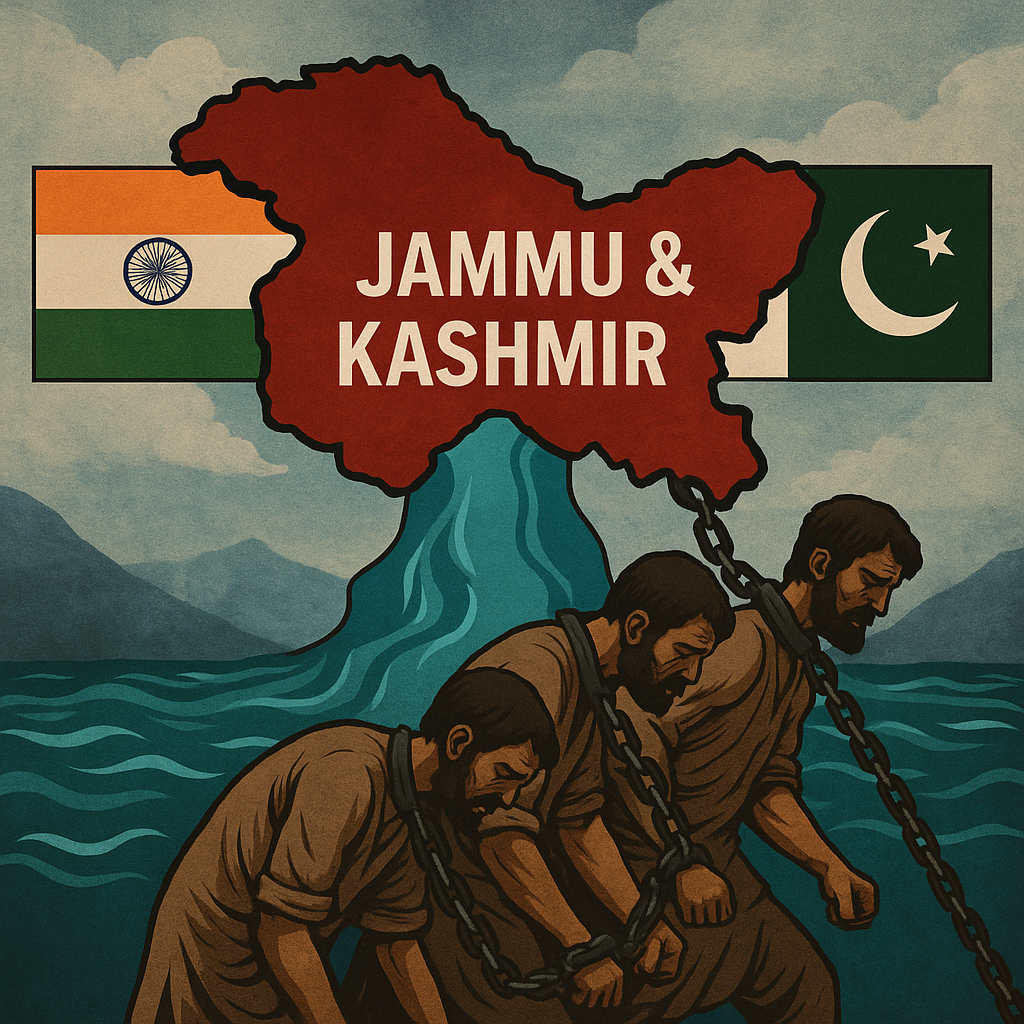

By Syed Nazir Gilani, Muzaffarabad AJK (Pakistan administrated Kashmir): The recent unilateral decision by the Indian government to suspend the Indus Waters Treaty is not merely a technical or bilateral issue between New Delhi and Islamabad. It is a direct disruption of a delicate arrangement that has governed the sharing of vital water resources for over six decades and more critically, it is yet another chapter in the long-standing marginalization of the people of Jammu and Kashmir, whose rivers, glaciers, and mountains are the true sources of these waters.
This water does not inherently belong to India or Pakistan. It flows from the heart of a land that has yet to be allowed its full voice — a land whose inhabitants are not only at the center of geopolitical conflict but also stewards of its most essential resources. The region’s natural wealth, including its rivers, lakes, and watersheds, are a trust held in the name of the Kashmiri people. India and Pakistan are not proprietors but trustees, and this trust has, for far too long, been exercised without consent or consultation from those most directly affected.
The United Nations General Assembly, through its 2010 resolution, formally recognized access to clean water and sanitation as a basic human right. Further, the UN Human Rights Council reaffirmed this principle under Article 11 of the International Covenant on Economic, Social and Cultural Rights (ICESCR). Denying stakeholders access, control, or benefit from their own resources, therefore, stands in violation not only of historical justice but of international law.

The Azadi Times
No state grants. No corporate lobby. Just ground‑truth reporting from Kashmir & beyond
You make this possible.
When the Indus Waters Treaty was signed in 1960, neither India nor Pakistan made room for equity or inclusion. The treaty failed to acknowledge the inherent and historical water rights of the people of Jammu and Kashmir. Instead, both nations opted for a transactional division of resources, prioritizing their national interests and disregarding the local populations whose lands cradle the origins of these mighty rivers.
Had both countries acted with responsibility, fairness, and foresight — upholding the stewardship of Kashmiris as natural custodians — today’s tensions could have been avoided.
Toward a Just and Sustainable Framework
To ensure lasting peace, ecological stability, and rightful participation, a new vision is needed. One that centers the Kashmiri people as active stakeholders, not passive observers. A new framework must include:


- Recognition of the People of Jammu & Kashmir as a Third Party to the Indus Waters Treaty.
- Establishment of an Independent, UN-Mandated Commission to review and oversee transboundary water governance and resource-sharing.
- Formulation of a Kashmiri Charter of Water Stewardship, built upon:
- Indigenous Water Rights
- Sustainable and Participatory Resource Management
- Intergenerational and Regional Equity
- Post-Conflict Reparations and Environmental Justice
Legal Avenues, Not Battlefield Agendas
It is imperative that both nations resist the impulse for confrontation and instead pursue legal arbitration through appropriate international forums such as the International Court of Justice (ICJ). The court must assess whether the exclusion of Jammu and Kashmir from the Indus framework breaches international legal norms, including the Principle of Permanent Sovereignty Over Natural Resources.
Kashmir’s rivers like its people must no longer be treated as pawns in a larger political struggle. True sovereignty lies with the people of the state, who have, for decades, borne the burden of decisions made without their participation or approval.
This moment is not just about water. It is about voice, representation, and recognition. It is about ending the cycle where geopolitical rivalries turn the people of Kashmir into collateral casualties politically, economically, and ecologically.

India and Pakistan must choose a path of cooperation, law, and justice, rather than brinkmanship and historical repetition.
Because neither peace nor water can flow freely without dignity and inclusion.
Disclaimer:
This article is an editorial piece, and the views and opinions expressed are solely those of the author. They do not necessarily reflect the official stance or editorial policy of The Azadi Times.