

On 28 August, Barrister Iftikhar Gilani took the oath as the 17th prime minister of Azad Jammu and Kashmir (AJK). He won 30 votes in the Legislative Assembly against 14 for the PPP’s candidate. He had not won a territorial seat. Voters in his own constituency rejected him, and he entered the house through a reserved seat for technocrats.
In his first speech, the new premier thanked PML-N leaders in Pakistan, including Nawaz Sharif, Prime Minister Shehbaz Sharif and Punjab Chief Minister Maryam Nawaz. Pakistan’s prime minister, in turn, congratulated him and promised federal support.
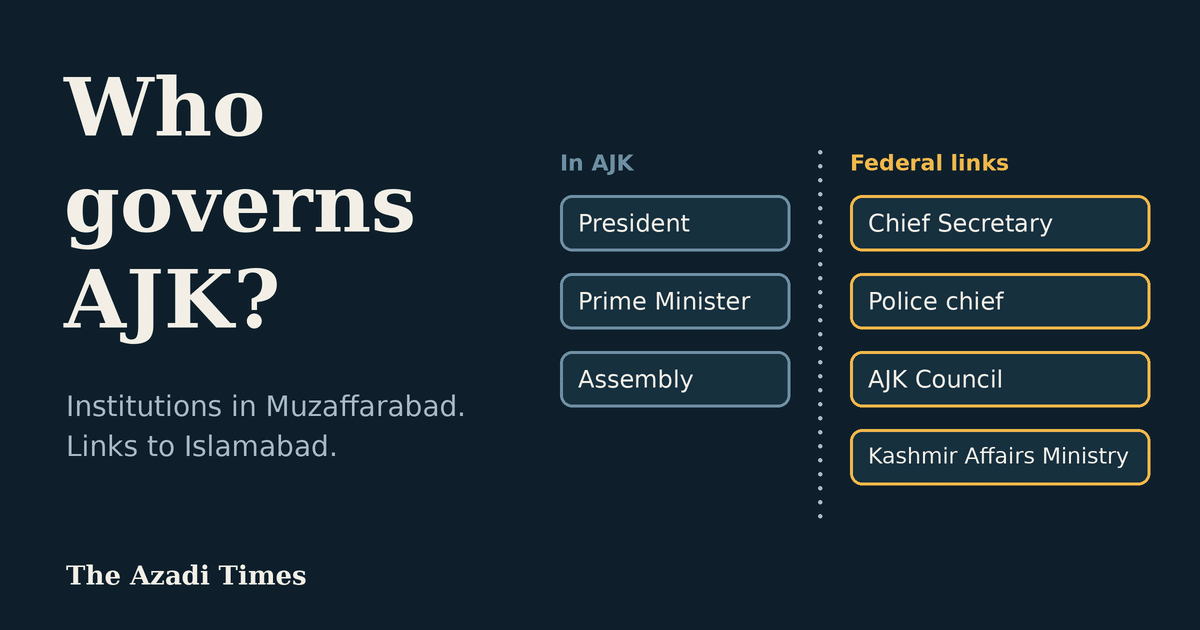
The scene is a compact answer to a question many readers ask: who governs this territory? On paper, it is a self-governing parliamentary system. In practice, the lines between Muzaffarabad and Islamabad are blurred, and the 2026 crisis has put that blur at the centre of the debate.

A note on terms. “Pakistan-administered Kashmir” covers two regions: AJK and Gilgit-Baltistan. This article deals with AJK, which has its own constitution and government. Gilgit-Baltistan is governed under a separate arrangement.
At a glance
Institution Who or what it is Constitution AJK Interim Constitution Act, 1974 (amended, most recently by the 13th Amendment, 2018) Head of state President, elected by the Assembly for five years. Currently Dr Muhammad Najeeb Naqi Khan Head of government Prime Minister, elected by the Assembly. Currently Iftikhar Gilani (since 28 August 2026) Legislature Legislative Assembly, 53 seats Courts Supreme Court and High Court Federal link Ministry of Kashmir Affairs and Gilgit-Baltistan, AJK Council, federally posted senior officials
The formal structure
The AJK government looks familiar to anyone who knows Pakistan’s. A president elected by the Legislative Assembly serves as head of state, while the elected prime minister is the chief executive. The president’s role is mostly ceremonial: executive powers are exercised by the prime minister and cabinet, and the president is bound to act on their advice. The president also appoints the chief justices of the Supreme Court and High Court.
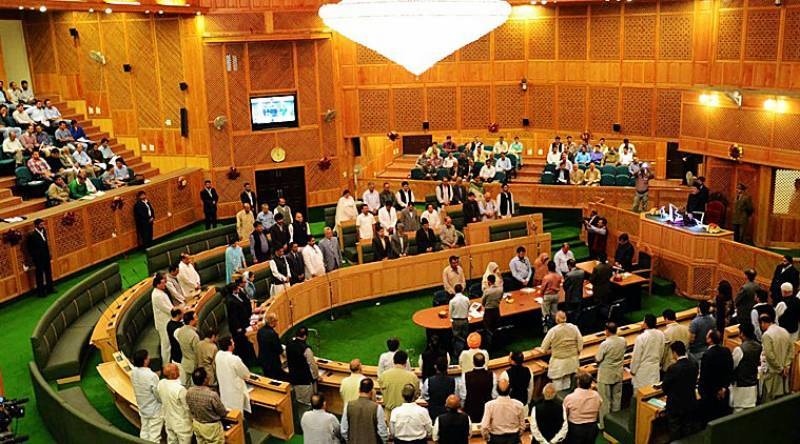

The assembly has 53 members. Forty-five are general seats, of which 33 are elected from constituencies inside the territory and 12 from seats reserved for refugees living across Pakistan. The remaining eight are reserved for women, an Islamic scholar, a technocrat and overseas Kashmiris. The refugee seats are the subject of our earlier explainer and a major reason for the 2026 unrest.
The judiciary has its own apex court. The Supreme Court has a chief justice and two other judges, a number fixed by the 1974 Act.
“Interim” since 1974
The word in the constitution’s name matters. The territory’s status is officially unsettled pending the resolution of the Kashmir dispute. The constitution defines AJK as territories of the former state “liberated by the people of that State” and administered for the time being by its government.


That wording has a practical consequence for how AJK relates to Pakistan. According to Dawn’s reporting on the region and the Al Jazeera account from July, AJK has no representation in Pakistan’s national parliament. A Tribune explainer from 2012 pointed out that AJK is not mentioned in Pakistan’s constitution, unlike other special areas, yet residents carry Pakistani identity documents. Pakistan’s official position is that it supports Kashmiri self-determination under the UN framework, and that AJK’s separate status reflects it.
Where Islamabad comes in
Several mechanisms connect the AJK government to the federal one. Their weight is disputed, and some have changed over time.
1. The Ministry of Kashmir Affairs
The federal ministry has been central since the territory’s early years. It was set up in January 1949, and defence and foreign affairs for AJK, including dealings with the United Nations, were ceded to it. A history of the ministry notes that until 1970, the fate of AJK governments largely depended on its bureaucrats, who acted as kingmakers.
The current federal minister for Kashmir Affairs, Amir Muqam, attended the October ceremony for new AJK Council members alongside the AJK president and prime minister.
2. “Lent officers”
The most visible day-to-day link is personnel. The chief secretary and inspector general of police are posted to AJK by the federal government under the 1949 Karachi Agreement, for tenures that rarely exceed three years. They are commonly called “lent officers.”
The arrangement was adjusted in 2014. Dawn reported that after a dispute between the then PPP government in Muzaffarabad and the PML-N government in Islamabad, it was agreed that transfers of lent officers take effect only after the AJK administration notifies them with the prime minister’s approval. The federal government still chooses the officers. In February 2026, it posted a new police chief through a notification from its Establishment Division. After the violent protests of May 2024, the federal government replaced AJK’s police chief days later.
These officers run the civil administration and the police, which is why critics say elected AJK governments cannot fully direct their own bureaucracy. Supporters of the system would say that it keeps administration professional and insulated from local patronage. We have not found an official defence of the arrangement stated in those terms, and we invite one.
3. The AJK Council
The council is the most contested institution. It has 14 members and is chaired by Pakistan’s prime minister. Under the original 1974 design, it was the dominant body. Human Rights Watch wrote in 2006 that the council exercised paramount authority over the Legislative Assembly, which could not challenge its decisions. According to a 2023 summary, it held jurisdiction over fifty-two subjects, including everything of significance, and controlled tax collection.
The 13th Amendment in June 2018 changed this on paper. Dawn reported that it stripped the council of its administrative, legislative and financial powers, and The News described it as relegating the council to an advisory body while giving AJK major fiscal autonomy. In 2019, the UN human rights office noted that AJK’s political leaders said more powers had shifted to the assembly, while the office itself concluded that the amendment actually transferred the council’s powers to Pakistan’s prime minister. More recently, Al Jazeera’s July reporting described the council as overseeing areas such as electricity, banking and parts of taxation that largely fall outside the assembly’s authority. In October, Pakistan’s prime minister promised to strengthen the council as new members were sworn in.
We therefore cannot give a single clean answer on the council’s present powers. Readers should consult the amended constitution’s text, and we will report corrections.
4. The power to remove governments
A 2006 Human Rights Watch report found that under Section 56 of the Interim Constitution, drafted by the federal law and Kashmir Affairs ministries, Pakistan’s government could dismiss any elected AJK government regardless of its assembly support. That report predates the 13th Amendment, and we could not independently confirm whether the provision survives in the same form. We include it because it shaped how governance in AJK was understood for years.
What AJK cannot decide
Under the original design, the assembly’s powers covered the residual areas of governance, with defence, foreign affairs, communications, currency and matters relating to UN resolutions on Kashmir excluded. Those subjects stayed with Pakistan.
A Tribune explainer quoted an activist who said the elected government’s powers were closer to those of a municipality. That was a 2012 assessment, and it came before the 13th Amendment. It captures a view still heard from AJK critics today.
The accession condition
One rule shapes politics in AJK more than any administrative arrangement. Article 7(2) of the Interim Constitution restricts who may take part in public life. (Some sources number the provision differently.) Human Rights Watch summarised its effect: it bars from the political process any parties and individuals who do not support the idea of Kashmir’s accession to Pakistan. Freedom House likewise notes that the constitution bans political parties that do not endorse eventual accession.
The consequences have been documented over decades. The Human Rights Commission of Pakistan reported in its review of 2022 that parties supporting an independent state remained excluded from the electoral process, with the election commission rejecting the nomination papers of candidates who did not support accession.
For a publication that supports self-determination, the contradiction is plain. Pakistan says it backs a UN-mandated plebiscite, under which Kashmiris would choose their future, yet the AJK constitution does not allow candidates to campaign for independence. Pakistani officials argue that the accession option reflects the territory’s historical choice and Pakistan’s declared position. Critics, including historian Anam Zakaria, reject that. Zakaria told Al Jazeera the oath in itself contradicts the right to self-determination and sidelines Kashmiris with a different vision.
What the 2026 crisis revealed
The Joint Awami Action Committee (JAAC) built its protest movement on economic grievances, but its confrontation with the authorities exposed the governance question underneath. Its members told Al Jazeera that real authority sits in Rawalpindi, meaning Pakistan’s military establishment, rather than with civilian leaders, which is why they negotiate through that channel. Researcher Ershad Mahmud argued that Islamabad’s bureaucracy, military and intelligence establishment have reduced AJK’s elected leadership to a largely symbolic role.
The government’s response, by contrast, stresses constitutional process and law and order. After the unrest, the AJK chief secretary and police chief appeared together to say the state would maintain its writ, and described the JAAC as an outlawed outfit. Both of those officials are federal appointees. That is not evidence of anything improper, but it illustrates how the structure works. The people speaking for AJK’s government were posted by the federal one.
Why it matters
Three points stand out.
The gap between form and practice. AJK has the institutions of self-government, but the personnel, constitutional conditions and fiscal links tie it closely to Islamabad. Reformers describe the 2018 amendment as a real shift of power. Others, including the UN human rights office in its 2019 commentary, say much of that power moved to the Pakistani prime minister instead of the local assembly.
Legitimacy. The new government came out of elections held during a deadly protest movement, with the JAAC banned and a boycott in place. A Dawn editorial warned that installing a prime minister rejected by his own constituency would reinforce concerns that local autonomy is being undermined.
Self-determination. The “interim” label, the accession oath and the exclusion of pro-independence candidates make AJK’s political space narrower than its institutions suggest. That is the strongest reason this governance question belongs in any discussion of Kashmiri rights.
Frequently asked questions
Is Azad Kashmir a province of Pakistan? No. It is not a province and is not part of Pakistan’s constitutional framework in the way provinces are, and it has its own constitution. It has no representation in Pakistan’s parliament.
Who is the head of AJK? The president is head of state (currently Dr Muhammad Najeeb Naqi Khan), and the prime minister is chief executive (currently Iftikhar Gilani).
Does AJK control its own police and civil service? Its own officers serve in both, but the chief secretary and police chief are posted by Pakistan’s federal government.
What is the AJK Council? A 14-member body chaired by Pakistan’s prime minister. Its powers were curtailed by the 2018 amendment, but accounts differ on how much influence it retains.
Can pro-independence parties contest elections? According to HRW, Freedom House and HRCP, candidates must support accession to Pakistan, which excludes pro-independence parties.
What is the difference between AJK and Gilgit-Baltistan? Both are Pakistan-administered, but they are governed under separate constitutional arrangements.
Key sources: Dawn (reports on the 13th Amendment and lent officers); Human Rights Watch, “With Friends Like These…” (2006); Freedom House, Freedom in the World 2022; HRCP, State of Human Rights in 2022: AJK; Al Jazeera, “Pakistan’s Kashmir votes: Why the election hinges on 12 disputed seats” (27 July 2026); Express Tribune and Geo reporting on the August 2026 government formation.
The Azadi Times invites comment from the AJK government, the Ministry of Kashmir Affairs and legal experts. We will update this article as verified information arrives.