

Voters who live in Lahore, Rawalpindi and Sialkot help choose who governs Muzaffarabad. Here is how that arrangement began, why it ignited deadly protests, and what it says about who holds power in the territory.
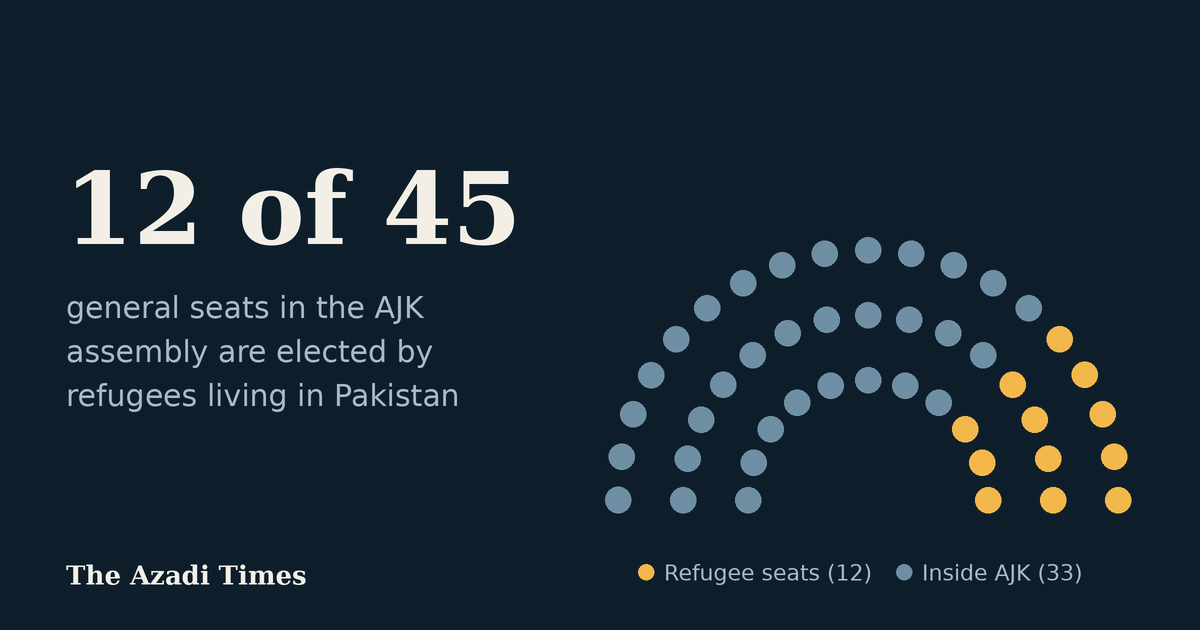
Of the 53 seats in the Legislative Assembly of Azad Jammu and Kashmir (AJK), the territory governed by Pakistan, twelve are not decided by people who live there. They are chosen by Kashmiri refugees settled across Pakistan, in cities such as Lahore, Rawalpindi and Sialkot. That fact, dry on paper, drove one of the most violent summers the territory has seen in years.
Understanding the refugee seats is the key to understanding the crisis in Pakistan-administered Kashmir in 2026. They are at once a constitutional provision, a diplomatic symbol, an electoral lever and, for thousands of protesters, a grievance. This explainer sets out the history, the numbers and the arguments, including those of people we disagree with.

What the refugee seats are
The AJK assembly has 53 members. Forty-five are general seats, of which 33 are elected from constituencies inside the territory and 12 from seats reserved for refugees who now live across Pakistan. The other eight are reserved for women, a religious scholar, a technocrat and overseas Kashmiris. The twelve refugee seats are split evenly: six represent refugees from the Jammu division and six represent refugees from the Kashmir Valley.
These voters fled or left what is now Indian-administered Jammu and Kashmir, some during the upheaval of 1947 and the war of 1947–48, others in later decades. Reporting based on Indian sources notes that, like voters in AJK itself, they must hold State Subject certificates to vote or stand. The certificate is a legacy of the old princely state, and it is the legal thread linking refugees to the territory’s claim over the whole of Jammu and Kashmir.
Where the seats came from
The arrangement is not new. According to Al Jazeera, it traces back to electoral arrangements in 1960, reinforced by laws in 1964 and 1970, formalised in the 1974 Interim Constitution, and reaffirmed by a constitutional amendment in 2018. A legal commentary in Dawn adds that the seats are entrenched under Article 22 of the Interim Constitution.
A former AJK chief justice, Chaudhry Muhammad Ibrahim Zia, told Al Jazeera the seats rest on an even earlier foundation: the AJK government’s founding declaration of 24 October 1947, which he said expressed the collective will of the people of the former state. In his view, they have solid historical and constitutional grounding.
The numbers
The scale of the dispute is easier to see with figures. According to Election Commission data cited by Al Jazeera, AJK’s electorate was more than 3.8 million this year, and the twelve refugee constituencies account for roughly 439,000 registered voters, scattered across Pakistani cities.
By our calculation, that means refugee voters make up about 11 to 12 per cent of the electorate but fill roughly a quarter of the 45 general seats.


The split between the two groups is stark. The Express Tribune reported that the Jammu refugee population is estimated at around 434,000, while the Kashmir Valley refugee population is about 30,000, yet each group gets six seats. Using those estimates, a Valley seat represents roughly 5,000 people and a Jammu seat roughly 72,000. These are population estimates rather than voter-roll counts, so treat the ratio as indicative.
The imbalance has a long history. Scholarship summarised in a reference on Kashmiris in Azad Kashmir says refugees have historically been over-represented in the AJK legislatures relative to their numbers, and that in 1990 there were about 400,000 refugee voters against 1.2 million residents of AJK. The scholar cited, Christopher Snedden, argues that this gives the central government in Islamabad openings to influence election results.
Why the JKJAAC wants them abolished
The Jammu Kashmir Joint Awami Action Committee (JKJAAC) began as a campaign over flour prices and electricity tariffs, not assembly seats. Al Jazeera noted that its original charter was almost entirely economic, and the refugee seats first appeared in its expanded charter in October 2025.
The group’s objection is about jurisdiction and power. JAAC committee member Kashif Abbasi told Al Jazeera that the election is meant for people who live in AJK, and these twelve seats sit outside its jurisdiction. The broader complaint, reported across outlets, is that the seats allow Pakistan-based political parties to influence the AJK government and divert development funds intended for the territory.
Canada-based researcher Ershad Mahmud, author of a book on Poonch, told Al Jazeera that the seats persist partly because they serve Islamabad’s interests. In his view they let Pakistan argue that AJK represents the entire former state and help Pakistan-based parties shape government formation in Muzaffarabad.
Notably, the JAAC did not start from a demand for outright abolition. On 30 May, it put two alternatives in writing: keep symbolic refugee representation until the Kashmir dispute is permanently settled, or replace the twelve assembly seats with four seats on the AJK Council. That council is a body chaired by Pakistan’s prime minister that handles federal-facing subjects. An All-Parties Conference in Muzaffarabad rejected both proposals on 3 June.
The case for keeping them
The defenders of the seats are not a monolith, and their arguments deserve a fair hearing.
The core argument is political and symbolic. Supporters say the seats reflect the assembly’s claim to represent the whole former princely state, not just the territory AJK administers. A Geo News analysis summarised the view that because the Kashmir dispute is unresolved, displaced Kashmiris retain a legitimate stake, and the seats acknowledge that displacement.
Abdul Majid Khan, a former AJK finance minister who comes from a refugee family, rejects the idea that seat-holders form a powerful bloc. He told Al Jazeera that AJK’s annual budget of about 310 billion rupees far exceeds the development funds allocated to the refugee constituencies.
Pakistan’s government takes a procedural line. Defence Minister Khawaja Asif told the National Assembly on 11 June that the seats’ future should be decided by voters rather than under street pressure. That is the government’s position, and it is worth noting that it comes from the very authority whose interests critics say the seats serve.
The critics’ reply
Some commentators challenge the legal framing directly. One opinion piece in Eurasia Review argues that UN resolutions say nothing about refugee quotas in the AJK assembly, and that the legal continuity of Jammu and Kashmir is preserved through State Subject status, not assembly quotas. It also points out that the refugee constituencies are non-resident and extraterritorial, and that many holders have integrated into Pakistan’s political and economic life. This is an opinion piece, but it captures an argument raised by the JAAC’s supporters.
What the courts have said
The courts have not rescued the JAAC’s case. In June, the AJK Supreme Court issued an advisory opinion, in response to a presidential reference, finding that the seats are constitutionally protected under Article 22 and cannot be altered through administrative measures, political agreements or public pressure.
Zia, the former chief justice, said that means the seats cannot be removed without a proper constitutional process, and that no such process was possible until a new legislature was elected.
Put plainly, the law sends the matter to the assembly, and the assembly is itself elected partly through the contested seats. That circularity is a large part of why the dispute proved impossible to settle by negotiation.
The self-determination question
For an outlet that supports Kashmiri self-determination, this is the deepest layer of the story.
Under a UN Commission for India and Pakistan resolution adopted on 5 January 1949, Kashmir’s final status was to be decided through a free and impartial plebiscite. That vote has never been held on either side of the Line of Control.
Pakistan’s government argues the refugee seats preserve the principle that the whole former state has a voice. Critics respond that the arrangement protects Islamabad’s influence more than it serves Kashmiris. Historian Anam Zakaria, who wrote a book on Pakistan-administered Kashmir, points to a further contradiction: candidates for public office in AJK must first swear allegiance to its accession to Pakistan, which she says itself contradicts the right to self-determination and sidelines Kashmiris with a different vision. Readers should consult the Interim Constitution’s text on this requirement, and we will publish a separate explainer on it.
Zakaria also stresses a point that is easy to lose. Nothing Pakistan does in the territory it administers is comparable, she argues, to the long-running violence and human rights abuses in Indian-administered Kashmir. Both things can be true, and an honest account holds them together.
There is also a view that autonomy and self-determination do not conflict. Lahore-based constitutional lawyer Hassan Kamal Wattoo told Al Jazeera that there is no tension between real autonomy for AJK and an eventual plebiscite.
What happened at the ballot box
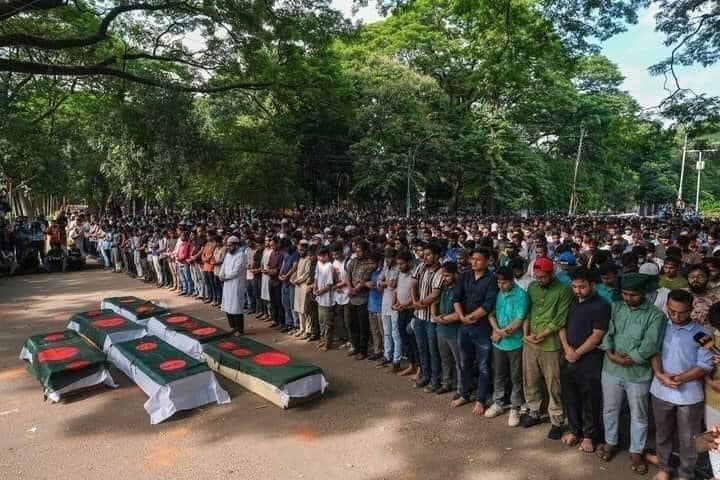
The election went ahead in phases, with the refugee constituencies voting in the second phase on 2 August. The JAAC, banned since 5 June, urged supporters to boycott. Authorities also barred international media from reporting from the region. Al Jazeera reported that more than 50 people were killed during the protests, according to residents and rights groups. An earlier Al Jazeera count put the toll at nearly 40. The figures differ because no independent count has been possible.
The result showed why the seats matter. A Dawn editorial said the PML-N emerged as the single largest party, helped by eight seats for Kashmiri refugees in Punjab. The same editorial recorded that lawyer Iftikhar Gillani, who lost in his own constituency, was chosen as prime minister through a reserved seat for technocrats, and that even mainstream parties such as the PPP questioned the legitimacy of elections held amid an uprising.
Supporters of the seats will say the PML-N’s strength reflects votes cast by a legitimate constituency. The JAAC will say it shows exactly what it warned about. Both readings rest on the same facts.
What remains unresolved
Three questions hang over the territory:
- Can the seats ever change? Legally, only a constitutional amendment can do it, and that requires an assembly that the JAAC says was shaped by the very arrangement it opposes.
- Who actually negotiates? Al Jazeera reported that JAAC members believe real authority sits with Pakistan’s military establishment rather than elected leaders, and Mahmud argues the local leadership has been reduced to a largely symbolic role.
- Can the facts be checked? With foreign media barred and communications repeatedly cut, independent verification remains limited.
Frequently asked questions
How many refugee seats are there in the AJK assembly? Twelve, out of 45 general seats and 53 in total. Six are for refugees from the Jammu division and six for refugees from the Kashmir Valley.
Who votes for them? Registered Kashmiri refugees living in Pakistan, roughly 439,000 voters according to Election Commission figures cited by Al Jazeera.
Why does the JAAC want them abolished? It says voters outside AJK should not decide who governs inside it, and that the seats let Pakistan-based parties influence the government and divert funds.
Can the seats be abolished? According to the AJK Supreme Court, only through a formal constitutional amendment.
Is the JAAC still banned? AJK authorities designated it a proscribed organisation on 5 June 2026, and we have seen no report of the ban being lifted.
The Azadi Times invites the JKJAAC, the AJK government and representatives of refugee communities to respond. We will update this article as verified information arrives.