SRINAGAR, Indian-administered Kashmir — In the narrow lanes of Srinagar’s old city, behind wooden shopfronts that have stood for generations, there is a sound that has not changed in centuries: the soft tap of a hammer on silver, the hiss of a blowtorch, the quiet murmur of a craftsman explaining a design to a customer. This is where Kashmiri jewellery is still made — not in factories, not in mass-production units, but by hand, in workshops that have passed from father to son for longer than most nations have existed.
Kashmiri jewellery is not simply ornament. It is a record of the valley’s history — its Hindu and Muslim past, its Persian and Central Asian influences, its Buddhist and Sufi layers, and its long, complicated relationship with the gemstones that lie beneath its mountains. To understand Kashmiri jewellery is to understand Kashmir itself: a place of extraordinary beauty, deep craftsmanship, and unresolved political identity.
This is the story of that craft — its designs, its gold and silver, its sapphires and gemstones, and the artisans who have kept it alive through war, occupation, and economic collapse.
What Is Kashmiri Jewellery?
Kashmiri jewellery refers to the traditional ornaments crafted in the Kashmir Valley and the surrounding regions, distinguished by specific design motifs, metalwork techniques, and the use of locally sourced gemstones. It is worn across communities — by Kashmiri Pandits, Kashmiri Muslims, and the wider diaspora — and it carries meanings that are both aesthetic and symbolic.
The craft has deep roots. According to historical and craft documentation, Kashmiri jewellery design draws on nature: the almond (badam), the chinar leaf, the myna bird, and the bulbul are recurring motifs. These are not random decorations. They are the visual vocabulary of the valley — the trees, birds, and fruits that define its landscape — translated into gold and silver.
The craft also reflects Kashmir’s position on the old trade routes. Persian, Central Asian, and Mughal influences are visible in the filigree work, the use of enamel, and the geometric precision of certain pieces. But the result is distinctly Kashmiri — a style that is recognisable at a glance to anyone who knows the trade.

The Dejihor and the Bridal Taj: Symbols of Marriage and Identity
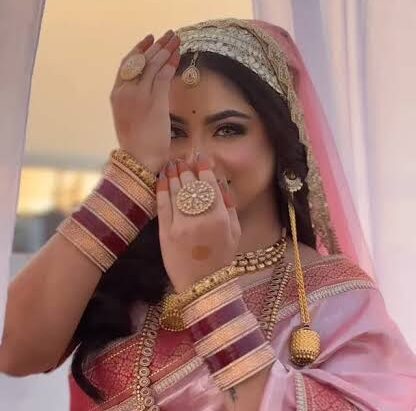
No discussion of Kashmiri jewellery is complete without the Dejihor — the long, dangling ear ornament worn by Kashmiri Pandit women. For Kashmiri Pandits, the Dejihor is not merely jewellery; it is a symbol of marriage and identity. It is traditionally worn by married women, and it carries a significance that goes beyond decoration.
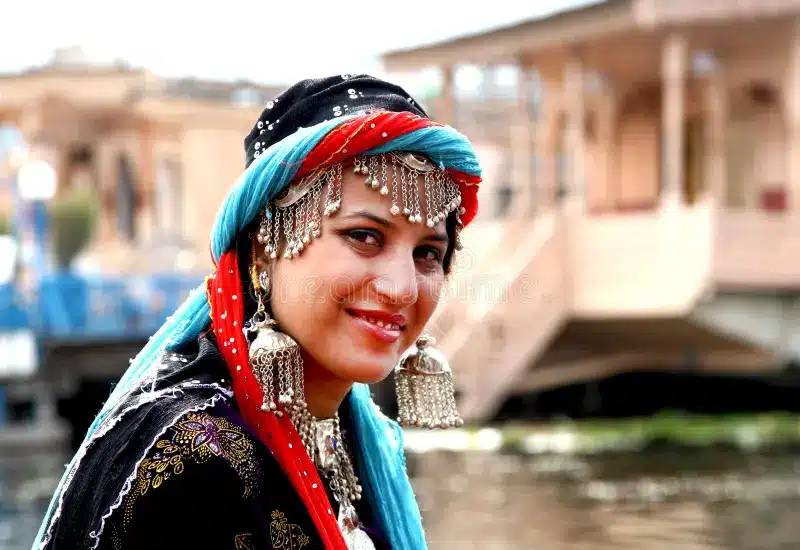
The Dejihor hangs from the top of the ear and extends downward in a series of linked elements. Its design varies by region and family, but the essential form — a long, elegant chain of gold or silver, often set with stones — is consistent. For Kashmiri Pandit women, wearing the Dejihor is an assertion of cultural continuity, especially in the diaspora, where the ornament has become a marker of belonging.
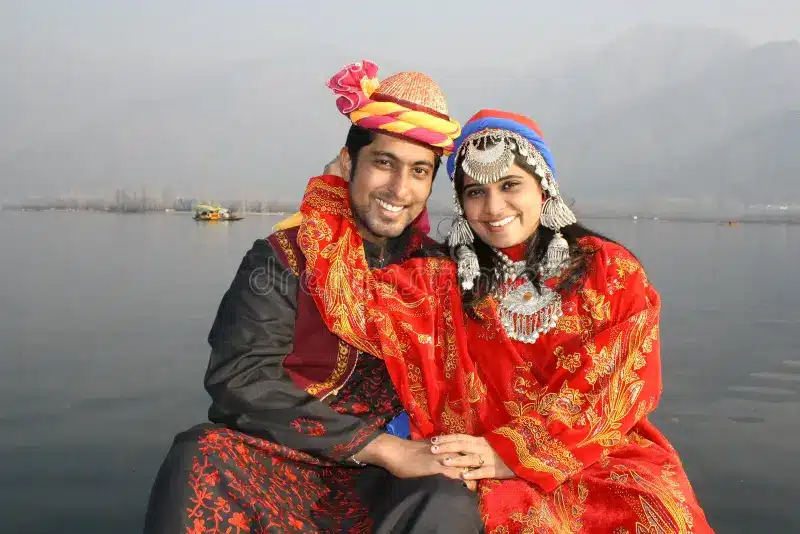
Alongside the Dejihor is the Taj — a bridal crown, typically made of silver or gold, worn during weddings. The Taj is pointed and ornate, and it is one of the most recognisable pieces of Kashmiri bridal jewellery. Together, the Dejihor and the Taj form the core of the Kashmiri Pandit bridal ensemble, a tradition that has survived displacement and migration.

Among Kashmiri Muslims, the bridal jewellery follows a different but related vocabulary. The Halqaband — a necklace set with rubies, emeralds, precious stones, and mirrors — is a common bridal piece. The Jhumka (dome-shaped earrings) and the Kana Vai (a chain worn across the forehead or hair) are also part of the traditional repertoire. The shared motifs — almonds, chinar leaves, birds — cut across religious lines, a reminder that Kashmiri culture predates the divisions that now define its politics.
Gold, Silver, and the Sapphire Connection
The metals and stones used in Kashmiri jewellery tell their own story.
Gold is the prestige metal. Bridal jewellery is traditionally made in gold, and gold ornaments are passed down through generations as family wealth. In Kashmiri Muslim weddings, gold is central; in Kashmiri Pandit weddings, gold and silver are both used, with silver often favoured for certain ritual pieces.
Silver is the people’s metal. It is more affordable, more widely worn, and deeply embedded in everyday Kashmiri life. Silver ornaments — bangles, anklets, earrings, and chains — are worn by women across communities, and silverwork is one of the crafts for which Kashmir is known. According to craft documentation, the silverware of Kashmir includes ornaments, household items, and decorative objects, often worked with intricate filigree and engraving.
And then there is the sapphire — the stone that made Kashmir famous in the global gem trade.
The connection between Kashmiri jewellery and the Kashmir blue sapphire is not incidental. The sapphires mined in the Zanskar range in the 1880s were among the finest ever found, and they entered the jewellery trade through the markets of Srinagar and beyond. According to India’s Press Information Bureau, Kashmiri jewellery incorporates precious and semi-precious stones including sapphire, emerald, and agate, and sapphire, agate, and lapis lazuli are among the gemstones found in Jammu and Kashmir.
This is the link that connects the two stories: the Kashmir blue sapphire — exhausted within five years of discovery, now among the rarest gemstones on Earth — was once set into the jewellery of the valley. The stones that remain in museums and auction houses are the survivors of a trade that began in the mountains and passed through the hands of Kashmiri craftsmen.
Designs Rooted in Nature: Almonds, Chinar Leaves, and Birds
The visual language of Kashmiri jewellery is unmistakable. It is a language of nature — of the things that grow and live in the valley.
The almond (badam) is one of the most common motifs. It appears in earrings, pendants, and chains, often stylised into a teardrop or leaf shape. The almond is a Kashmir staple — it grows in the valley, it is eaten, and it is used in traditional medicine — and its image in jewellery is a way of carrying the valley’s abundance on the body.
The chinar leaf is another signature motif. The chinar tree is iconic in Kashmir, and its broad, multi-pointed leaf appears in jewellery as a symbol of the region itself. Chinar-leaf pendants and earrings are among the most recognisable Kashmiri designs.
Birds — particularly the myna and the bulbul — are also common. They appear in earrings and brooches, often in flight or perched on a branch. The bird motif connects Kashmiri jewellery to a wider Persian and Mughal tradition, where birds are symbols of freedom and beauty.
These motifs are not merely decorative. They are a form of cultural memory — a way of encoding the valley’s landscape into objects that can be carried across borders and generations. For Kashmiri women living in the diaspora, a chinar-leaf pendant or a badam-shaped earring is a piece of home.
The Changing Craft: Local Artisans and Outside Influences
The craft of Kashmiri jewellery has always been shaped by the people who make it — and those people are changing.
Historically, the jewellery trade was dominated by local artisan families, many of them Muslim, who worked in the old city of Srinagar and in towns across the valley. These artisans were known for their skill in filigree, engraving, and stone-setting. Their work was sold in local markets and to visiting traders, and it formed part of the valley’s cultural economy.
In recent decades, however, the craft has faced pressure. Migration, conflict, and economic disruption have reduced the number of working artisans. According to craft documentation, many traditional goldsmiths have left the valley, and artisans from outside — particularly from Maharashtra and Bengal — have moved in to fill the gap. Silverware, however, remains largely a local craft, with Kashmiri artisans continuing to dominate the silver trade.
This shift has consequences. When outside artisans take over, the designs can change — sometimes subtly, sometimes significantly. The risk is that the distinctive Kashmiri vocabulary of almonds, chinar leaves, and birds is diluted or replaced by more generic forms. The counter-risk is that the craft becomes frozen, unable to adapt to new markets and new tastes.
The artisans themselves are aware of this tension. Many speak of the need to preserve traditional designs while also finding new ways to sell their work — online, to diaspora customers, and to international buyers. The future of Kashmiri jewellery, they say, depends on whether the craft can remain rooted in the valley while also reaching beyond it.
Why Kashmiri Jewellery Matters
Kashmiri jewellery is more than an aesthetic tradition. It is a form of historical record.
The Dejihor and the Taj carry the memory of Kashmiri Pandit life before displacement. The Halqaband and the Jhumka carry the memory of Kashmiri Muslim bridal traditions. The almond and chinar motifs carry the memory of the valley’s landscape. The sapphires carry the memory of a resource that was extracted and exported, leaving the communities around the mines among the poorest in the region.
And the craft itself — the handwork, the skill, the patience — carries the memory of a time when Kashmir was known not only for conflict but for beauty. That memory is not political in the narrow sense. It is cultural, and it belongs to everyone who claims Kashmir as home.
For the international reader, Kashmiri jewellery offers a way into the region that is not framed by headlines. It is a reminder that Kashmir has a culture that predates the dispute, and that this culture is still alive — in workshops, in weddings, in the hands of artisans who have not stopped working.
For the Kashmiri reader, it is a reminder of what is at stake. The craft is not guaranteed to survive. It depends on customers, on artisans, on the willingness of the diaspora to keep buying and wearing and passing down. Every Dejihor that is worn, every chinar-leaf pendant that is sold, is a small act of cultural preservation.
Frequently Asked Questions
What is Kashmiri jewellery?
Kashmiri jewellery refers to traditional ornaments made in the Kashmir Valley and surrounding regions, characterised by nature-inspired motifs (almond, chinar leaf, birds) and the use of gold, silver, and gemstones including sapphire.
What is the Dejihor?
The Dejihor is a long, dangling ear ornament worn by Kashmiri Pandit women, traditionally as a symbol of marriage and identity. It is one of the most recognisable pieces of Kashmiri jewellery.
What is the Taj in Kashmiri jewellery?
The Taj is a bridal crown, typically made of silver or gold, worn by Kashmiri Pandit brides during weddings. It is pointed and ornate and forms part of the traditional bridal ensemble.
Do Kashmiri jewellers use sapphires?
Yes. Kashmiri jewellery incorporates precious and semi-precious stones including sapphire, emerald, and agate. The Kashmir blue sapphire, mined in the Zanskar range in the 1880s, is among the rarest gemstones in the world and was historically set into Kashmiri jewellery.
Are Kashmiri Pandit and Kashmiri Muslim jewellery different?
They share motifs and materials but differ in specific pieces. The Dejihor and Taj are central to Kashmiri Pandit bridal jewellery; the Halqaband and Jhumka are common in Kashmiri Muslim bridal jewellery. Both traditions use gold, silver, and gemstones.
Conclusion: A Craft That Carries the Valley
Kashmiri jewellery is a living archive. It carries the valley’s landscape, its communities, its gemstones, and its history. It is made by hand, in workshops that have survived empires, and it is worn by women who carry it across borders and generations.
The sapphires are gone from the mountains, but they remain in the jewellery. The Pandits are dispersed, but the Dejihor remains. The artisans are fewer, but the craft continues. And the almond, the chinar leaf, and the bird — the symbols of the valley — are still being shaped into gold and silver, in the old city of Srinagar and in workshops across the region.
For anyone who wants to understand Kashmir beyond the headlines, Kashmiri jewellery is a place to begin. It is beautiful, it is complex, and it is still being made — by hands that remember.