
SRINAGAR — In Kashmir, October is not merely a month of changing seasons. It is a season of memory, a time when the chill in the air carries the echoes of history. The crimson of the chinar leaves is mirrored in the collective remembrance of bloodshed, and the anniversaries that mark the calendar are not celebrations but sombre reflections on a promise broken and a future deferred. At the heart of this historical gravity lie three consecutive dates in 1947—the 22nd, 24th, and 27th of October—a brutal and decisive trilogy that catapulted the princely state of Jammu and Kashmir into a conflict that remains, seven decades later, the world’s most persistent nuclear flashpoint.
This is not just a story of borders and accessions. It is the story of a people whose right to choose their own political destiny was violently disrupted, first by a tribal invasion, then by a local assertion of sovereignty, and finally, by the landing of foreign troops. The events of those six days forged the modern political reality of a divided land, setting the stage for decades of diplomacy, conflict, and unyielding resistance. For The Azadi Times, examining this period is essential to understanding why the cry for self-determination in Kashmir is not a relic of the past, but a living, breathing demand for justice.
The Prelude to Conflict
In 1947, as British India was divided into the new dominions of India and Pakistan, princely states were given the right to accede to either dominion or remain independent. Jammu and Kashmir, ruled by Maharaja Hari Singh, found itself in a unique position.
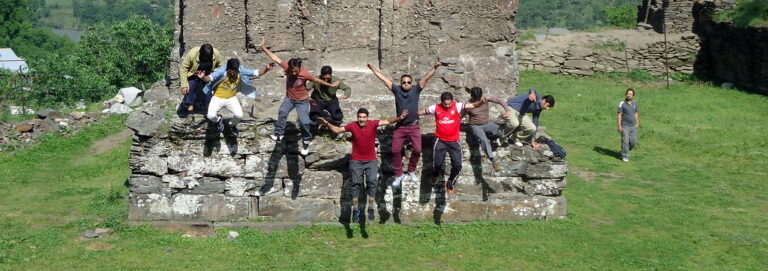
Exploring the Wonders of Sharda, Neelum Valley: A Professional Insight
A Hindu ruler governing a Muslim-majority state, Hari Singh, hesitated to join either side. His ambitions for independence clashed with mounting pressure from both Delhi and Karachi, and his indecision would soon turn catastrophic.
Kashmir’s economy was closely tied to what had become Pakistan — its rivers flowed westward, its roads and trade routes led toward Rawalpindi. Yet, politically, Hari Singh sought to preserve his autonomy. For the people of the valley, however, another desire simmered — the aspiration for Azadi, freedom from autocracy, and the right to determine their own political future.
By October, discontent had already spread across western Jammu regions like Poonch, where ex-soldiers of World War II rebelled against the Maharaja’s taxation and repression. Their uprising created a spark that would ignite the larger conflict.

22 October 1947 – The Tribal Invasion
On 22 October 1947, thousands of Pashtun tribesmen from the North-West Frontier Province (now Khyber Pakhtunkhwa) crossed into Kashmir, reportedly supported by elements within the newly formed Pakistan military.
The tribal fighters, known locally as lashkars, were motivated by multiple factors — some by religious sentiment, others by the promise of loot, and still others by the belief that they were liberating fellow Muslims from the rule of a Hindu Maharaja.
Their entry marked the first armed incursion into the princely state, setting off a chain of events that would internationalize the Kashmir dispute.


The tribesmen advanced rapidly, capturing Muzaffarabad and Domel, and moving toward Baramulla, a town just 50 kilometers from Srinagar. But what might have been seen by some as a liberation movement soon turned chaotic — reports of looting, burning, and civilian atrocities in Baramulla alienated local Kashmiris and provided Delhi with the justification it needed.
“The tribesmen entered with slogans of liberation, but soon their actions created panic,” said a Kashmiri historian from the University of Azad Jammu and Kashmir. “Their entry became the pretext for Indian intervention, something that would haunt Kashmir’s future.”
24 October 1947 – The Declaration of Azad Kashmir
Amid the chaos of invasion and rebellion, a group of Kashmiri political leaders gathered in Rawalpindi and declared the establishment of the Azad Government of the State of Jammu and Kashmir on 24 October 1947.
This government claimed to represent the will of the people who had risen against the Maharaja’s rule. Sardar Muhammad Ibrahim Khan, a prominent lawyer and political figure, became the first President of Azad Jammu and Kashmir (AJK).
The declaration was both a symbolic act of defiance and a practical step toward organizing the resistance. “It was not merely about territory,” writes political analyst Dr. Naeem Ch. “It was about the assertion of the Kashmiri people’s right to govern themselves, free from autocratic rule.”
While critics in India viewed it as a Pakistan-backed setup, many in Kashmir considered it a legitimate government born of the people’s uprising. The Azad Kashmir government continues to exist today, though its autonomy remains limited within Pakistan-administered territories.
In the days following the declaration, local militias aligned with the new government joined forces to fight against the Maharaja’s troops — and the approaching Indian army.
27 October 1947 – When Troops Landed in Srinagar
As the tribal forces neared Srinagar, Maharaja Hari Singh, facing imminent collapse, turned to India for military assistance.
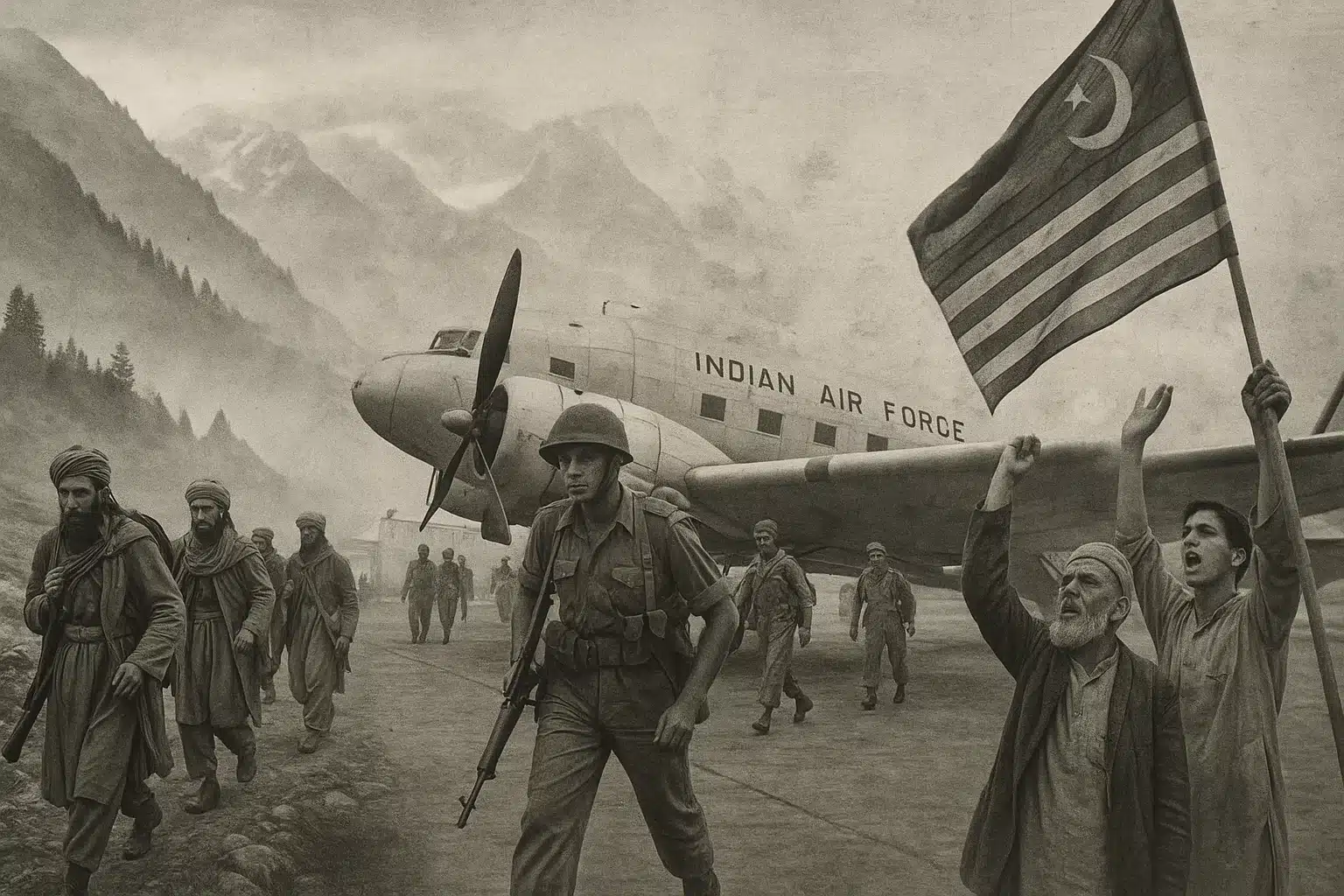
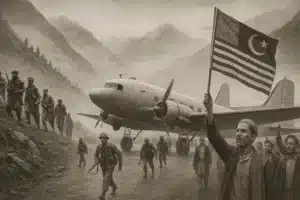
On 26 October, he signed the controversial Instrument of Accession, ceding authority over defense, external affairs, and communications to India. The next day, 27 October 1947, Indian troops were airlifted to Srinagar Airport in what became the official beginning of India’s military presence in Jammu and Kashmir.
New Delhi described the move as a legitimate response to the Maharaja’s request for help, but for many Kashmiris — and for Pakistan — it marked the start of occupation.
“From that moment, the conflict was no longer internal,” notes international journalist Altaf Ahmad. “It became a territorial dispute between two new nations — but for the Kashmiris, it was a question of their very identity and freedom.”
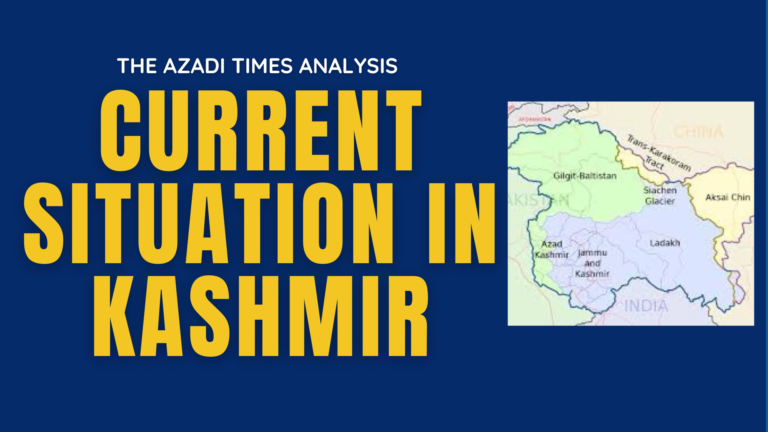
The arrival of Indian troops transformed the political landscape. Fighting intensified, spreading across the mountains and valleys, until a UN-mediated ceasefire came into effect in January 1949. The line that divided the combatants became the Line of Control (LoC) — and the valley of Kashmir, once united, was split between two administrations.
UN Steps In
The war between India and Pakistan raged until a UN-brokered ceasefire took effect on 1 January 1949, establishing the Line of Control that divides the region to this day. Critically, the United Nations Security Council intervened, passing a series of resolutions, most notably Resolution 47 of 1948.
The core of these resolutions was a three-step process: Pakistan was to withdraw its forces and nationals from the territory, India was to progressively reduce its troops to a minimum, and then, a free and impartial plebiscite would be held under UN auspices to allow the people of Jammu and Kashmir to decide their future: accession to India or Pakistan.
This promise of a plebiscite became the cornerstone of the Kashmiri demand for self-determination. It was an international legal commitment that acknowledged the disputed nature of the state’s accession and placed the will of its people at the centre of any final settlement.
“The UN resolutions are not just pieces of paper for us,” says Nahida Nasreen, a human rights activist in Srinagar. “They are a testament to the fact that the world once recognized our right to choose. The failure to implement them is the original sin of this conflict.”
That failure was absolute. The conditions for the plebiscite were never met. India and Pakistan could not agree on the demilitarization process, and over time, India’s position hardened, eventually declaring the accession unconditional and the entire state of Jammu and Kashmir an integral part of the Union.
Voices of Resistance
For Kashmiris, these October dates are not just history — they are living memory.
In Azad Jammu and Kashmir, 24 October is celebrated as Independence Day, marking the establishment of the Azad government. Across the Line of Control, 27 October is observed as a Black Day, symbolizing the beginning of military occupation.
Meanwhile, 22 October is remembered as the day when the tragedy began — when outside forces entered a land already struggling for freedom.
Journalist Sana Shafi, based in Muzaffarabad, explains:
“Each of these days tells a story of betrayal and resilience. The tribal invasion, the Azad declaration, and the troop landing — they are not isolated events. Together, they define the Kashmir narrative, the struggle for self-determination that continues even today.”
Young Kashmiris on both sides of the divide see these anniversaries not merely as political milestones but as markers of an unfinished journey. In recent years, social media campaigns and community events have reignited discussions about the historical truths of 1947, challenging official narratives from both India and Pakistan.
“The world often views Kashmir through the lens of territorial rivalry,” says Prof. Basharat Ali, a historian from Muzaffarabad. “But for us, it’s about our identity — a people divided by borders, yet united by pain and hope.”
A Conflict Unresolved
More than seven decades later, the events of October 1947 continue to cast a long shadow.
Kashmir remains one of the most militarized regions on earth. The Line of Control still divides families, and each generation grows up with the echoes of history written into their lives.
While global politics have shifted — from the Cold War to the War on Terror — the essence of the Kashmir dispute has remained the same: a struggle for the right to decide one’s own destiny.
The United Nations, despite repeated reaffirmations of its resolutions, has largely remained silent in the face of political realities. The plebiscite, once promised, has turned into a distant dream.
Yet, the Kashmiri spirit endures. From the mountains of Neelum to the streets of Srinagar, the call for Azadi continues to resonate — not as a slogan of division, but as a demand for dignity and choice.
As October returns each year, Kashmiris reflect not just on the invasions and declarations of the past, but on the enduring question that the world has yet to answer:
Can a people divided by history ever be united by justice?
The Unyielding Echo of History
As Kashmiris on both sides of the Line of Control and in the global diaspora mark these October anniversaries, they are not merely recalling history. They are engaging in an act of political defiance and cultural memory. The trilogy of 22, 24, and 27 October 1947 is the foundational trauma and the foundational resistance of the Kashmiri nation.
It is a story of how a people’s future was bargained away in a week of chaos and realpolitik. But it is also the story of a resilience that has refused to be extinguished by decades of conflict. The chinar leaves will continue to turn crimson each October, a silent, powerful reminder of a promise written in blood and a right that, despite everything, remains undimmed. The question asked in the autumn of 1947—What do the people of Kashmir want?—remains, tragically and urgently, the question of today.
As one Kashmiri poet wrote:
“We were not asked when they drew the lines,
We were not called when they signed the accords,
But the mountains still echo our names —
For we are Kashmir, and our story is not yet told.”