
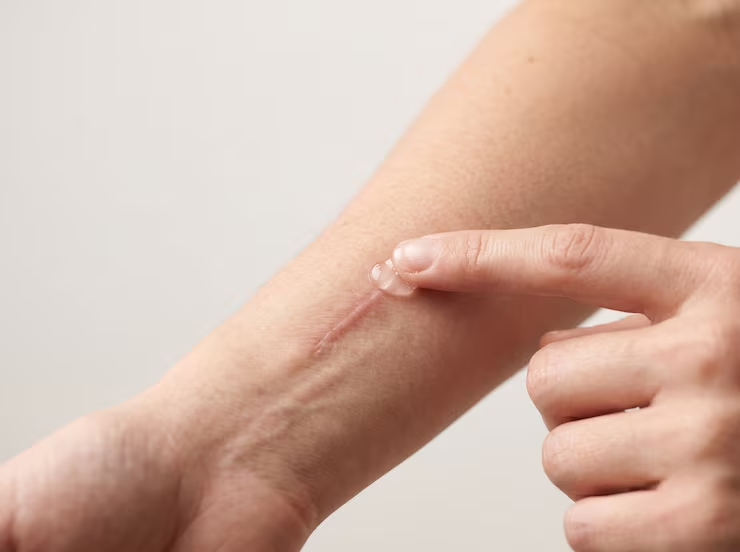

Burn scars are among the most searched skin concerns in the world, and the query usually carries the same hope: that they can be removed. Dermatologists and burn specialists give a consistent answer. They cannot be erased entirely. But they can be improved — often substantially — with the right combination of treatments, applied early and consistently.
What follows is a plain guide to the options, from pharmacy shelves to hospital clinics, and to the expectations that should accompany each one.
Why burn scars behave differently
A burn wound heals by laying down collagen, the protein that gives skin its structure. In normal healing, collagen fibres are laid down in an organised pattern. After a burn, especially a deep one, that pattern is disrupted. The result is scar tissue that is thicker, stiffer, more raised and often differently coloured from the surrounding skin.
Burn scars take several forms. Hypertrophic scars stay within the boundary of the original wound and are raised and red. Keloid scars grow beyond the wound edge. Contracture scars tighten the skin and can restrict movement, particularly when they cross a joint. Each type responds differently to treatment.
At-home care: what is worth doing


The first line of management is non-invasive and can be started at home.
Silicone gel sheets and silicone gels are the most widely recommended over-the-counter option. They are placed over the scar and worn for 12 to 24 hours a day, depending on the product and the skin’s tolerance. Studies and clinical practice show they help soften, flatten and smooth raised scars, and can reduce the itching and pain that often accompany burn scarring.
Moisturising matters more than it sounds. A non-fragranced cream keeps the scar from drying out, which reduces itching and cracking. Gentle circular massage, done consistently, helps keep scar tissue supple and can improve mobility when the scar crosses a joint.


Sun protection is not optional. Ultraviolet exposure can cause a healing scar to darken permanently or become more discoloured. Covering the area or using sunscreen is a simple step that protects the result of everything else.
When to see a specialist
If the scar is raised, stiff, painful, itching persistently, or restricting movement, home care is not enough. A dermatologist or a specialist at a burn centre can offer treatments that work at a deeper level.
Laser therapy is now a leading option. Different lasers target different problems. Vascular lasers address redness. Ablative fractional lasers, including CO2 lasers, target thick and stiff tissue. Pigment-specific lasers address discolouration. The mechanism is broadly the same: the laser breaks down disorganised scar tissue and stimulates the growth of new, healthier collagen. Multiple sessions are usually required, and improvement continues over months rather than days. Laser treatment can improve texture, thickness, colour and flexibility, and can also reduce pain and itching.
Injections are used for raised scars. Steroid injections such as triamcinolone, sometimes combined with other medications such as 5-fluorouracil, are injected directly into the scar to flatten it and reduce inflammation.
Cryotherapy freezes scar tissue to reduce its size. It is generally used for smaller, raised scars rather than large burn areas.
Surgical scar revision is reserved for severe cases — scars that are very large or that restrict movement. Surgery removes the scar tissue, and is normally followed by other treatments to stop the new scar from becoming problematic.
What no treatment can promise
The most important point is also the least pleasant to hear. No treatment makes a burn scar disappear. The realistic goal is to replace a prominent, symptomatic scar with one that is less noticeable and more comfortable.
The best plan is individual. It depends on the type of scar, its size and location, how old it is, and the person’s skin type. A scar on a joint raises different concerns from one on the forearm. A keloid behaves differently from a hypertrophic scar. A fresh scar responds differently from one that is years old.
That is why the single most useful step is a consultation with a board-certified dermatologist or a specialist at a burn centre. They can assess the scar and build a plan that combines the right options in the right order.
The bottom line
For anyone searching how to get rid of burn scars, the honest answer is that removal is not on the table, but meaningful improvement usually is. Silicone, moisturiser and sun protection are the starting point. Lasers, injections, cryotherapy and surgery are the tools available when the scar needs more. Results take time, patience and consistency.
Focus Keywords
Primary: how to get rid of burn scars
Secondary: burn scar treatment, silicone gel sheets for scars, laser therapy for burn scars, steroid injections for scars, keloid and hypertrophic scars
SEO Meta Description