
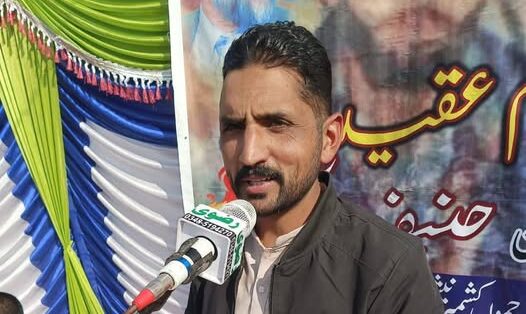

Kotli, Pakistan-administered Kashmir: The offloading of a Kashmiri political leader from Islamabad International Airport, preventing him from performing Umrah, has triggered renewed concern over religious freedom, political discrimination, and undisclosed travel restrictions imposed on citizens of Pakistan-administered Jammu and Kashmir.
Abid Ali Raja, a pro-independence leader from Kotli and a senior youth figure of the Jammu Kashmir Liberation Front (JKLF), was barred from boarding a Saudi-bound flight despite having been issued a valid boarding pass. He was travelling with his wife to perform Umrah when officials of the Federal Investigation Agency (FIA) stopped him at the final stage of departure, citing his alleged inclusion on a “passport control list.”
No written order, court warrant, or prior notification was provided to justify the action.

According to Raja, he had purchased an Umrah package worth approximately PKR 600,000. Due to the last-minute offloading, his ticket was rendered unusable, resulting in an estimated financial loss of at least PKR 300,000. His wife was forced to travel to Saudi Arabia alone, a development that has drawn strong criticism from political circles and human rights advocates.
Political Affiliation or Security Justification?
Leaders of the JKLF have described the incident as part of a broader pattern of political victimisation targeting Kashmiri activists advocating the right to self-determination. Sardar Aman Khan, Zonal General Secretary of the JKLF, condemned the move as “a shameful and unjustifiable act,” arguing that Raja’s only “crime” is his peaceful political advocacy for the political, economic, and territorial rights of the people of Jammu and Kashmir.
Observers note that preventing an individual from undertaking a religious pilgrimage—particularly in a country that constitutionally identifies itself with Islam—raises serious moral and legal questions. Analysts argue that the restriction of religious travel based solely on political beliefs contradicts international human rights norms, including freedom of religion and freedom of movement.
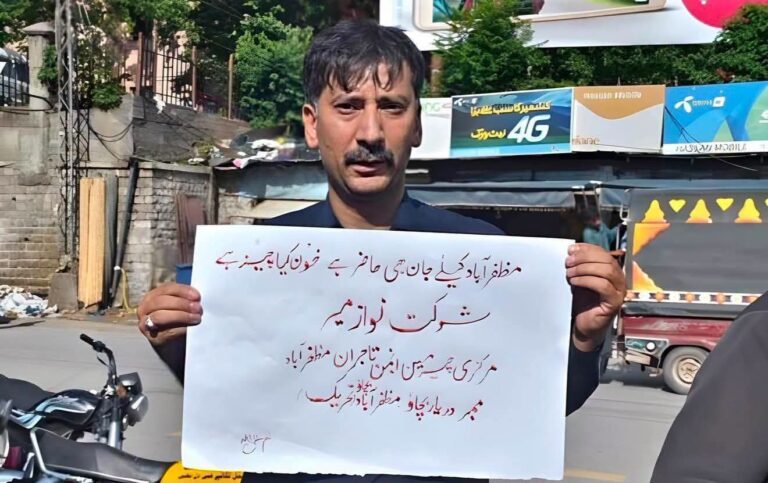


Non-Transparent Travel Bans on Kashmiris
The incident has once again highlighted the issue of what rights groups describe as “invisible travel bans” imposed on residents of Pakistan-administered Kashmir. According to multiple political sources, nearly 500 political activists have been placed on passport control lists, while many others have reportedly been included in PNIL (Provisional National Identification Lists), often without formal charges or legal proceedings.
This development is particularly contentious given that, in October, Pakistan’s federal authorities reportedly assured local representatives and Jammu Kashmir Joint Awami Action Committee (JKJAAC) rotest committees that such undocumented travel restrictions would be lifted. Despite these assurances, Kashmiri citizens continue to face barriers—even when travelling for religious purposes such as Umrah.
Human rights defenders warn that such practices reinforce perceptions of Kashmiris being treated as second-class citizens, deprived not only of political participation but also of basic civil and religious liberties.
Calls for Accountability and Compensation
The JKLF and other Kashmiri political groups have demanded an independent inquiry into the actions of the officials involved, disciplinary proceedings against those responsible, and full compensation for the financial losses suffered by Abid Ali Raja.
They have further warned that continued repression, surveillance, and coercive measures will not suppress political dissent. On the contrary, such actions risk deepening public resentment and further eroding trust between the Kashmiri population and state institutions.
“If Kashmiris are not permitted to travel from Pakistan’s airports,” a party statement noted, “then this should be declared openly, rather than enforced through arbitrary and humiliating actions.”
A Wider Human Rights Question
The offloading of Abid Ali Raja is not merely an isolated airport incident. It underscores broader concerns regarding governance, civil liberties, and the shrinking space for peaceful political expression in Pakistan-administered Jammu and Kashmir.
As restrictions extend from political activity into personal and religious life, international observers may increasingly scrutinise the region’s human rights record—particularly in light of Pakistan’s stated commitments to democratic norms and religious freedom.