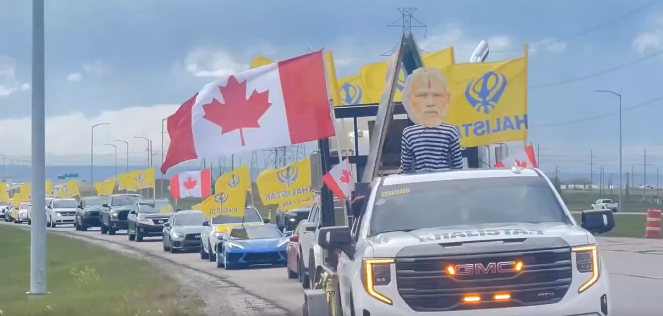

CALGARY, Alberta — June 17, 2025 — As Indian Prime Minister Narendra Modi attends the G7 Summit hosted in the scenic mountain resort of Kananaskis, Alberta, Khalistani activists and human rights advocates took to the streets of Calgary once again on Tuesday to protest his presence. Organized by the advocacy group Sikhs for Justice (SFJ), the demonstrations aim to denounce Modi’s alleged human rights abuses and to press for the creation of an independent Sikh state of Khalistan.
This marks the second consecutive day of mass protests in Calgary led by Khalistan supporters, following Modi’s arrival in Canada on Monday. Protesters gathered in downtown Calgary, carrying powerful placards depicting the Indian prime minister in a prison jumpsuit and behind bars — symbolizing what they call “Modi’s crimes against humanity and against the Sikh community.”
Calls for Khalistan Grow Louder on Global Stage
The Khalistan movement, which seeks to establish a sovereign Sikh nation in India’s Punjab region, has gained renewed momentum in recent years—especially among the Sikh diaspora in Canada, the United Kingdom, and the United States. Monday and Tuesday’s protests were organized to coincide with Modi’s high-profile visit to Canada during the G7 leaders’ summit, making the event a focal point for Khalistani political expression.
Bakshish Singh Sandhu, co-founder of Sikhs for Justice, said the group is “grateful to Prime Minister Mark Carney for bringing Modi to Canadian soil, so he can be publicly exposed and held accountable before the international community.”
“We are not just protesting for the idea of Khalistan; we are protesting to hold Modi responsible for crimes against Sikhs in India,” Sandhu said. “Our demand is clear: recognition of the Sikh right to self-determination, and justice for atrocities committed over the years — from 1984 to today.”
Tensions Between Canada and India Deepen
The presence of Prime Minister Modi at the G7 summit has sparked criticism not only from activists but also within Canada’s political landscape. Several members of the federal NDP and even voices from within Prime Minister Mark Carney’s own party have questioned the decision to invite Modi, citing past allegations of Indian government interference in Canadian affairs.

In late 2023, former Prime Minister Justin Trudeau publicly accused Indian government agents of orchestrating the assassination of Hardeep Singh Nijjar, a Canadian citizen and prominent Khalistan separatist, in Surrey, British Columbia. The incident led to a diplomatic standoff and growing concern about foreign interference in Canada.
The Royal Canadian Mounted Police (RCMP) also alleged links between the Indian state and acts of murder, coercion, and extortion targeting Sikh activists within Canada. These events have severely strained Indo-Canadian relations and emboldened the Khalistani movement abroad.


Global Attention on Modi’s Human Rights Record
As leaders from the United States, France, the United Kingdom, Germany, Japan, Italy, and the European Union gather at the summit, protests in Calgary have drawn international attention to India’s domestic policies and its treatment of minorities, particularly Sikhs, Muslims, and Kashmiris.
Demonstrators accuse Modi’s government of fueling religious intolerance and suppressing dissent through state-controlled institutions and security forces. “The Indian state under Modi has become increasingly authoritarian,” said one protester waving a Khalistan flag. “He does not belong at a summit for democratic leaders.”
Posters and banners at the rally bore messages such as:
“Justice for Hardeep Singh Nijjar”
“No Peace Without Khalistan”
“India: Stop the Genocide”
“Modi = Mass Murderer”
Several advocacy groups, including Sikh youth organizations and human rights NGOs, were also present in solidarity with the Khalistani cause.
Multinational Demonstration Efforts
The protests in Calgary are part of a broader wave of demonstrations during the G7 summit. Alongside the Khalistan protests, other groups raised concerns about the war in Gaza, the invasion of Ukraine, environmental degradation, and Indigenous rights.
Ukrainian President Volodymyr Zelenskyy also attended the summit, where he spoke to Western leaders about continuing support in his country’s ongoing war against Russia. Meanwhile, activists from various causes have taken to the streets of Calgary and Banff, calling on world leaders to uphold human rights and democratic values.
Despite tight security around the summit, Calgary officials have affirmed their support for peaceful protest, stating that no major disruptions or arrests were reported during the Khalistan demonstration.
Sikh Diaspora Remains Politically Mobilized
Canada is home to one of the largest Sikh populations outside India, particularly in provinces like British Columbia and Alberta. The diaspora has been deeply involved in pushing for Khalistan, viewing Canada as a safe space for raising their voice where it might be suppressed in India.
Khalistani leaders accuse the Indian government of systematically targeting Sikh activists through surveillance, harassment, and, in some cases, assassination. These concerns were heightened after the Nijjar killing, which many see as a turning point in the movement’s international visibility.
The Khalistan Referendum, organized by Sikhs for Justice in cities across North America and Europe, has also kept the idea of a Sikh homeland alive in public discourse. Although not recognized by any state, these symbolic referendums aim to demonstrate mass support for independence.
Conclusion: Khalistan Movement Gains Renewed Urgency
The presence of Indian Prime Minister Narendra Modi at the G7 Summit in Canada has reignited international debate over India’s human rights record and the legitimacy of the Khalistan movement. While Modi seeks to bolster his global image as a statesman, thousands of Khalistani supporters are determined to hold him accountable on the world stage.
The peaceful protests in Calgary serve as a powerful reminder that calls for Khalistan and Sikh self-determination are not going away. Instead, they are gaining momentum — from grassroots mobilization to international headlines.
As one protester put it succinctly:
“Modi may ignore us, but the world is beginning to listen.”