
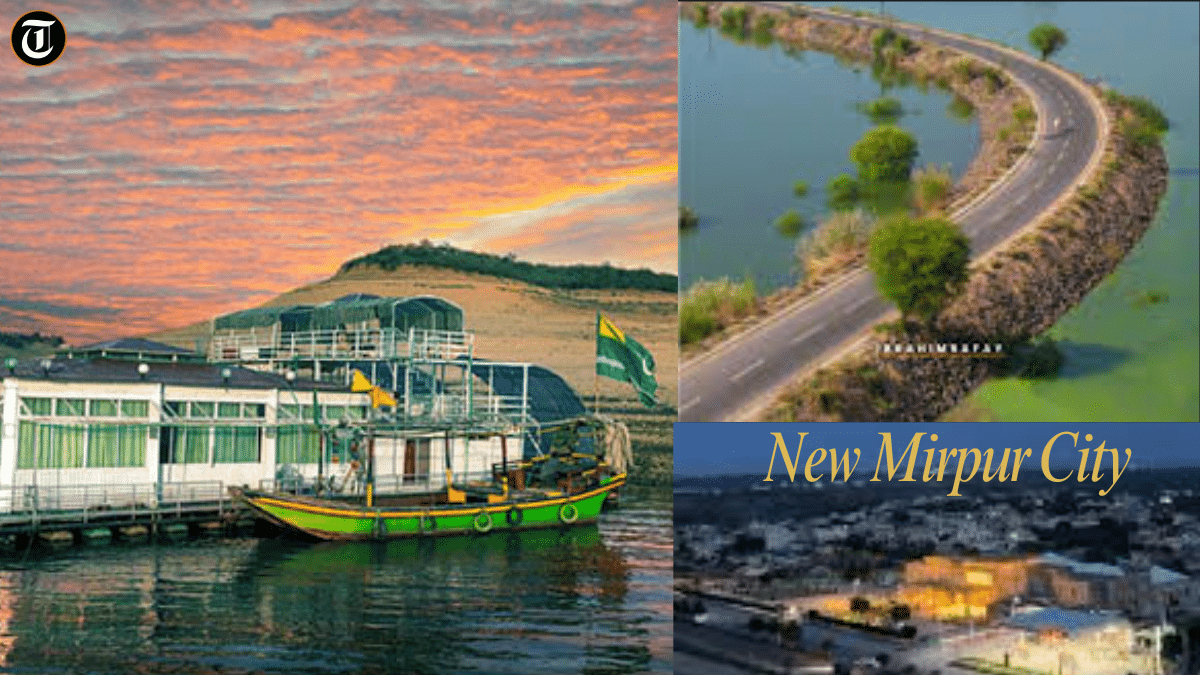

In the early 1960s, the old city of Mirpur began to disappear. The Jhelum River was rising, slowly at first, then with terrifying speed. Villages, mosques, markets, and ancestral homes were swallowed by the reservoir of the Mangla Dam — one of the largest earth-filled dams ever built. When the gates finally closed, an estimated 280 villages had vanished, and between 100,000 and 150,000 people had been displaced.
For the people of Mirpur, this was not abstract development. It was the second uprooting in a generation. Fifteen years after Partition, they were being forced from their lands again — this time not by war, but by a dam built in the name of national progress. Families watched bulldozers tear through homes that had stood for centuries. Graveyards were relocated. Orchards were destroyed. Mosques that once echoed with the adhaan became islands before vanishing beneath the waves.
The government promised compensation and resettlement. In practice, support was uneven and inadequate. New housing colonies were built, but jobs were scarce, infrastructure was poor, and the pain of losing not just property but community was immense. For many, survival meant looking beyond Kashmir.
What emerged from this tragedy was New Mirpur City — and a migration that would reshape both Kashmir and Britain.
Building New Mirpur City: Resettlement as Urban Planning
New Mirpur City was not built from scratch. It was constructed as a planned resettlement for families displaced by the Mangla Dam, which was completed in 1967 as part of the Indus Basin Replacement Works following the 1960 Indus Waters Treaty.
The original dam displaced roughly 81,000 people and submerged approximately 67,800 acres of land.
The resettlement was one of the largest of its kind in the world at that time. New Mirpur City and five surrounding hamlets were developed at a cost of Rs. 240 million (approximately $50 million at the time).
The city was designed with roads, schools, water storage tanks, and public buildings — a deliberate effort to replace what had been lost.
But the resettlement was flawed. Many families allotted land in Punjab and Sindh could not settle there due to unfavorable conditions. Others never received the plots or compensation they were promised. The displacement of an entire population away from their culture and kin was, by most accounts, not a success.
Decades later, history repeated itself. The Mangla Dam Raising Project (2004–2009) raised the dam by 30 feet, displacing another 63,000 people.
This time, lessons had been learned. The new resettlement was planned in consultation with affectees, and all displaced families were relocated in close vicinity rather than scattered across provinces. A new city near Mirpur and four satellite towns — Islamgarh, Chakswari, Dadyal, and Siakh — were developed with modern infrastructure, vocational training institutes, and public utility buildings.
The compensation package was unprecedented: market-rate land payments plus 15%, replacement housing costs, residential plots, and skills training. Over Rs. 75 billion was spent on resettlement — far more than the dam-raising works themselves.
“Little England”: The Diaspora Connection
New Mirpur City’s story cannot be separated from the British Kashmiri diaspora. As the old city sank, Britain was rebuilding after World War II and facing severe labor shortages in its textile mills, foundries, and public transport. The Pakistan government negotiated with the UK to allow displaced Mangla families to migrate as part of a resettlement program.
Thousands of Mirpuris arrived in Bradford, Birmingham, Oldham, Sheffield, Derby, and Luton in the early 1960s. They came with little more than suitcases and the addresses of distant relatives. Their work was tough — long factory hours, cold winters, language barriers. But they brought with them values of hard work and community solidarity.
Today, there are an estimated 747,000 Mirpuris in the United Kingdom, forming roughly 70% of the British Pakistani community.
Mirpur itself is often called “Little England” — many shops accept the pound sterling, British products fill the shelves, and houses stand empty for much of the year, occupied only when owners return from Birmingham or Luton for holidays
.

Remittances from the UK became the lifeblood of Azad Kashmir’s economy. They funded schools, mosques, hospitals, and businesses. The diaspora transformed Mirpur from a displaced community into a prosperous town with strong transnational ties.
Modern Mirpur: From Resettlement to Real Estate Hub
New Mirpur City has evolved far beyond its origins as a resettlement colony. Today, it is one of the fastest-growing urban centers in Pakistan-administered Kashmir, driven by diaspora investment, infrastructure projects, and large-scale housing developments.
Mega housing projects are transforming the city’s landscape. Gated communities like Citi Housing Mirpur promise “waterfront luxurious living” with dam-facing plots, gold-standard amenities, and international-standard infrastructure
The project, spread across multiple districts including a Gold District, Business District, Eco Forest District, and Meadows District, offers plots ranging from 5 marla to 4 kanal.
Real estate prices in Mirpur remain lower than in Lahore, Karachi, or Islamabad, making it attractive to overseas Pakistanis seeking both emotional connection and financial return.
Commercial investment is also booming, with rental yields between 8% and 12% — higher than the national average.
The OPF Housing Scheme at Chittarpari, approved in 1981 and spread over 5,710 kanals (714 acres), created 2,957 residential and 195 commercial plots. Development works for all three phases are complete, and colonization is ongoing with over 170 houses already constructed.
Infrastructure That Could Change Everything
Two infrastructure projects could redefine New Mirpur City’s future.
The first is the Mirpur Dry Port, inaugurated in August 2022 after more than 30 years of demand. Built on a 110-kanal plot at an estimated cost of Rs. 815.8 million, the dry port is expected to become an industrial hub and serve the cargo needs of hundreds of thousands of UK-based expatriates.
Dry ports function as intermodal terminals connected to seaports, handling bulk cargo, generating employment, and alleviating poverty.
The second is the long-awaited Mirpur International Airport. In late 2025, the Pakistan government greenlit the project, with the Pakistan Airports Authority commencing technical feasibility studies including site identification and environmental assessments. Authorities expect the feasibility study to be completed by December 2025, with construction to begin in the current financial year.
The airport is a direct response to pressure from the British Kashmiri diaspora — British Members of Parliament wrote to Prime Minister Shehbaz Sharif urging its construction.
Currently, travelers to Mirpur face a journey of over 120 kilometers from Islamabad International Airport. The new airport would provide direct air access, reducing travel time and stimulating economic growth.
CPEC and the Special Economic Zone
Mirpur’s strategic importance extends beyond diaspora ties. Under the China-Pakistan Economic Corridor (CPEC), a Special Economic Zone (SEZ) is planned for Mirpur, spread over 1,078 acres of mixed-industry land.
The SEZ is situated just 22 km from GT Road and 140 km from Sialkot, and would connect to the main CPEC route via the Mansehra-Muzaffarabad-Mirpur-Mangla Expressway (M4).
The M4 expressway, stretching approximately 200 km at an estimated cost of Rs. 264 billion, will be the shortest route from Central Punjab to CPEC through Azad Kashmir. It includes four tunnels totaling 3 km, 122 bridges, and 260 culverts, with a designed speed limit of 120 km/hr.
The road will reduce travel time between Muzaffarabad and Mirpur from six hours to approximately three and a half hours.
For the SEZ, Mirpur’s diaspora connection is seen as a unique advantage. Over half a million overseas Mirpuris, primarily in the UK, form the backbone of an informal garment industry already rooted in the city. With the UK-based Kashmiri diaspora as the chief target market, the industry is estimated to be worth 8–10 million rupees per annum. The SEZ could transform these informal units into formal industrial operations.
The Unfinished Story
New Mirpur City is a city of layers. Beneath its modern housing schemes and commercial plazas lies the memory of 280 submerged villages. Behind its prosperity is the labor of a diaspora that rebuilt their lives in British factory towns. Its future depends on infrastructure projects — an airport, a dry port, a CPEC corridor — that have been promised for decades.
The Mangla Dam gave Pakistan water and electricity. It took from Kashmiris a landscape of belonging. New Mirpur City was meant to compensate for that loss. Whether it has succeeded depends on who you ask.
For the elderly who remember watching the Jhelum rise, the city will always be a reminder of what was taken. For the diaspora who return each summer to houses built with British wages, it is a bridge between two worlds. For the investors buying waterfront plots and commercial plazas, it is an emerging market with untapped potential.
What is clear is that New Mirpur City is not just a place. It is a story — of displacement and resilience, of loss and reinvention, of a community that was forced to leave its land and then, across an ocean, found the means to rebuild it.