


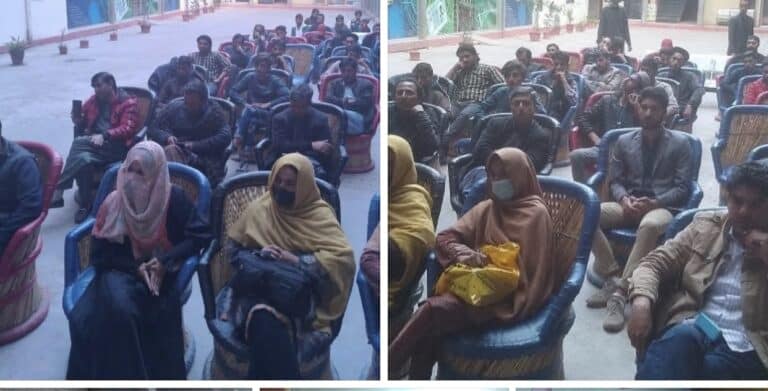
Gilgit: The Awami (Public) Action Committee (GBAAC) has presented a comprehensive set of demands following its Workers’ Convention held in Gilgit, calling for the establishment of an autonomous assembly, the abolition of the controversial land reforms act, local government elections, and the closure of the Sost Pak-China border customs checkpoint. The convention also emphasized the need to reduce bureaucratic expenditures and redirect the savings into the region’s social development budget.
The event, which took place on Sunday, saw participation from numerous activists, as well as central leaders such as Gilgit Baltistan Awami Action Committee Chairman Ihsan Ali Advocate, Organizing Secretary Comrade Baba Jan, Javed Hussain, Sher Nader Shahi, Asghar Shah, and Deputy Khan, among others. A total of ten resolutions were adopted during the convention, including a call for a nationwide movement to secure the region’s rights following approval of a national narrative by a Grand National Jirga.
Calls for Political Autonomy and Fundamental Rights
One of the central demands was the formation of a sovereign constituent assembly to replace the existing legislative body. The GBAAC argued that the current assembly is a remnant of colonial administrative structures that fail to protect the basic human, democratic, economic, social, and political rights of the people of Gilgit-Baltistan. The new assembly, the GBAAC insisted, should be empowered to bring about the necessary reforms and dismantle these colonial systems.
Another significant demand highlighted by the GBAAC was the call for local government elections at the district and tehsil levels to ensure that local representatives, elected by the people, are entrusted with governing powers. This, according to the GBAAC would help secure self-governance and promote the welfare of the working class.
Land Reforms and State Control
The Gilgit Baltistan Awami Action Committee also took a strong stance against the existing land reforms act, which it claims is being used to allow state encroachment on public and communal lands. The GBAAC stressed that all land, rivers, mountains, forests, glaciers, and springs in Gilgit-Baltistan are the collective property of the local people and should not be subject to state acquisition under the guise of reforms. The committee has thus called for the complete abolition of the land reforms act, which they believe undermines local ownership and control.
Economic Justice and Resource Management
On economic issues, the convention called for a complete overhaul of the region’s budget allocations. GBAAC leaders demanded that at least 80% of the annual budget, including internal resources, should be diverted towards meeting the basic needs of the people, including education, healthcare, electricity, water, high-speed internet services, and job creation for youth. They further advocated for cuts in bureaucratic expenditures and luxury expenses, arguing that these funds would be better spent on the welfare of the population.


Another resolution proposed the cancellation of all mining leases currently granted in the region, asserting that the mineral wealth of Gilgit-Baltistan should be regarded as the collective property of its people. The GBAAC also called for an end to the exploitation of natural resources by non-local companies, urging that business activities in the region be restricted to local enterprises only.
Removal of Border Customs and Tax-Free Zone Demand
The convention participants also expressed strong opposition to the controversial customs checkpoint at Sost, which they argue operates unlawfully. They demanded the immediate removal of this checkpoint and called for the designation of Gilgit-Baltistan as a tax-free zone to encourage local trade and commerce.
Calls for Fair Distribution of Resources and Employment
The GBAAC further called for the recognition of the rightful share of Gilgit-Baltistan in the revenue and employment generated by major infrastructure projects in the region, such as the Diamer-Bhasha Dam and the Dasu Dam. The convention demanded that 75% of the royalties and 100% of employment opportunities from the Diamer-Bhasha Dam project be reserved for the people of Gilgit-Baltistan, while the Dasu Dam project should allocate at least 50% of royalties and employment to the region.


Reviving Ancient Trade Routes and Local Banking
The revival of traditional trade routes with neighboring countries was another key demand made at the convention. Participants called for the restoration of historical trade links with neighboring states to boost regional commerce and economic development.
Additionally, the GBAAC demanded that all financial institutions operating in Gilgit-Baltistan allocate their collective capital towards funding local youth and small businesses. This, they argued, would help stimulate the local economy and create sustainable livelihoods for the region’s residents.
Moving Forward with a National Movement
The convention concluded with the announcement that the Gilgit Baltistan Awami Action Committee, after taking the Grand National Jirga into confidence, would intensify its resistance movement to ensure the implementation of the national narrative. The GBAAC leadership made it clear that they would not rest until the demands of the people of Gilgit-Baltistan are met and their fundamental rights are fully recognized.
The convention’s resolutions reflect a growing dissatisfaction with the political and economic status quo in Gilgit-Baltistan, where local people have long felt sidelined by both provincial and federal governments. The demands for political autonomy, economic justice, and the restoration of local governance systems are expected to form the basis of a larger struggle in the coming months.