
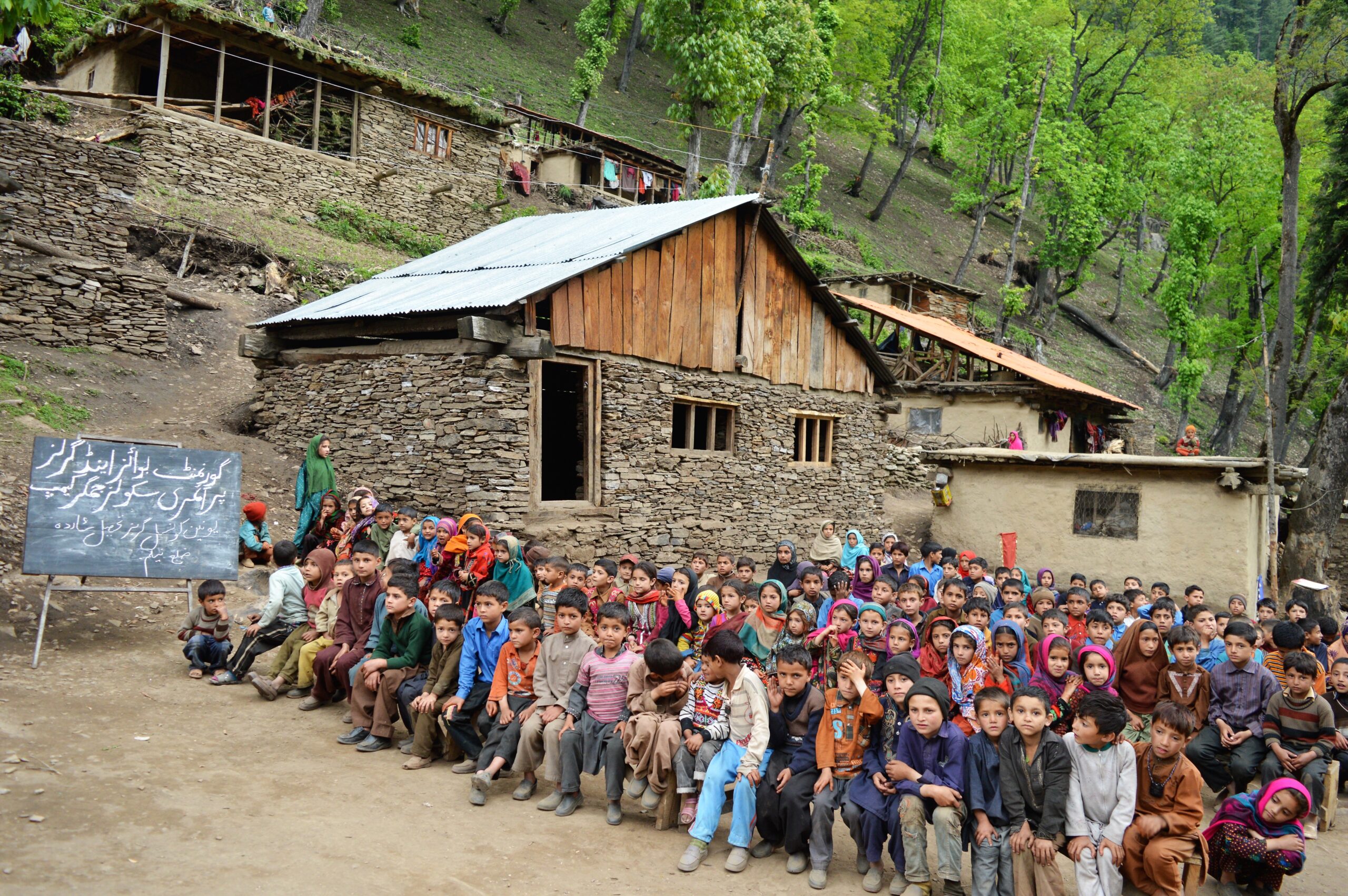
As World Children’s Day approaches on 20 November, UNICEF’s 2026 message — “My day, my rights, my future” — asks governments and communities to listen to children and involve them in decisions that shape their lives. In Azad Jammu and Kashmir (AJK), that message can be tested against a practical question: do public institutions know not only how many children are enrolled, but also whether they attend, progress, learn and remain safe?
The Elementary and Secondary Education Department’s public dashboard provides a useful snapshot of the school system. It lists 6,019 schools, 506,851 enrolled students and 31,795 teachers. But the same dashboard marks dropout and transition rates as “N/A”. The figures show the scale of the system; the missing indicators make it harder to judge how well it is serving children over time.
The dashboard does not display a clear reference year or data-collection date alongside these figures. They should therefore be read as the department’s published snapshot, not as a separately verified count for the 2026 academic year.
What AJK’s education dashboard shows
According to the department’s online performance dashboard, the 506,851 enrolled students comprise 258,023 girls and 248,828 boys. The school system has 3,163 boys’ schools and 2,856 girls’ schools, while the department lists 16,303 male teachers and 15,492 female teachers.
The dashboard reports a gross enrolment ratio of 98 per cent for boys and 89 per cent for girls. It also gives a gender parity index of 0.97 overall and 1.00 at primary level. These indicators offer a starting point for examining access, but they do not measure the same thing as regular attendance, completion or learning. A gross enrolment ratio can include pupils outside the official age range for a level; it should not be treated as proof that every child is attending or completing school.
More importantly, the dashboard lists the dropout rate as “N/A” at both elementary and secondary levels. Transition rates between levels are also marked “N/A”. Without those measures, parents and policymakers cannot use the public dashboard to see how many pupils leave school, how many move from primary to middle or secondary education, or whether the pattern differs by district and gender.
A separate survey offers a rural view — not a region-wide estimate
The 2025 Annual Status of Education Report (ASER) provides another source of evidence. Its national presentation says researchers separately covered 10 AJK districts and 300 rural villages. They surveyed 14,496 children aged three to 16 and assessed 13,621 children aged five to 16 in the region.
That is a substantial household-based sample, but its AJK component is rural. It should not be described as a complete urban-and-rural estimate for the whole region. ASER also states that its national findings exclude AJK and Gilgit-Baltistan, whose rural samples were collected and reported separately. The national report’s 7.7 per cent out-of-school estimate for children aged six to 16 therefore cannot be applied to AJK.
The distinction matters. AJK needs its own clearly presented regional and district-level figures, with the age range, sample design, reference year and definitions published alongside them. Household surveys can identify children who are not visible in school registers; administrative data can track enrolment, attendance and progression. Used together, they can provide a more complete picture than either source alone.


AJK already has a child-rights framework
The AJK Child Rights (Care and Protection) Act, 2016 applies throughout the region and defines a child as a person under 18. It recognises the AJK Commission for Child Welfare and Development, provides for district commissions and child-protection units, and assigns the Commission responsibilities that go beyond responding to individual cases.
Those responsibilities include collecting and publishing information about children and children at risk, promoting child-centred and inclusive education, and incorporating children’s rights into school curricula. The Act’s education provisions recognise the right to education, call for free and compulsory primary education, and identify regular attendance and reducing dropout as priorities. It also says a child’s views should be heard and given due weight when decisions affecting that child are made.
The existence of a law does not, by itself, demonstrate how consistently its protections are delivered. Public reporting on the Commission’s work, district protection units, complaints, referrals, budgets and outcomes would help residents assess implementation without assuming either success or failure in the absence of evidence.
Education reforms need transparent follow-through
AJK’s education system has also been the subject of a major staffing and infrastructure proposal. Dawn reported on 24 April 2026 that the cabinet approved an education package worth more than Rs3.7 billion, envisaging over 4,000 posts across school and college education. The proposals included staffing for new primary schools and upgraded institutions, as well as reallocating some posts from schools with lower enrolment to those with higher enrolment.
On 18 September, Dawn reported that the newly formed cabinet had appointed a three-member committee to review the earlier package and teacher recruitment policy. A review is not evidence that the package was cancelled or fully implemented. It does, however, make a public update important: which proposals remain approved, where posts and funds will go, what timetable applies, and how results will be measured?
For families, the value of a new post or upgraded building depends on whether it leads to a functioning classroom, a qualified teacher, safe facilities and better learning. Public reporting should connect budget allocations and recruitment decisions to actual school-level improvements.
What children and families need to see measured
A more useful public education dashboard would publish dated, clearly defined indicators and update them regularly. At minimum, it should show:
- Enrolment, attendance, dropout, transition and completion rates by district, gender and age group.
- The number of out-of-school children, including estimates from household surveys and the method used to calculate them.
- Learning outcomes in reading, writing and mathematics, rather than relying on enrolment alone.
- Teacher vacancies, deployment, attendance and training, alongside school facilities such as electricity, toilets, drinking water and accessibility for children with disabilities.
- Education budgets, releases, expenditure and project progress, including the final status of the 2026 education package.
- Accessible ways for children and parents to raise concerns, with public information about referrals and responses under the child-protection framework.
Children should also have safe, age-appropriate opportunities to say what makes it difficult to attend school and what would improve their learning. This is not a substitute for professional data collection; it is part of the right to participate recognised in the AJK law and highlighted by UNICEF’s World Children’s Day campaign.
For students and families navigating the system, The Azadi Times has also published a guide to checking AJK Board results in 2026. Reliable public information is one part of making education services easier to access; the larger task is ensuring that children can remain in education and learn.
A rights day should lead to measurable action
World Children’s Day is more than a ceremonial date. In AJK, the law, the department’s school statistics, the ASER household survey and the proposed education reforms provide material from which progress can be assessed. They also show why enrolment totals alone are not enough.
The test is whether every child can enter school, attend regularly, move safely to the next level, acquire essential skills and receive protection when at risk. Publishing complete, dated and district-level information would allow families, teachers, legislators and civil society to judge whether public commitments are translating into those outcomes.
Sources and documents
- UNICEF: World Children’s Day 2026 — “My day, my rights, my future”.
- AJK Elementary and Secondary Education Department: Performance Dashboard.
- AJK Child Rights (Care and Protection) Act, 2016.
- ASER Pakistan 2025: National presentation and regional sample coverage.
- ASER Pakistan: 2025 methodology and comparability FAQs.
- Dawn, 24 April 2026: AJK cabinet approves Rs3.7bn education package.
- Dawn, 18 September 2026: AJK cabinet orders review of education package.
Image note: The featured photograph is an archival image of pupils at Government Primary School in Jumber, AJK, taken on 19 May 2017. It is not presented as a photograph of current school conditions. Photo: Abdul Moueed / Wikimedia Commons, licensed under CC BY-SA 4.0.