
By Idris Sharar
Pahari is an important linguistic and cultural tradition across parts of western Jammu and Kashmir. It is more than a means of everyday communication: it carries local memory, family histories, oral knowledge, songs and a sense of community. Its future depends not only on cultural recognition but also on documentation, education, publishing, public policy and transmission to younger generations.
The term “Pahari” is used for several languages and speech traditions across the wider Himalayan region. This article focuses on Pahari and closely related Pahari-Pothwari varieties spoken in areas including Poonch, Mirpur and Muzaffarabad. It does not use the term as a blanket label for every language described as Pahari across the Himalayas.

The name Pahari and its geography
“Pahari”, derived from the word for hills or mountains, has been applied to a range of languages and varieties in the subcontinent. In his Linguistic Survey of India, George Abraham Grierson described broad Eastern, Central and Western Pahari groupings, covering languages and varieties in different parts of the Himalayan region, including Nepali, Kumaoni and Garhwali.
In western Jammu and Kashmir, Pahari is also used locally as an identity for a particular set of speech varieties. Poonchi, Mirpuri and other regional forms are discussed under overlapping labels, but their boundaries are not defined identically by every researcher or institution. Local self-identification, linguistic evidence and the speech communities themselves therefore matter when describing the language.
Linguistic classification: Pahari, Pothwari and related varieties
Pahari-Pothwari is commonly discussed within the western Indo-Aryan linguistic continuum and in relation to Western Punjabi. Older classifications sometimes used the term “Lahnda” for a range of western Punjabi varieties. Modern linguistic work continues to examine the relationships among Pothwari, Poonchi, Chibhali and Mirpuri, and the labels used for them.



Grierson’s broad Eastern, Central and Western Pahari categories should not be treated as identical to the Pahari-Pothwari varieties spoken in Pakistan and western Jammu and Kashmir. Nor can a language’s classification be settled by a single label. Researchers consider pronunciation, grammar, vocabulary, mutual intelligibility, historical evidence and the identities used by speakers.
Speech across Poonch, Mirpur and Muzaffarabad shows local differences in pronunciation, vocabulary and idiom. The popular observation that an accent changes every 12 kilometres may describe an individual impression, but it is not an established linguistic rule. Testing such claims requires systematic fieldwork, recorded speech and comparative analysis.
History and scripts: what can be established?
The history of Pahari should not be tied to a single ruler, empire or ancient institution without documentary evidence. Sharada is an important historical site associated with regional intellectual and religious traditions, but claims that Ashoka founded South Asia’s first university there require reliable historical proof. Available linguistic evidence also does not establish that the language spoken at Harappan, Buddhist, Porus or Ashokan courts was directly the same as present-day Pahari-Pothwari.


Sharada, Takri and Landa have all featured in the wider written history of north-western South Asia. However, describing each as a uniform historical script of present-day Pahari would require specific manuscripts, inscriptions and regional records. The spread of Persian-Arabic writing and the later dominance of Urdu in education and administration affected the written space available to local languages, although the details varied by period and area.
Some literary circles identify the efforts of Pahari-speaking communities in Britain, the magazine Chitka and the early 1990s as an important phase in modern Pahari writing. A definitive account would require original magazine issues, interviews with editors, publication records and documents held by literary organisations. Preserving these materials would help establish a more reliable history of written Pahari.
Oral literature: a living record
Pahari’s cultural wealth includes folk tales, proverbs, idioms, wedding songs, lullabies, seasonal songs, heroic narratives and everyday stories passed between generations. They reflect local landscapes, relationships, work, migration, love, loss, humour and shared experience. Oral literature should be documented as a source of social history and local knowledge, not treated merely as entertainment.
Proverbs such as “Aapey changay, jag changa” express social experience and moral ideas in a few words. The poetry of Mian Muhammad Bakhsh and other regional literary and Sufi traditions also offer scope for research into shared vocabulary, linguistic contact and cultural influence. Such works should be studied comparatively rather than assigned conclusively to one language without textual evidence.
Census figures and the research gap
Estimating the number of Pahari speakers is difficult because censuses have used different language labels and methods of recording mother tongues. India’s 2011 Census published mother-tongue data that include entries under Pahari and other labels, but those figures should not be treated as a complete count of all Pahari-Pothwari varieties in western Jammu and Kashmir. Reliable estimates for Azad Jammu and Kashmir, other parts of Pakistan and diaspora communities require updated surveys with transparent methods.
The Institute of Languages at the University of Azad Jammu and Kashmir and other academic institutions could contribute to systematic research on phonetics, grammar, dictionaries, oral literature, scripts and digital resources. A stronger evidence base would help communities and policymakers make informed decisions.
Keeping the language alive
Festivals and symbolic declarations alone cannot secure a language’s future. Practical steps include speaking Pahari with children at home, developing optional school materials, training teachers, preparing reliable dictionaries and grammars, recording oral literature in audio and video, publishing children’s books, supporting radio and digital broadcasting, and improving tools for writing online.
Any work on spelling systems, keyboards and fonts should take account of different local preferences and be developed through consultation. Government, universities, literary organisations, journalists, teachers and civil society can support a shared programme that documents regional varieties without ranking one accent above another. The participation and views of Pahari speakers must remain central.
Conclusion
Pahari and its oral traditions form an important part of the cultural heritage of western Jammu and Kashmir. A stronger account of its history requires reliable documents, linguistic research and community knowledge rather than unsupported historical claims. Its survival will depend on giving the language a practical place in homes, education, literature, media and digital life.
Idris Sharar’s appeal: Public authorities, universities, literary institutions, journalists, lawyers, academics and political representatives should take practical steps to support Pahari teaching, research, publication and digital preservation. The first step towards safeguarding a language is to speak it, write it, read it and pass it on.
References and further reading
- G. A. Grierson, Linguistic Survey of India, Volume IX, Part IV. Digitised editions and catalogue.
- Clausal Negation in Pahari-Pothwari, University of York / White Rose eTheses. Research thesis.
- Language Classification of MP, White Rose eTheses. Research thesis.
- India Census 2011, C-16: Population by Mother Tongue. Official census catalogue.
- University of Azad Jammu & Kashmir, Institute of Languages. Official institute information.
- “A Descriptive Study of Pahari Verb Morphology”. Study.
- “A Preliminary Study of Pahari and Its Sound System”. Article; historical claims should be checked against independent primary sources.
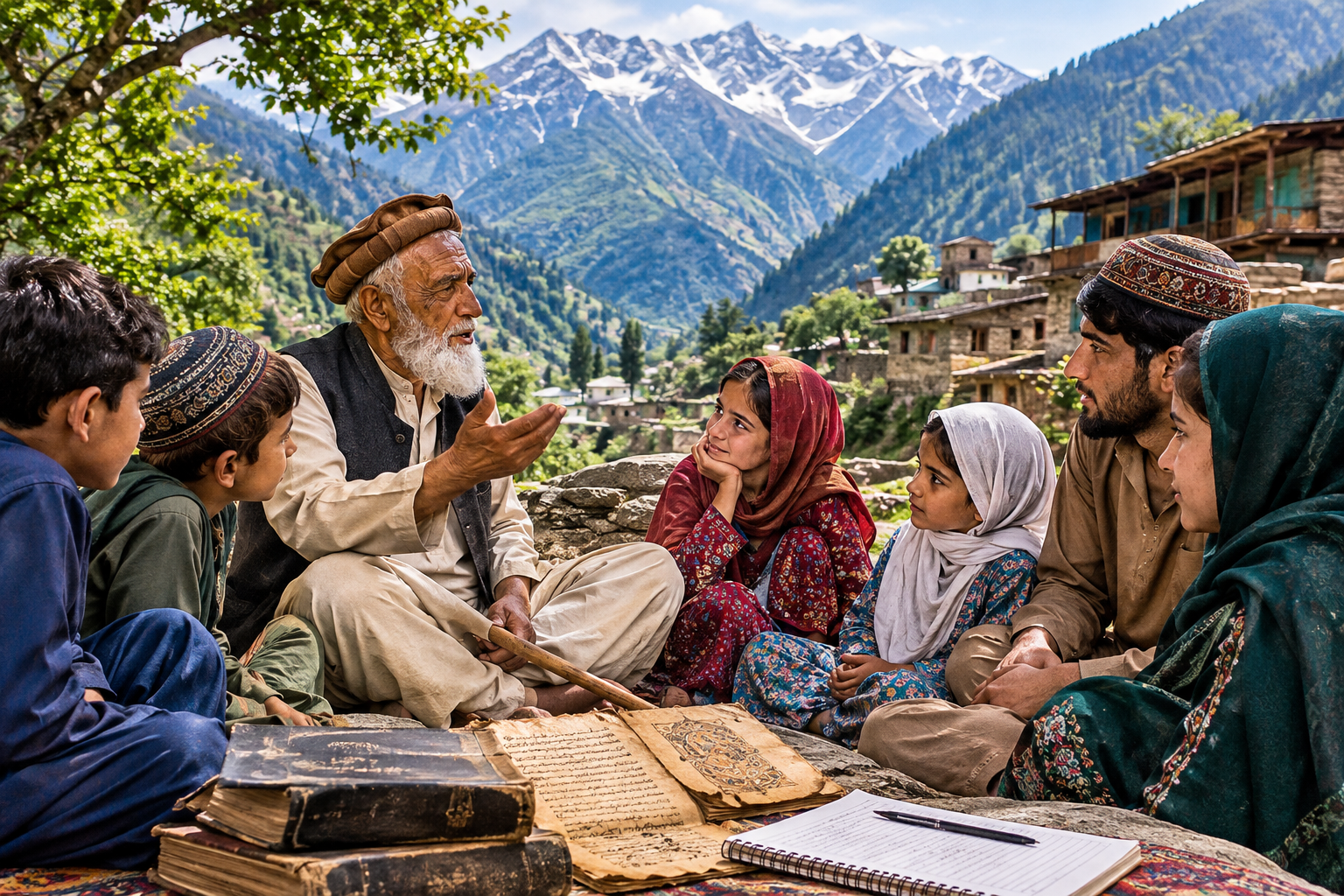
Editorial note: Unverified population estimates and disputed historical claims have not been presented as established facts. Further primary documentation may allow the history of modern Pahari writing, including the magazine Chitka, to be updated. The featured image is illustrative and AI-generated, not a documentary photograph.