Home Blog Page 2

Srinagar: The Eternal Capital of Kashmir’s Soul

There are cities built by men, and there are cities that feel as though they were assembled, piece by piece, by something far greater than human ambition. Srinagar belongs to the second kind.

Nestled in the heart of the Kashmir Valley at an elevation of 1,600 metres above sea level, draped across both banks of the ancient Jhelum River, Srinagar is not simply the capital city of Kashmir. It is the living, breathing proof that some places exist not merely in geography but in the imagination of every person who has ever yearned for beauty.

For centuries, poets called it Jannat-ul-Arz — Paradise on Earth. Mughal emperors abandoned their thrones in Delhi and Agra just to spend summers here. Mystics walked barefoot to its shores looking for God and returned saying they had found Him in the reflection of the mountains on the Dal Lake. And today, millions of travellers from across the world arrive at its doorstep, cameras ready, hearts unprepared — because no photograph has ever truly done Srinagar justice, and no traveller has ever truly been ready for it.

This is that city. This is Srinagar.

What Does the Name “Srinagar” Mean?

Before entering the city itself, it is worth pausing at its name — because names in Kashmir are never accidental.

“Srinagar” is a Sanskrit compound: Sri, meaning wealth, beauty, and divine grace, and Nagar, meaning city or settlement. Together, the name translates as “The City of Wealth and Beauty” — or more poetically, “The Abode of Grace.”

It is one of the rare cases in history where a city has grown into its own name. Srinagar has been, across millennia, exactly what its name promised: a place of extraordinary natural wealth, breathtaking beauty, and an almost inexplicable grace that clings to its air, its water, its people.

There is also an older tradition that links the city’s founding to the great Mauryan emperor Ashoka, who is believed to have established a settlement here around 250 BCE — a city he called Srinagari. Whether legend or history, the continuity is remarkable: a city carrying the same essential name and the same essential spirit across more than two thousand years.


A History Written in Stone, Water and Fire

Srinagar is one of the oldest continuously inhabited cities in South Asia. Its history does not unfold in simple chapters — it spirals, intersects, contradicts and enriches itself across thousands of years of civilisation.

The Ancient Foundation

The earliest credible historical reference to Srinagar comes from Rajatarangini — the River of Kings — written in the 12th century by the Kashmiri historian Kalhana. This remarkable text, considered one of the first genuine historical chronicles in South Asian literature, traces the lineage of Kashmiri rulers back into antiquity and speaks of settlements on the banks of the Jhelum that would eventually grow into the city we know today.

During the reign of Ashoka’s son Jaloka, Buddhism flourished in Kashmir with an intensity that left deep marks on the region’s spiritual character. Monasteries, stupas and philosophical schools transformed Kashmir — and its capital — into a global centre of Buddhist learning. Travellers from Central Asia, China and Tibet made their way here to study and returned carrying ideas that would reshape entire civilisations.

The Coming of Islam and the Sultanate Era

The 14th century brought transformational change. In 1339, Shah Mir — a nobleman believed to have migrated from Swat — established the first Muslim sultanate in Kashmir, founding a dynasty that would rule for over two centuries. This was not conquest in the conventional sense; it was a gradual, deeply layered cultural transformation shaped as much by Sufi missionaries as by political power.

It was during this period that Srinagar began to acquire the spiritual and architectural character for which it is known today. The great Sufi saint Shah Hamadan — Mir Sayyid Ali Hamadani — arrived in Kashmir in the 14th century from Persia, bringing with him craftsmen, scholars and a tradition of Islamic architecture that fused Persian elegance with Kashmiri woodworking genius. The Khanqah-e-Moalla, built in his honour on the banks of the Jhelum, stands to this day as one of the most beautiful wooden mosques in all of Asia.

The Mughal Interlude — Srinagar’s Golden Age

If there is a period in Srinagar’s history that the city still wears most visibly, it is the Mughal era.

In 1586, Emperor Akbar brought Kashmir into the Mughal Empire — but it was his son Jahangir who fell truly, helplessly in love with Srinagar. Jahangir made the city his summer court, his sanctuary, his obsession. He visited twelve times during his reign and wrote of Kashmir in his memoir, the Tuzuk-e-Jahangiri, with a tenderness that emperors rarely extend to anything outside of power:

“If there is a paradise on earth, it is this, it is this, it is this.”

These are among the most quoted words in all of Kashmir’s history — and they were written about Srinagar specifically, about its lakes and mountains and the quality of its evening light. Jahangir commissioned the Shalimar Bagh in 1619 for his empress Nur Jahan. His son Shah Jahan — the same man who built the Taj Mahal — added Nishat Bagh to Srinagar’s crown. Together, these gardens remain among the greatest achievements of Mughal civilisation anywhere in the world.

The Later Centuries

After the Mughal decline came the Sikh period, when Maharaja Ranjit Singh incorporated Kashmir into the Sikh Empire in 1819. In 1846, following the First Anglo-Sikh War, the British transferred control of Kashmir — including Srinagar — to the Dogra Maharaja Gulab Singh through the Treaty of Amritsar in exchange for 7.5 million Nanakshahi rupees, a transaction that remains one of the most contested transfers of land in South Asian history and whose consequences reverberate to this very day.

The late 19th and early 20th centuries brought roads, a British Residency, a municipality, and the beginnings of modern tourism — particularly on and around Dal Lake, where the iconic houseboat culture was born when British residents, prohibited from owning land in Kashmir, chose instead to build their homes on water.

Dal Lake — The Mirror That Defines Srinagar

No understanding of Srinagar is complete — or even possible — without Dal Lake. The two are inseparable. The city exists in relationship to the lake the way a face exists in relationship to its reflection: each gives the other meaning.

Golden hour view of Dal Lake with a traditional shikara boat gliding on calm water, reflecting snow-capped Himalayan mountains and soft morning mist.

Stretching across approximately 18 square kilometres in the northeast of the city, Dal Lake is not simply a body of water. It is an ecosystem, a neighbourhood, a marketplace, a tradition and — on the right morning, when the mist sits low and the mountains cut clean lines against the sky — something that feels uncomfortably close to a religious experience.

The Floating World

What makes Dal Lake unlike almost any other lake on earth is that a significant portion of its surface is inhabited. Roughly 50,000 people live on and around the lake itself — in houseboats, on floating islands called rads (locally spelled raddh), and in small wooden communities that have occupied the same patches of water for generations.

The rads are perhaps the lake’s most astonishing feature: floating gardens constructed from decomposed vegetation and mud, anchored loosely to the lakebed, on which entire fields of vegetables — lotus roots called nadru, tomatoes, cucumbers, melons — are cultivated. Every morning, farmers paddle their shikaras through the early mist to the floating vegetable market at the heart of the lake, where produce is bought and sold directly from boat to boat without ever touching land. It is a market system that has been operating, largely unchanged, for centuries.

The Shikara — Poetry on Water

The shikara is to Srinagar what the gondola is to Venice — but older, more varied in its purpose, and, many would argue, more beautiful. These slender wooden boats, propelled by heart-shaped paddles, serve as taxis, cargo vessels, flower stalls, mobile tea shops and romantic sunset vessels all at once. The sound of a shikara paddle cutting through still water at dawn — that soft, rhythmic plash — is the signature sound of Srinagar, the note the city plays to introduce itself each morning.

The Houseboats — A Colonial Legacy Reborn

The Cedar-wood houseboats of Dal Lake are among the most distinctive accommodations on earth. Built in colonial times when British officials could not own land in Kashmir, these floating homes — some dating back over a century — are now among the most sought-after lodgings for travellers visiting Srinagar.

They range from simple and affordable to elaborately carved, carpeted and furnished with genuine antiques. To sleep on Dal Lake, to wake up with the mountains reflected in the water outside your window, is an experience that has no equivalent anywhere.

The Mughal Gardens — Civilisation Made Green

Srinagar contains what is arguably the finest collection of Mughal gardens outside of the original Mughal heartland — and many would argue they surpass anything surviving in Delhi or Agra for their setting alone.

Shalimar Bagh — The Garden of Love

Built in 1619 by Emperor Jahangir for his empress Nur Jahan, Shalimar Bagh — whose name means “Abode of Love” — is the crown jewel of Srinagar’s gardens. Laid out across three terraced levels descending toward Dal Lake, the garden is a masterpiece of Mughal landscape design: geometrically precise yet graceful, formal yet alive. Hundreds of ancient Chinar trees — the great Oriental plane trees whose leaves turn a spectacular crimson and gold in autumn — line its channels, and black marble pavilions, built for royal leisure, anchor each terrace.

In autumn, when the Chinar leaves fall like burning embers across the water channels, Shalimar Bagh becomes almost unbearably beautiful — the kind of beautiful that makes people stop walking and simply stand.

Nishat Bagh — The Garden of Joy

Larger than Shalimar and arguably more dramatically situated, Nishat Bagh — “Garden of Joy” — was built in 1633 during the reign of Shah Jahan by his brother-in-law Asif Khan. Climbing twelve terraces up the slope of the Zabarwan Mountains directly behind Srinagar, it commands a panoramic view of Dal Lake that has been described by travellers across four centuries in superlatives that have not yet worn out.

The view from Nishat Bagh’s upper terraces — Dal Lake below, Srinagar spread across its banks, the Pir Panjal Range closing the southern horizon — is one of the great views of Asia.

Chashma Shahi — The Royal Spring

Smaller and more intimate than the other gardens, Chashma Shahi — “The Royal Spring” — was built in 1632 around a natural freshwater spring whose water is considered by Kashmiris to have medicinal properties. Its three modest terraces are jewel-like in their precision, and the spring itself — cold, clear, and tasting of the mountain — has been drawing visitors for nearly four centuries.

Asia’s Largest Tulip Garden

Added to Srinagar’s floral crown in the modern era, the Indira Gandhi Memorial Tulip Garden holds the distinction of being the largest tulip garden in Asia. Every spring, as the snow retreats and the valley warms, more than 1.5 million tulips across 68 varieties explode into colour against the backdrop of the Zabarwan hills and Dal Lake. The garden opens for roughly three weeks each April — and in those three weeks, Srinagar turns into a place that is almost photographically unfair to the rest of the world.

The Culture — Kashmir’s Living Inheritance

Srinagar is where Kashmiri culture concentrates itself. The city has been shaped by so many different civilisations — Buddhist, Hindu, Sufi Islamic, Persian, Mughal, Sikh, Dogra — that its culture is not the product of any one of these alone but of their extraordinary, centuries-long conversation.

The Kashmiri Language

Kashmiri — called Koshur by its speakers — is one of the oldest and most linguistically distinctive languages of the subcontinent. Classified as a Dardic language, it carries within it layers of Sanskrit, Persian, Arabic and Tibetan, and its literature contains some of the most moving mystical poetry ever written in any language.

The 14th-century poet-mystic Lal Ded — Lalleshwari — wrote verses in Kashmiri called vaakhs (sayings) that remain astonishing in their directness and depth. She was followed by Sheikh Nooruddin Noorani, known as Nund Rishi, whose poetry defined Kashmiri Sufi Islam. And then came Habba Khatoon — the Nightingale of Kashmir — whose love songs, written in the 16th century, are still sung by Kashmiri women today.

To hear a Kashmiri song in Srinagar — in a houseboat at dusk, in a tea house in the old city, drifting across the lake — is to hear a language that sounds like it was specifically invented to describe the place in which it was born.

The Pheran and the Kangri

Culture lives in small things. In Srinagar, it lives in the pheran — the long, loose woollen robe worn by both men and women through the winter months — and in the kangri, the small clay firepot filled with glowing embers that Kashmiris carry beneath their pherans to stay warm. The kangri is not merely a heating device; it is a social object, a conversation starter, an heirloom in some families, a way of life. To hold a kangri, to feel its warmth radiating through a pheran while snowflakes fall on the old city of Srinagar — this is what Kashmiri winter feels like from the inside.

Wazwan — The Feast That Is Also a Philosophy

If Srinagar’s gardens represent what Kashmiris did with beauty, Wazwan represents what they did with hospitality.

Wazwan is not simply a meal. It is a ceremony, a declaration, a tradition so deeply embedded in Kashmiri culture that no major celebration — wedding, religious festival, homecoming — is considered complete without it. A traditional Wazwan can consist of thirty-six or more courses, served over hours, all of them meat-based, cooked overnight by specialist chefs called wazas who have trained for years in techniques passed down through generations.

Guests eat from a large shared platter called a traem, seated in groups of four — an arrangement that makes the meal as much about community as about food.

The dishes of a Srinagar Wazwan represent centuries of culinary refinement:

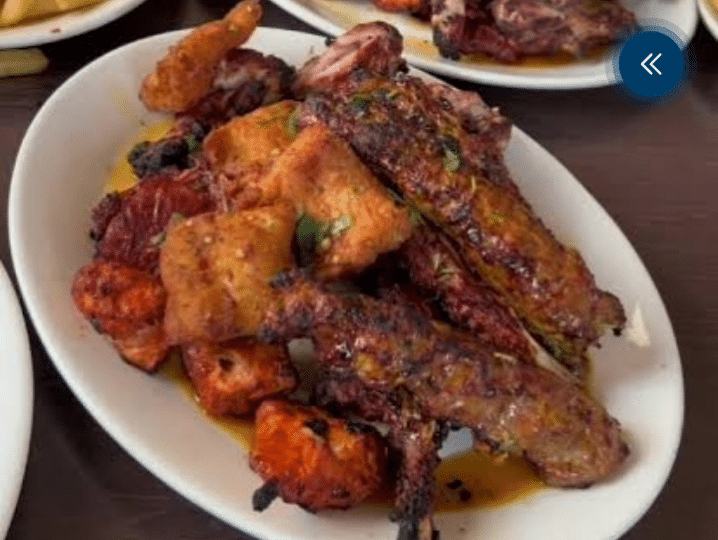
Rogan Josh — perhaps the most internationally known Kashmiri dish, braised lamb cooked slowly in a sauce coloured brilliant crimson by Kashmiri chillies (not for heat but for colour) and scented with whole spices. The name means “Red Juice” and the dish delivers exactly that.

Gushtaba — large, hand-pounded meatballs poached in a yoghurt-based gravy perfumed with cardamom and fennel. This is traditionally the final savoury course of a Wazwan, a signal that the feast is drawing to its close.

Yakhni — lamb braised in a delicate, creamy yoghurt sauce fragrant with fennel and ginger, its subtlety a deliberate contrast to the boldness of Rogan Josh.

Rista — saffron-coloured meatballs in a deep red, aromatic sauce, distinct from other preparations by its distinctive texture and colour.

Nadru Yakhni — lotus root cooked in yoghurt and spices. The lotus root (nadru), harvested from the beds of Dal Lake, is one of Srinagar’s most characteristic ingredients: starchy, textured, absorbing the flavours it is cooked in with extraordinary eagerness.

And to drink: Kahwa — saffron-infused green tea with cinnamon, cardamom and crushed almonds — warming, aromatic, and so specific to Kashmir that drinking it anywhere else always tastes slightly apologetic. And Sheer Chai — pink salt tea, made through an unusual brewing process that turns the liquid a pastel rose, served with a crust of cream. It is an acquired taste for outsiders and a comfort like no other for Kashmiris.

The Handicrafts — Where Art Becomes Industry and Industry Becomes Art

Srinagar is one of the great handicraft capitals of the world, and it has been for centuries. The artisans of this city have produced objects of such refinement that they found their way into the treasuries of Mughal emperors, European royalty and the world’s finest museums.

Pashmina — The World’s Most Celebrated Fibre

Genuine Pashmina is harvested from the undercoat of the Changthangi goat — a high-altitude animal adapted to the extreme cold of the Himalayan plateau. The fibres are extraordinarily fine: a single Pashmina hair is one-sixth the diameter of a human hair. Weaving them into a shawl requires months of labour by highly skilled artisans, and the result is a fabric of unparalleled softness, lightness and warmth.

The word “cashmere” — now a generic term used globally — derives directly from Kashmir, a reminder that the world’s luxury textile vocabulary was partly written in Srinagar. Authentic Kashmiri Pashmina carries a Geographical Indication (GI) tag, meaning the name is protected by law and can only be applied to goods produced in Kashmir.

Kashmiri Carpets — Floors as Canvas

Hand-knotted Kashmiri carpets are among the most technically demanding and aesthetically sophisticated floor coverings produced anywhere on earth. A single carpet of moderate size may require two or more years of uninterrupted work by multiple weavers, tying hundreds of knots per square inch in wool or silk dyed with natural pigments. The designs — intricate medallions, flowering vines, hunting scenes, geometric abstractions — draw on Persian, Central Asian and indigenous Kashmiri traditions simultaneously.

These carpets have covered the floors of Mughal courts and Victorian drawing rooms alike, and they continue to be among Kashmir’s most significant exports.

Walnut Wood Carving

The walnut (doon) trees of Kashmir produce one of the finest hardwoods in the world — a timber with a natural lustre and grain that responds to carving with extraordinary precision. Srinagar’s craftsmen have been working with walnut wood for centuries, producing furniture, decorative boxes, architectural panels and frames of astonishing intricacy. The finest examples feature three-dimensional floral reliefs so detailed that individual stamens of carved flowers seem to catch the light differently depending on the hour.

Papier-Mâché

Less well known internationally but equally remarkable is Srinagar’s papier-mâché tradition — kar-i-kalamdani — in which multiple layers of paper pulp are shaped into boxes, bowls, vases and ornaments, then hand-painted in extraordinarily fine detail with natural pigments. The craft was introduced to Kashmir by Shah Hamadan from Persia in the 14th century and has been refining itself ever since.

The Sacred City — Mosques, Shrines and Temples

Srinagar is a city of faith — not the aggressive, contested faith of political argument, but the quiet, ancient, deeply personal faith of people who have been praying in the same places for centuries.

Hazratbal Shrine — Kashmir’s Most Sacred Site

On the western shore of Dal Lake stands Hazratbal — “The Place of Dignity” — a gleaming white mosque and shrine that is the most revered Islamic site in Kashmir. Within its sanctum is preserved what is believed to be a strand of hair from the Prophet Muhammad (peace be upon him) — the Moi-e-Muqqadas, brought to Kashmir in the 17th century.

Hazratbal is Kashmir’s most important gathering place. On religious occasions — particularly Eid and the anniversary of the Prophet’s birth — hundreds of thousands of people converge on the shrine from across the valley. The sight of the white-domed mosque reflected in Dal Lake on a clear morning is one of Srinagar’s defining images: a picture of a city at peace with itself.

Jama Masjid — A Thousand Years of Congregational Prayer

In the heart of the old city, surrounded by the narrow lanes of Nowhatta, stands the Jama Masjid — the Great Congregational Mosque of Srinagar. Originally built in 1402 during the reign of Sultan Sikandar, it has been destroyed by fire and rebuilt multiple times, each reconstruction faithful to the original design: a vast courtyard surrounded by a wooden arcade supported by 378 deodar cedar columns, each carved from a single tree.

The Jama Masjid represents the culmination of Kashmiri Islamic architecture — a style that incorporates pointed Indo-Saracenic arches, pagoda-like spires and the warm, organic quality of wood into a form unlike any other mosque architecture in the world.

Shankaracharya Temple — The Ancient Eye of the City

On the summit of Shankaracharya Hill, rising 300 metres above the city and dominating the Srinagar skyline, stands a small Shiva temple whose origins are as ancient as the city itself. The octagonal stone structure is believed by some historians to date to the 5th century, with the site itself — a promontory commanding views of the entire valley — having been sacred since at least the Mauryan period.

The temple is named after the great Advaita philosopher Adi Shankaracharya, who is said to have meditated here in the 8th century CE. The climb to its summit rewards the visitor with a view across all of Srinagar, the full expanse of Dal Lake, and the encircling mountains that make this valley feel, from above, like a world complete in itself.

Khanqah-e-Moalla — The Sufi Heart of Srinagar

On the right bank of the Jhelum, in the oldest part of the city, stands the Khanqah-e-Moalla — the great Sufi shrine and gathering place built in honour of Shah Hamadan. Constructed entirely of wood in the Kashmiri architectural tradition — with its distinctive multi-tiered pyramidal roof and intricate carved interiors — it is considered one of the finest examples of wooden Islamic architecture in the world.

For Kashmiris, it is far more than a historical monument. It is a living spiritual centre, a place of prayer and remembrance, and a physical embodiment of the Sufi tradition that has shaped Kashmiri Islam into the distinctive, inclusive, mystically inclined form it takes today.

The Economy — Saffron, Apples and a City in Motion

Srinagar’s economy is built on several pillars that are as ancient as the city itself and as urgent as its present circumstances.

Tourism is the city’s largest industry and its most visible. In 2024, the Kashmir Valley received more than 2.6 million visitors — including over 35,000 international tourists — a figure that reflects not just Kashmir’s growing global profile but the specific magnetism of Srinagar as a destination. The city appeared in Google’s top ten most-searched travel destinations in 2024, ranking alongside Bali, Malaysia and Azerbaijan.

Kashmiri Saffron — grown primarily in the Pampore plateau a short distance from Srinagar — is among the finest and most valuable saffron on earth. Kashmiri saffron holds a Geographical Indication tag and commands premium prices on international markets. A single kilogram of this saffron requires the hand-harvesting of roughly 150,000 flowers, each picked in the early morning hours over a brief three-week flowering season every October.

Handicrafts — carpets, Pashmina, woodwork, Papier-mâché — contribute significantly to the economy and to Kashmir’s export earnings. Srinagar’s Lal Chowk and the old bazaars of Maharaj Gunj are the commercial heart of this trade.

Horticulture — Kashmir produces some of the finest apples, walnuts, almonds, cherries and pears in all of South Asia. The orchards that ring Srinagar, especially in spring when they bloom simultaneously, are themselves a spectacle worth travelling for.

A Travel Guide to Srinagar — Practical Notes

Best Time to Visit: Srinagar rewards visitors in every season, but the undisputed highlights are:

  • March to May: The valley comes alive — tulips, almonds, cherry blossoms, and the famous Badam Wari almond garden in full bloom.
  • June to August: Pleasantly mild when most of South Asia bakes — an ideal summer retreat.
  • September to October: The Chinar trees turn. This is perhaps the most visually spectacular season, when the whole city seems to be on fire in the best possible way.
  • December to February: Snow transforms Srinagar into a different kind of beautiful — quieter, more contemplative, extraordinary.

Getting There: Srinagar International Airport is well connected. Road access through the Jawahar Tunnel connects the city to Jammu to the south; the Zoji La pass links it to Leh and Ladakh to the east.

Where to Stay: A houseboat on Dal Lake is not merely a recommendation — for anyone visiting Srinagar for the first time, it is close to an obligation. Beyond the lake, the city offers a full range of hotels from budget to luxury, including several heritage properties in the old city.

What to Buy: Authentic Pashmina (insist on a GI-certified piece), hand-knotted silk carpets, walnut wood crafts, saffron, and dried Kashmiri fruits and nuts.

The Long View — Srinagar and the Question of Kashmir

The Azadi Times does not shy away from context.

Srinagar exists within a political reality that has no simple resolution and no single narrative that everyone agrees upon. The city and the broader territory of Kashmir are the subject of one of the world’s most long-standing and unresolved international disputes. The portion of Kashmir in which Srinagar sits has been under Indian administration since 1947 — referred to in international diplomatic and journalistic terminology as Indian-administered Kashmir — while a portion to the west is under Pakistani administration, and a portion to the north under Chinese control.

We report on Srinagar — its culture, its history, its people, its extraordinary natural and architectural heritage — as an independent international news outlet. We do not represent any government, any national narrative, or any political programme. Our position is, and will remain, that the story of Srinagar is first and foremost the story of its people — the Kashmiris who have built this city, sustained it, loved it, wept for it and remained stubbornly, beautifully attached to it across every generation.

The political future of Kashmir is a matter for Kashmiris. The beauty of Srinagar is a matter of record.

Conclusion — Some Cities You Visit. Srinagar Visits You.

There is a particular quality to the memory of Srinagar that travellers often describe in almost identical terms, regardless of when they visited or how long they stayed. It is the quality of a place that follows you home.

You will find yourself, weeks or months after leaving, suddenly recalling the exact colour of Dal Lake at seven in the morning — that pewter-and-rose light that belongs to no painter’s palette and no description yet written. You will remember the sound of the call to prayer echoing across the water, the smell of Kahwa in a houseboat kitchen, the weight of a walnut-carved box in your hands at a bazaar in the old city, the way the Chinar trees in Nishat Bagh stood in the October afternoon as if they had been placed there by someone who understood theatre.

Srinagar is the kind of place that makes you a better observer of every other place you visit afterwards. It recalibrates the eye. It sets a standard.

The Mughals knew this. The Sufi poets knew this. Every traveller who has crossed the Banihal Pass and descended into the Kashmir Valley and arrived on the shores of Dal Lake has known this.

Some cities you visit. Srinagar visits you — and it does not leave.

Published by The Azadi Times · Independent International News from Kashmir
We report without fear, without favour, and without affiliation to any state.

    Pahalgam Travel Guide 2026: India-Administered Kashmir’s ‘Mini Switzerland’ Offers $6 Horse Treks and 60 Mbps Workation Stays

    SRINAGAR — Some places you visit. Other places visit you, and then refuse to leave.

    Pahalgam, for me, has been the latter kind.

    Ninety kilometers east of Srinagar, tucked between the Lidder River and pine-covered mountains that rise like green walls, lies a valley that Indians have quietly called “heaven on earth” for decades. But here’s what no one tells you before you go: the heaven part isn’t an exaggeration. It’s an understatement.

    I arrived on a September morning, when the air was cool enough to need a jacket but the sun was warm enough to forget you were wearing one. The drive from Srinagar took about three hours — past apple orchards heavy with fruit, past villages where children waved at passing cars, past the point where the Lidder River first appears alongside the road, impossibly clear, impossibly blue.

    That river, I would soon learn, never leaves you. It follows you to Betaab Valley. It greets you at Heevan Hotel. It whispers beneath your window at night, and when you wake up, it’s still there, still clear, still moving.

    The First Night: A Lodge Above the Water

    We stayed at Bentes Lodge, a property that sits on a hill overlooking the river and the valley beyond. The rooms aren’t large — let me be honest about that. But they have everything you actually need: multiple charging points, a geyser that actually works, and a window that frames a view you will try and fail to capture on your phone.

    What I didn’t expect was the Wi-Fi. Sixty to seventy megabits per second. Fibernet. In a mountain valley in Kashmir. Airtel 4G worked perfectly too. If you’re the kind of traveler who needs to stay connected — a “workation” person, as they call it now — this is where you stay.

    But the real magic of Bentes isn’t the internet. It’s the common dining hall with its stone fireplace, the long wooden tables, the way the morning light falls across the floor while you drink tea that tastes like nothing you’ve ever had outside this region.

    Down the hill, right on the river, sits Heevan Hotel. We stayed there on a previous trip, and I remember waking up, walking to the window, and seeing the Lidder River so clear that I could count the stones at the bottom. That’s not an exaggeration either. Go see for yourself.

    The Taxi, The Driver, and No Rush

    The plan was simple: hire a cab, visit the viewpoints, take as much time as we wanted.

    We found a Tavera. The driver’s name doesn’t matter, but his words do. I asked him if he would mind if we stopped along the way to shoot videos. “No problems,” he said. “You can take as much time as you want.”

    That’s the thing about Pahalgam. No one rushes you. The valley has been doing this for decades — hosting pilgrims, honeymooners, Bollywood film crews — and yet somehow, it hasn’t learned to hurry. The mountains won’t allow it.

    We set off toward Chandanwari.

    Chandanwari: Where the Pilgrimage Begins

    Chandanwari is the last village before the road ends. After this, there is only trekking. This is where the Amarnath Yatra starts every year — thousands of pilgrims walking toward a shrine of ice at 12,000 feet.

    But in September, the pilgrims are gone. The snow at Chandanwari is gone too, though if you come in May or June, you’ll find it. Skiing. Sledding. Snowball fights between strangers.

    I’ve been here in winter as well. That’s the best time, I think — when the snow is fresh and the trees wear white like wedding clothes and the only sound is your own footsteps. But the shops are closed then. You have to park far back and walk. It’s worth it.

    Today, we stopped at the stalls near the final point, drank tea, watched other travelers take photos. Then we turned back toward Betaab Valley.

    Betaab Valley: A River the Color of Nothing Else

    The valley is named after a Bollywood film from 1983 — Betaab, starring Sunny Deol and Amrita Singh. They shot it here, and the name stuck. That’s how it works in Kashmir. The movies come, they leave their names behind, and the valley keeps being beautiful regardless.

    You have to pay 100 rupees to enter now — about $1.20. It feels wrong to pay for nature, but then you see the Lidder River at this stretch, and you stop caring about the fee.

    The water is turquoise. Not blue, not green — something in between. Something you can’t name. I stood on the bank for a long time, just watching it move.

    Within minutes of arriving, a man approached me on a horse. “Sir, waterfall? I take you. Very beautiful.”

    “No thank you,” I said.

    “No problem, sir. Very close.”

    “No.”

    He rode off. Another came. Same offer. Same answer.

    And then I looked up, and there it was — a waterfall, maybe 200 meters away, visible from the road. That’s the thing about Betaab Valley. The waterfalls are everywhere. You don’t need to pay anyone to see them. Just walk.

    There’s a bridge here too. A small one. You might recognize it if you’ve seen the song “Ishq Wala Love” from Student of the Year. That’s the bridge. Walk across it. Take a photo. Then keep walking.

    The Road to Aru Valley: Europe, But Cheaper

    From Betaab, we drove toward Aru Valley. But first, a stop at the deer park — a small enclosure where we saw animals we couldn’t name and spent maybe fifteen minutes before getting back in the car.

    And then came the road.

    I have driven through the Swiss Alps. I have driven through New Zealand’s South Island. I have driven through the Canadian Rockies. This road — the one from Pahalgam to Aru Valley — belongs in the same conversation.

    Pine trees on both sides. The road curving like a slow river. Mountains in the distance wearing clouds like scarves. If someone had blindfolded me, dropped me here, and asked me to guess the country, I would have said Switzerland. I would have been wrong. But I would have understood why I was wrong.

    Aru Valley: The Most Beautiful Place in Kashmir

    I have said this before, and I will say it again: Kashmir is the most beautiful place I have ever seen. And within Kashmir, Pahalgam is the best. And within Pahalgam, Aru Valley is the best of the best.

    We arrived in the late afternoon. The light was golden, the way it only gets in mountains. People were setting up tents along the riverbank — bright blue and yellow domes against the green grass. You can camp here. You should camp here.

    This was my third time in Aru Valley. On my first two trips, I missed something. I took horses up to the upper viewpoints, saw the panoramic views, checked the box. But I never just… sat by the river. I never found the spot where the water is calm and the trees lean over like they’re listening to something.

    I found it this time. And I almost missed it again. It’s not marked. No sign. No guide will take you there. You just have to wander.

    I sent the drone up to capture what the upper valley looks like — the part where most tourists go. It’s beautiful. But the real Aru Valley is down by the water, where no one else seems to stop.

    The Skateboarding Incident

    I should mention this, because it happened, and because I promised honesty.

    I brought a skateboard to Aru Valley. I don’t know why. It seemed like a good idea at the time. The roads were smooth. The weather was perfect. What could go wrong?

    I fell. Hard. The microphone I was wearing captured the entire thing — the scrape, the thud, the moment of silence before I decided whether to laugh or cry. I laughed. But my elbow still hurts.

    If you’re watching the video version of this story, that’s the sound you hear. You’re welcome.

    Baisaran Valley: Mini Switzerland, Real Horses

    The next day, we took horses to Baisaran Valley.

    Five hundred rupees per horse. That’s six dollars. For an hour-long ride through pine forests, up a gentle slope, into a meadow that looks like a painting someone forgot to finish.

    They call it Mini Switzerland. The name is silly. The place is not.

    The meadow is ringed by dense trees. The grass is green even in September — I can only imagine what it looks like in May or June. Mountains rise on all sides. There are no shops here, no stalls, no noise. Just the wind and the horses and the sound of your own breathing.

    We walked around for an hour. Took photos. Sat on the grass and said nothing. Then we rode back down.

    You can walk if you prefer. It takes about ninety minutes each way. But the horse ride is part of the experience — the slow clop of hooves, the guide walking beside you, the way the forest opens suddenly into the meadow like a curtain rising on a stage.

    From Baisaran, you can continue to Kashmir Valley — more meadows, fewer people. We didn’t go that far. But next time, we will.

    Where to Stay, What to Pay

    Let me give you the numbers, because that’s what travelers need.

    Bentes Lodge:

    • Wi-Fi: 60–70 Mbps

    • Rooms: Small but warm, good geyser, river views

    • Price: INR 3,500–6,000 per night ($42–72 USD)

    Heevan Hotel:

    • Right on the Lidder River

    • Water so clear you can see the bottom

    • Price: INR 4,000–8,000 per night ($48–96 USD)

    Horse to Baisaran: INR 500 ($6 USD)

    Betaab Valley entry: INR 100 ($1.20 USD)

    Taxi from Srinagar to Pahalgam: INR 2,500–3,500 ($30–42 USD)

    Tent camping in Aru Valley: INR 800–2,000 ($10–24 USD)

    The Best Time to Go

    May and June: snow at Chandanwari, green meadows, perfect weather — but crowded.

    September and October: crisp air, fewer people, golden light — no snow.

    Winter: magical, empty, cold — but most shops are closed and roads are tricky.

    I’ve been in winter. I’ve been in September. I can’t tell you which is better. They feel like two different places entirely.

    The Truth About Kashmir

    Kashmir appears in news headlines for reasons that have nothing to do with beauty. I am a travel journalist. I don’t write about politics. But I would be lying if I pretended the politics don’t exist.

    What I can tell you is this: the Kashmir I saw — the Pahalgam I walked through, the Aru Valley where I fell off a skateboard, the Baisaran meadow where I sat on a horse and forgot what year it was — that Kashmir is real. It exists alongside everything else. And it deserves to be seen.

    The people are kind. The tea is strong. The river never stops moving.

    Final Word

    I have been to a lot of beautiful places. New Zealand. Switzerland. The Canadian Rockies. The Scottish Highlands.

    Pahalgam belongs in that list. And it costs a fraction of what those places cost. A six-dollar horse ride to a meadow that looks like the Swiss Alps. A one-dollar entry to a valley where Bollywood shot its most romantic songs. A sixty-dollar room with a view that would cost six hundred in Zermatt.

    I fell off a skateboard in Aru Valley. I drank tea in Chandanwari. I stood on a bridge from a movie I’ve never seen. And I left wondering why more people don’t come here.

    Maybe that’s the answer. Maybe the reason is the headlines. Maybe the reason is fear.

    But the valley is still there. The river is still clear. The horses are still waiting.

    Go see for yourself.

    Pakistan-Administered Kashmir Travel Guide 2026: 10 Hidden Valleys with $5 Hotels and 10,000-Foot Peaks

    Pakistan-administered Kashmir is no longer the region’s best-kept secret. In 2025, the territory recorded a historic milestone: more than 1.5 million tourists visited its valleys, meadows, and mountain lakes, according to official data from the Department of Tourism and Archaeology. That figure represents not just a post-pandemic rebound but a fundamental shift in how South Asian travelers are reimagining their own backyard.
    While international headlines have long focused on the geopolitical tensions along the Line of Control — the de facto border separating Pakistan- and India-administered Kashmir — a parallel story has been unfolding. Domestic tourists, adventure seekers, and families are increasingly drawn to a region that offers what much of the Himalayas has lost: unspoiled nature, affordable hospitality, and a sense of discovery that no luxury resort can manufacture.
    Stretching across the Pir Panjal and western Himalayan ranges, Pakistan-administered Kashmir encompasses the districts of Muzaffarabad, Neelum, Poonch, Bagh, and Sudhanoti, among others. The territory’s highest peaks exceed 4,000 meters, its rivers feed into the Indus basin, and its forests harbor wildlife ranging from Himalayan black bears to leopard cats. Yet it remains remarkably accessible from Islamabad, Pakistan’s capital, with most major destinations reachable within a four- to six-hour drive.
    What follows is a destination-by-destination guide to ten of the region’s most compelling locations, compiled from on-the-ground reporting, local tourism data, and verified geographical records. The information is current as of the 2025 travel season.

    The Rawalakot Circuit: Three Destinations, One Journey

    Banjosa Lake: The Artificial Lake That Feels Wild

    At approximately 6,500 feet above sea level, Banjosa Lake sits 135 kilometers (84 miles) southeast of Islamabad, making it one of the most accessible highland destinations in Pakistan-administered Kashmir. The reservoir, created by damming a mountain stream, is surrounded by dense pine forests that reflect sharply in its clear surface on still mornings.

    10 Most Beautiful Places in Pakistan-Administered Kashmir (AJK): A Complete Travel Guide
    10 Most Beautiful Places in Pakistan-Administered Kashmir (AJK): A Complete Travel Guide

    The lake’s appeal lies in its tranquility. Unlike the more developed tourist hubs of Murree or Nathiagali, Banjosa retains a relatively undeveloped character. Visitors come for picnics, short boat rides, and forest walks. Summer temperatures range from 15°C to 25°C (59°F to 77°F), offering a genuine escape from the plains. In winter, the mercury drops close to freezing, and occasional snowfall transforms the surrounding forest into a monochrome landscape.
    Accommodation options span a wide range. Hotels and guesthouses in the immediate vicinity typically charge between $14 and $88 per night, depending on amenities. Budget-conscious travelers often opt to stay in Rawalakot or Khai Gala, where simpler lodgings are available at lower rates. A handful of restaurants serve local Kashmiri cuisine, though visitors should not expect the dining diversity of larger cities.
    The drive from Islamabad takes roughly four hours via the Rawalakot Road, which winds through increasingly mountainous terrain after Kohala. The final approach to the lake is along a narrow forest track — manageable in a standard sedan during dry months but potentially challenging after heavy rain.

    Toli Pir: Walking Above the Clouds

    Continue 30 kilometers beyond Rawalakot, and the road climbs to Toli Pir Top, a hill station perched at 8,800 feet that offers what many consider the most commanding panoramic views in the Poonch district. On clear days, visitors can see across the Pir Panjal range into India-administered Kashmir, with the Poonch River threading through the valley below.
    Toli Pir is the origin point of three distinct mountain ridges, giving its summit a geographical significance that matches its visual drama. The site has been incorporated into the Punjal Mastan National Park, which also encompasses Ganga Peak, Lasdana, and Pir Kanthi — a designation that offers some protection against unchecked development.
    Most visitors drive to a base camp approximately 30 minutes below the summit, then complete the ascent on foot. The hike is moderate, taking roughly 30 minutes along a well-trodden trail. Summer temperatures hover between 10°C and 20°C (50°F to 68°F). In winter, heavy snowfall renders the upper reaches largely inaccessible except to experienced trekkers.
    The road to Toli Pir is narrow and features numerous blind curves; drivers unfamiliar with mountain conditions are advised to hire local transport. Small eateries at the summit serve hot kehwa and basic refreshments, though most visitors bring their own provisions. Those seeking overnight stays typically return to Rawalakot or Khai Gala, where hotel rates are comparable to those near Banjosa.

    Lasdanna: The Road Less Traveled

    If Banjosa and Toli Pir have begun to register on the tourist map, Lasdanna remains genuinely off the beaten path. Located in the Bagh district at 8,600 feet, this valley sits just 10 kilometers from Toli Pir, connected by a newly constructed road that has made the journey significantly easier.
    Lasdanna is defined by what it lacks: no large hotels, no souvenir shops, no crowds. What it offers instead is immersive nature — dense forests, alpine meadows, and a silence broken only by wind and bird calls. Summer temperatures range from 12°C to 22°C (54°F to 72°F), and winters bring substantial snowfall.
    Accommodation is limited to Kashmir Tourism guesthouses, forest lodges, and a few small hotels charging between $11 and $28 per night. Simple restaurants serve basic meals. The destination suits travelers who prioritize solitude over convenience and are prepared for limited amenities.
    The practical appeal of Lasdanna is its connectivity. The new road link means visitors can construct a single itinerary covering Banjosa Lake, Toli Pir, and Lasdanna in two to three days. From Lasdanna, the route continues toward Barasta Bagh and Ganga Choti, allowing for further exploration without backtracking.

    The Bagh District: Where Peaks Meet Pilgrims

    Ganga Peak: A Trekker’s Summit

    Rising to 9,990 feet, Ganga Peak — also known as Ganga Choti — is the highest point among the ten destinations featured here and one of the most rewarding for trekking enthusiasts. Located approximately 200 kilometers (124 miles) from Islamabad and 21 kilometers from Bagh city, the peak offers a challenging but achievable summit that has made it increasingly popular among Pakistan’s growing hiking community.
    The approach begins at Sudhan Gali, a small town where jeeps and local transport are available to reach the base camp. From there, a well-defined trail ascends through pine and oak forests before emerging above the tree line into open meadowland. The final approach can be steep in sections, but the 360-degree views from the summit — encompassing the Bagh-Poonch basin and distant Himalayan snowlines — justify the effort.
    Summer temperatures at Ganga Peak range from 10°C to 18°C (50°F to 64°F), making it genuinely cool even at the height of the South Asian summer. Winter brings heavy snowfall that typically blocks the upper trails until March or April.
    Sudhan Gali offers the nearest proper accommodation, with hotels ranging from $16 to $53 per night. Several restaurants serve local cuisine. Some locals have established camping arrangements near the peak itself, though these are basic and generally unsuitable for families with young children. Roadside eateries along the approach road provide food and refreshments for day-trippers.

    The Neelum Valley: Kashmir’s Geographic Spine

    As international travel costs soar, AJK’s untouched landscapes offer sub-$20 accommodations and 10,000-foot peaks just hours from Islamabad
    As international travel costs soar, AJK’s untouched landscapes offer sub-$20 accommodations and 10,000-foot peaks just hours from Islamabad

    The Neelum Valley runs north-south parallel to the Line of Control, with the Neelum River — known as the Kishanganga on the Indian side — forming its central artery. The valley is the longest and most visually dramatic in Pakistan-administered Kashmir, stretching from Muzaffarabad to the high-altitude village of Taobat near the administrative boundary with Gilgit-Baltistan. The following six destinations are arranged geographically from south to north.

    Keran: Where Two Kashmirs Meet

    Keran is a village of singular geopolitical resonance. Situated on the western bank of the Neelum River at approximately 5,000 feet, it lies directly across the water from a settlement in India-administered Kashmir. The Line of Control runs through the river here, making it one of the few places where visitors can visually comprehend the human division of Kashmir.
    The village is located 250 kilometers (155 miles) from Islamabad and 94 kilometers from Muzaffarabad. The journey follows the Neelum Valley Road, which clings to the mountainside above the river for much of its length. Along the way, travelers pass Jabbar Waterfall and Dhani Waterfall, both of which make worthwhile stops.
    In summer, Keran’s temperatures range from 18°C to 30°C (64°F to 86°F) — warmer than the higher-altitude destinations but still pleasant. Winters are cold but not extreme. The village has developed a modest tourism infrastructure, with riverside resorts, hotels, and restaurants. Accommodation typically starts from around $14 per night, making it one of the more affordable options in the valley. The riverside setting and the novelty of its location make Keran particularly popular with families.

    Upper Neelam: The View from Above

    A 10- to 15-minute drive uphill from Keran brings visitors to Upper Neelam, an older settlement that predates its riverside counterpart as a population center but has only recently been developed for tourism. At 5,900 feet, the village offers an elevated perspective over the Neelum River, Keran below, and the surrounding forested mountains.
    Upper Neelam has become notable for its range of accommodation, from basic guesthouses at approximately $11 per night to luxury properties charging up to $123 — a price range that reflects the destination’s emerging status as a premium location within Pakistan-administered Kashmir.
    The village serves as a logistical base for excursions to Ratti Gali Lake and Baboon Top, two higher-altitude attractions that require additional travel time.
    Authentic Kashmiri cuisine is available at local restaurants, including dishes such as rogan josh, yakhani, and the region’s distinctive pink-hued kehwa. Summer temperatures range from 15°C to 28°C (59°F to 82°F).

    Sharda Valley: The Weight of History

    No destination in Pakistan-administered Kashmir carries the historical significance of Sharda. Located 280 kilometers (174 miles) from Islamabad at 6,500 feet, the village is home to the ruins of Sharda Peeth — an 8th-century temple and center of learning that scholars believe was one of the most important educational institutions in medieval South Asia.
    Historical records, including accounts by the Chinese pilgrim Xuanzang in the 7th century and the Persian historian Al-Biruni, describe Sharda as a flourishing center of Hindu and Buddhist scholarship. The temple complex, constructed in the Kashmiri stone-temple style between the 6th and 12th centuries CE, was renowned for its library and its association with the Sharada script — from which the Kashmiri language takes its name. Hindu tradition recognizes Sharda as one of the 18 Maha Shakti Peethas, believed to mark where the goddess Sati’s right hand fell.
    Today, the ruins consist of a partially preserved stone structure with a nine-foot-wide staircase of 63 steep steps. The site is maintained by the Pakistan Army unit stationed nearby, which has helped prevent further deterioration. Excavations have revealed artifacts dating from the prehistoric period through the Bronze Age, underscoring the area’s deep human history.
    The Neelum River widens considerably at Sharda, slowing its current and creating conditions suitable for boating. Summer temperatures range from 16°C to 30°C (61°F to 86°F). Hotels charge between $11 and $53 per night, and restaurants cater to both day-trippers and overnight guests. The proposed opening of a cross-border pilgrimage corridor — which would allow worshippers from India-administered Kashmir to visit the shrine — remains under diplomatic discussion, though no timeline has been established.

    Adangkhel: Kashmir’s Hidden Village

    Beyond Sharda, the valley narrows and the road becomes more demanding. Adangkhel, located approximately 315 kilometers (196 miles) from Islamabad at 7,874 feet, exemplifies the rewards of persevering into the upper Neelum Valley. The village sits on a high ridge above the town of Kel, accessible only by a traditional palki — a covered litter carried by porters — that takes approximately 40 minutes from the roadhead.
    The journey is part of the experience. Visitors ascend through dense forest, emerging into open meadows surrounded by peaks that seem to float above the cloud layer. In summer, when temperatures range from 15°C to 30°C (59°F to 86°F), the landscape is intensely green. In winter, heavy snowfall isolates the village entirely.
    Adangkhel has begun to develop a small tourism infrastructure, with wooden cottages and guesthouses charging between $21 and $123 per night. The accommodations are simple but comfortable, and the setting — what locals describe as “standing among the clouds” — offers a level of natural immersion that no lower-altitude destination can match.

    Taobat: The Last Village

    At approximately 350 kilometers (217 miles) from Islamabad and 7,217 feet above sea level, Taobat marks the practical end of the Neelum Valley road. Beyond this point, the terrain becomes too rugged for conventional vehicles; four-wheel-drive jeeps are required for the final stretches, and even these cannot operate reliably outside the summer months.
    Taobat’s appeal is its extremity. The village sits in a broad meadow basin, surrounded by hills and nourished by streams that feed the Neelum River. Summer temperatures range from 10°C to 20°C (50°F to 68°F), and the pace of life is dictated entirely by the seasons. Winter snowfall blocks the roads, and the population shrinks as families move to lower elevations.
    Wooden guesthouses and cottages charge between $14 and $18 per night — among the most affordable in the upper valley. Food is basic and locally sourced. The journey from Sharda to Taobat requires several hours of driving on rough roads, making this a destination for committed travelers rather than casual tourists.

    Taobat Bala: The Meadow Above

    A 20- to 25-minute uphill walk from Taobat brings visitors to Taobat Bala, a high meadow at 8,500 feet that represents the upper limit of accessible tourism in the Neelum Valley. The area is characterized by open grassland, flowing streams, small waterfalls, and an almost total absence of human presence.
    Summer temperatures mirror those of Taobat below, between 10°C and 20°C (50°F to 68°F). Winter conditions are severe, with heavy snowfall rendering the area inaccessible for months.
    Tourism infrastructure at Taobat Bala remains minimal — a handful of guesthouses charging from approximately $5 per night cater primarily to hikers and nature enthusiasts. The destination suits travelers seeking solitude and physical engagement with the landscape, rather than those requiring comfort and convenience.

    Practical Considerations: Planning a Visit

    When to Travel

    The optimal window for visiting Pakistan-administered Kashmir runs from late April through early October. Within this period, May through September offers the most reliable weather and open road conditions. July and August represent peak season, with higher accommodation prices and greater visitor numbers. October brings autumn colors to the forests, while November through March is generally viable only for the lower-altitude destinations due to snow-blocked roads in the upper valleys.

    Getting There

    Islamabad is the primary gateway. The Murree Expressway and Kohala Bridge provide the main road access to Muzaffarabad, the territorial capital. From Muzaffarabad, the Neelum Valley Road runs north to Taobat, while the Poonch district — including Rawalakot, Bagh, and their associated destinations — is accessed via separate roads to the southwest.
    Public transport is available but limited; most visitors hire private vehicles with experienced drivers familiar with mountain conditions. Four-wheel-drive is recommended for the upper Neelum Valley beyond Sharda.

    Costs and Currency

    Pakistan-administered Kashmir remains one of South Asia’s most budget-friendly mountain destinations. As noted throughout this guide, accommodation typically ranges from $5 to $123 per night depending on location and standard. Meals are inexpensive by international standards. A four-day organized tour covering Rawalakot, Banjosa Lake, and Toli Pir costs approximately $550 per person, based on 2025-2026 pricing from established operators.
    The official currency is the Pakistani rupee (PKR). Foreign visitors should exchange currency in Islamabad before traveling, as banking facilities in the region are limited.

    Permits and Security

    Foreign nationals require a No Objection Certificate (NOC) to enter certain areas of Pakistan-administered Kashmir, particularly those near the Line of Control. The permit application process should be initiated at least two weeks before travel through the Ministry of Kashmir Affairs and Gilgit-Baltistan in Islamabad. Domestic Pakistani tourists do not require permits.
    The security situation has improved significantly in recent years, but travelers should monitor official travel advisories and avoid areas close to the Line of Control unless specifically authorized.

    Conclusion: Tourism’s Double Edge

    The surge in visitor numbers — 1.5 million in 2025 alone — brings both opportunity and risk to Pakistan-administered Kashmir. The economic benefits are tangible: employment in hotels, transport, and food services; investment in infrastructure; and a growing recognition of the region’s value beyond its geopolitical symbolism. The Department of Tourism and Archaeology has indicated that new destinations are being prepared for promotion ahead of the 2026 season.
    Yet the very qualities that draw visitors — the unspoiled landscapes, the quiet villages, the sense of discovery — are fragile. The experiences described in this guide remain authentic because much of the region has, until recently, been difficult to reach. As roads improve and visitor numbers climb, the challenge for authorities and communities alike will be to manage growth without sacrificing the essence of what makes these places worth visiting.
    For now, Pakistan-administered Kashmir offers something increasingly rare: a genuine mountain experience at a human scale. The ten destinations profiled here represent the best of what the region has to offer — from the accessible serenity of Banjosa Lake to the remote meadows of Taobat Bala. The journey requires effort, patience, and a tolerance for basic conditions. The reward is a landscape that justifies its ancient reputation as paradise on earth.

    ModelScope Vision: The Free AI Platform That Lets You Train Your Own Image Models Without Writing a Single Line of Code

    Everyone has access to AI image generators now. Midjourney, DALL-E, Stable Diffusion—the names are familiar. But here’s what nobody talks about: control.
    You want a specific style. A consistent character. A particular aesthetic that matches your brand or vision. So you craft elaborate prompts, add negative prompts, tweak parameters, and still get results that feel… generic. Like they came from the same machine everyone else is using. Because they did.
    The real power in AI creation isn’t generation. It’s training. Teaching the machine your specific visual language so that even simple prompts produce results that feel uniquely yours. But model training has historically required Python scripts, GPU rentals, and enough technical knowledge to make most creators quit before they start.
    That changed when I found ModelScope Vision.

    What Is ModelScope Vision?

    ModelScope is Alibaba’s open-source AI model ecosystem—think of it as GitHub specifically for artificial intelligence models. Within this ecosystem sits ModelScope Vision, a browser-based platform that handles image generation, video generation, and—crucially—custom LoRA model training entirely through a web interface.
    No code. No installations. No credit card required.
    The platform operates on a credit system: 200 free credits upon signup, plus 100 additional credits daily. For context, a standard image generation costs a fraction of a credit, and model training is completely free. Watermark-free exports don’t trigger paywalls. Advanced generation with negative prompts and multiple model selections runs without subscription nagging.
    In an industry where “free” usually means “free until you need quality,” this feels almost suspicious.

    The Feature That Changes Everything: LoRA Training

    LoRA Model Training Results LoRA (Low-Rank Adaptation) training allows creators to teach AI models specific visual styles using just 10-15 reference images.

    Why Custom Models Matter

    Here’s the scenario. You run a faceless YouTube channel. Your content requires a consistent 2D cartoon aesthetic. Without custom training, every prompt becomes a negotiation: “2D cartoon style, flat colors, thick outlines, anime-inspired but western…” You write paragraphs. The AI interprets differently each time. Consistency becomes a battle.
    With LoRA training, you upload 10 to 15 images representing your desired style. You name the model. You set a trigger word. The platform trains for free. And suddenly, typing “a man walking in a river” produces exactly your aesthetic—no style descriptors needed.
    The workflow transforms from prompt engineering to creative direction.

    How the Training Works

    The process is deliberately simple:
    1. Navigate to the training section
    2. Select a base reference model (the foundation the AI builds upon)
    3. Name your LoRA model and set a trigger word
    4. Upload 10-15 representative images
    5. Click “Start Free Training”
    Training completes in minutes to hours depending on queue length. Once finished, the model appears in your personal library, accessible during any generation task by filtering for “My Models.”
    I trained a 2D illustration model using a curated set of cartoon references. The result? Typing “detective examining clues” produced an image that looked like it belonged in the same universe as my training set—without mentioning art style, medium, or visual references once.

    Image Generation: Beyond the Basics

    AI Image Generation Tools The landscape of AI image generation has exploded, but few platforms offer the depth of control available through ModelScope Vision.

    Instant vs. Advanced Generation

    ModelScope Vision offers two generation modes:
    Instant Generation handles quick outputs with basic parameters—prompt, size, quantity. It’s fast, functional, and produces quality suitable for most social media content.
    Advanced Generation is where professionals live. This mode adds:
    • Negative prompts (specify what you don’t want)
    • Multiple model selection (combine base models with your custom LoRA)
    • Reference image input (use your face or existing artwork as structural guidance)
    • Enhanced parameter control for fine-tuning output characteristics
    I tested advanced generation using a complex cinematic prompt from ChatGPT—something involving dramatic lighting, specific camera angles, and atmospheric elements. The output matched the prompt with surprising fidelity, maintaining coherent physics and proper light sourcing that often breaks in lesser tools.

    The Watermark Surprise

    Most “free” AI platforms watermark outputs and demand payment for clean versions. ModelScope Vision offers watermark-free generation as a standard option. Clicking it doesn’t redirect to a pricing page. It simply generates without the logo. This alone saves creators hours of post-processing or subscription fees.

    Face Swapping and Character Consistency

    Upload a reference image of yourself, select a model, and generate. The platform maintains facial structure while applying the requested scenario. I generated a “detective” version of myself that preserved recognizable features while adopting the requested mood and setting. For creators building personal brands or consistent characters, this eliminates the randomness that plagues standard generation.

    Video Generation: The Final Frontier

    Text to Video AI Technology Text-to-video technology represents the next evolution in AI content creation, with open-source platforms leading accessibility.
    ModelScope Vision doesn’t stop at images. The platform offers three distinct video generation approaches:

    Image-to-Video

    Upload a static image and animate it using text prompts. I tested this with a generated action scene, prompting “man running and shooting with a gun.” The resulting video maintained character consistency while adding fluid motion—no morphing, no sudden identity shifts, no nightmare fuel.

    First Frame + Last Frame

    This is where it gets cinematic. Upload two images representing your opening and closing shots. The AI generates the transition between them. I created a sequence showing a character in two different poses, and the platform produced a smooth, logical movement connecting the states.
    The quality impressed me. Motion felt intentional rather than algorithmic. Physics remained coherent. For creators building narrative sequences or music visualizers, this feature alone justifies exploration.

    Text-to-Video

    Direct generation from text prompts without image inputs. While currently less controllable than image-based methods, it offers genuine utility for abstract concepts or when source imagery isn’t available.
    All video outputs are watermark-free. Length and resolution parameters are adjustable. And the entire pipeline runs within the same credit system—no separate “video credits” or premium tier requirements.

    The Technical Backbone: Why This Actually Works

    DeepSeek AI Architecture Advanced models like DeepSeek and Qwen power ModelScope’s ecosystem, offering capabilities that rival proprietary alternatives.
    ModelScope isn’t a scrappy startup burning venture capital. It’s backed by Alibaba’s DAMO Academy, one of the world’s largest AI research organizations. The platform integrates models that others charge premium rates for:
    • DeepSeek (advanced language and multimodal models)
    • Qwen (Alibaba’s flagship LLM series)
    • Stable Diffusion variants optimized for specific use cases
    • Custom community models uploaded by researchers and creators
    The free API tier offers 2,000 daily calls for advanced models. For developers building applications or automating workflows, this replaces paid API subscriptions that typically cost hundreds monthly.

    Mobile-First Design

    Everything runs in browser. No app installation. No desktop GPU requirements. I tested the entire workflow—model training, image generation, video creation—on a mid-range Android phone. Performance remained smooth, proving that sophisticated AI work no longer requires hardware investments.

    The Credit Economy: How Far Do Free Credits Actually Go?

    Let’s break down the math because “free” means different things on different platforms:
    Table
    ActivityCredit CostFree Tier Capacity
    Standard image generation~0.5-2 credits100-400 images daily
    Advanced generation~2-5 credits40-100 images daily
    Model trainingFreeUnlimited models
    Video generation (8 sec)~10-20 credits10-20 videos daily
    API calls (advanced models)2,000/daySeparate quota
    With 200 signup credits plus 100 daily refills, casual creators can generate substantial content without spending money. Heavy users can link Alibaba Cloud accounts for an additional 50 daily credits.
    The invitation system adds another layer: using a referral code during signup grants double initial credits (400 instead of 200). Both parties benefit, creating genuine incentive for community growth rather than extraction.

    Real-World Use Cases: Who Actually Benefits?

    Faceless YouTube Creators

    Train a consistent character model. Generate unlimited variations. Animate for B-roll. The entire pipeline—from concept to final video—happens within one platform without subscription stacking.

    Indie Game Developers

    Rapid prototype character designs. Generate texture variations. Create promotional artwork in a unified style. The LoRA training ensures visual consistency across hundreds of assets.

    Social Media Managers

    Produce daily content without quality degradation. Train brand-specific aesthetics. Generate video content for Reels, TikTok, and Shorts from static campaign imagery.

    Writers and Concept Artists

    Visualize scenes without artistic skill. Maintain character appearance across multiple illustrations. Explore mood and atmosphere through rapid iteration.

    Developers and Startups

    Build AI-powered applications using the free API. Prototype features without infrastructure costs. Scale only when revenue justifies investment.

    The Limitations Nobody Talks About

    Transparency requires acknowledging boundaries:
    Queue times vary. Free users share processing resources with millions of others. During peak hours, generation might take minutes rather than seconds. Patience becomes part of the workflow.
    Model training quality depends on input curation. Uploading random images produces random results. The 10-15 training images need curation, consistency, and clear representation of your desired output.
    Video length caps exist. Current generation limits hover around 8-12 seconds per clip. Longer narratives require stitching multiple generations, which demands additional editing.
    English interface support is functional but occasionally awkward. ModelScope originates from China, and while the web interface translates reasonably well, some advanced documentation remains Chinese-language.
    Account verification requires email access. The verification email sometimes lands in spam folders. Users need to check thoroughly before requesting resends.

    How to Get Started: A Practical Walkthrough

    Step 1: Account Creation

    Visit ModelScope Vision through the official portal. Create an account using email registration. During signup, enter an invitation code if available—this doubles your initial credits from 200 to 400.
    Critical note: Check your spam folder for the verification email. It doesn’t always arrive in primary inboxes.

    Step 2: Explore the Interface

    Familiarize yourself with three main sections:
    • Image Generation (instant and advanced modes)
    • Video Generation (image-to-video, text-to-video, first/last frame)
    • Model Training (LoRA creation interface)

    Step 3: Train Your First Model

    1. Collect 10-15 images representing your desired style
    2. Navigate to training, select a base model
    3. Name your model and set a trigger word (e.g., “MYSTYLE”)
    4. Upload images and start training
    5. Wait for completion notification

    Step 4: Generate Content

    Use your trained model in advanced generation by selecting it from “My Models.” Test with simple prompts first—let the LoRA handle the stylistic heavy lifting.

    Step 5: Scale Strategically

    Link an Alibaba Cloud account for bonus credits. Use the API for automated workflows. Build a content calendar around your daily credit refresh.

    The Bigger Picture: Open Source vs. Proprietary AI

    DeepSeek Performance Benchmarks Open-source models like DeepSeek are increasingly competitive with proprietary alternatives, challenging the paid subscription model.
    ModelScope Vision represents something larger than a single tool. It’s evidence that open-source AI ecosystems can match—and sometimes exceed—proprietary alternatives without paywalling creativity.
    While Western platforms race to monetize every generation, Chinese tech companies have pursued a different strategy: ecosystem building. By making advanced tools freely accessible, they cultivate user bases, gather training data, and establish platform loyalty. The long game isn’t subscription revenue; it’s becoming infrastructure.
    For creators, this creates a window. These tools won’t remain unlimited forever. Platforms eventually monetize. But right now, the combination of genuine functionality, generous free tiers, and no-code accessibility makes ModelScope Vision arguably the most creator-friendly AI platform available.

    Final Assessment: Should You Use It?

    If you’re a casual user who generates occasional AI art for entertainment, ModelScope Vision is overkill. Stick with ChatGPT’s DALL-E integration or Bing Image Creator.
    But if you’re a serious creator building consistent content, this platform solves problems that cost hundreds monthly elsewhere. Custom model training alone justifies exploration. Add watermark-free video generation, daily credit refreshes, and API access, and the value proposition becomes undeniable.
    The learning curve is gentle. The output quality is professional. The price is genuinely zero.
    In an industry where “free” usually means “free trial,” ModelScope Vision offers something radical: free capability. And that might be the most disruptive thing in AI right now.
    Have you trained custom AI models before? What challenges did you face? Share your experience in the comments below.

    The Complete Guide to Free AI Video Generators in 2026: 5 Tools That Actually Work Without Breaking the Bank

    The Hidden Cost of “Free” AI Video Tools If you’ve spent any time searching for AI video generators, you’ve seen the same recycled recommendations. Tools promising “unlimited free videos” that turn out to be barely watchable. Platforms that demand a new signup every two generations. The reality? Most “free” AI video tools are loss leaders designed to funnel you into expensive subscriptions.
    But a new wave of AI video generators is changing the game. After extensive testing of dozens of platforms, we’ve identified five tools that deliver genuine value—allowing creators to produce 8 to 10 high-quality videos per account without spending a dime. Some require creative workarounds. Others are legitimately free with no strings attached. All of them produce content worth watching.
    Whether you’re building a faceless YouTube channel, creating social media content, or experimenting with AI filmmaking, this guide breaks down exactly what works, what doesn’t, and how to maximize your output without violating terms of service.

    1. Slop.club: The Unlimited Workhorse (With Caveats)

    AI Content Creation Tools Comparison The landscape of AI content creation tools is expanding rapidly, with new platforms emerging monthly for video generation.
    Let’s start with the most controversial entry. Slop.club won’t win any awards for video quality, but it offers something rare: genuinely unlimited generations with the right setup. For creators prioritizing volume over cinematic perfection—think meme compilations, basic animations, or experimental content—this platform fills a niche.

    How It Works

    The platform operates on a credit system. New accounts receive eight free credits, with an additional seven available through simple tasks. Each video generation consumes two credits, meaning approximately seven videos per account before hitting the limit.
    The key to unlimited use lies in IP rotation. When credits expire, users can disconnect and reconnect their VPN to obtain a fresh IP address, then open a new incognito browser session. This creates a technical reset that allows continued free access.

    The Reality Check

    Slop.club offers two usable models: LTX (which currently has stability issues) and 12.2 Turbo. Video quality is, frankly, average. Motion coherence is inconsistent, and prompt adherence varies. But compared to the flood of subpar tools promoted across social media, Slop.club delivers functional results.
    Best for: Bulk content creation where perfection isn’t the priority. Think B-roll footage, background animations, or rapid prototyping.
    The catch: This method exists in a gray area of platform terms. Use it for experimentation, not for building a business that depends on consistent access.

    2. YT Creates: The Mobile Animation Specialist

    Not every creator needs cinematic realism. For the booming market of 2D animation, cartoon-style shorts, and vertical video content, YT Creates offers a surprisingly robust solution—completely free and currently unlimited.
    Available on the Google Play Store, this mobile application leverages VO3 technology to transform static images into animated shorts. The interface is deliberately simple: upload an image, select your animation style, and generate. Within minutes, you have a vertical video ready for TikTok, Instagram Reels, or YouTube Shorts.

    Technical Limitations

    There’s one significant constraint: aspect ratio lock. Even if you upload a 16:9 widescreen image, the output defaults to 9:16 vertical format. This makes it useless for traditional filmmaking but perfect for the short-form content dominating social media algorithms.
    Exporting is straightforward. Navigate to the “used videos” section, tap the arrow icon, and the file saves directly to your gallery. No watermarks. No credit limits. No upsells.
    Best for: Faceless animation channels, explainer shorts, and social media content farms.
    Quality assessment: VO3 produces smooth, stylized motion. Don’t expect Pixar, but the output exceeds most “free” mobile alternatives by a significant margin.

    3. Google Flow: The Hidden Enterprise Solution

    Google Flow AI Video Generator Google Flow represents the tech giant’s entry into AI video generation, offering cinematic quality through the Google Pro ecosystem.
    Here’s where things get interesting. Google Flow is technically a premium product. But for millions of users in specific markets, it’s completely free—and not through any hack or workaround.

    The Jio Pro Method

    In India, telecommunications giant Jio bundles 18-month Google Pro subscriptions with standard mobile recharges. This isn’t a special promotion; it’s included with basic calling and data plans. For creators willing to do minimal legwork, this translates to approximately 1,000 monthly credits per Google account.
    Here’s the math that matters: Google recently launched a “light” model for video generation costing just 10 credits per video. With 5,000 to 6,000 credits available across multiple accounts, that’s 500 to 600 videos monthly at zero cost.

    The Setup Process

    1. Install the MyJio application
    2. Log in with any Jio number (yours, a family member’s, or a friend’s)
    3. Scroll to the “What’s New” section
    4. Select Google Gemini → “No More”
    5. Create or link a Google account
    6. Activate Google Pro on that account
    The entire process takes under five minutes per number. With Jio’s built-in account switching, you can chain multiple activations efficiently.

    Quality Assessment

    Google Flow sits at the professional end of the spectrum. The light model sacrifices some fidelity compared to the full version, but the output remains broadcast-quality for most use cases. Character consistency, camera motion, and prompt adherence are industry-leading.
    Best for: Professional creators, narrative filmmaking, and anyone needing reliable, high-quality output without platform-hopping.
    Geographic limitation: This method is currently restricted to Jio’s operational markets, primarily India.

    4. Grok AI: The Premium Trial Strategy

    Grok AI Video Generation Grok Imagine offers advanced AI video generation capabilities through xAI’s platform, with support for image-to-video animation and cinematic prompts.
    Elon Musk’s xAI entered the video generation space with Grok AI, and the results are impressive. The platform supports image uploads with animation prompts, generates up to 10-second clips in 720p resolution, and produces some of the most physically coherent motion in the industry.
    The challenge? Grok discontinued its free tier. But the platform offers a three-day free trial of its Super Grok subscription—and with proper management, this trial can be rotated indefinitely.

    The Trial Activation Method

    1. Visit Grok’s website and initiate the free trial
    2. At payment selection, choose UPI (India) or equivalent local payment
    3. Complete the ₹1 authorization transaction
    4. Immediately cancel auto-renewal through your payment app (PhonePe, Google Pay, etc.)
    5. Use the full three days without future charges
    The critical step is cancellation. In PhonePe, navigate to Profile → Manage Payments → Auto Pay → Delete “X AI LLC.” This ensures zero charges post-trial while maintaining full access during the trial period.

    The Email Challenge

    Grok blocks most temporary email providers. Verification codes simply don’t arrive. The solution requires premium temporary email services that use real Gmail domains rather than obvious throwaway addresses.
    Services like Smail Pro Premium ($3 monthly) or Email Nater provide Gmail addresses that bypass Grok’s filters. These same emails work across multiple platforms, making the small investment worthwhile for serious creators.
    Best for: High-quality image-to-video animation, cinematic B-roll, and creators comfortable with trial rotation.
    Resolution cap: 720p maximum, though upscaling tools can enhance output.

    5. Bite Plus: The Quality King

    If you prioritize absolute video quality above all else, Bite Plus is the current champion among accessible AI video generators. This platform offers Cidance 1.5—one step below the industry-leading Cidance 2.0 but still producing results that rival professional animation software.

    What Makes It Different

    Bite Plus provides 2 million free tokens upon signup. An 8-second video at 720p consumes approximately 1.77 million tokens, yielding roughly 10 high-quality videos per account. Reduce resolution or duration, and that number jumps to 40+ videos.
    The platform supports:
    • First frame and last frame conditioning (control start and end states)
    • 1080p output for premium subscribers
    • 12-second maximum duration
    • Precise prompt adherence with minimal motion artifacts

    Animation Quality

    During testing, Bite Plus demonstrated exceptional character consistency and physics simulation. When prompted with “person speaking naturally,” lip sync remained coherent throughout the clip. Background elements maintained spatial relationships without the warping common in lower-tier tools.

    The Unlimited Path

    Like Grok, Bite Plus blocks standard temporary emails. The same premium email strategy applies: invest in Smail Pro Premium or Email Nater’s 3-day trial (₹410 with UPI payment available), generate unlimited Gmail addresses, and rotate accounts as tokens deplete.
    Best for: Professional faceless channels, high-end social media content, and creators building portfolios.
    Token efficiency tip: Generate at 720p, then use separate AI upscaling tools for final resolution. The quality difference is negligible, but token consumption drops significantly.

    The Ethics and Sustainability of Free AI Video Generation

    AI Video Generator Comparison Chart Comparative analysis of leading AI video generators reveals significant variations in cost, quality, and accessibility across platforms.
    Let’s address the elephant in the room. The methods described above—trial rotation, IP switching, and premium temporary emails—exist in ethical and legal gray zones. Platforms offer free tiers and trials as loss leaders, expecting conversion to paid subscriptions. Systematic circumvention undermines their business models.
    However, the current AI video market presents a genuine accessibility problem. Professional-grade tools like Runway Gen-3, Pika 1.5, and Sora cost $20 to $200 monthly—prohibitive for creators in developing economies, students, and experimenters. Until pricing models democratize, these workarounds serve as on-ramps to the creator economy.

    Sustainable Alternatives

    For creators generating revenue, consider:
    • Google Flow’s Jio method (legitimate and sustainable)
    • YT Creates (genuinely free with no workarounds)
    • Investing in one premium tool rather than gaming multiple trials
    The trial rotation strategy works for learning and portfolio building. But businesses built on perpetually resetting accounts face inevitable disruption when platforms tighten verification.

    Technical Requirements and Setup

    Essential Tools

    • VPN Service: Urban VPN (free tier sufficient for Slop.club rotation)
    • Premium Email: Smail Pro ($3/month) or Email Nater (₹410/trial)
    • Payment App: PhonePe, Google Pay, or PayPal for trial activations
    • UPI ID: Required for Indian payment processing

    Workflow Optimization

    1. Batch your generation. Don’t create one video per session. Maximize each account’s credits before rotating.
    2. Prompt engineering matters. Even free tools produce better output with detailed, structured prompts. Specify camera angles, motion types, and lighting conditions.
    3. Post-process consistently. Use CapCut, DaVinci Resolve, or similar tools to color-grade, add audio, and refine AI-generated footage.

    The Future of Free AI Video Generation

    The landscape shifts weekly. Google is aggressively expanding Flow’s capabilities. OpenAI’s Sora promises eventual public release. Startups like Kling, Hailuo, and Luma Dream Machine are racing to capture market share with competitive free tiers.
    For creators, this means today’s workarounds are tomorrow’s standard features. The platforms that currently require trial gymnastics will likely offer legitimate free tiers as competition intensifies.
    The smart strategy? Use these tools to build skills, audiences, and revenue. Then reinvest in legitimate subscriptions to the platforms that serve your specific needs. The creators who thrive won’t be those who best exploit free trials, but those who master the underlying craft of AI-assisted filmmaking.

    Final Verdict: Which Tool Should You Choose?

    Table
    ToolBest ForVideos/AccountQualityEffort Level
    Slop.clubBulk experimentsUnlimited (with rotation)⭐⭐High
    YT CreatesMobile animationUnlimited⭐⭐⭐Low
    Google FlowProfessional work500+/month⭐⭐⭐⭐⭐Medium
    Grok AIImage animationUnlimited (trial rotation)⭐⭐⭐⭐High
    Bite PlusPremium quality10-40⭐⭐⭐⭐⭐Medium
    For pure beginners: Start with YT Creates and Google Flow (if Jio is available). For quality-focused creators: Bite Plus justifies the email service investment. For maximum volume regardless of quality: Slop.club remains the unlimited option.
    The AI video revolution isn’t coming. It’s here. And for now, at least, you don’t need a Hollywood budget to participate.
    Have you found other genuinely free AI video generators? Share your discoveries in the comments below.

    Uganda Army Chief Demands $1 Billion and ‘Most Beautiful Woman’ from Turkey in Diplomatic Meltdown

    0
    Kampala, Uganda — In an extraordinary diplomatic episode that has left foreign policy experts scrambling for explanations, Uganda’s army chief has issued a 30-day ultimatum to Turkey demanding $1 billion in cash and the hand of the country’s “most beautiful woman” in marriage, threatening to sever all diplomatic ties if his demands are not met .
    General Muhoozi Kainerugaba, who also happens to be the son of Uganda’s long-serving President Yoweri Museveni, posted the demands on X (formerly Twitter) over the weekend, sparking a firestorm of international condemnation and social media ridicule while raising serious questions about the stability of one of Africa’s most strategically important military partnerships.

    The Ultimatum: Cash and a Bride

    In a series of now-deleted posts that nonetheless went viral, Kainerugaba demanded the payment as a “security dividend” for Uganda’s nearly two-decade military presence in Somalia, where Ugandan troops have been deployed under African Union missions combating the Al-Qaeda-affiliated militant group Al-Shabaab .
    “On top of the $1 billion from Turkey, I want the most beautiful woman in that country for a wife!” the general wrote in one post that garnered over 2.6 million views within hours .
    The threat was explicit: comply within 30 days or face the closure of Turkey’s embassy in Kampala, the suspension of Turkish Airlines operations in Ugandan airspace, and a complete termination of diplomatic relations . “For Turkey it’s a really simple deal… Either they pay us or I close their embassy here,” Kainerugaba wrote .

    From Ally to Antagonist

    The bizarre demands mark a dramatic deterioration in relations between two countries that have historically maintained close military and economic ties. Turkey has invested heavily in Ugandan infrastructure and maintains significant commercial interests in the region.
    Kainerugaba accused Turkey of profiting from infrastructure deals in Somalia—including ports and airports in Mogadishu—while Uganda shouldered the security burden . “Who needs a friend who keeps stabbing you in the back,” he wrote, advising Ugandan citizens to “avoid all travel to Turkey. For your own safety” .
    The Turkish Foreign Ministry has remained conspicuously silent on the matter, while social media users in Turkey responded with a mixture of mockery and outrage. One Turkish user noted that Uganda’s entire GDP is smaller than that of Izmir, Turkey’s third-largest city . Another suggested the general should “ask for a brain” from Turkish doctors .

    Pattern of Provocation

    This is far from the first time Kainerugaba has triggered diplomatic crises through social media. The general has developed a reputation for what observers call “Twitter diplomacy”—a series of increasingly erratic online statements that have repeatedly forced his father to issue formal apologies to foreign governments.
    In October 2022, he offered 100 Ankole cows—described as “the most beautiful cows on earth”—in exchange for the hand of Italian Prime Minister Giorgia Meloni, threatening to “capture Rome” if his offer was refused . President Museveni was forced to publicly rebuke his son for interfering “in the internal affairs of brother countries” .
    That same year, Kainerugaba threatened to invade neighboring Kenya, boasting that “it wouldn’t take us, my army and me, two weeks to capture Nairobi” . The remarks led to his temporary removal as Chief of Defence Forces and another formal apology from his father.
    Other controversial posts have included homophobic threats of violence, offers to deploy 100,000 Ugandan soldiers to defend Israel, and bizarre declarations about nuclear powers .

    The Succession Question

    The incidents have fueled speculation about Kainerugaba’s political ambitions. As the son of one of Africa’s longest-serving leaders—Museveni has ruled Uganda since 1986—the general is widely seen as a potential successor in a country where power has never changed hands through free elections.
    His behavior raises troubling questions about what a Kainerugaba presidency might look like. “This isn’t just about one man’s Twitter account,” says Dr. Angela Okello, a Kampala-based political analyst. “It’s about whether Uganda’s military establishment is being primed for a dynastic transition that could destabilize the entire Horn of Africa.”

    International Implications

    Uganda’s military partnership with Western powers, particularly the United States, has come under increasing scrutiny. The country receives significant security assistance and maintains troops in Somalia as part of counter-terrorism operations. Yet Kainerugaba’s erratic behavior and apparent affinity for authoritarian strongmen—including his expressed admiration for former U.S. President Donald Trump’s social media style—complicate these relationships .
    The Turkey incident also highlights the growing phenomenon of “social media diplomacy”—where military and political leaders bypass traditional diplomatic channels to make inflammatory statements that can trigger real-world consequences. In an era of heightened global tensions, such unfiltered communications pose significant risks to international stability.

    The Silence from Kampala

    As of publication, neither President Museveni nor the Ugandan Foreign Ministry has issued any statement clarifying whether Kainerugaba’s demands represent official government policy or personal opinion. The silence has been deafening.
    For Turkey, the episode presents a diplomatic dilemma: respond and risk elevating the situation, or ignore it and potentially embolden similar behavior from other actors. For now, Ankara appears to have chosen the latter course, hoping the 30-day deadline passes without incident.
    But the incident serves as a stark reminder that in an age of social media and authoritarian consolidation, the line between personal delusion and state policy has never been thinner. As one Turkish social media user noted: “We have an expression in Turkish—the most accurate translation is ‘A dog whose death is due realises it, urinates on the mosque wall'” .
    The world will be watching to see whether Uganda’s military establishment chooses restraint—or whether the general’s 30-day clock becomes a countdown to diplomatic disaster.


    Indian Police Cross State Lines to Seize ‘Viral’ Interfaith Bride, Sparking Federalism Crisis

    0
    Kochi, India — In a move that legal scholars say exposes deepening fractures in India’s federal structure, a police team from the central state of Madhya Pradesh has launched an unprecedented cross-state operation to seize a 16-year-old tribal woman whose interfaith marriage has become a flashpoint in the country’s culture wars.
    Monalisa Bhosle—whose striking appearance at the 2025 Kumbh Mela religious festival made her an overnight social media sensation—married Muslim actor Farman Khan on March 1 in a Hindu temple ceremony in Kerala, India’s southernmost state. What began as a private union has since erupted into a national controversy testing the boundaries of state autonomy, religious freedom, and the rights of women from marginalized communities.
    The four-member police squad employed surveillance techniques typically reserved for counter-terrorism operations, tracing the couple through mobile phone data to a location in Thrikkakara before demanding their appearance before authorities.
    Upon the team’s arrival in Kochi, the couple immediately sought protection from local police, with Bhosle submitting a formal complaint requesting she not be forcibly returned to her home state where she alleges facing threats from right-wing groups.
    Kerala Police Commissioner C.H. Nagaraju confirmed that his officers had provided the visiting team with a copy of the Kerala High Court order staying any arrest until May 20.

    Yet sources within the investigation suggest the Madhya Pradesh team’s objectives include taking Bhosle into custody—despite Kerala having independently verified her documents and recognized the marriage as legally valid.

    “This represents a direct challenge to state jurisdiction,” says Dr. Priya Sharma, a constitutional law expert at Delhi University. “When one state disregards another’s judicial processes, we enter dangerous territory for federal governance.”

    The Age Question: Documentary Chaos

    At the heart of the dispute lies a bureaucratic nightmare emblematic of India’s fragmented identity systems. Bhosle and Khan submitted Aadhaar cards and birth certificates to Kerala authorities showing her date of birth as December 30, 2006—making her 18 at marriage.
    Her family, however, claims she is 16, citing school records.
    The National Commission for Scheduled Tribes (NCST), conducting a parallel investigation, determined her birth date as December 30, 2009—making her 16 at marriage—and directed police to file charges under the Protection of Children from Sexual Offences (POCSO) Act.
    Notably, police have only registered an abduction case under Section 137(2), stopping short of the more severe charges.
    The discrepancy highlights a systemic issue: in India’s tribal communities, where birth registration remains inconsistent, multiple official documents often exist for the same individual. “The state is essentially choosing which document to believe based on political convenience,” notes tribal rights advocate Dr. Ananya Roy. “This selective enforcement disproportionately targets interfaith couples.”

    When Marriages Become National Security Threats

    The wedding drew national attention not for the couple’s union, but for the political machinery that descended upon it. Senior Communist Party of India (Marxist) leaders attended the ceremony—a presence that immediately triggered accusations of “Love Jihad” from Hindu nationalist groups.
    The term—describing an alleged conspiracy by Muslim men to marry and convert Hindu women—has been repeatedly debunked by India’s own National Investigation Agency (NIA), yet remains a potent political weapon.
    At least 11 Indian states have enacted anti-conversion laws since 2020, with the United Nations Special Rapporteur on Freedom of Religion calling them “tools of persecution” that violate international human rights standards.

    At a press conference, Bhosle rejected these allegations: “We got married according to Hindu rites at a temple. Everyone in the country knows that… I respect all religions”. She and Khan have also accused filmmaker Sanoj Mishra—who had signed Bhosle for a film project—of harassment and death threats.
    The case highlights an alarming erosion of state autonomy in India’s federal structure. Kerala authorities, having independently verified the couple’s documents, recognize the marriage as legally valid. Yet Madhya Pradesh’s continued investigation—spanning over 1,500 kilometers—suggests a determination to override local jurisdiction.
    “This is not about one marriage,” says Dr. Sharma. “It’s about whether states in India retain any meaningful sovereignty over matters within their territorial jurisdiction, or whether political agendas in ruling-party states can override local legal processes.”
    The Kerala High Court’s interim protection order expires on May 20, creating a window for potential confrontation. For now, the couple remains in legal limbo—married in one state, potentially criminalized in another.

    International Law vs. Domestic Practice

    India’s treatment of interfaith couples stands in stark contrast to its international obligations. Article 16 of the Universal Declaration of Human Rights guarantees the right to marry “without any limitation due to race, nationality or religion,” while Article 18 protects freedom of religion, including the right to change one’s faith.
    The International Covenant on Civil and Political Rights (ICCPR)—to which India is a party—similarly prohibits religious discrimination in marriage. Yet India’s domestic anti-conversion laws require government registration for religious changes, effectively criminalizing personal spiritual decisions.
    “The Special Marriage Act of 1954 was meant to provide a secular route for interfaith couples,” explains legal researcher Samriddhi Chatterjee. “But its 30-day public notice requirement exposes couples to societal interference, effectively turning marriage bureaus into surveillance tools for vigilante groups”.

    The Human Cost

    Beyond the legal technicalities lies a stark reality: a young woman from the Pardhi tribal community—a historically marginalized group often classified as “criminal tribes” under British colonial law—whose moment of viral fame has made her a target.
    The same media ecosystem that celebrated her “Mona Lisa eyes” at the Kumbh Mela now scrutinizes her personal choices, her religious identity, and her right to self-determination. The case serves as a barometer for India’s democratic health—testing whether constitutional protections for minorities, women, and federal principles can withstand majoritarian political pressures.

    AJK Elections 2026: Legal Controversies Deepen as Joint Awami Action Committee Signals Conditional Entry

    0

    Muzaffarabad, Pakistan-Administered Kashmir: Political dynamics in Pakistan-administered Kashmir are rapidly evolving ahead of the anticipated 2026 legislative assembly elections, with new alliances, protests, and legal debates reshaping the electoral landscape.

    At the center of this shifting terrain is the Jammu Kashmir Joint Awami Action Committee (JKAAC), a coalition that has emerged as a powerful voice of grassroots resistance, particularly on issues of governance, economic justice, and constitutional rights.

    After previously boycotting elections, the committee is now signaling a conditional willingness to participate, provided key legal and constitutional reforms are introduced.

    A major point of contention remains a constitutional requirement that mandates all electoral candidates to declare allegiance to Kashmir’s accession to Pakistan.

    This clause, embedded in the interim constitutional framework of Azad Kashmir, has long been criticized by nationalist groups advocating for an independent or autonomous Kashmir.

    Leaders within JKAAC argue that this requirement restricts political pluralism and effectively excludes voices that challenge the status quo.

    Speaking at a recent gathering in Mirpur, senior committee member Khawaja Mairan directly addressed Prime Minister Faisal Mumtaz Rathore, stating:

    > “Remove the accession-to-Pakistan clause from election requirements, and I am ready to contest against you in any constituency.”

    This statement reflects a broader demand for electoral inclusivity and ideological neutrality.

    The JKAAC has gained significant public support in recent years, largely due to its role in organizing mass protests across the region.

    One of its most notable successes was its sustained campaign over the delayed Mirpur-Dadyal bridge project, which had remained incomplete for decades.

    According to committee leaders, it was only after persistent demonstrations and public pressure that authorities expedited the project’s completion and inaugurated it.

    This victory has strengthened the committee’s claim that public mobilization can achieve tangible governance outcomes, enhancing its credibility among local communities.

    In previous election cycles, the JKAAC and several nationalist groups opted for a complete boycott, arguing that participation under current legal conditions would legitimize what they describe as a “restricted democratic framework.”

    However, recent statements suggest a strategic shift.

    Rather than outright rejection, the committee is now exploring participation — but only if:

    The ideological declaration clause is removed or amended

    Electoral reforms ensure a level playing field

    Independent political identities are allowed without constitutional limitations


    This evolving stance indicates a transition from protest politics to potential electoral engagement.

    The committee has also criticized mainstream political parties operating in the region, alleging that many function as extensions of Pakistan-based parties rather than independent local entities.

    This criticism resonates with a segment of the electorate that feels disconnected from traditional power structures.

    Analysts suggest that if the JKJAAC enters the electoral arena, it could disrupt established political alignments and mobilize youth and protest voters Introduce new narratives centered on autonomy and governance reforms

    With elections approaching, the coming weeks are expected to be decisive.

    Whether the government responds to reform demands particularly regarding the controversial clause.

    Saudi Arabia Opens Aquarabia: The Middle East’s Largest Water Theme Park

    0
    Qiddiya City, Saudi Arabia — The turnstiles began turning at dawn on Thursday, April 23, 2026, as Aquarabia Qiddiya City officially opened its gates to the public. Spread across 252,000 square meters (approximately 2.7 million square feet) of engineered landscapes and hydrological systems, the facility immediately establishes itself as the largest water theme park in the Middle East and a critical component of the Kingdom’s $64 billion strategy to transform its entertainment infrastructure.
    The opening, confirmed by the Saudi Press Agency, follows a month-long soft launch period during which selected visitors and media representatives tested the park’s 22 rides and eight distinct themed zones. Those preliminary operations, which began in late March, allowed engineers to calibrate systems and management to refine guest flow protocols before today’s public debut.

    Beyond Recreation: Economic Strategy and Vision 2030

    Aquarabia does not exist in isolation. It represents the second major entertainment asset to activate within Qiddiya City, a 376-square-kilometer giga-project located 40 minutes southwest of Riyadh at the edge of the Tuwaiq Mountains. The development is wholly owned by the Public Investment Fund (PIF), Saudi Arabia’s sovereign wealth vehicle, and operates under the broader mandate of Vision 2030—the government initiative to diversify the national economy beyond hydrocarbon dependence.
    The park’s design reflects deliberate cultural engineering. Each of its eight themed zones draws inspiration from the Kingdom’s indigenous wildlife and landscapes, translating ecological heritage into immersive entertainment environments. This narrative approach serves dual purposes: attracting international tourists seeking authentic regional experiences while providing domestic visitors with stylized connections to national identity.
    The economic projections attached to Qiddiya City are substantial. Upon full build-out, the destination anticipates 48 million annual visitors and a resident population of 600,000 distributed across 25 distinct districts.
    These figures, if realized, would position the development as a significant contributor to the Kingdom’s goal of capturing 100 million annual tourist visits by 2030.

    Operational Specifications and Guest Experience

    Aquarabia operates on a seasonal schedule suited to the desert climate, opening daily from noon until 8:00 PM. Fridays are reserved exclusively for women, a operational protocol reflecting cultural sensitivities and local social norms.
    The park’s infrastructure includes:
    • 22 distinct rides and aquatic experiences, ranging from high-speed water coasters to family-oriented lazy rivers
    • 7 dry rides for guests preferring to remain out of water
    • 81 private luxury cabanas offering premium hospitality services
    • 25 food and beverage outlets serving international and regional cuisine
    • 7 retail stores providing swimwear, sun protection, and souvenir merchandise
    The facility’s architectural programming emphasizes what developers term “record-breaking” attractions, including high-speed water coasters and specialized surfing packages designed to simulate ocean conditions within a controlled environment.

    Context: The Six Flags Precedent

    Aquarabia’s opening follows the successful December 31, 2025, activation of Six Flags Qiddiya City, the first Six Flags entertainment complex constructed outside North America since 2004. That facility, covering 320,000 square meters (79 acres), features 28 rides including five world record-holding attractions.
    The most significant of these is Falcons Flight, an Intamin-designed exa coaster that claims three simultaneous world records: tallest (195 meters/640 feet), fastest (250 km/h/155 mph), and longest (4,250 meters/2.6 miles) roller coaster globally. The attraction functions as the anchor tenant of the City of Thrills district and has driven significant international media attention to the Qiddiya development.
    Six Flags Qiddiya City operates on a ticket pricing structure that provides context for Aquarabia’s expected admission costs. Adult tickets start at $85, children’s admissions at $70, with complimentary entry for children under four years of age. These prices include unlimited access to all rides; premium add-ons such as the Unlimited GoFast Pass, which provides priority queue access, command additional fees.
    Industry analysts anticipate Aquarabia will implement comparable pricing, given the shared ownership structure and target demographic alignment.

    The Competitive Landscape: Regional Entertainment Infrastructure

    Aquarabia enters a market experiencing rapid capacity expansion. The Middle East has emerged as a global center for theme park investment, with the UAE’s IMG Worlds of Adventure, Dubai Parks and Resorts, and Qatar’s upcoming Lusail Entertainment City all competing for regional and international visitor spending.
    However, Qiddiya City’s integrated approach—combining entertainment, sports, and cultural assets within a single master-planned destination—differentiates it from standalone competitors. The development’s sports portfolio includes the Prince Mohammed bin Salman Stadium (scheduled for 2029 completion and designed to host 2034 FIFA World Cup matches), a Mercedes-AMG Performance Center with a unique elevated motorsports track, and the Speed Park Track featuring a 20-story vertical climb section.
    Cultural infrastructure is equally substantial. The Performing Arts Centre, positioned on the edge of the Tuwaiq Mountains, is designed to become one of the world’s iconic entertainment venues, while PlayMaker Studios provides purpose-built film production facilities targeting international and regional content creators.

    Cultural Programming and Social Considerations

    The women-only Friday operations at Aquarabia represent more than operational scheduling—they constitute a deliberate market segmentation strategy. Similar protocols exist at other Saudi entertainment venues, including the previously opened Six Flags Qiddiya City, which offers discounted tickets (starting at $20) for individuals with special needs and their companions, available exclusively at park entry points.
    These accommodations reflect the broader Vision 2030 objective of improving quality of life for Saudi residents while respecting cultural frameworks. The Qiddiya development team reportedly conducted consultations with more than 20,000 individuals during the planning phase to identify recreational preferences and operational requirements.
    The results have influenced not only Aquarabia’s programming but also the announcement of future attractions, including a Dragon Ball-themed entertainment district targeting the franchise’s 2 billion global fans and a dedicated Gaming & Esports District designed to capture share of the $250 billion global gaming market.

    Investment and Construction Timeline

    The financial scale of Qiddiya City’s entertainment assets is considerable. In 2021, Qiddiya Investment Company awarded a $1 billion construction contract to the Saudi-French consortium of Almabani General Contractors and Bouygues Bâtiment International for the Six Flags facility.
    In 2022, an additional SAR 2.8 billion (approximately $746 million) contract was executed for the Aquarabia water park development.
    These investments form components of a broader giga-project ecosystem that includes NEOM, the Red Sea Project, and Diriyah Gate. Collectively, these developments represent over $1 trillion in planned infrastructure spending as the Kingdom attempts to reposition its economic base before peak oil demand scenarios materialize.
    For Aquarabia specifically, the operational test will occur during the approaching summer months, when temperatures in the Riyadh region regularly exceed 45°C (113°F). The park’s ability to maintain guest comfort and operational efficiency during extreme heat conditions will determine its capacity to meet the projected 48 million annual visitor target for the broader Qiddiya City development.

    Analysis: Tourism Diversification in Practice

    Aquarabia’s opening provides tangible evidence of Saudi Arabia’s tourism diversification strategy transitioning from planning to execution. While the Kingdom has historically maintained restrictive social regulations that complicated international marketing, the Qiddiya developments—including both Six Flags and the water park—operate with standardized international protocols that minimize cultural friction for foreign visitors.
    The critical question for 2026 and beyond involves capacity utilization. Can these facilities attract sufficient international visitation to justify capital costs, or will they primarily serve domestic demand? The 48 million annual visitor projection for Qiddiya City implies per-capita spending levels that would place the development among the world’s highest-yielding entertainment destinations.
    Early indicators from Six Flags Qiddiya City, which has operated for less than four months, suggest strong initial demand. The park’s record-breaking attractions have generated substantial social media engagement and international press coverage, establishing brand recognition that Aquarabia can leverage.
    However, sustainability of demand remains uncertain. The regional entertainment market is becoming crowded, and the Kingdom’s broader tourism infrastructure—hotel capacity, transportation networks, visa processing—must scale proportionally to support these ambitious visitation targets.
    For now, the turnstiles at Aquarabia are turning. Whether they continue to do so at projected volumes will determine if this $746 million water park represents a prudent diversification investment or an expensive demonstration project in a nation learning to build an economy beyond oil.
    This report contains no sponsored content or affiliate relationships. All financial figures are based on official statements and verified industry data.

    Ceiling Design in 2026: How the Fifth Wall Became the Focal Point of Modern Architecture

    Walk into any newly constructed home or renovated commercial space in 2026, and the first thing that captures attention is no longer the flooring or wall color. Look up, and you will likely find a carefully orchestrated ceiling design that transforms the entire character of the room.
    The global interior finishes market has reached an inflection point. What was once an afterthought—an expanse of flat white paint hiding electrical wiring—has emerged as a critical design element that influences acoustics, lighting quality, thermal comfort, and spatial perception. Industry data indicates that ceiling systems now account for 15-20% of total interior renovation budgets, up from just 8% a decade ago.
    This comprehensive guide examines the material science, economic realities, and design innovations defining ceiling architecture in 2026. Whether you are a homeowner planning a modest renovation or a commercial developer specifying systems for large-scale projects, understanding the trade-offs between PVC, gypsum, POP, wood, and emerging smart systems is essential for making informed investment decisions.

    The Material Landscape: Five Categories, Distinct Applications

    Ceiling materials are not interchangeable. Each category exhibits specific performance characteristics that determine suitability for environmental conditions, budget constraints, and aesthetic objectives.

    PVC: The Waterproof Workhorse at $0.50-$0.75 per sq ft

    Polyvinyl chloride (PVC) ceiling panels have revolutionized wet-environment applications. Unlike gypsum or POP, which absorb moisture and deteriorate, PVC exhibits zero water absorption at the molecular level. This property makes it the only viable choice for bathrooms, kitchens, and coastal properties where humidity consistently exceeds 70%.
    The economic case for PVC is compelling. At $0.50-$0.75 per square foot, it represents the most economical entry point for false ceiling systems. A standard 10×10 foot room (100 square feet) can be completed for $50-$75, including installation.
    Performance Characteristics:
    • Weight: Less than one-fifth the density of gypsum board, reducing structural load and enabling single-worker installation

    • Installation Speed: Interlocking panel systems allow completion in 1-2 days versus 7-10 days for traditional POP

    • Maintenance: Surface stains adhere without penetration; cleaning requires only a damp cloth and mild detergent

    • Fire Rating: B1 classification (flammable but self-extinguishing) with available flame-retardant additives for enhanced safety

    The primary limitation involves thermal stability. PVC begins deforming at temperatures above 60°C (140°F), restricting placement near high-heat sources such as commercial kitchen exhaust systems or industrial lighting fixtures.

    Gypsum Board: The Fire-Resistant Standard at $0.90-$1.50 per sq ft

    Gypsum (calcium sulfate dihydrate) dominates dry-environment applications due to superior fire resistance and seamless finish capabilities. When exposed to heat, gypsum releases water vapor through a process called calcination, retarding temperature rise and providing up to 2-hour fire ratings—critical for commercial buildings and multi-family residential structures.
    Standard gypsum false ceiling systems cost $0.90-$1.50 per square foot, with a 10×10 room running $90-$150 installed.
    Premium variants using branded Gyproc boards and specialized channels push costs to $1.45-$1.75 per square foot.
    Acoustic Performance: Gypsum systems achieve Noise Reduction Coefficient (NRC) ratings of 0.50-0.65, providing moderate sound absorption suitable for general living spaces and standard office environments.
    The critical vulnerability remains moisture sensitivity. Standard gypsum boards exposed to humidity above 75% experience sagging, mold proliferation, and structural compromise. Green-board (moisture-resistant) variants offer improved performance but still underperform PVC in consistently wet environments.

    Plaster of Paris (POP): The Sculptural Medium at $0.90-$1.50 per sq ft

    POP (calcium sulfate hemihydrate) remains unmatched for complex three-dimensional designs, curved geometries, and seamless ornamental work. Unlike prefabricated gypsum boards, POP applies as a wet plaster, enabling on-site molding into virtually any form during the curing process.
    Cost structures parallel gypsum at $0.90-$1.50 per square foot () for simple applications, but complex ornamental work—featuring intricate floral reliefs, medallions, or curved cove lighting—can escalate to $2.40-$4.80 per square foot.
    The Time Penalty: POP demands significant temporal investment. Installation requires 7-10 days including curing time, compared to 2-4 days for gypsum and 1-2 days for PVC.
    The wet application process generates substantial dust and requires temporary vacancy of the installation space, adding hidden costs for commercial projects.
    Durability Concerns: POP’s crystalline structure develops micro-cracks over time, particularly in structures subject to settling or vibration. Unlike gypsum, which can be patched, POP repairs often require complete re-application of affected sections.

    Wood: The Acoustic Premium at $2.40-$4.80 per sq ft

    Natural wood ceilings provide unmatched warmth and superior acoustic performance, with NRC ratings reaching 0.75-0.90 when properly engineered. However, this performance comes at significant cost premium:
    • Plywood: $1.80-$2.40 per square foot
    • Medium-Density Fiberboard (MDF): $1.45-$2.20 per square foot
    • Solid Hardwood (Teak, Oak): $3.00-$4.80 per square foot
    • Engineered Wood: $2.20-$3.00 per square foot
    For a 10×10 foot room, wood ceiling systems range from $240-$480 installed—4-7 times the cost of PVC alternatives.
    Maintenance Burden: Wood systems require annual termite inspections ($24-$60), refinishing every 8-10 years ($1.20-$1.80 per square foot), and strict humidity control (40-60% relative humidity) to prevent warping and dimensional instability.
    Fire-retardant treatment adds cost but is mandatory for commercial applications.

    Glass and Specialty Materials: The Architectural Statement

    Tempered and laminated glass ceilings ( $4.20-$7.20 per square foot) maximize natural light transmission while creating dramatic spatial effects. Installation requires structural engineering consultation due to weight loads and safety considerations.
    Emerging materials gaining traction in 2026 include:
    • Cementitious Wood Fiber: Compressed wood fibers with cement binders; excellent acoustic absorption with industrial aesthetics

    • Recycled Polyethylene Felts: Plastic bottle-derived panels mimicking wool felt acoustics with vibrant color options

    • Micro-Perforated Stretch Membranes: Acoustic transparency with visual continuity for high-design commercial spaces

    Room-Specific Design Strategies

    Ceiling specification must respond to functional requirements, environmental conditions, and spatial psychology unique to each room type.

    Kitchen Ceilings Design Ideas: Combating Heat, Grease, and Humidity

    Kitchen environments present the most demanding ceiling specifications. Cooking generates steam, grease aerosols, and temperature spikes that destroy standard materials. PVC panels with B1 fire ratings and grease-resistant glossy surfaces provide optimal performance.
    Critical Specification: Avoid all absorbent materials—standard gypsum, POP, and untreated wood—in kitchen environments. Steam penetration causes irreversible damage within 12-18 months, necessitating complete replacement.
    Design Parameters:
    • Maintain minimum 8.5 feet finished ceiling height to accommodate ventilation ducting and prevent heat accumulation
    • Specify 200-600mm modular PVC systems to enable easy replacement of individual panels if damaged
    • Integrate recessed LED lighting with sealed fixtures to prevent grease accumulation

    Bedroom Ceilings: Acoustic Comfort and Psychological Calm

    Bedrooms require ceilings that promote sleep quality through acoustic dampening and visual tranquility. Research indicates that bedroom noise levels exceeding 40 decibels significantly impair sleep architecture, making acoustic performance paramount.
    Optimal Configurations:
    • Layered Gypsum with Insulation: Resilient channels and acoustic batting reduce impact and airborne sound transmission
    • PVC with Acoustic Backing: Specialized PVC panels with integrated fiberglass backing provide NRC 0.60-0.70 ratings

    • Soft Geometry: Curved cove lighting and wavy edge designs  $1.45-$3.00 per square foot) reduce visual tension and create subconscious relaxation cues
    Lighting Integration: Warm cove lighting (2700-3000K color temperature) positioned at ceiling perimeter avoids direct glare while providing gentle ambient illumination that supports circadian rhythms.

    Living Room Ceilings: Architectural Drama and Flexibility

    Living rooms accommodate diverse activities—entertaining, media consumption, relaxation—requiring adaptable ceiling systems. The 2026 trend toward “biophilic” design incorporates natural elements and soft geometries.
    Emerging Trends:
    • Floating Layer Ceilings: Single-plane drops with hidden LED cove lighting create the illusion of levitation ($1.45-$3.00 per square foot)
    • Geometric POP Patterns: Triangular, hexagonal, or asymmetric layouts add visual interest without overwhelming spatial proportions
    • Wood-Gypsum Combinations: Strategic wood panel insertion within gypsum fields provides warmth while controlling costs
    Scale Considerations: Rooms exceeding 400 square feet benefit from complex geometries (tray ceilings, stepped profiles) that break visual monotony. Smaller spaces (under 200 square feet) require minimalist approaches to avoid claustrophobia.

    Commercial Suspended Acoustic Systems

    Office environments, educational facilities, and hospitality spaces demand ceiling systems that address acoustic performance, mechanical integration, and aesthetic cohesion. Suspended acoustic ceilings—secondary systems hung below structural slabs—provide these capabilities.

    Acoustic Performance Metrics

    The Noise Reduction Coefficient (NRC) measures sound absorption across frequencies, ranging from 0 (total reflection) to 1.0 (total absorption). Effective office acoustics require NRC 0.70+ to control reverberation and enable speech intelligibility.
    Material Performance:
    • Mineral Fiber Tiles: NRC 0.55-0.75; cost-effective standard for general office spaces
    • Fiberglass Panels: NRC 0.85-0.95; premium performance for conference rooms and open-plan offices
    • Perforated Metal with Acoustic Backing: NRC 0.60-0.80; durability with industrial aesthetics
    Ceiling Attenuation Class (CAC): Measures sound insulation between rooms sharing a ceiling plenum. Values above 35 indicate effective privacy barriers, critical for healthcare and legal environments.

    Design Configurations

    Modern suspended systems transcend the utilitarian 2×2 grid, offering architectural expression:
    Linear Baffles: Vertically oriented planks create rhythmic patterns while exposing structural elements and maintaining acoustic performance.
    Three-Dimensional Modules: Geometric forms provide sculptural presence with NRC ratings exceeding 0.80.
    Cloud Configurations: Suspended acoustic “clouds” provide targeted sound control over specific zones (reception desks, collaborative areas) without full ceiling coverage, reducing material costs by 40-60%.

    Smart Ceiling Integration: The Connected Fifth Wall

    The convergence of LED technology, IoT sensors, and building automation systems has transformed ceilings into intelligent infrastructure. Smart ceiling systems now integrate:
    Lighting Automation: LED matrices with circadian rhythm programming adjust color temperature throughout the day—cool whites (5000K) for morning alertness, warm ambers (2200K) for evening relaxation.
    Motion sensors enable occupancy-based illumination, reducing energy consumption by 60-80%.
    Environmental Monitoring: Embedded sensors track temperature, humidity, CO2, and volatile organic compounds (VOCs), triggering HVAC adjustments to optimize air quality and energy efficiency.
    Integration Considerations: Smart ceiling retrofits require accessible ceiling cavities for wiring and device mounting. Gypsum and POP systems accommodate embedded fixtures but complicate future modifications. Suspended grid systems provide superior accessibility for technology upgrades.

    Economic Analysis: Total Cost of Ownership

    Initial material costs represent only 40-60% of lifecycle ceiling expenses. Comprehensive budgeting must incorporate installation, maintenance, and replacement timelines.
    10-Year Cost Projection (10×10 foot room, 100 sq ft):
    Table

    MaterialInitial CostMaintenance (10yr)ReplacementTotal 10-Year Cost
    PVC$50-75$6 (cleaning)$0$56-81
    Gypsum$90-150$30 (repainting)$36 (repair)$156-216
    POP$90-150$48 (repairs)$96 (redo)$234-294
    Wood$240-480$96 (refinishing)$0$336-576
    Source: Compiled from industry data

    Break-Even Analysis: PVC’s lower maintenance requirements achieve cost parity with gypsum within 4-5 years in high-humidity environments, despite similar initial pricing for premium PVC finishes.

    Decision Framework: Material Selection Matrix

    Specify PVC When:
    • Ambient humidity exceeds 70% (bathrooms, kitchens, coastal properties)
    • Maintenance budgets are constrained
    • Fire ratings below B1 are acceptable
    • Installation speed is critical (1-2 days)
    Specify Gypsum When:
    • Fire resistance is paramount (commercial buildings, high-rises)
    • Seamless painted finishes are required
    • Acoustic performance (NRC 0.50-0.65) is sufficient
    • Budget allows for periodic maintenance (repainting every 4-5 years)
    Specify POP When:
    • Complex three-dimensional geometries are required
    • Ornamental detailing (medallions, cornices) is desired
    • Project timeline accommodates 7-10 day installation
    • Budget permits skilled artisan labor
    Specify Wood When:
    • Acoustic performance (NRC 0.75+) is critical
    • Premium aesthetic justifies 3-4x material cost
    • Humidity control systems maintain 40-60% RH
    • Long-term maintenance budgets are available

    Installation and Maintenance Protocols

    Critical Installation Factors:
    • Height Reduction: False ceilings reduce room height by 6-12 inches. Minimum finished ceiling height should remain above 8 feet to avoid spatial compression.
    • Structural Load: Wood and glass systems require engineering verification of support capacity. PVC and gypsum impose minimal loads (less than 5 kg/m²).
    • Weather Timing: POP installation requires dry conditions; monsoon humidity extends curing time by 50-100%.
    Maintenance Schedules:
    • PVC: Bi-annual cleaning with damp cloth; inspect interlocks annually
    • Gypsum: Annual crack inspection; repaint every 4-5 years; immediate repair of water stains
    • Wood: Quarterly humidity monitoring; annual termite inspection; refinishing every 8-10 years

    Final Verdict: Strategic Ceiling Investment

    The ceiling design market in 2026 offers unprecedented material diversity, yet selection criteria remain straightforward: match material properties to environmental demands, prioritize total cost of ownership over initial price, and integrate smart systems only where accessibility permits future upgrades.
    For residential applications, PVC dominates wet environments while gypsum maintains fire-safety leadership in dry spaces. POP retains relevance for sculptural luxury despite maintenance burdens. Commercial environments increasingly adopt suspended acoustic systems that balance performance with design flexibility.
    The “fifth wall” has emerged from architectural obscurity to become a critical determinant of spatial comfort, acoustic performance, and energy efficiency. Informed material selection transforms this overhead plane from a maintenance liability into a long-term asset.
    The Azadi Times maintains strict editorial independence. This analysis contains no sponsored content or affiliate relationships. Technical specifications derive from manufacturer data and industry standards. Cost estimates reflect market conditions as of April 2026, with currency conversions based on prevailing exchange rates (1 USD).