









MUZAFFARABAD, Pakistan-administered Kashmir — In a region marred by decades of conflict, the latest developments along the Ceasefire line Line of Control (LoC) have ignited renewed fears of escalation between India and Pakistan. Following the brutal Pahalgam attack and subsequent cross-border skirmishes, authorities in Pakistan-administered Kashmir have issued urgent advisories to residents, urging them to stockpile essential supplies as tensions continue to mount.
Kashmir Needs Your Voice
With internet services suspended in Pakistan-administered Kashmir since 6 June 2026, timely reporting has become increasingly challenging. The Azadi Times is inviting Kashmir-based writers and journalists to join our network of authors and contributors.
The catalyst for the current crisis was the catastrophic assault in the Baisaran Valley near Pahalgam, Indian-administered Kashmir, on April 22. The attack, which claimed the lives of 28 civilians—predominantly Hindu tourists—shook the region to its core. Although the Resistance Front (TRF) initially claimed responsibility, they later recanted, leaving a cloud of uncertainty over the true perpetrators. Meanwhile, India has pointed fingers at Pakistan-based groups, a charge that Islamabad forcefully denies.
In the wake of this tragedy, the delicate balance that has long characterized the region is showing signs of imminent disruption. Both nations have begun exchanging artillery fire along the volatile border, sparking concerns that isolated skirmishes could quickly spiral into a broader conflict. The escalation has led to a series of unprecedented military and diplomatic measures by both sides.

Escalation Along the LoC: Military and Diplomatic Moves
In response to the recent hostilities, India has taken several punitive actions. The suspension of the Indus Waters Treaty, the expulsion of Pakistani diplomats, and the closure of borders to Pakistani nationals underscore India’s hard-line stance. In a reciprocal move, Pakistan has suspended the Shimla Agreement, closed its airspace to Indian aircraft, and halted all trade relations, deepening the rift between the two nuclear-armed neighbors.
These defensive measures are compounded by relentless artillery exchanges along the LoC, with both sides reporting casualties and significant equipment losses. The military buildup has not only increased tensions on the ground but also raised alarm bells within the international community, which now fears that any further escalation could destabilize an already fragile regional peace.
Civilian Preparations Amid Uncertainty
Amid the volatile military situation, the civilian population in Pakistan-administered Kashmir is bracing for the possibility of wider conflict. Authorities have issued advisories to stock up on essential supplies such as food, water, and medicine. Chaudhry Anwar-ul-Haq, the Prime Minister of Pakistan-administered Kashmir, announced the allocation of a 1 billion PKR emergency fund to guarantee the availability of critical resources in 13 constituencies along the LoC. This swift move is designed to cushion the impact on communities that are already facing significant uncertainties.



Local administrations have also mobilized transportation and infrastructure resources to secure the region. In areas such as the Neelum Valley, where tourism has been a key driver of the economy, business owners and residents alike are experiencing a sharp decline in visitor numbers—a direct consequence of the growing fears of conflict. Daily life in these border areas now revolves around not only survival but also the collective hope for a de-escalation of hostilities.
Help us expose the truth
The Azadi Times is funded by readers like you. No corporate sponsors. No government influence. Just fearless reporting.
Historical Context and the Lingering Legacy of Conflict
Kashmir’s turbulent history is steeped in both cultural richness and longstanding conflict. The region has been a focal point of geopolitical strife ever since the partition of the Indian subcontinent. Over the years, repeated outbreaks of violence and political deadlock have left a deep imprint on the collective psyche of its people.
This current standoff has reverberated widely, as familiar themes of loss, resilience, and the perpetual struggle for autonomy come to the fore. The recent events serve as a stark reminder of how historical grievances and ongoing territorial disputes continue to shape the destiny of this contentious region.

Commemorating Past Struggles in the Midst of Crisis
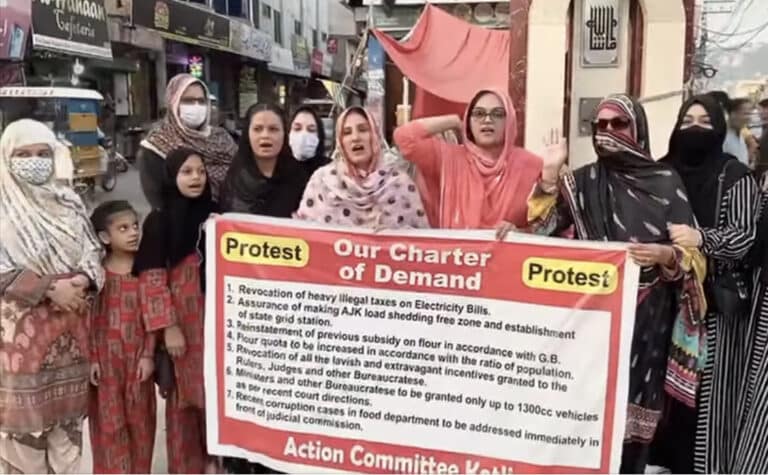
Even as tensions escalate, there is a palpable effort to remember and honor the sacrifices of Kashmiris who fought for their rights in the past. Shaukat Nawaz Mir, Chairman of the Jammu Kashmir Joint Awami Action Committee (JKJAAC), has announced a commemoration gathering scheduled for May 13 in Muzaffarabad. The event will pay tribute to the lives lost during the 2024 protests in Azad Kashmir—protests that were driven by the populace’s desperate demand for affordable electricity and wheat. These protests, marked by significant sacrifices, have become emblematic of the enduring spirit of resistance among Kashmiris.
Mir stated, “In the face of relentless adversity, the people of Kashmir continue to stand united. Our struggles are not just for survival; they are for justice, dignity, and our right to self-determination. We are committed to a peaceful future, even as we confront the harsh realities of conflict.”
International Implications
The ramifications of the LoC tensions extend far beyond the immediate borders of India and Pakistan. The international community, acutely aware of the precarious balance of power in South Asia, is watching these developments with growing apprehension. Analysts have warned that a sustained military confrontation in the region could have disastrous global repercussions, particularly considering the nuclear capabilities of the involved nations.
Diplomatic channels have been abuzz with calls for dialogue and restraint. Global leaders and international organizations are urging both India and Pakistan to prioritize diplomatic engagement over military escalation. There is a widespread consensus that only through concerted dialogue and a commitment to resolving underlying disputes can a peaceful resolution be achieved.
The Broader Impact on Regional Security and Future Prospects
The current standoff is poised to impact every facet of life in the region—from the daily routine of ordinary citizens to the strategic calculus of international security agencies. The disruption in trade, tourism, and cross-border communications is likely to have long-term economic and social implications for both sides of the LoC.
In Pakistan-administered Kashmir, the government’s proactive measures to secure essential supplies and protect vulnerable communities underscore the urgent need for stability. At the same time, the crisis has reaffirmed the resilience of the Kashmiri people, who continue to hope for a future defined by peace and self-determination rather than endless strife.
As tensions soar along the LoC in the wake of the Pahalgam attack, the region finds itself at a critical juncture. The unfolding events, marked by a combination of military escalation, cautious civilian preparations, and urgent diplomatic calls, underline the complexity of the Kashmir issue. International stakeholders now face the daunting challenge of mediating a conflict that could reshape the strategic landscape of South Asia.
For the Kashmiri populace, the hope remains that the current crisis will eventually give way to a more secure and autonomous future—one where the scars of the past do not hinder the promise of a peaceful tomorrow.

