


MUZAFFARABAD, Jammu & Kashmir — Mobile internet services were restored in parts of Muzaffarabad, the capital of Pakistan-administered Jammu and Kashmir, on Wednesday after a 53-day shutdown, hours after Pakistan Peoples Party (PPP) Chairman Bilawal Bhutto Zardari publicly called for the restoration of internet services during a media interaction in the city.
The restoration came a day before Bilawal Bhutto’s scheduled public rally in Muzaffarabad, prompting debate among residents who questioned whether the easing of restrictions was linked to the upcoming political event rather than a broader policy decision.
As of publication, authorities had not issued an official statement explaining why internet services were restored after nearly two months of disruption or whether the restoration would remain in effect following the rally.
Internet Returns After Nearly Two Months
Mobile internet services across much of Pakistan-administered Jammu and Kashmir have remained disrupted since early June, when authorities imposed communication restrictions amid widespread protests and political unrest linked to the ongoing Long March movement.
The prolonged shutdown affected residents, journalists, businesses, students, emergency communication, and digital services, with repeated calls from civil society groups and political leaders for unrestricted internet access.
On Wednesday, connectivity was restored in Muzaffarabad, marking the first time in 53 days that many users were able to access mobile internet services.
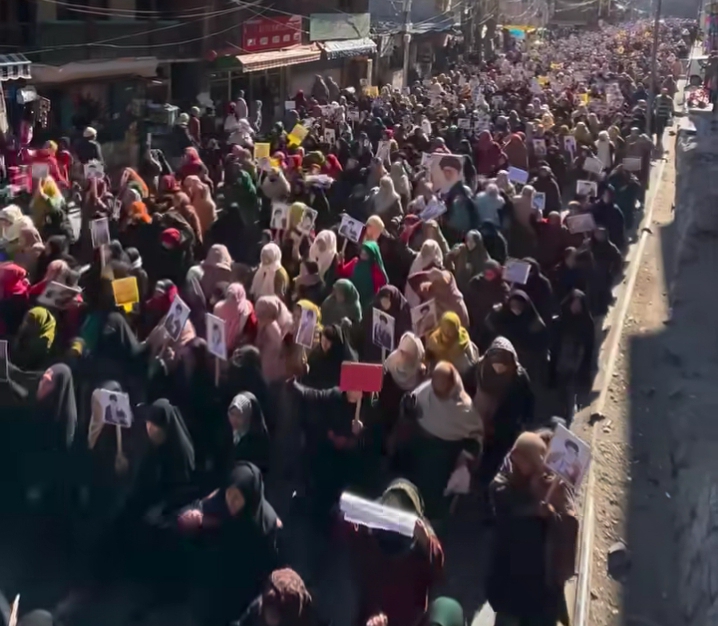
The restoration occurred shortly after Bilawal Bhutto Zardari addressed journalists at the residence of senior Kashmiri politician Chaudhry Latif Akbar, where he urged authorities to reopen internet services in the region.
While the sequence of events has attracted public attention, The Azadi Times has not independently verified whether the restoration was directly linked to Bilawal Bhutto’s remarks.
Residents Question the Timing
The timing of the restoration quickly became a subject of discussion across Muzaffarabad.

Several residents interviewed by The Azadi Times welcomed the return of internet access but questioned why communication services appeared to resume only ahead of a major political gathering.
“If internet access can be restored today, many people are asking why it remained suspended for nearly two months,” one resident said.
Others argued that communication services should remain available to the public regardless of political events, describing internet access as an essential service rather than a temporary administrative measure.
Local journalists also noted that the return of connectivity would allow reporters and media organizations to communicate more effectively after weeks of restrictions that complicated news gathering and public information.
Similar Pattern Reported in Mirpur
The latest development follows a similar episode reported in Mirpur last week.
Ahead of a political rally organized by the Pakistan Muslim League (Nawaz) (PML-N), residents said mobile internet services were temporarily restored across parts of the city.
However, according to local residents and journalists, the services were suspended again shortly after the event concluded.
Authorities did not publicly explain either the temporary restoration or the subsequent suspension.
The recurrence of similar developments in two separate cities has led some residents to question whether communication restrictions are being eased selectively during major political events.
Communication Restrictions and Public Concerns
Internet shutdowns have become an increasingly significant issue in Pakistan-administered Jammu and Kashmir over recent months, particularly during periods of political tension and public demonstrations.
Digital rights advocates have consistently argued that prolonged communication restrictions affect far more than access to social media. Extended shutdowns disrupt education, online businesses, banking services, journalism, emergency communication, and the public’s ability to obtain and share information.
International human rights organizations have also repeatedly emphasized that restrictions on internet access should be lawful, proportionate, transparent, and limited in duration.
Authorities in Pakistan have generally cited security considerations when communication restrictions have been imposed in different parts of the country, although detailed explanations regarding specific shutdowns are not always made public.
Uncertainty Over Future Access
By Wednesday evening, mobile internet services remained operational in Muzaffarabad.
However, uncertainty persists over whether connectivity will continue after Thursday’s political rally.
Several residents expressed concern that the restoration could prove temporary, pointing to the reported suspension of services in Mirpur following last week’s political gathering.
At the time of publication, no official announcement had clarified whether internet services had been permanently restored or temporarily reactivated.
Editorial Note
This report is based on information gathered by The Azadi Times through local journalists, residents, and publicly available statements made during Bilawal Bhutto Zardari’s visit to Muzaffarabad. While the restoration of mobile internet services has been independently confirmed, the reasons behind the decision have not been officially explained.