Research and compilation: Idris Sharar
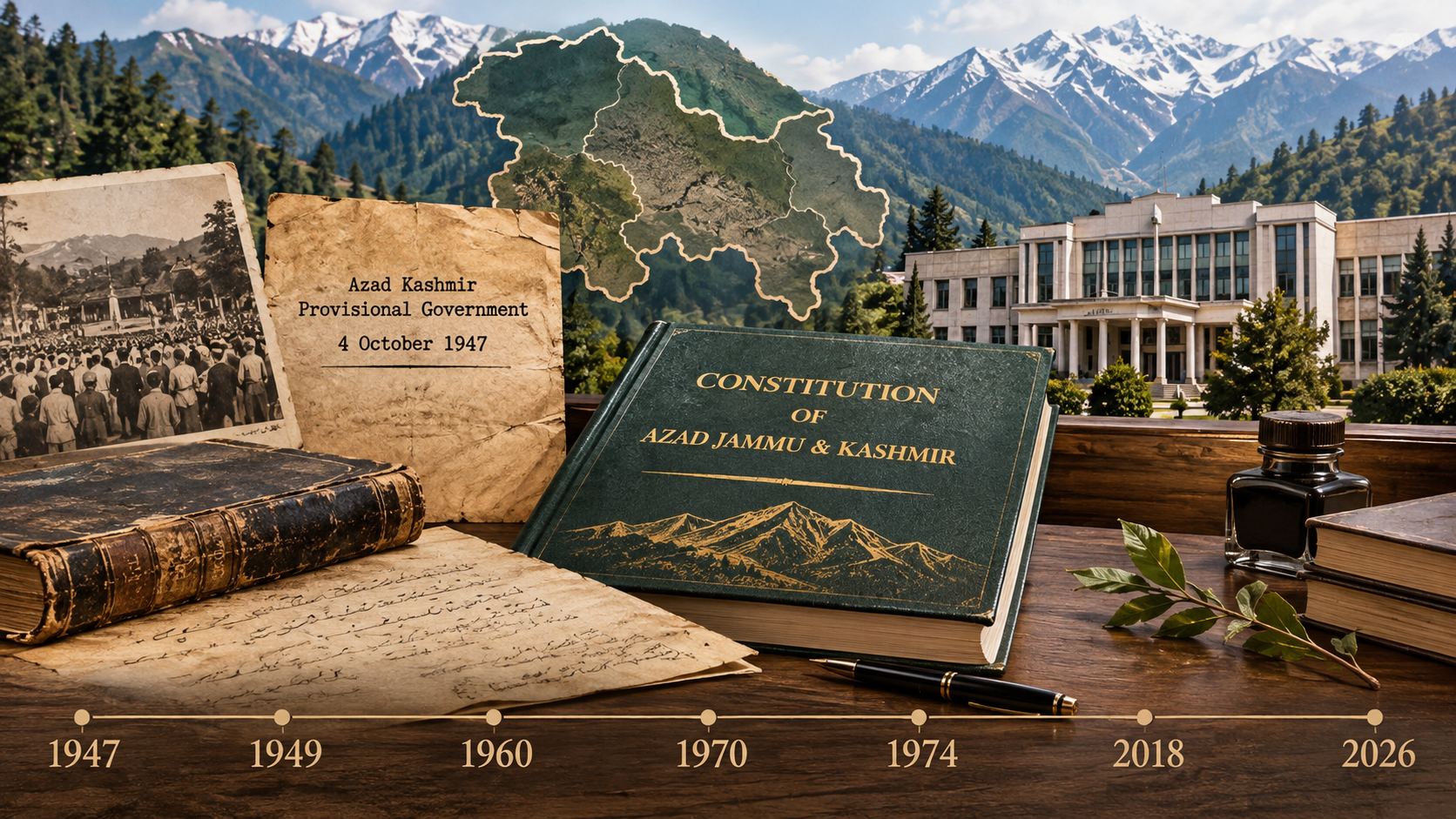
The present government, assembly and constitutional institutions of Azad Jammu and Kashmir (AJK) emerged through a series of administrative and constitutional changes beginning in 1947. The early wartime administration, the 1949 Karachi Agreement, the Basic Democracies system, government acts in 1964 and 1968, the 1970 system of adult franchise, the 1974 Interim Constitution and the 2018 Thirteenth Amendment are among the major milestones in that development.
This account draws on the available official constitutional text and institutional records. It corrects several frequently repeated claims that do not match those records, including the description of the 1970 Assembly as a 40-member body, the claim that AJK had a prime minister in 1952, and the assertion that only five powers remained with Pakistan after the 2018 amendment.

1947: The provisional government and wartime administration
24 October 1947 is the officially recognised date for the establishment of the Azad Government of the State of Jammu and Kashmir. The preamble to the Interim Constitution and official historical accounts describe the initial administration as operating in the form of a war council. There was no permanent written constitution at the time, and administrative and legislative authority was concentrated in the President under the applicable rules of business.
Some historical accounts also refer to a proclamation in Lahore on 4 October 1947 by Ghulam Nabi Gilkar, reportedly using the name “Mr Anwar”. The original proclamation, its legal status and its institutional relationship with the government established at Pallandri on 24 October require further examination of primary records. It should therefore not be presented as an undisputed constitutional starting date.
In the early years, the President was nominated with the support of the Working Committee of the Muslim Conference. Official historical material also refers to a period when a “Supreme Head” office existed; it was discontinued in 1952. A Courts and Laws Code was introduced in 1948 and replaced by new legislation in 1949.



1949: The Karachi Agreement and administrative responsibilities
The Karachi Agreement of 28 April 1949 is a key document concerning the division of responsibilities among the AJK government, the Government of Pakistan and the All Jammu and Kashmir Muslim Conference. It formalised Pakistan’s role in several matters relating to the Kashmir dispute, the United Nations process, defence and foreign affairs, as well as arrangements concerning Gilgit-Baltistan.
The agreement is often summarised as transferring administrative responsibility for Gilgit-Baltistan to Pakistan. However, claims that it divided departments into a simple fixed formula, such as “eight for Pakistan and four for AJK”, should not be treated as a definitive legal schedule without reference to the complete original text. Its clauses, the administrative circumstances of the time and later decisions need to be considered separately.
Pakistan’s Ministry of Kashmir Affairs was established in March 1949. It is therefore inaccurate to describe 1956 as the first point at which the ministry or the federal government assumed a direct role. The relationship between AJK institutions and the federal government continued to evolve through subsequent laws and rules.


1950–1957: Rules of business, the President and ministers
Rules of business were central to the early administrative system. Official constitutional history records revisions in 1952 and a further review or amendment in 1957. During this period, the President remained the head of the administration and was assisted by ministers.
Khan Abdul Hameed Khan should not be described as the first prime minister in 1952. According to the official parliamentary history, the formal office of prime minister emerged under the constitutional arrangement introduced in 1974, and Khan Abdul Hameed Khan became the first prime minister in 1975.
1960: The Basic Democracies system
A presidential election mechanism based on the Basic Democracies system was introduced in 1960. Alongside the election of the President through elected basic democrats, a council structure was established. The official historical summary describes a 24-member council, with 12 members elected from AJK and 12 from among refugees living in Pakistan.
Legislation during this period included laws relating to Basic Democracies and disqualification from elections and public office. Their precise operation and political context should be assessed through the full texts of the relevant laws.
1964 and 1968: Changes to the government acts
The Azad Jammu and Kashmir Government Act of 1964 changed the composition and representation of the State Council. According to the official constitutional history, eight councillors were to be elected through the Basic Democracies system, while arrangements in 1965 provided for the inclusion of two members from among refugees living in Pakistan. The council’s chairman also performed the functions of President.
A new Government Act was introduced in 1968. Under that arrangement, eight councillors were elected and four members were nominated by the Chief Adviser from among refugees living in Pakistan. The council elected its chairman, who also served as President. An interim government was established in 1969. The period from 1964 to 1970 therefore cannot be accurately described as a single unchanged constitutional arrangement.
1970: Adult franchise and a presidential system
The Government Act of 1970 marked a major change. For the first time, voters in AJK and state subjects living in Pakistan elected the President and members of the Legislative Assembly through adult franchise. A presidential system was introduced and Sardar Muhammad Abdul Qayyum Khan became the first elected President.
A common error is to describe the 1970 Assembly as having 40 members. The official history of the AJK Legislative Assembly and the historical account accompanying the Interim Constitution state that the 1970 Assembly had 24 elected members and one co-opted woman member. The figure of 40 elected members relates to the initial Assembly structure after the 1974 constitutional arrangement, not the first adult-franchise election in 1970.
1974: The Interim Constitution and parliamentary government
The Azad Jammu and Kashmir Interim Constitution Act, 1974 (Act VIII of 1974), came into force on 31 August 1974. It replaced the 1970 Government Act, subject to the provisions of the new constitutional framework. The presidential system gave way to a parliamentary system, with the President as constitutional head of the state and the Prime Minister as chief executive.
A new Assembly took shape in 1975. According to the official Assembly history, Khan Abdul Hameed Khan was elected the first Prime Minister and Sardar Muhammad Ibrahim Khan became President. That Assembly had 40 elected members and two co-opted women members.
Institutions and powers under the Interim Constitution
Under the Interim Constitution, the President is elected by members of the Assembly for a five-year term. The Prime Minister is elected on the basis of majority support in the Assembly and serves as chief executive. The Prime Minister and cabinet are collectively responsible to the Assembly. AJK also has a Supreme Court and a High Court within its constitutional judicial structure.
The current constitutional framework provides for a 53-member Legislative Assembly. Forty-five members are directly elected: 33 from constituencies within AJK and 12 from constituencies for state subjects living in Pakistan. Eight seats are reserved: five for women, one for ulema or mashaikh, one for overseas state subjects and one for a technocrat or professional. This is the present composition, not the original structure established in 1974.
The AJK Council also remains part of the Interim Constitution. The Prime Minister of Pakistan is its chairman and the AJK President its vice-chairman, alongside other members nominated or elected under the constitutional provisions. Following the 2018 amendment, the Council’s role became largely advisory; it was not abolished.
Constitutional oath and restrictions on political activity
The First Schedule of the Interim Constitution contains oaths for the President, Prime Minister, ministers, Assembly members and other office-holders. These oaths include a commitment to the objective of the state’s accession to Pakistan. Article 7(3) restricts activities or propaganda against the ideology of the state’s accession to Pakistan.
It is incorrect to cite this restriction as Article 7(2). In the compiled constitutional text, Article 7(2) concerns the right to form or join a political party, while the restriction relating to the accession ideology appears in Article 7(3). The distinction matters when discussing the legal framework.
1977–1985: Martial law and suspension of elected government
Following the imposition of martial law in Pakistan in July 1977, the elected government in AJK was also suspended. The official constitutional history states that the elected government under the 1974 arrangement remained suspended from August 1977 until June 1985. Administration was conducted through chief executives and other administrative heads at different times. An elected government led by Sardar Sikandar Hayat Khan resumed office on 17 June 1985.
Constitutional amendments and the 2018 Thirteenth Amendment
The Interim Constitution has been amended repeatedly. Significant changes include amendments in 1975 and 1976, the Seventh Amendment in 1986, the Tenth in 1993, the Eleventh in 2005 and the major changes made in 2018. Official compilations prepared at different dates do not always present the same amendment count, so the relevant amending acts and commencement dates remain the best sources for a complete chronology.
The Thirteenth Amendment of 2018 substantially changed the division of legislative and administrative responsibilities. Several powers previously exercised by the AJK Council were transferred to the AJK Assembly and government, the Council’s role was made advisory, and provisions were included for the transfer of its assets, funds and related employees.
It is misleading to say that only five powers remained with Pakistan after the amendment. Part I of Schedule III of the current constitutional text lists matters relating to Pakistan’s responsibilities, including defence and security, currency, foreign affairs, posts and telecommunications, aviation, banking, customs and other subjects. Part II identifies matters on which the AJK Assembly may legislate with the consent of the Government of Pakistan, including electricity, certain education policy matters, mineral oil and gas, and census. The division of powers should therefore be read from Schedule III rather than reduced to an unsupported “five departments” formula.
Article 56 should also not be described as a power for the Government of Pakistan to dismiss an elected AJK government. In the compiled text after the 2018 changes, Article 56 is titled “Act not to derogate from responsibilities of Pakistan”. Provisions concerning elected government, the Assembly and emergency powers must be read separately.
2021–2026: Assembly and current leadership
The Assembly elected in 2021 operated within the current 53-seat structure: 33 constituencies within AJK, 12 refugee constituencies in Pakistan and eight reserved seats. Following the 2026 electoral process, Barrister Syed Iftikhar Ali Gilani was elected and sworn in as the 17th Prime Minister of AJK on 28 August 2026.
According to the official AJK government portal, Dr Muhammad Najeeb Naqi Khan took oath as the 23rd President on 24 September 2026. As of November 2026, the President is Dr Muhammad Najeeb Naqi Khan and the Prime Minister is Barrister Syed Iftikhar Ali Gilani.
Is Azad Jammu and Kashmir a province of Pakistan?
AJK is not a constitutional province of Pakistan. It has its own Interim Constitution, elected President, Prime Minister, Legislative Assembly, Supreme Court and High Court. Its constitutional status differs from that of Pakistan’s provinces, and it does not have provincial representation in Pakistan’s National Assembly or Senate. The preamble to the 1974 Interim Constitution states that the final disposition of the State of Jammu and Kashmir is to be determined in accordance with the free expression of the people’s will in the context of United Nations resolutions.
At the same time, AJK’s constitutional and administrative relationship with Pakistan is extensive. Pakistan has a role in defence, foreign affairs, currency and other matters listed in the constitutional schedules, while AJK’s elected institutions exercise authority over internal legislation and government functions. Understanding this arrangement requires reading constitutional texts and amendments alongside the record of how they have been implemented.
Key milestones at a glance
- 24 October 1947: Establishment of the Azad Government of the State of Jammu and Kashmir.
- 1948–1949: Early judicial and administrative laws and rules of business; Pakistan’s Ministry of Kashmir Affairs established in March 1949.
- 28 April 1949: Karachi Agreement on the division of responsibilities.
- 1952 and 1957: Revisions to rules of business and administrative arrangements.
- 1960: Basic Democracies system and presidential election mechanism.
- 1964 and 1968: Government acts changed council composition and representation.
- 1970: Adult franchise, elected President and an Assembly with 24 elected members.
- 1974–1975: Interim Constitution and parliamentary system; first Prime Minister elected.
- 1977–1985: Suspension of elected government during martial law; elected government resumed in 1985.
- 2018: Thirteenth Amendment changed the division of powers and the role of the AJK Council.
- 2026: Barrister Iftikhar Ali Gilani became Prime Minister and Dr Muhammad Najeeb Naqi Khan became President.
References and primary sources
- AJK Interim Constitution 1974 — official text compiled up to 19 September 2023.
- AJK Legislative Assembly — brief history.
- Office of the Prime Minister AJK — history.
- AJK Statistical Year Book 2025.
- Government of Azad Jammu and Kashmir — official portal.
- Dawn: oath of Barrister Iftikhar Ali Gilani as Prime Minister, 28 August 2026.
- Ministry of Kashmir Affairs and Gilgit-Baltistan.
Editorial note: This article is based on the available official constitutional text and historical records. Further archival work is needed on the 4 October 1947 Lahore proclamation and some details of the Karachi Agreement. Any amendments after the 2023 official compilation should be checked against the latest government gazette.