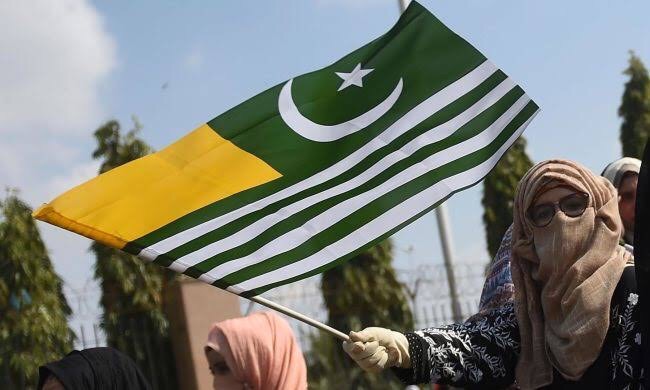

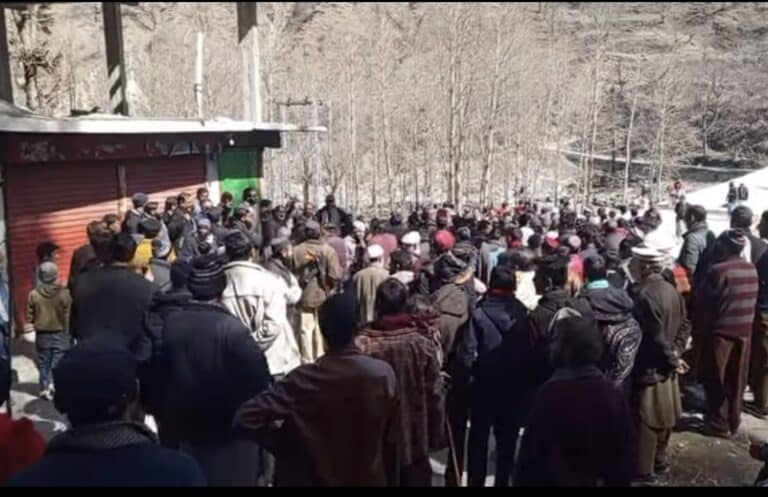
Muzaffarabad: (Azadi Times) The Jammu Kashmir Joint Awami Action Committee, which has been at the forefront of the people’s rights movement in Pakistan-administered Jammu and Kashmir, has declared a shutter-down and wheel jam strike on February 5.
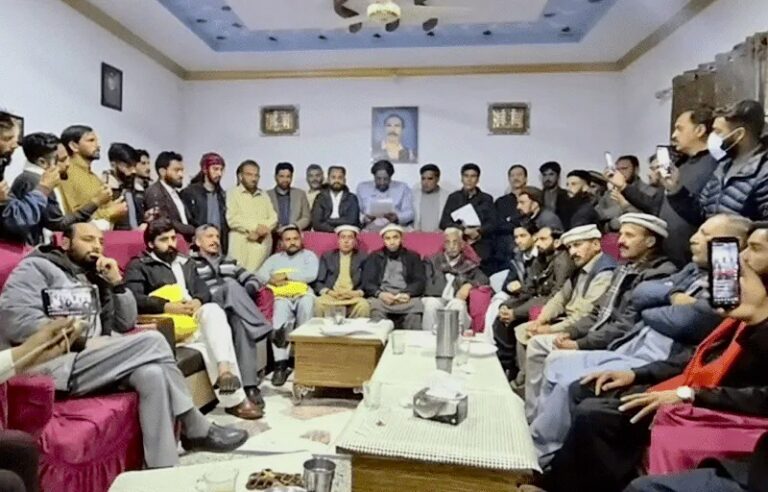
The strike is intended to commemorate “People’s Rights Day” if the committee’s demands are not met. This announcement was first made in the early days of January and was reiterated on January 28 during a meeting held in Muzaffarabad.
The state has responded to this announcement by mobilizing the leadership of ruling political parties, military-religious organizations, and political-religious groups to declare “Kashmir Solidarity Day” and denounce those who support the celebration of “People’s Rights Day” as traitors and anti-national elements with foreign agendas.
Additionally, the administration has decided that any program apart from the “Unity Day” events on February 5 will require prior permission, and unauthorized programs will not be allowed to proceed.
The situation has led to a state of confusion among resistance political activists, while journalists and intellectuals appear to be divided on the matter.
However, an overwhelming majority of ordinary citizens are in favor of celebrating “People’s Rights Day” on February 5 and participating in the strike. According to various surveys conducted on social media, over 97% of respondents support the strike, with the opinion in favor of “Unity Day” not exceeding 3%.



It is important to note that political parties, student organizations, trade unions, and traders’ unions often have differences in ideology, methodology, and strategy, which prevent them from working together consistently.
As a result, alliances and committees are formed for short-term demands and programs, uniting people based on shared objectives. These alliances and committees are limited to the specific demands and programs they are formed around.

Attempting to extend the scope of a committee or coalition beyond its original purpose can lead to divisions and the breakdown of the committee or coalition.
The Jammu Kashmir Joint Awami Action Committee, therefore, does not have the authority to dictate the political agenda of different political tendencies.
Its mandate is solely focused on advocating for the approval of the Charter of Demand. Setting up fronts against the political agenda of any specific group can be seen as promoting polarization.
“Kashmir Solidarity Day” originated as an initiative by the Pakistani state to divert attention from the martyrdom day of Maqbool Butt Shaheed, a prominent leader who symbolized the struggle for freedom in Jammu and Kashmir.
The armed movement for national liberation, which gained popularity throughout Jammu and Kashmir, was later co-opted by religious extremist groups following the Soviet Union’s withdrawal from Afghanistan. Jamaat-e-Islami, which initially rejected the armed movement, seized the opportunity to engage in new activities.
To distract from the planned long march by the Jammu Kashmir National Students Federation, the state once again used Jamaat-e-Islami and declared February 5 as “Kashmir Unity Day.” The announcement was subsequently adopted as an official event by the Punjab government and has been observed annually to divert attention from the martyrdom day of Maqbool Butt Shaheed.
The state has always sought to dissociate itself from such initiatives by attributing their political legacy to various facilitators. As a result, the celebration of “Kashmir Solidarity Day,” originally intended to create divisions in Jammu and Kashmir, is now claimed by Jamaat-e-Islami, Muslim League-N, and PPP.
The Joint Awami Action Committee’s decision to declare February 5 as “People’s Rights Day” has provided an opportunity for the state to exploit these forces. Leaders who are not only against this movement but also part of the government are now engaged in state-sponsored propaganda against the movement. They have labeled participants in the movement as traitors and seek to assume control over it.
Despite these challenges, the committee enjoys broad support from the people, who are rejecting state propaganda. However, the committee’s leadership, having already tested the loyalty of “pro-accession” political workers, is now facing scrutiny from nationalist and progressive activists. In an unusual turn of events, the majority seems unable to comprehend the complexity of the situation amidst political decay, ideological bankruptcy, and increasing political ignorance.
The committee’s leaders recently stated during a social media broadcast that they had met with representatives of banned militant organizations such as Jeesh-e-Mohammed and Jamaat-e-Islami. They proposed celebrating Solidarity Day and People’s Rights Day jointly and offered to cede their stage to these organizations.
While this statement has created difficulties for those political tendencies against whom Solidarity Day is celebrated, it also highlights the need for the committee to clarify its stance.
Despite exceeding its mandate, the committee’s strike announcement has received widespread support from the public. In this situation, it is crucial to respond strongly to state propaganda instead of succumbing to fear.
The individuals claiming to carry the legacy of the martyrsand freedom fighters should make an effort to unite and counter the divisive tactics employed by the state.
It remains to be seen how the situation will unfold leading up to February 5. The strike called by the Jammu Kashmir Joint Awami Action Committee has the potential to disrupt normal life in Pakistan-administered Jammu and Kashmir, as well as send a strong message to the state authorities about the people’s demands for their rights.
It is a critical moment for the people of Jammu and Kashmir, and the outcome of the strike will have significant implications for the ongoing struggle for self-determination in the Jammu & Kashmir.